支付

Search documents
适老支付调查(下)|亲测:便利外衣下的“默认隐忧”
Bei Jing Shang Bao· 2025-10-26 05:52
Core Insights - The article discusses the growing prevalence of "pay later" and "no password payment" features on e-commerce platforms, highlighting both their convenience and potential risks for consumers, particularly among the elderly [1][5][11] Group 1: Functionality and User Experience - E-commerce platforms like Taobao, Pinduoduo, and Xiaohongshu have integrated "no password payment" and "pay later" options into their payment processes, often pre-selecting these options for users during checkout [3][6] - The activation process for these features is generally straightforward, requiring users to agree to service agreements and input payment passwords, but the process to deactivate them is often complex and not user-friendly [4][5][10] - Different platforms exhibit variations in their design and functionality, with some requiring users to navigate through multiple steps to disable features, which can lead to unintended transactions [4][6] Group 2: Consumer Concerns and Feedback - Many consumers, especially older adults, express confusion and concern regarding the implications of "no password payment" and "pay later" options, often misunderstanding them as free services [7][9] - A significant number of older users reported having these features activated without their explicit consent, leading to worries about unintentional spending and debt accumulation [7][12] - The article highlights a need for clearer communication and education regarding these payment options to ensure consumers understand their responsibilities and the risks involved [10][12] Group 3: Platform Responses and Recommendations - Platforms justify the promotion of these features by emphasizing their potential to enhance payment efficiency and user experience, particularly in fast-paced shopping scenarios [8][9] - Companies are encouraged to implement better user interface designs that prioritize consumer understanding, especially for vulnerable groups like the elderly, by simplifying activation and deactivation processes [10][13] - Regulatory suggestions include establishing clear guidelines to prevent misleading designs and ensuring that platforms provide accessible versions of their services for older users [14]


年内支付业“冰火两重天”:头部增资竞速,中小牌照加速清退
Nan Fang Du Shi Bao· 2025-10-25 09:06
Core Insights - The payment industry is experiencing a "polarized" situation since 2025, with leading payment institutions increasing capital significantly while smaller institutions are being forced out of the market due to license cancellations [1][7]. Group 1: Capital Increases by Leading Institutions - A wave of capital increases has been observed among licensed payment institutions since October, with over 10 institutions having completed capital increases in 2025 [2][6]. - Notable capital increases include: - Wangyin Online (Beijing) Payment Technology Co., Ltd. increasing its registered capital to 1.5 billion RMB [2]. - Yinseng Payment Service Co., Ltd. increasing its registered capital to 310 million RMB [5]. - Zhejiang Vipshop Payment Service Co., Ltd. increasing its registered capital to 200 million RMB [5]. - Tencent's payment service, Tenpay, received approval for a capital increase of 7 billion RMB, raising its registered capital to 22.3 billion RMB, marking a 45.75% increase [5]. Group 2: Regulatory Impact and Market Dynamics - The implementation of the "Non-Bank Payment Institution Supervision and Administration Regulations" in May 2024 has raised the minimum registered capital requirement to 100 million RMB, prompting many institutions to increase capital to comply with regulations [6]. - As of now, the number of licensed payment institutions has decreased to 164, with a total of 107 licenses canceled, indicating a trend of consolidation in the industry [7][9]. - The cancellation of licenses is primarily affecting smaller institutions, with 11 institutions having their licenses revoked in 2025 alone [7]. Group 3: Future Outlook - The ongoing "reshuffling" in the payment industry is expected to continue, leading to increased market concentration [10]. - For leading institutions, the focus will remain on compliance and diversified development, while smaller institutions must find niche markets to survive [10].
鑫闻界丨登陆A股15年,始建于1968年的滨化股份冲刺布局“A+H”
Qi Lu Wan Bao· 2025-10-25 04:45
Core Insights - The "A+H" listing model is becoming an important part of fundraising in the Hong Kong stock market [1] Group 1: Company Developments - Shandong Binhua Co., Ltd. has officially launched its "A+H" dual capital platform strategy, submitting its listing application for H-shares on the Hong Kong Stock Exchange [2] - The company was founded in 1968 and operates in three core sectors: chlor-alkali chemicals, C3 and C4 chemicals, and wet electronic chemicals [2] - LaKala Payment Co., Ltd. has also submitted an application for overseas listing on the Hong Kong Stock Exchange, with Citic Securities International as the sole sponsor [2] - Hitec Bio Co., Ltd. from Wuhan has announced plans to issue shares overseas and list on the Hong Kong Stock Exchange to enhance its global strategy [2] Group 2: Market Trends - Guanghetong Wireless Co., Ltd. has become the first wireless communication module company to achieve "A+H" listing, raising a total of HKD 2.9 billion through the issuance of approximately 135 million shares at HKD 21.50 each [3] - The funds raised will be used for research and development in robotics and edge AI, mergers and acquisitions, repaying bank loans, and supplementing working capital [3] - As of September 30, the Hong Kong Stock Exchange has raised USD 23.4 billion in IPOs this year, ranking first among major global stock exchanges [3] - The Hong Kong Stock Exchange has relaxed public holding requirements for "A+H" companies, allowing for either a projected market value of HKD 3 billion or a public holding of 10% [3] Group 3: IPO Activity - In the first nine months of the year, over 60 companies have gone public on the Hong Kong Stock Exchange, raising a total of HKD 182.9 billion, making it the top global market for IPOs [4] - There are approximately 300 pending listing applications, with half from new economy sectors such as electric vehicles, renewable energy, artificial intelligence, new materials, and biotechnology [4]

银联整顿终端市场,五家POS终端厂商资质遭撤停
Xi Niu Cai Jing· 2025-10-24 08:25
Core Insights - The UnionPay certification office has revoked or suspended the production qualifications of five terminal manufacturers due to violations of certification rules, affecting nearly 40 models of POS machines with an estimated market stock of over 1.2 million units [2] - This action marks the first instance of a concentrated "top-level" penalty since the launch of the "Clear Terminal" initiative in 2023, indicating a deeper regulatory crackdown in the payment industry [2] - The violations include security chip tampering, serious breaches of the "one machine, multiple codes" rule, and falsification of materials and unauthorized production [2] Group 1 - Five companies affected include Xiamen Dingbaiyi Technology Co., Ltd., Shanghai Jiayan Information Technology Co., Ltd., Shijiazhuang Chaolu Network Technology Co., Ltd., Shenzhen Jingshield Technology Industrial Co., Ltd., and Yunma Intelligent (Hainan) Technology Co., Ltd. [2] - The specific violations include: - Security chip tampering where Dingbaiyi and Jingshield were found to have terminals that could bypass UnionPay's security chip [2] - "One machine, multiple codes" violations where Chaolu and Yunma were confirmed to have backdoor technologies allowing service providers to exploit preferential merchant rates [2] - Falsification of materials and unauthorized production where Jiayan Information transferred orders to an unqualified factory without obtaining the new UnionPay terminal production license [2] Group 2 - UnionPay has mandated that acquiring institutions must complete risk assessments and replacement plans for existing terminals within 30 days and rectify issues by December 20, or face penalties such as limits on transaction volumes and suspension of new merchant additions [3]

拉卡拉三季度科技服务收入同比增长108.75%
Zhong Guo Jing Ji Wang· 2025-10-24 03:09
Core Insights - Lakala reported a revenue of 1.417 billion yuan for Q3 2025, a year-on-year increase of 0.72%, and a net profit of 110 million yuan, up 17.46% year-on-year [1] - For the first three quarters, the company achieved a total revenue of 4.068 billion yuan and a net profit of 339 million yuan, with a total transaction volume of 2.99 trillion yuan in domestic and cross-border payments [1] - The cross-border payment volume reached 60.2 billion yuan, reflecting a robust year-on-year growth of 77.56% [1] - The company is actively pursuing a "Payment + SaaS" transformation, with technology service revenue growing by 108.75% year-on-year in Q3 [1] Financial Performance - In Q3 2025, Lakala's revenue was 1.417 billion yuan, with a net profit of 110 million yuan [1] - For the first three quarters, total revenue was 4.068 billion yuan and net profit was 339 million yuan [1] - The company reported a total transaction volume of 2.99 trillion yuan, maintaining a leading position in the industry [1] Cross-Border Payment Growth - Cross-border payment volume reached 60.2 billion yuan, with a year-on-year increase of 77.56% [1] - The number of cross-border payment merchants and transaction amounts grew by 71.91% and 77.56% respectively in the first three quarters [2] - Lakala is the only domestic independent third-party payment institution with full brand foreign card acquiring qualifications, with foreign card transaction coverage increasing by nearly 20% year-on-year [2] SaaS and Digital Transformation - The company is focusing on the "Payment + SaaS" strategy, particularly in high-stickiness verticals like dining and retail [3] - Lakala's restaurant SaaS has served over 80,000 mid-to-high-end active dining stores, contributing to a 108.75% year-on-year increase in technology service revenue [3] - The retail SaaS product has also shown steady growth, serving over 100,000 merchants and significantly increasing the number of quality clients [3] AI Integration - Lakala is integrating AI technology into its payment and SaaS systems, being the first in the industry to launch an AI wallet [3] - As of September 30, the AI wallet had nearly 8 million registered users, with 1.5 million monthly active users [3]

外资支付再下一城!易联支付更名“派安盈支付”
券商中国· 2025-10-23 01:16
Core Viewpoint - The company formerly known as 易联支付 (Easy Union Payment) has officially changed its name to 派安盈支付 (Payoneer Payment) as part of a broader restructuring and acquisition process by the international fintech company Payoneer [1][5]. Group 1: Company Name and Management Changes - The name change from 易联支付有限公司 to 派安盈支付(广东)有限公司 was officially registered on October 17, 2025 [1]. - The legal representative has changed from 谭威强 to James Richard Allum, with several board members and executives exiting the company [2]. Group 2: Business Scope and Operations - The original business scope included internet payment, enterprise management services, and various IT support services, while the new scope focuses on non-bank payment services and second-class value-added telecommunications services [3]. - The updated business structure emphasizes the company's fintech service attributes, aligning more closely with its international parent company, Payoneer [3]. Group 3: Acquisition and Market Position - The completion of these changes marks the full integration of 易联支付 into Payoneer, which is now the third foreign payment platform authorized to provide online payment services in China [5]. - Payoneer, headquartered in New York and listed on NASDAQ, aims to enhance its global compliance infrastructure through this acquisition [5].


【西街观察】莫让免密支付成为老年人的“甜蜜负担”
Bei Jing Shang Bao· 2025-10-22 14:53
Core Viewpoint - The article highlights the challenges faced by elderly users in navigating digital payment systems, particularly with features like "no-password payment" and "buy now, pay later," which can lead to unintended charges and repeated purchases [1][2]. Group 1: Issues Faced by Elderly Users - Many elderly users inadvertently activate small-amount no-password payments or "buy now, pay later" options, leading to confusion and financial burdens [1]. - The design of digital payment systems often creates barriers for elderly users, with rapid pop-up prompts and hidden options that are difficult to understand [1][2]. - The process of disabling these payment features is complicated, requiring multiple steps that can be overwhelming for those unfamiliar with technology [2]. Group 2: Recommendations for Improvement - There is a pressing need for "age-friendly" modifications in payment systems to prevent these burdens from becoming overwhelming for elderly users [2]. - Payment platforms and institutions should eliminate default selections for sensitive payment features and implement clear prompts, possibly including mandatory knowledge checks or facial recognition for confirmation [2]. - A true "elderly mode" should be developed, simplifying processes and highlighting key information to enhance usability for older adults [2]. Group 3: Family and Regulatory Support - Families should engage in regular discussions about digital payment safety, helping elderly members understand the importance of cautious online behavior [3]. - Regulatory measures are essential to protect elderly consumers, including stricter penalties for misleading activation of payment features and simplified complaint processes [3][4]. Group 4: Overall Conclusion - Ensuring that payment systems prioritize "safety" and "informed consent" is crucial for making these tools genuinely beneficial for all users, particularly the elderly [4].
拉卡拉已向港交所递交上市申请
Xin Lang Cai Jing· 2025-10-22 01:48
Core Viewpoint - Lakala Payment Co., Ltd. has submitted an application for the issuance of overseas listed shares (H shares) and listing on the Hong Kong Stock Exchange, aiming to achieve an "A+H" share listing structure [3] Group 1: Company Overview - Lakala is a digital payment and digital business solutions provider, with a total payment volume exceeding 4 trillion yuan in 2024, holding a market share of 9.4% among independent digital payment service providers, ranking first in its segment [3] Group 2: Listing Details - The company has appointed CITIC Securities International as the sponsor and Ernst & Young as the auditing firm, along with a complete set of professional intermediaries including domestic and foreign lawyers, internal control consultants, industry consultants, and ESG consultants [3] - The funds raised from the listing will be used for four main purposes: accelerating license layout and expanding overseas markets, enhancing technological capabilities to form a global full-process product system, strategic investments and acquisitions over the next five years, and supplementing operational funds [3] Group 3: Regulatory Considerations - The issuance and listing are subject to approvals from the People's Bank of China, the Hong Kong Securities and Futures Commission, the Hong Kong Stock Exchange, and the China Securities Regulatory Commission, indicating potential uncertainties [4]
【Fintech 周报】多地预警黄金投资骗局;今年超300家中小银行合并、解散;农行股价“12连阳”
Sou Hu Cai Jing· 2025-10-20 10:34
Regulatory Dynamics - The Financial Regulatory Bureau has published a list of 238 insurance institutions with designated regulatory responsibilities, effective until June 30, 2025, indicating a shift of regulatory authority to local agencies for most property, reinsurance, and life insurance institutions [1] - Multiple local governments have issued warnings about scams related to gold custody, rental returns, and virtual investments, urging the public to be cautious of high-yield investment traps [1] Industry Dynamics - Over 300 small and medium-sized banks have merged, dissolved, or exited the market in 2025, indicating a significant acceleration in industry consolidation, particularly among local rural commercial banks and village banks [2] - Agricultural Bank of China has integrated over 190 rural commercial bank branches in Jilin, reflecting a systematic approach to reform and restructuring in the rural banking sector [3] - Several payment institutions have undergone capital adjustments and personnel changes, with La Ka La reducing its registered capital from approximately 788 million to 777 million yuan [4] Corporate Dynamics - China Pacific Insurance expects a net profit increase of 40% to 60% for the first three quarters of 2025, driven by stable economic performance and strategic business improvements [7] - New China Life Insurance reported a 19% year-on-year increase in premium income, totaling 172.7 billion yuan for the first nine months of 2025 [7] - Yuexiu Group has completed an 18 billion HKD acquisition of Hong Kong Life, enhancing its financial services portfolio [7] - Ant Group's acquisition of Yao Cai Securities has received approval from the Hong Kong Securities and Futures Commission, pending further regulatory approvals [8] - Agricultural Bank of China's A-share stock has experienced a "12 consecutive days" rise, with its price-to-book ratio surpassing 1 for the first time in years [8]




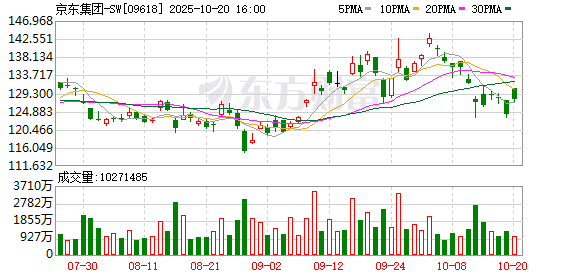
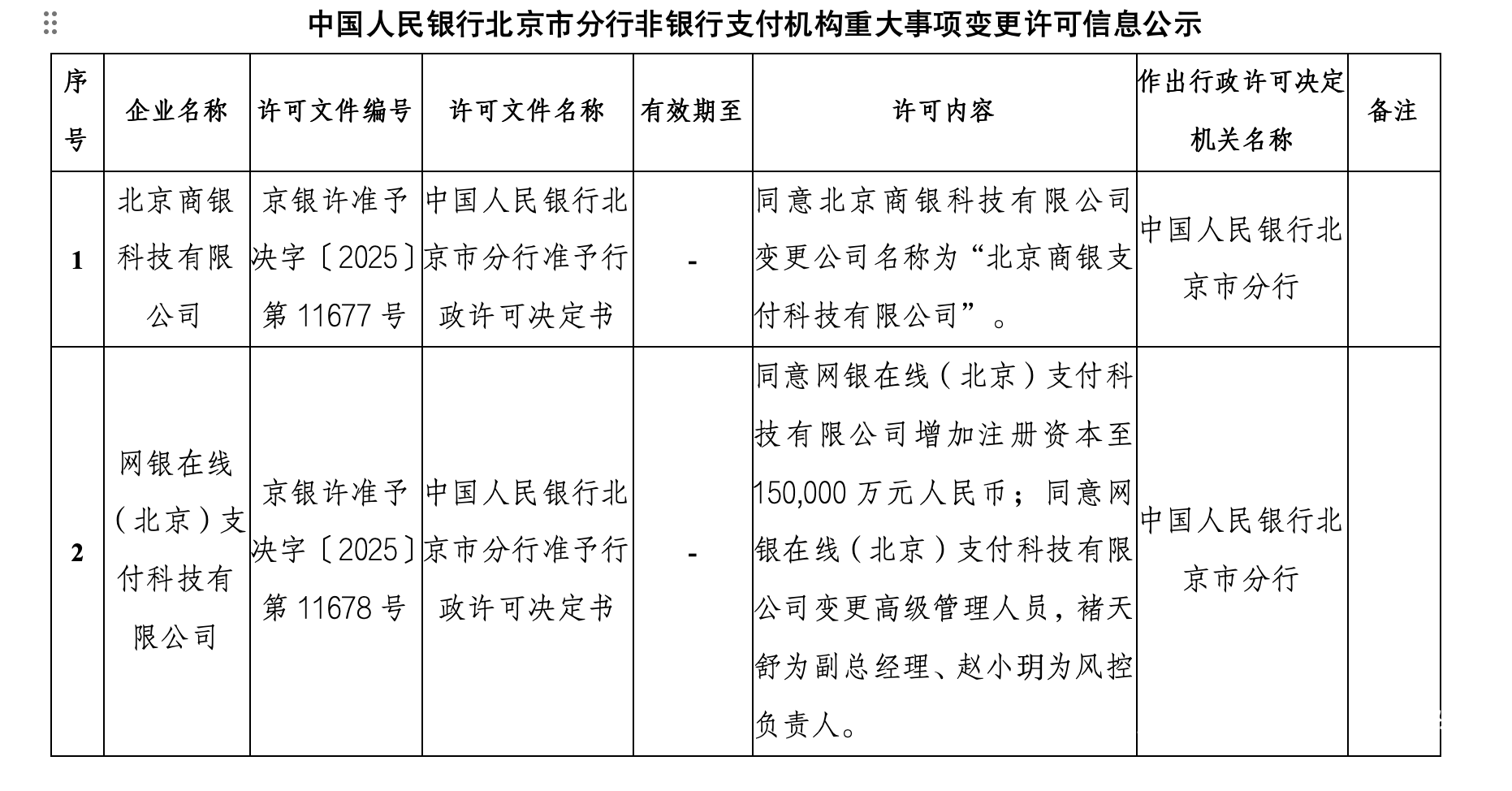
京东金融业务再加码 网银在线增资至15亿
Zhong Guo Jing Ying Bao· 2025-10-20 09:44
Core Insights - The People's Bank of China has approved an increase in registered capital for Online Banking (Beijing) Payment Technology Co., Ltd. to 1.5 billion RMB, along with changes in senior management [2] - Online Banking, established in 2003, is one of the earliest third-party payment institutions in China and was acquired by JD.com in 2012 [2] - The company has expanded its payment services across various industries, including travel, dining, and e-commerce, and has rebranded its services under the JD Pay platform [2] Company Developments - The increase in registered capital reflects the growth of JD Pay's payment business, which has recently partnered with over 100 leading enterprises, including Pizza Hut and KFC [4] - JD Pay operates under the regulatory framework established by the Non-Bank Payment Institutions Supervision and Administration Regulations, which has led to increased capital requirements for payment institutions based on transaction volumes [3] Industry Context - Since the implementation of the Non-Bank Payment Institutions Supervision and Administration Regulations, several payment companies have increased their registered capital, with Tencent's Tenpay leading at 22.3 billion RMB [3] - Other notable payment institutions include PayPal's subsidiary with 4.52 billion RMB and Du Xiaoman Payment with 4 billion RMB, indicating a trend of capital expansion in the industry [3]