
酒业

Search documents
中经酒业周报∣1-7月白酒产量214.6万千升,8月中旬全国白酒环比价格保持稳定,多家酒企发布半年报
Xin Hua Cai Jing· 2025-08-22 08:16
Industry Overview - From January to July, the production of white liquor reached 2.146 million kiloliters, a year-on-year decrease of 5.2% [3] - In July, the production of white liquor was 236,000 kiloliters, down 8.9% year-on-year [3] - Beer production in July was 3.741 million kiloliters, showing a year-on-year increase of 1.9% [3] - The production of wine in July was 6,000 kiloliters, down 25% year-on-year [3] Price Trends - As of mid-August, the national white liquor price index remained stable at 100.00 [3] - The price index for famous liquor decreased by 0.14% to 99.86, while local liquor increased by 0.29% to 100.29 [3] - The wholesale price index for white liquor increased by 8.13% year-on-year, with famous liquor up 10.10% [3] Company Developments - Guizhou Moutai launched a cultural product series "Huang Xiaoxi Eats Dinner" to promote tourism and liquor culture [4] - Wuliangye launched a membership center allowing customers to accumulate points and access exclusive products [4] - Multiple liquor companies reported their semi-annual results, with Jiangsu Yanghe's revenue down 35.32% to 14.796 billion yuan [5] - Chongqing Beer reported a slight revenue decline of 0.24% to 8.839 billion yuan in the first half of 2025 [6] New Product Launches - Gujing Gongjiu introduced a new product "Yearly Original Light Gu 20" with an alcohol content of 26% [7]


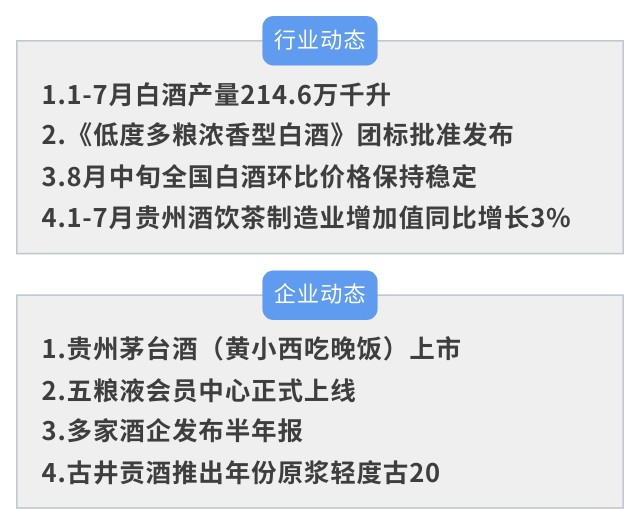
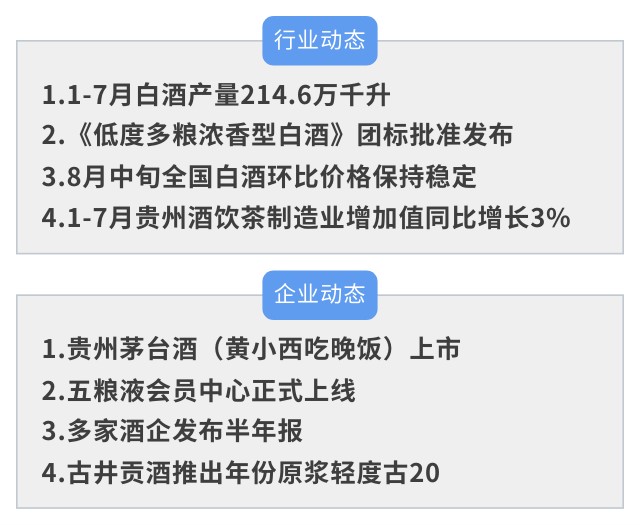
中经酒业周报∣1-7月白酒产量214.6万千升 8月中旬全国白酒环比价格保持稳定 多家酒企发布半年报
Xin Hua Cai Jing· 2025-08-22 08:06
Industry Dynamics - In July, the production of liquor (converted to 65 degrees) was 236,000 kiloliters, a year-on-year decrease of 8.9%, while the cumulative production from January to July was 2,146,000 kiloliters, down 5.2% year-on-year [3] - Beer production in July reached 3,741,000 kiloliters, showing a year-on-year increase of 1.9%, with a cumulative production of 23,270,000 kiloliters from January to July, up 0.6% [3] - The production of wine in July was 6,000 kiloliters, down 25% year-on-year, with a cumulative production of 50,000 kiloliters from January to July, a decrease of 26.5% [3] - A new group standard for "Low-Alcohol Multi-Grain Strong Aroma Liquor" has been approved and published by the China Alcoholic Drinks Association [3] - As of mid-August, the national liquor price index remained stable at 100.00, with a slight decrease in famous liquor prices and a slight increase in local liquor prices [3] Company Dynamics - Guizhou Moutai launched a cultural series product "Huang Xiaoxi Eats Dinner," integrating local culture with traditional brewing techniques [6] - Wuliangye launched a membership center, allowing customers to accumulate points and gain access to exclusive products and services [6] - Jiangsu Yanghe Distillery reported a 35.32% year-on-year decline in revenue for the first half of 2025, totaling 14.796 billion yuan, with a net profit decrease of 45.34% [7] - Tianyoude reported a revenue of 674 million yuan for the first half of 2025, down 11.24%, with a net profit decline of 35.37% [7] - Kuozi Liquor reported a revenue of 2.531 billion yuan, down 20.07%, with a net profit decrease of 24.63% [7] - Huaiqi Mountain reported a revenue increase of 11.03% to 817 million yuan, with a net profit increase of 3.41% [7] - Chongqing Beer reported a slight revenue decline of 0.24% to 8.839 billion yuan, with a net profit decrease of 4.03% [7] - Analysts indicate that the liquor market is under pressure, with increasing competition leading to performance declines for many companies [7] - Gujing Gongjiu launched a new product "Yearly Original Light Ancient 20," with an alcohol content of 26 degrees [8]
法国酒业对美加征关税表示“非常失望”
Xin Hua She· 2025-08-22 05:32
Core Viewpoint - The new trade agreement between the EU and the US, which imposes a 15% tariff on most EU goods exported to the US, has led to significant disappointment in the French wine industry, particularly among exporters who had hoped for tariff exemptions [1]. Group 1: Impact on French Wine Industry - The president of the French Wine and Spirits Exporters Federation expressed that the industry had made considerable efforts to secure tariff exemptions, making the agreement particularly disappointing [1]. - The head of a French cognac company stated that the global marketing environment for wine is already challenging, and the new tariffs represent another severe blow to the industry [1]. - The president of the Languedoc Wine Industry Association indicated that US importers will likely demand price reductions, or else US consumers will face higher prices, which could lead to decreased sales volumes [1]. Group 2: Financial Implications - Reports suggest that the new tariffs could result in substantial financial losses for the French and EU wine industries, with previous estimates indicating that a 20% tariff could lead to losses of €800 million for France and €1.6 billion for the EU [1]. - According to the French Wine and Spirits Exporters Federation, the total value of wine exports from the EU to the US in 2024 is projected to be around €8 billion, with nearly half of that being French products [1].
莫迪专机将飞往中国,却先收到1个坏消息,美代表团取消访问印度
Sou Hu Cai Jing· 2025-08-22 03:39
Core Viewpoint - The U.S. has unexpectedly canceled its planned visit to India, leading to the collapse of the sixth round of trade negotiations and the imminent implementation of a 50% tariff on Indian goods, which is unprecedented in U.S. trade history [2][3]. Group 1: U.S.-India Trade Relations - The U.S. Trade Representative's Office has not provided a clear explanation for the cancellation, but it signifies the end of hopes for tariff reductions [2]. - President Trump signed an executive order on August 6, imposing a 25% tariff on Indian imports, which, combined with a previously announced 25% tariff, totals a 50% tariff set to take effect on August 27 [2]. - The U.S. has been pressuring India to open its agricultural and dairy markets while India refuses to stop importing Russian oil, leading to a stalemate in negotiations [3]. Group 2: India's Response - India's Ministry of External Affairs criticized the U.S. actions as "unfair, unjust, and unreasonable," emphasizing that oil imports from Russia are driven by market demand and energy security [3]. - Prime Minister Modi has adopted a firm stance against U.S. pressure, advocating for self-reliance and the protection of domestic interests, including the announcement of a domestic chip production initiative [4]. - India has implemented countermeasures, including freezing military purchases from the U.S. and imposing a 150% tariff on American whiskey [4]. Group 3: Strategic Shifts - India is adjusting its foreign policy by engaging with Russia and China, aiming to reduce reliance on the U.S. dollar and establish a trade mechanism using the rupee [6][9]. - The visit of Chinese Foreign Minister Wang Yi to India coincides with these developments, highlighting a potential shift towards deeper cooperation between India and China [7]. - India's Finance Minister has proposed a "BRICS payment system," indicating a strategic pivot away from blind adherence to U.S. policies [9]. Group 4: Economic Implications - The 50% tariff could severely impact key Indian industries such as steel and pharmaceuticals, leading to significant economic losses and a breakdown in trust between the two nations [9]. - Modi's upcoming visit to the UN General Assembly is seen as a crisis management effort rather than a genuine attempt to repair relations with the U.S. [9]. - The situation reflects India's growing awareness that following U.S. policies may not yield the technological and financial support needed for its industrialization [9]. Group 5: Future Outlook - The upcoming Shanghai Cooperation Organization summit may serve as a pivotal moment for India to reshape its relationships and foster cooperation among developing countries against unilateral actions [11]. - The evolving dynamics between India and the U.S. suggest a move towards greater strategic autonomy for India, with global implications for trade and diplomacy [11].
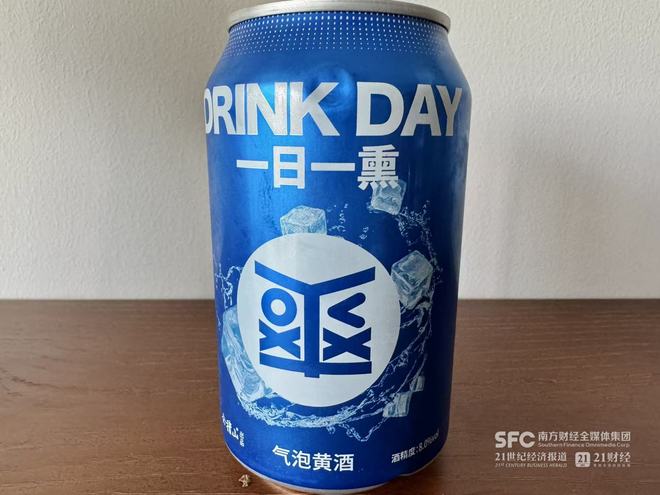
会稽山热度爆了,为何业绩没爆发?|酒业财报观察
2 1 Shi Ji Jing Ji Bao Dao· 2025-08-21 11:36
Core Viewpoint - The company Kuaijishan has experienced significant stock price increases and market attention, but its financial performance has not matched expectations, with lower revenue growth compared to previous years [1][2]. Financial Performance - In the first half of 2025, Kuaijishan reported revenue of 817 million yuan, a year-on-year increase of 11.03%, and a net profit attributable to shareholders of 93.87 million yuan, up 3.41% [1]. - The revenue growth rate for the first half of 2025 is lower than the growth rates of 18.24% and 14.25% seen in the first halves of 2024 and 2023, respectively [1]. - The company's net profit for the second quarter was only a few hundred thousand yuan, with a non-recurring net profit showing a loss [1]. - Kuaijishan's sales target for the year is a 15% to 20% increase in liquor sales, but the actual growth in liquor product sales for the first half was only 9.18% [1]. Market Position and Innovations - Kuaijishan has gained popularity due to its innovative product, sparkling yellow wine, and aggressive marketing strategies, leading to 11 stock price limit increases this year and a stock price rise of approximately 106% [2]. - The sparkling yellow wine "Yiri Yixun" saw a revenue increase of 60.5% in the first half, but its contribution to overall revenue remains limited [4][6]. Sales and Marketing Strategies - The company has implemented various marketing strategies, including celebrity endorsements and collaborations, which have contributed to a nearly 20% growth in its core market of Zhejiang [6]. - However, the sales expenses increased by over 53% in the first half, totaling more than 75 million yuan, which has impacted profitability [7]. Profitability and Valuation - The net profit growth of 3.4% is significantly lower than revenue growth, indicating challenges in converting sales into profit [7]. - The company previously benefited from one-time gains from asset disposals, which are not present this year, affecting profit comparisons [8]. - The current performance growth is insufficient to justify Kuaijishan's high valuation, which exceeds 50 times earnings, suggesting a need for breakthroughs in traditional product sales, innovative product growth, or new channel development [10]. Regional Performance - While Kuaijishan achieved high growth in its home market of Zhejiang, it experienced declines in key markets like Jiangsu and Shanghai, indicating challenges in expanding its national presence [11].

云门酱酒亮相山东糖酒会,青州从事引燃行业热潮!
Qi Lu Wan Bao· 2025-08-21 03:21
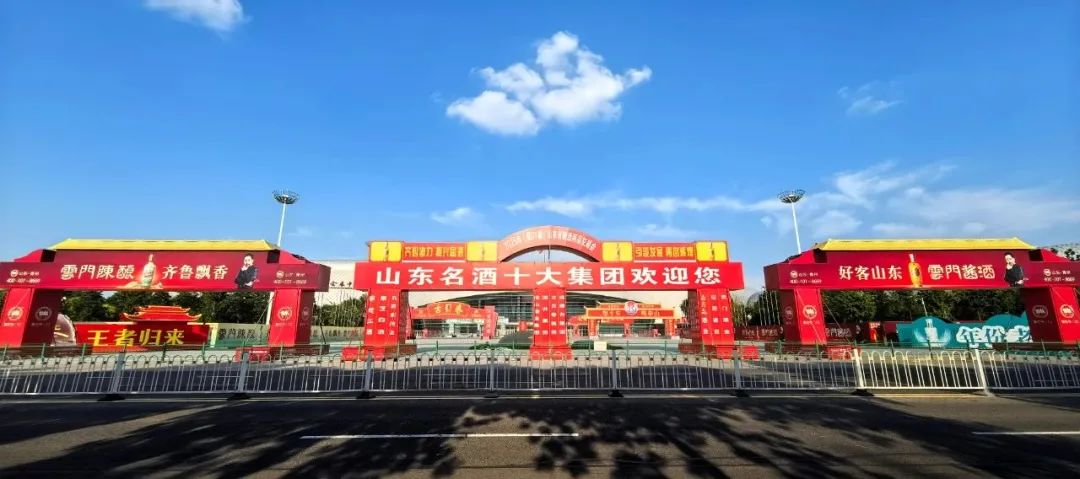
Core Viewpoint - The 91st Shandong Sugar and Wine Commodity Fair showcased Yunmen Liquor's innovative product matrix, emphasizing the cultural expression of "Yunmen Aesthetics" and enhancing the potential of the Shandong liquor market [1][13]. Group 1: Event Overview - The fair took place from August 16 to 18, 2025, in Weifang, with Yunmen Liquor participating as a representative of Shandong liquor brands [1]. - The opening ceremony featured Pan Xuesen, General Manager of Yunmen Liquor, who represented the co-organizing unit and hosted the event [1][2]. Group 2: Product Showcase - Yunmen Liquor's exhibition included classic products such as Yunmen Sauce Liquor, Yunmen Aged Liquor, Qingzhou Aged Liquor, and Yunmen Spring, highlighting the blend of tradition and modernity [3][7]. - The "Qingzhou Cong Shi" series was a focal point of the exhibition, attracting significant attention from attendees due to its unique design and cultural depth [7]. Group 3: Consumer Engagement - The company set up a live streaming room at the fair, engaging consumers with real-time broadcasts and offering attractive limited-time promotions and gifts to enhance participation [8]. Group 4: Awards and Recognition - During the thematic forum of the fair, Yunmen Liquor's "Yunmen Aged Liquor·Yubai 2025" was awarded "Most Promising New Shandong Liquor Product," while a recommended distributor received recognition for integrity [9]. Group 5: Future Outlook - Yunmen Liquor aims to drive innovation, focus on quality, and lead with culture to enhance brand influence and market competitiveness, contributing to the high-quality development of the Shandong liquor industry [13].
怡园酒业发布中期业绩 股东应占亏损274.5万元 同比收窄22.26%
Zhi Tong Cai Jing· 2025-08-20 22:53
Group 1 - The company reported revenue of 18.775 million RMB for the six months ending June 30, 2025, representing a year-on-year increase of 42.5% [1] - The loss attributable to the company's owners narrowed to 2.745 million RMB, a decrease of 22.26% compared to the previous year [1] - The basic and diluted loss per share for the period was 0.34 cents [1]
演讲45场100个小时,“酒业流量担当”吴向东这100天在忙什么?
Sou Hu Cai Jing· 2025-08-20 04:16
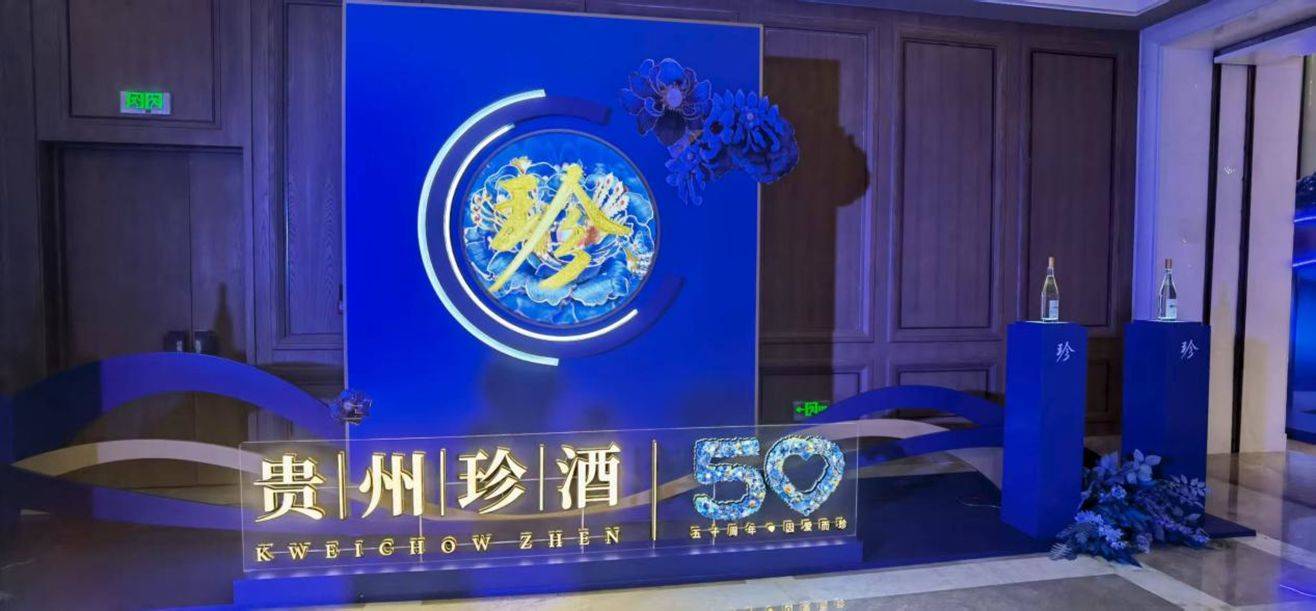
Core Viewpoint - The company is launching a new strategic initiative called "Wan Shang Alliance" centered around its new product "Da Zhen·Zhen Jiu" to navigate the current industry downturn and enhance market presence [3][5][15]. Group 1: Product Launch and Strategy - The new product "Da Zhen·Zhen Jiu" is positioned as a "superior quality, mid-range price" offering, with a group purchase price set at 600 yuan per bottle, targeting the 3000 yuan product quality level [8][9]. - The "Wan Shang Alliance" aims to unify pricing control and implement a continuous dividend mechanism to align the interests of alliance merchants, with over 2100 merchants signed up since its inception [3][12]. - The company has conducted approximately 50 "Wan Shang Alliance Wealth Creation Forums" in about 100 days to promote this initiative [3][13]. Group 2: Market Context and Challenges - The white liquor industry has been experiencing a downward trend since the first quarter of the year, with no signs of recovery as of May [6][9]. - The current market trend shows a shift towards lower-priced liquor, with popular price ranges now between 300 to 500 yuan, raising questions about the viability of the 888 yuan price point for "Da Zhen" [9][11]. - The company is focusing on middle-class families and small business owners who value quality but are price-sensitive, indicating a potential new growth point in the 600 yuan price range [11][15]. Group 3: Business Model and Market Response - The "Wan Shang Alliance" features a unique business model that includes price control, profit-sharing, and stock options for alliance merchants, which has generated mixed reactions in the market [13][14]. - Some merchants who attended the forums have signed contracts and are actively expanding their market reach, while others remain skeptical [14][15]. - The company emphasizes that its model is not a pyramid scheme, highlighting the absence of a multi-level referral system [15]. Group 4: Financial Performance and Future Outlook - The stock price of the company increased by 24.9% from August 11 to 15, indicating positive market sentiment towards its recent initiatives [15][16]. - The company aims to leverage its existing production capacity of 44,000 tons per year and storage capacity of 120,000 tons to support the launch of new products [11].
华润啤酒“半年考”:豪掷123亿,为何换不来白酒的“醇香”?
中国基金报· 2025-08-20 01:13
Core Viewpoint - The acquisition of Jinsha Liquor by China Resources Beer for over 12.3 billion yuan has faced unprecedented scrutiny as the expected growth in the liquor business has not materialized, leading to disappointing financial results [2][3]. Financial Performance - In the first half of 2025, China Resources Beer reported a revenue of 23.942 billion yuan, a year-on-year increase of 0.8%, while net profit attributable to shareholders rose by 23.0% to 5.789 billion yuan [2]. - The liquor business generated a revenue of only 78.1 million yuan, with nearly 80% of this coming from the "Zhai Fu" product line, and reported a loss before interest and tax of 152 million yuan [2][8]. - Jinsha Liquor's revenue for 2023 was 208.3 million yuan, with a profit before interest and tax of 13 million yuan [7]. Acquisition Background - In 2022, China Resources Beer acquired a 55.19% stake in Jinsha Liquor for 12.3 billion yuan, marking the largest transaction in China's liquor acquisition history [5]. - The acquisition was intended to create a dual-driven strategy of "beer + liquor," aiming to tap into the more profitable and resilient liquor market [5]. Performance Decline - Post-acquisition, Jinsha Liquor's performance has not met expectations, with revenues of 87.8 million yuan, 176.7 million yuan, and 364.1 million yuan from 2019 to 2021, followed by a decline in 2024 with a revenue of 216.1 million yuan, a year-on-year increase of only 3.7% [6][9]. - In the first half of 2025, Jinsha Liquor's revenue fell by 33.9% to 78.3 million yuan, resulting in a loss before interest and tax of 152 million yuan [9]. Market Challenges - The liquor market is facing weakened consumer demand and intensified competition due to excessive production capacity, leading to disappointing investment outcomes [9]. - The introduction of a "drinking ban" policy has significantly impacted the liquor sector, particularly affecting high-end dining and business banquet scenarios [10]. Strategic Misalignment - Analysts suggest that the failure of China Resources Beer to successfully integrate its liquor business stems from a mismatch in operational models, attempting to apply fast-moving consumer goods strategies to the liquor sector, which relies more on long-term brand cultivation and targeted marketing [15]. - The acquisition of Jinsha Liquor and investment in other liquor companies occurred at a peak in the market, leading to high inventory levels and declining consumption post-2022 [15]. Future Outlook - To overcome its current challenges, China Resources Beer may need to divest from consistently underperforming assets and focus on rebuilding a professional liquor team to enhance brand culture and consumer engagement [16].



王朝酒业发盈警 预期上半年综合盈利约740万港元至930万港元 同比减少约50%至60%
Zhi Tong Cai Jing· 2025-08-19 12:34
Core Viewpoint - Dynasty Fine Wines Group (00828) expects to report an unaudited consolidated profit range of approximately HKD 7.4 million to HKD 9.3 million for the first half of 2025, representing a year-on-year decrease of about 50% to 60% [1] Group Summary - The decline in profit is primarily attributed to two factors: 1) A moderate decrease in sales revenue due to fluctuations in the Chinese macroeconomic and consumer market, leading to reduced operating profit [1] 2) Increased marketing and promotional expenses [1] - The company is closely monitoring market conditions and has adjusted its business strategy to mitigate negative impacts on operations [1] - The company has also strengthened cost control measures and taken appropriate actions in a timely manner [1]