网约车

Search documents
1.4万亿Uber还要继续吃Robotaxi的苦
Xin Lang Cai Jing· 2025-11-05 04:49
Core Viewpoint - Uber's core business shows steady growth, but to achieve explosive growth again, it needs new drivers, particularly in advertising and autonomous driving [2][9]. Financial Performance - In Q3 2025, Uber reported revenue of $13.47 billion, a 20% year-over-year increase, and net profit surged nearly threefold to $6.6 billion from $2.6 billion [4]. - Adjusted EBITDA grew by 33% to approximately $2.3 billion [4]. - The ride-hailing segment generated $7.68 billion in revenue, up 20% year-over-year, while the delivery segment (Uber Eats) saw revenue of $4.48 billion, a 9% increase [4][6]. - Total bookings for Q3 2025 reached $49.7 billion, a 21% increase year-over-year, with ride-hailing orders growing by 19.6% to $25.1 billion [6]. Business Segments - Uber's revenue growth is primarily driven by its ride-hailing and delivery services, with total bookings becoming a crucial metric [6]. - The delivery business has shown strong performance, with order volume increasing by 25% in Q3 compared to 20% in the previous quarter [6]. - Uber's non-restaurant delivery services have reached an annualized order volume of $12 billion, contributing to the growth of the delivery segment [8]. Regional Performance - The North American region has historically been Uber's largest revenue source, but its contribution has dropped below 50% for the first time, indicating a slowdown in growth [8]. - The Europe, Middle East, and Africa (EMEA) region is now the fastest-growing area for Uber, contributing over 30% of total revenue [8]. Future Growth Drivers - Short-term growth is expected to come from advertising, which is anticipated to enhance overall profit margins due to its high gross margin characteristics [10]. - Uber has 190 million active users, providing a significant opportunity for monetizing its advertising business through in-app ads and journey-based promotions [10]. - Long-term growth hinges on the commercialization of autonomous driving, which is currently seen as a double-edged sword due to increased capital expenditures and short-term profitability pressures [10][12]. Autonomous Driving Strategy - Uber's strategy in autonomous driving has shifted from a "hardcore player" to a "pragmatic ecosystem integrator," focusing on partnerships rather than high-risk self-development [12]. - The company has formed partnerships with various autonomous driving firms, including Baidu and Momenta, and plans to deploy a fleet of 100,000 autonomous vehicles by 2027 [13][14]. - However, the current scale of Uber's autonomous vehicle fleet is limited compared to its millions of ride-hailing drivers, making it challenging to achieve cost reductions and profitability in this segment [13]. Competitive Landscape - Uber faces significant competition in the autonomous driving space from tech giants like Waymo and Cruise, which have advanced technologies and substantial funding [15][16]. - Tesla's plans to launch its own Robotaxi network pose a direct threat to Uber's core business model [17]. - Chinese autonomous driving companies also present competition, leveraging their data advantages in complex traffic scenarios [19]. Conclusion - In the short term, autonomous driving may act as a cost center impacting profits, but in the long term, it is crucial for Uber's valuation and business model sustainability [20].



优步20251104
2025-11-05 01:29
Uber Q3 2025 Earnings Call Summary Company Overview - **Company**: Uber Technologies, Inc. - **Quarter**: Q3 2025 Key Industry Insights - **Industry**: Ride-hailing and food delivery services - **Market Trends**: Significant growth in user engagement and service utilization, with a focus on cross-platform integration and autonomous vehicle deployment Core Points and Arguments 1. **Revenue Performance**: Uber's Q3 revenue exceeded expectations, driven by record audience and engagement growth, with total bookings increasing by 21% [2][3] 2. **Future Projections**: Anticipation of continued double-digit growth in gross bookings for Q4, with over 130 million trips during Halloween weekend and gross bookings surpassing $2 billion [2][3] 3. **Strategic Focus Areas**: Six strategic priorities identified: - Enhance cross-platform user engagement - Develop a hybrid model integrating human drivers and autonomous vehicles - Invest in local businesses, particularly grocery and retail, with annual order volume around $12 billion - Create more delivery opportunities through Uber AI solutions - Support merchant growth via advertising and other channels - Integrate generative AI technology across operations [2][5] 4. **Cross-Platform Usage**: Approximately 20% of consumers use both ride and delivery services, with cross-platform consumers spending three times more than single-channel users [2][6][7] 5. **Autonomous Vehicle Initiative**: Partnership with NVIDIA to deploy 100,000 autonomous vehicles, starting with 5,000 using NVIDIA technology, showing significant growth in testing markets like Austin [2][8] 6. **Delivery Service Expansion**: Delivery services saw the fastest growth in four years, with grocery and retail operations achieving an annualized run rate of $12 billion [3][9] 7. **Geographic Strategy**: Significant progress in sparse geographic areas, with growth rates 1.5 times higher than dense markets, indicating substantial untapped potential [3][10] 8. **Profitability Metrics**: Q3 profits and EBITDA grew by 33%, achieving a historical high gross margin of 4.5%, with free cash flow nearing $9 billion [3][11] 9. **Uber One Membership Program**: Rapid growth with 36 million members, contributing to two-thirds of total delivery bookings, enhancing customer retention and profitability [3][13] 10. **Insurance Strategy**: Legislative progress in states like Georgia and California, reducing operational costs by lowering insurance limits [3][15] 11. **Technological Developments**: Introduction of a driver insight dashboard to improve driver behavior and safety, alongside exploring new revenue sources like logistics and AI solutions [3][16][17] 12. **Partnerships**: Collaboration with Toast to streamline restaurant operations on Uber Eats, enhancing growth and profitability [3][18] 13. **Shift to Adjusted Operating Income**: Transitioning to adjusted operating income reflects the company's growth and maturity, aiming for better comparability for investors [3][19] Additional Important Insights - **Market Position in Europe**: Uber has become a leading food delivery service in the UK and France, with a focus on organic growth and enhancing service quality [3][11] - **Long-term Investment in AV**: Short-term losses expected in the autonomous vehicle sector, but anticipated long-term profitability as supply chains stabilize [3][12][19] - **Data Collection for AV**: Real-time data collection from ride-sharing operations to support autonomous vehicle development, in collaboration with NVIDIA for enhanced sensor systems [3][20]
星瞰IPO | 衔玉而生却亏了19亿,享道出行拿什么拼港股入场券
Sou Hu Cai Jing· 2025-11-04 16:05
Core Viewpoint - The company, Xiangdao Mobility, has submitted its IPO application to the Hong Kong Stock Exchange, despite facing significant operational challenges and a history of substantial losses [1][3]. Financial Performance - Xiangdao Mobility reported a cumulative net loss exceeding 1.9 billion RMB over the past three and a half years, with losses of approximately 781 million RMB, 604 million RMB, and 407 million RMB from 2022 to 2024, and a slight reduction to 115 million RMB in the first half of 2025 [4][8]. - Revenue for the years 2022 to 2024 is projected to grow from approximately 4.73 billion RMB to 6.39 billion RMB, with year-on-year growth rates of 20.9% and 11.8% [4][8]. - However, in the first half of 2025, revenue declined by 2.8% to 3.01 billion RMB, primarily due to a decrease in ride-hailing service income [6][8]. Revenue Composition - Ride-hailing services account for over 70% of total revenue, with 2022-2024 revenues from this segment being 3.36 billion RMB, 4.21 billion RMB, and 4.99 billion RMB, respectively [7][12]. - The company’s order volume from 2022 to 2024 increased from approximately 14.73 million to 22.33 million, but saw a 3.73% decline in the first half of 2025 [11][12]. Dependency on Aggregation Platforms - Xiangdao Mobility heavily relies on aggregation platforms for order acquisition, with a significant portion of its orders coming from partnerships with major platforms like Didi and Baidu Maps [9][13]. - The company paid approximately 273 million RMB, 327 million RMB, and 442 million RMB in commission fees to these platforms from 2022 to 2024, indicating rising costs associated with this dependency [13][14]. Strategic Focus on Robotaxi - The company plans to allocate part of the IPO proceeds to the development of autonomous driving and Robotaxi services, having initiated trials in Shanghai as early as 2021 [17]. - Xiangdao Mobility aims to leverage Robotaxi as a strategic core to transform the mobility industry, despite facing challenges such as high costs and regulatory uncertainties [18].

纳指低开1.58%,英伟达跌超2%,Palantir跌超8%
Ge Long Hui· 2025-11-04 14:38
Core Viewpoint - Multiple CEOs on Wall Street have warned that U.S. stocks may experience a correction of over 10% due to high valuations [1] Market Performance - Major U.S. stock indices opened lower, with the Nasdaq down 1.58%, the S&P 500 down 1.15%, and the Dow Jones down 0.75% [1] Company-Specific Developments - Tesla shares fell by 3.3% after the Norwegian sovereign wealth fund rejected Elon Musk's $1 trillion compensation plan, and October shipments to China decreased by nearly 10% year-over-year [1] - Nvidia's stock declined by 2.4%, while Palantir's shares dropped over 8%, amid rising concerns about an AI bubble, with "big short" Michael Burry revealing an 80% short position in both Palantir and Nvidia [1] - Uber's stock fell by more than 8% as Q3 operating profits fell short of expectations, and the CEO projected that Robotaxi would remain unprofitable for the next few years [1]

优步(UBER.US)盘前跌逾7% CEO预计Robotaxi未来几年仍无法盈利
Zhi Tong Cai Jing· 2025-11-04 14:30
Core Insights - Uber's stock dropped over 7% in pre-market trading, closing at $92.43 [1] - The company's Q3 operating profit was $1.11 billion, below analyst expectations of $1.62 billion [1] - Adjusted EBITDA was $2.26 billion, also slightly below expectations [1] - Total bookings increased over 20% year-on-year to $49.7 billion, marking the largest growth in 2023 [1] - For Q4, Uber expects adjusted core profit between $2.41 billion and $2.51 billion, slightly below the market expectation of $2.48 billion [1] - The CEO indicated that profitability from autonomous ride-hailing is not expected in the coming years [1]
优步(UBER.US)Q3营收超预期 Q4调整后核心利润指引略逊预期
Zhi Tong Cai Jing· 2025-11-04 13:52
Core Insights - Uber Technologies reported strong Q3 results, with total bookings of $49.74 billion, exceeding expectations of $48.73 billion, and revenue growth of 20% to $13.47 billion, surpassing the forecast of $13.28 billion [1] - The company anticipates Q4 total bookings to be between $52.25 billion and $53.75 billion, slightly above analyst expectations of $52 billion [3] - CEO Dara Khosrowshahi highlighted the growth potential of Uber's delivery services, driven by the Uber One program, which encourages users to book more food and grocery deliveries [2] Financial Performance - Net profit for Q3 increased nearly threefold to $6.6 million, or $3.11 per share, compared to $2.6 billion, or $1.20 per share, in the same period last year [1] - Adjusted EBITDA grew by 33% to approximately $2.26 billion, aligning with market expectations [1] - The delivery segment saw a sales increase of 29%, outpacing the 20% growth in ride-hailing revenue [3] User Engagement and Market Position - Consumers using multiple Uber services have a retention rate 35% higher than other users, with spending three times greater [3] - Currently, only about 20% of active users utilize both ride-hailing and delivery services, although top-performing countries exceed this level [3] - Uber's stock price has risen approximately 65% year-to-date, reflecting strong performance and a solidified position in the ride-hailing industry [1]
UberQ3总预订额大增21%,营业利润不及预期,盘前跌超4%|财报见闻
Hua Er Jie Jian Wen· 2025-11-04 13:45
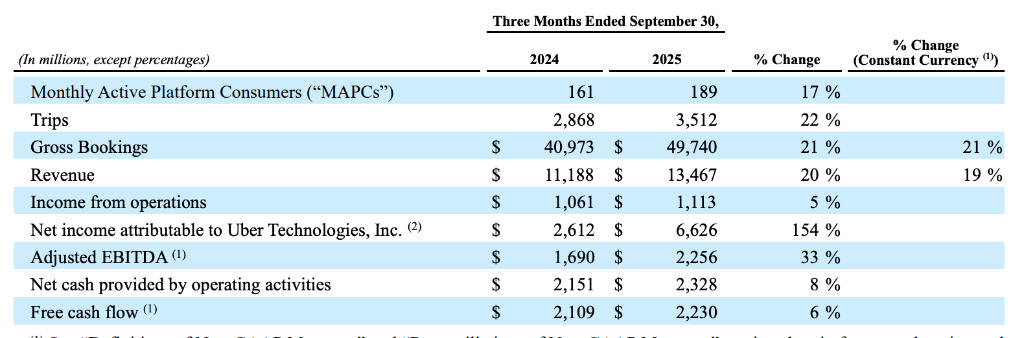
Core Viewpoint - Uber's Q3 financial results showed strong operational metrics despite lower-than-expected profitability, with total bookings reaching $49.7 billion, a year-over-year increase of over 20%, marking the largest growth in 2023 [1][4] Financial Performance - For the three months ended September 30, 2023, Uber reported: - Revenue of $13.467 billion, a 20% increase year-over-year [2] - Net income attributable to Uber Technologies, Inc. of $6.626 billion, a 154% increase [2] - Adjusted EBITDA of $2.256 billion, up 33% [2] - Monthly Active Platform Consumers (MAPCs) increased by 17% to 189 million [2][8] - Total trips increased by 22% to 3.512 billion [2] Business Growth and Challenges - Total bookings for Q3 reached $49.7 billion, driven by strong demand in both ride-hailing and delivery services, reflecting a significant rebound in overall travel activity [4] - The company provided a broad Q4 guidance, projecting total bookings between $52.25 billion and $53.75 billion, which is lower than the 22% growth seen in Q3 [3] - The delivery business saw adjusted EBITDA surge by 47% to $921 million, outpacing the mobility business's 21% growth [5] - Freight business remained stagnant with total bookings flat at $1.3 billion and an adjusted EBITDA loss of $20 million [5][8] Strategic Focus - CEO Dara Khosrowshahi outlined six strategic growth areas, including expanding ride-hailing and delivery services, developing a mixed platform of human and autonomous vehicles, and leveraging generative AI [6] - The company has divested approximately $1.4 billion from its $10.3 billion investments in other companies to prioritize these strategic initiatives [6] Market Reaction - Following the earnings report, Uber's stock price fell over 4% to $99.72 per share, despite a year-to-date increase of over 57% [6]
Uber Profit, Revenue Jump on Increased Trips
WSJ· 2025-11-04 12:08
Core Insights - The ride-hailing company reported increased profit and revenue in the third quarter, highlighting a significant rise in trip volume, marking one of the largest increases in its history [1] Financial Performance - The company experienced higher profit in the third quarter [1] - Revenue also saw an increase during the same period [1] Operational Metrics - The company achieved one of the largest trip-volume increases in its history [1]

员工砍福利,CEO涨薪资?上汽旗下享道出行IPO:三年半狂亏19亿
Xin Lang Ke Ji· 2025-11-04 02:11
Core Insights - The core issue for the company is its declining performance in the ride-hailing market, with significant reliance on aggregation platforms for orders, leading to a precarious financial situation and ongoing losses [2][4][5] Financial Performance - In the first half of 2025, the company's revenue decreased by 2.8% to 30.13 billion yuan, continuing a trend of declining income [2] - Cumulative losses over three and a half years reached 1.907 billion yuan, with net losses reported as 781 million yuan, 604 million yuan, 407 million yuan, and 115 million yuan for the years 2022 to the first half of 2025 respectively [2][3] - The company's revenue from ride-hailing services fell from 2.428 billion yuan in the first half of 2024 to 2.298 billion yuan in the first half of 2025, a decrease of 5.4% [1][2] Operational Challenges - The company has faced a decline in order compliance rates, with a drop in order volume by 6.4% in May and 4.8% in June 2023 [7][8] - The number of ride-hailing orders decreased from 1.08 billion in the first half of 2024 to 1.04 billion in the first half of 2025, while the Gross Transaction Value (GTV) also fell from 2.699 billion yuan to 2.628 billion yuan [3][5] Employee Compensation and Cost Management - Employee welfare expenditures have been reduced significantly, with total compensation dropping from 314 million yuan in 2022 to 97.38 million yuan in the first half of 2025 [11] - In contrast, the CEO's total compensation increased from 893,000 yuan in the first half of 2024 to 969,000 yuan in the first half of 2025, primarily due to higher bonuses [11] Market Position and Dependency - The company ranks fifth among domestic ride-hailing platforms based on GTV, but this ranking is achieved while heavily relying on aggregation platforms for order flow, with 98.08% of orders coming from these platforms in the first half of 2025 [2][5] - The dependency on aggregation platforms poses risks, as the agreements with these platforms typically last for one year and can be renewed, but non-renewal could disrupt operations [3][4]

上汽旗下网约车企业享道出行IPO:三年半狂亏19亿!业绩压力降本增效,员工砍福利,CEO倪立诚的薪资却涨了?
Sou Hu Cai Jing· 2025-11-04 01:34
文 | 《次世代车研所》栏目 张俊 又一家网约车企业冲刺IPO,这次是旗下的享道出行。 虽然背靠上汽、等明星股东,但享道出行的表现并不理想。今年上半年,其收入同比下滑2.8%;另 外,2022年至今,享道出行一直处于亏损状态,三年半时间累计亏损高达19.07亿元。 尴尬的是,享道出行的网约车业务也严重依靠聚合平台的"输血",2022年至今,其来自聚合平台的订单 占比一路攀升,今年上半年已经高达98.08%。今年5月和6月,享道出行的订单量以及订单合规率也均 出现环比下降。天眼查显示,享道出行因合规问题累计遭遇行政处罚共149条。 业绩萎靡之下,享道出行将降本的"大刀"砍向了员工福利支出。对比来看,享道出行CEO倪立诚的福利 待遇却逆势增长,今年上半年,他的薪酬总额从89.3万元增长至96.9万元。 上半年收入下滑,连年亏损不断 资料显示,享道出行由上汽集团发起成立,引入了Momenta、高德、宁德时代等投资者。公司提供网约 车服务、车辆租赁服务、车辆销售及Robotaxi服务,打造覆盖个人出行、企业出行以及未来出行中多元 场景需求的一站式出行服务平台。 招股书显示,在收入方面,2022年至2024年,享道出行 ...