贸易

Search documents
10月高频数据跟踪
LIANCHU SECURITIES· 2025-11-06 11:33
Production Side - In October, the operating rates for full steel and semi-steel tires were 59.85% and 66.58%, respectively, showing a decline compared to the previous month[3] - The average operating rates for electric furnaces and rebar were 60.58% and 41.90%, both lower than the previous month[3] - The capacity utilization rates for coking, glass, cement clinker, and cold-rolled steel continued to improve, recorded at 79.99%, 78.61%, 59.46%, and 98.41% respectively[3] Demand Side - The average transaction area of commercial housing in 30 cities increased by 1.34% month-on-month but decreased by 24.49% year-on-year[4] - The average transaction area of land in 100 cities decreased by 20.55% month-on-month and 15.85% year-on-year[4] - The average daily sales of passenger cars were 65,118 units, a decrease of 22.89% compared to the previous month[4] Price Side - The wholesale price index for agricultural products increased by 1.79% month-on-month, with slight increases in vegetable and fruit prices[6] - The average price of gasoline and diesel saw year-on-year declines of 2.28% and 4.29% respectively[6] - The price of rebar decreased by 1.24% month-on-month, while the price of copper and aluminum increased by 4.05% and 0.60% respectively[6] Risks - Risks include domestic policy implementation falling short of expectations and overseas policies exceeding expectations[7]
贸易板块11月6日涨1.84%,中信金属领涨,主力资金净流入1.53亿元
Zheng Xing Xing Ye Ri Bao· 2025-11-06 08:51
Market Overview - The trade sector increased by 1.84% on November 6, with CITIC Metal leading the gains [1] - The Shanghai Composite Index closed at 4007.76, up 0.97%, while the Shenzhen Component Index closed at 13452.42, up 1.73% [1] Stock Performance - CITIC Metal (601061) closed at 15.04, rising by 8.59% with a trading volume of 925,600 shares and a turnover of 1.374 billion [1] - Wuhuan Development (600058) closed at 9.66, up 5.23%, with a trading volume of 390,800 shares and a turnover of 375 million [1] - Sumec (600710) closed at 12.15, increasing by 3.05%, with a trading volume of 263,600 shares and a turnover of 320 million [1] - Other notable stocks include Yiatong (002183) with a 1.54% increase and Jiangsu Guotai (002091) with a 0.87% increase [1] Capital Flow - The trade sector saw a net inflow of 153 million from institutional investors, while retail investors experienced a net outflow of 1.65 billion [2] - Major stocks like CITIC Metal and Wuhuan Development attracted significant net inflows from institutional investors, with 63.23 million and 62.05 million respectively [3] - Retail investors showed a negative net flow in several stocks, including CITIC Metal and Wuhuan Development, indicating a divergence in investment behavior [3]


推动产业生态深度融合 “2025山东与跨国公司产业生态合作伙伴对话会”在沪成功举办
Zhong Guo Fa Zhan Wang· 2025-11-06 08:39
Core Points - The dialogue conference on "Investment in Shandong, Win-Win Future" was held on November 6, 2023, at the National Exhibition and Convention Center in Shanghai, focusing on industrial ecological cooperation [1] - The event attracted over 60 foreign business associations, Fortune 500 multinational companies, and industry leaders [1] - A total of 25 key cooperation projects were signed during the conference, including 20 trade projects with an import-export total of approximately $5.84 billion and 5 investment projects with a total investment of about $290 million [1] Group 1 - The conference was hosted by the Shandong Provincial Government and featured speeches from officials including the Deputy Minister of Commerce and the Vice Governor of Shandong [1] - Major companies and associations such as Medtronic, Baker Hughes, IBM, and Ant Group participated in discussions on "Artificial Intelligence + Manufacturing: Industry Model Driven Ecological Transformation" [1] - The participating cities, including Qingdao, Zibo, Yantai, Jining, Weihai, and Binzhou, promoted their industrial ecosystems [1] Group 2 - The trade projects covered various sectors, including energy, minerals, agricultural products, and electromechanical equipment [1] - The investment projects focused on new energy materials, high-end equipment, and health care [1] - The event highlighted the importance of international collaboration in enhancing Shandong's industrial ecosystem [1]
上海浦东:已总体达到CPTPP和DEPA正文条款的开放水平
Di Yi Cai Jing· 2025-11-06 08:01
Core Viewpoint - Pudong is advancing its institutional openness by refining rules in various sectors, aiming to align with international standards and enhance its role as a global economic hub [1][2]. Group 1: Institutional Openness - Pudong has achieved a level of openness comparable to CPTPP and DEPA, focusing on expanding rules and standards in service, digital, and goods trade [1]. - The region has eliminated restrictive measures in the manufacturing sector and initiated pilot programs in value-added telecommunications and cell and gene therapy services, establishing 9 and 40 enterprises respectively [2]. - Pudong is aligning with OECD service trade restrictions and World Bank business environment assessments to improve its service and trade openness [1][2]. Group 2: Trade and Financial Services - Pudong is enhancing cross-border financial services by expanding free trade account functionalities and facilitating cross-border payments [2]. - The region has implemented the first customs special supervision area for bonded remanufacturing in China, allowing for 97 types of bonded repair services [2]. - A negative list for data export has been introduced, enabling compliant companies to bypass prior approval processes for data cross-border flow [2]. Group 3: Infrastructure and Connectivity - Pudong is positioned as a key gateway for international trade, with the Pudong International Airport projected to handle 3.78 million tons of cargo and mail in 2024, ranking second globally [3]. - The Shanghai Port continues to lead globally in container throughput, reaching 51.51 million TEUs [3]. Group 4: Business Cooperation and Support - The upcoming Oriental Hub International Business Cooperation Zone will facilitate business activities with a 30-day visa-free stay for international visitors [4]. - The "Overseas Enterprise Gathering Area" offers comprehensive support for companies venturing abroad, with over 80 professional service institutions and 270 global sites established [5]. Group 5: Technological Advancements - Pudong is focusing on high-tech industries, with significant increases in fiscal science and technology investment, rising from 4.2% in 2021 to 9.2% in 2023 [5]. - The integrated circuit industry has reached a scale of $41 billion, accounting for one-fifth of China's total, with a 7.4% increase in electronic component exports [6]. - The biopharmaceutical sector has over 4,000 companies, with significant contributions to global drug approvals and transactions [6].
“2025四川民营企业100强”榜单发布 通威集团位列榜首
Xin Hua Cai Jing· 2025-11-06 06:38
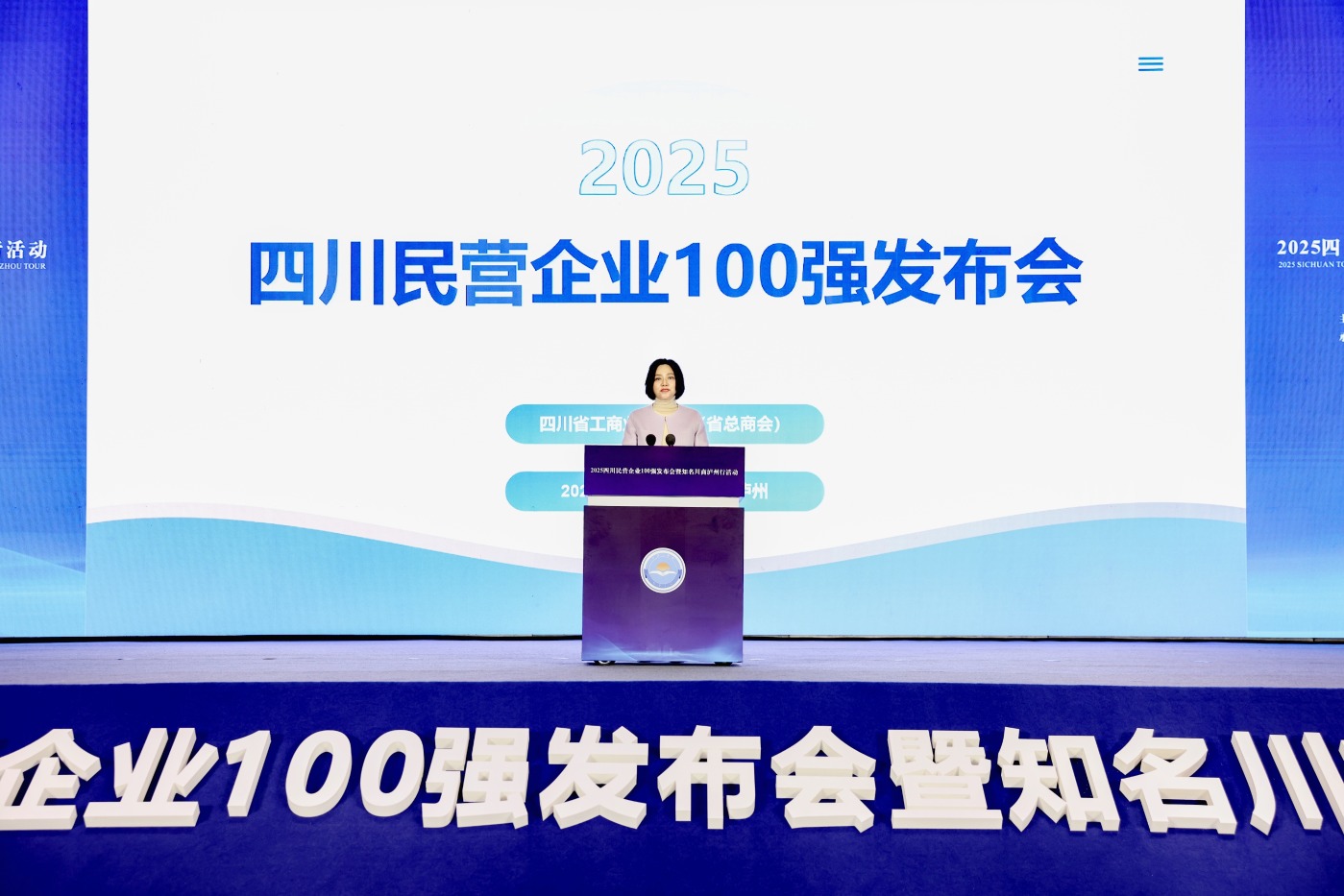
Core Insights - The "2025 Sichuan Top 100 Private Enterprises" list was released, with Tongwei Group ranking first for the first time [1] - Significant changes in rankings were noted compared to the 2024 list, with Tongwei Group's revenue exceeding 240 billion yuan, moving up one position [1][2] - The threshold for entry into the list was set at 3.945 billion yuan, an increase of nearly 200 million yuan from the previous year [2] Group 1: Rankings and Revenue - The top 10 companies in the 2025 list include Tongwei Group, Qiya Group, New Hope Liuhe, Sichuan Chuanwei Group, and others [1] - The total revenue of private enterprises reached 1.74 trillion yuan, with 61 companies experiencing revenue growth [2] - The net profit of private enterprises totaled 52.04 billion yuan, with 43 companies increasing their net profit [2] Group 2: Manufacturing Sector - Manufacturing is the main support for the top 100 enterprises, with 73 companies in this sector, contributing 1.39 trillion yuan in revenue, accounting for 80.3% of the total [5] - The total assets of manufacturing enterprises also reached 1.39 trillion yuan, representing 79.3% of the total, with a significant increase of 16.4% from the previous year [5] - Tax contributions from manufacturing enterprises amounted to 45.668 billion yuan, making up 83.4% of the total [5] Group 3: Additional Rankings - The top 10 companies in the 2025 Sichuan Manufacturing Private Enterprises list mirror the top 10 of the overall list [5] - The top 10 companies in the 2025 Sichuan Service Industry Private Enterprises list include Chengdu JD Century Trading and others [6] - The top 10 companies in the 2025 Sichuan Private Enterprises R&D Investment list feature Tongwei Group and several pharmaceutical companies [6] Group 4: Economic Impact - Sichuan's GDP ranked fifth nationally, with the private economy contributing significantly, accounting for 56.4% of the total economic output [7] - The added value of the private economy reached 3.646 trillion yuan, reflecting a slight increase from the previous year [7]





美国关税施压,中国为何稳如泰山?英国专家点出四张关键底牌
Sou Hu Cai Jing· 2025-11-05 19:14
Core Viewpoint - The article discusses the escalating trade tensions between the United States and China, particularly focusing on the significant tariffs imposed by the U.S. on Chinese electric vehicles and China's retaliatory measures, highlighting China's resilience and strategic advantages in the face of U.S. pressure [1][3]. Group 1: Tariff Impositions - The U.S. has imposed a staggering 245% tariff on Chinese electric vehicles, which has prompted China to respond with a 125% counter-tariff, showcasing China's willingness to confront U.S. trade aggression [1][3]. - The U.S. initially implemented a 34% "reciprocal tariff," which quickly escalated to 145%, indicating a pattern of extreme pressure tactics that China is not yielding to [3]. Group 2: China's Strategic Advantages - China possesses four key advantages in trade: control over rare earth resources, a large domestic market, a diversified trade network, and effective policy management [4][6][9]. - China's rare earth resources are particularly critical, as it controls over 90% of global processing and has advanced separation and purification technologies, making it difficult for the U.S. to find alternatives [11][15]. - The domestic market, with a population of 1.4 billion and a growing middle class, provides China with a buffer against external shocks, allowing for a shift from "scale expansion" to "value competition" [6]. Group 3: Trade Network Diversification - China has diversified its trade network significantly, with imports and exports to Belt and Road Initiative countries growing by 6.2%, now accounting for 51.7% of its total trade, surpassing traditional markets like the U.S. and EU [7][9]. - In 2025, China's exports grew by 8.3% and imports by 7.4%, demonstrating resilience in a complex global economic environment [9]. Group 4: Impact on U.S. Industries - China's recent expansion of export restrictions on rare earth elements, now including 12 types, poses a significant threat to U.S. industries, particularly in automotive and defense sectors, which rely heavily on these materials [13][15]. - The U.S. military's reliance on Chinese rare earths is underscored by the fact that the F-35 fighter jet requires 417 kg of rare earth materials, with China supplying 82% of global rare earth permanent magnet materials [15]. Group 5: Overall Trade Resilience - China's foreign trade structure is evolving, with a 59.4% share of electromechanical product exports, including a 28.7% increase in high-value products like electric vehicles and solar panels [15]. - The diversification of markets, with significant growth in exports to ASEAN and Africa, enhances China's resilience against U.S. tariffs, making the impact of the U.S. trade war less significant than anticipated [17].
兴化海顺贸易有限公司成立 注册资本50万人民币
Sou Hu Cai Jing· 2025-11-05 16:22
Core Insights - A new company, Xinghua Haishun Trading Co., Ltd., has been established with a registered capital of 500,000 RMB [1] - The legal representative of the company is Ding Haifeng [1] Business Scope - The company is engaged in various business activities including internet sales (excluding licensed goods) [1] - It offers technical services, development, consulting, exchange, transfer, and promotion [1] - The sales range includes new metal functional materials, leather, office supplies, cement products, lubricants, automotive decoration products, household appliances, daily necessities, electronic products, battery accessories, office equipment, lighting, toys, doors and windows, food (only pre-packaged), furniture, paper products, agricultural and sideline products, and information technology consulting services [1] - The company is authorized to conduct business activities independently based on its business license, except for projects that require approval [1]
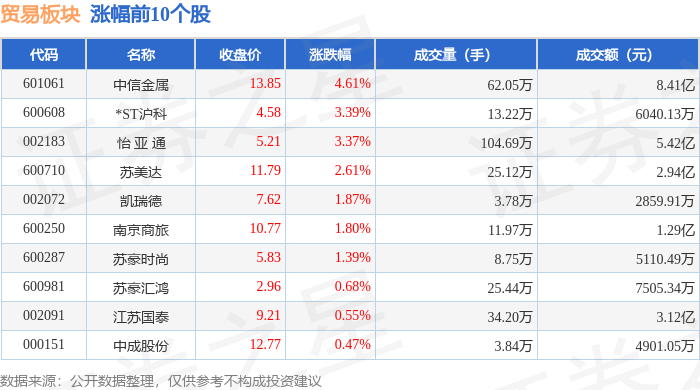
贸易板块11月5日涨1.55%,中信金属领涨,主力资金净流入1.81亿元
Zheng Xing Xing Ye Ri Bao· 2025-11-05 08:48
Market Overview - The trade sector increased by 1.55% on November 5, with CITIC Metal leading the gains [1] - The Shanghai Composite Index closed at 3969.25, up 0.23%, while the Shenzhen Component Index closed at 13223.56, up 0.37% [1] Stock Performance - CITIC Metal (601061) closed at 13.85, rising by 4.61% with a trading volume of 620,500 shares and a turnover of 841 million yuan [1] - Other notable performers included: - ST Huike (600608) up 3.39% to 4.58 with a turnover of 60.4 million yuan [1] - Yiyaton (002183) up 3.37% to 5.21 with a turnover of 542 million yuan [1] - Sumec (600710) up 2.61% to 11.79 with a turnover of 294 million yuan [1] Capital Flow - The trade sector saw a net inflow of 181 million yuan from institutional investors, while retail investors experienced a net outflow of 207 million yuan [2] - The net inflow from speculative funds was 25.12 million yuan [2] Individual Stock Capital Flow - CITIC Metal had a net inflow of 126 million yuan from institutional investors, accounting for 14.93% of its trading volume [3] - Yiyaton experienced a net inflow of 53.99 million yuan from institutional investors, but a net outflow of 20.58 million yuan from speculative funds [3] - Jiangsu Guotai (002091) had a net inflow of 14.02 million yuan from institutional investors, while retail investors saw a net outflow of 21.31 million yuan [3]
港企组团亮相第八届进博会!李家超参会:“经港出海”优势多
Nan Fang Du Shi Bao· 2025-11-05 07:24
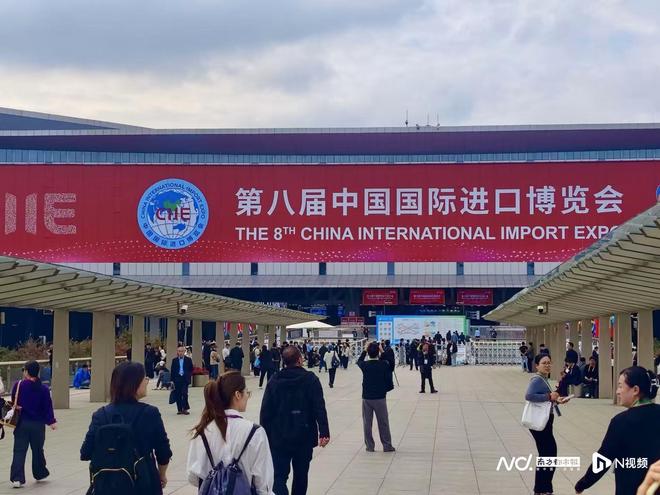
Group 1 - The 8th China International Import Expo (CIIE) opened in Shanghai on November 5, lasting for six days, with the theme "Open Cooperation for New Opportunities, Share a New Future" [1][3] - Approximately 380 Hong Kong enterprises are participating in this year's expo, marking a new high, with a wide range of industries represented [1][3] - The expo is seen as a platform for Hong Kong businesses to expand domestic sales and showcase their brands and innovative capabilities [1] Group 2 - Hong Kong Chief Executive John Lee led a delegation to the CIIE, which includes key government officials, emphasizing the event's significance for international business opportunities [3][5] - The expo features over 3,200 enterprises from more than 110 countries and regions, providing substantial business opportunities for Hong Kong companies [3] - During his visit, John Lee will host a promotional event titled "Hong Kong: The Preferred Platform for Mainland Enterprises Going Global," highlighting Hong Kong's advantages as an international platform [5] Group 3 - The Hong Kong Trade Development Council (HKTDC) has participated in the expo for eight consecutive years, leading the establishment of the "Hong Kong Food Pavilion" and "Hong Kong Services Pavilion" [7] - The "Hong Kong Food Pavilion" showcases 33 enterprises with a focus on health and taste, featuring six categories of products, including traditional brands and innovative health-focused products [7] - The "Hong Kong Services Pavilion" includes 21 enterprises across five sectors, demonstrating Hong Kong's strengths in innovative technology, medical technology, finance, professional services, logistics, and information and communication technology [7]
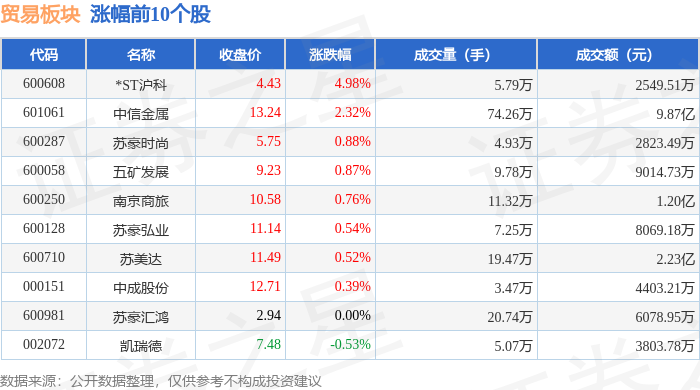
贸易板块11月4日跌0.18%,江苏国泰领跌,主力资金净流出710.82万元
Zheng Xing Xing Ye Ri Bao· 2025-11-04 08:45
Market Overview - The trade sector experienced a decline of 0.18% on November 4, with Jiangsu Guotai leading the drop [1] - The Shanghai Composite Index closed at 3960.19, down 0.41%, while the Shenzhen Component Index closed at 13175.22, down 1.71% [1] Stock Performance - Notable gainers included *ST Huke, which rose by 4.98% to a closing price of 4.43, and CITIC Metal, which increased by 2.32% to 13.24 [1] - Jiangsu Guotai saw a decline of 2.55%, closing at 9.16, with a trading volume of 398,700 shares and a turnover of 367 million yuan [2] Capital Flow - The trade sector experienced a net outflow of 7.11 million yuan from institutional investors, while retail investors saw a net outflow of 25.13 million yuan [2] - Speculative funds had a net inflow of 32.24 million yuan into the trade sector [2] Individual Stock Capital Flow - CITIC Metal had a significant net outflow of 96.78 million yuan from institutional investors, while it attracted a net inflow of 66.61 million yuan from speculative funds [3] - Jiangsu Guotai experienced a net outflow of 55.87 million yuan from institutional investors, with retail investors contributing a net inflow of 9.18 million yuan [3]