银行理财

Search documents
“存款搬家潮”下,有理财公司规模增近5倍
第一财经· 2025-09-07 15:18
Core Viewpoint - The bank wealth management market in the first half of 2025 experienced fluctuations, with a gradual recovery in the second quarter, leading to a total scale of 30.67 trillion yuan by the end of June, a 2.38% increase from the beginning of the year [4][6]. Group 1: Market Performance - The overall scale of the wealth management market decreased in the first quarter but began to recover in the second quarter, reaching a total of 30.67 trillion yuan by June 30 [4]. - The number of existing wealth management products reached 27.48 trillion yuan, with a year-on-year growth of 12.98% [10]. - The Shanghai Composite Index has seen multiple breakthroughs of previous highs, closing at 3812.51 points [4]. Group 2: Company Performance - Among 24 disclosed wealth management companies, a total net profit of 156.67 billion yuan was achieved, with some companies experiencing significant profit declines while others maintained high growth [6][8]. - 招银理财 (Zhaoyin Wealth Management) led the industry with a net profit of 13.64 billion yuan, despite a 5.74% decrease year-on-year [6]. - 浦银理财 (Puyin Wealth Management) showed remarkable growth with a net profit of 9.25 billion yuan, a year-on-year increase of over 70% [6]. Group 3: Industry Trends - The performance disparity among wealth management companies is influenced by macroeconomic factors and strategic adjustments within institutions [7]. - The trend of declining deposit rates has accelerated the shift of resident savings into net value-based wealth management products, providing stable funding sources [7]. - Foreign wealth management companies have emerged as significant players, with notable growth rates, such as 法巴农银理财 (French Bank Agricultural Bank Wealth Management) achieving a nearly fivefold increase in scale [10][11]. Group 4: Challenges and Opportunities - Some companies, like 平安理财 (Ping An Wealth Management), faced substantial profit declines, with a 41.28% drop in net profit [8]. - The pressure on profitability is attributed to the "ceiling" effect of scale and the trend of reducing management fees, which compresses revenue [8]. - The market is expected to continue expanding as deposit rates decline, prompting wealth management companies to enhance product offerings and service channels [14].


银行理财子公司,近七成公司净利润增速为正
Zhong Guo Ji Jin Bao· 2025-09-07 13:48
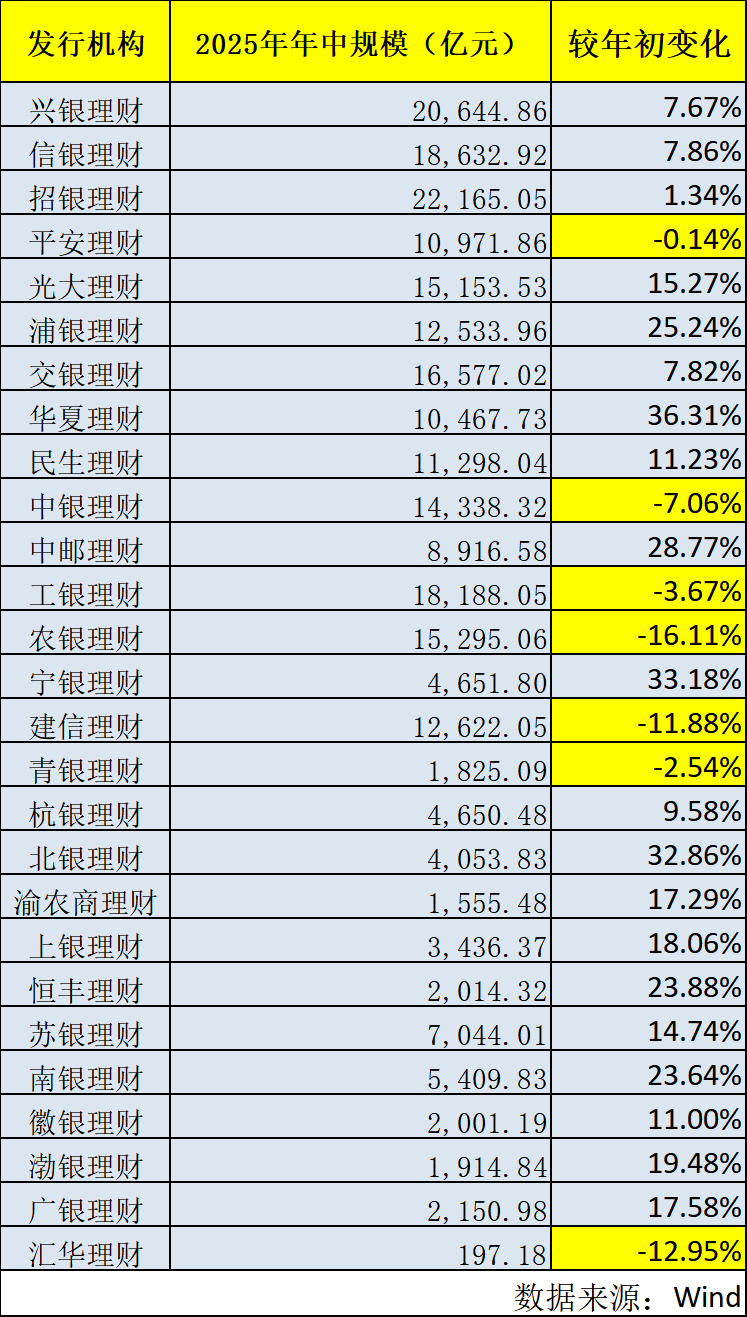
Core Insights - The performance of wealth management subsidiaries of listed banks has shown significant improvement in the first half of 2025, with 13 subsidiaries managing over 1 trillion yuan, including Huaxia Wealth Management entering the "trillion club" [1][3] - Among the 22 wealth management subsidiaries that disclosed their performance, 15 reported positive net profit growth, with 9 achieving double-digit year-on-year growth [1][6] Wealth Management Scale - As of June 30, 2025, 13 wealth management subsidiaries have surpassed 1 trillion yuan in assets under management, with 2 subsidiaries entering the "2 trillion club" [3] - Huaxia Wealth Management experienced a 36.31% increase in management scale compared to the beginning of the year, making it the fastest-growing company in this regard [3] - 14 out of 27 wealth management subsidiaries achieved double-digit growth in management scale, representing 51.8% of the total [3] Profitability - In terms of profitability, 15 out of 22 wealth management subsidiaries reported positive year-on-year net profit growth, accounting for 68.18% [7][9] - Five companies, including Bank of China Wealth Management and Yunnan Rural Commercial Bank Wealth Management, reported net profit growth exceeding 20% [7] - The standout performer was Pudong Development Bank Wealth Management, with a remarkable 76.19% year-on-year net profit growth [7][9] Performance by Institution - The top three wealth management subsidiaries by net profit in the first half of 2025 were: 1. China Merchants Bank Wealth Management with a net profit of 1.364 billion yuan, down 5.74% year-on-year 2. Bank of China Wealth Management with a net profit of 1.358 billion yuan, up 22.23% year-on-year 3. Agricultural Bank of China Wealth Management with a net profit of 1.273 billion yuan, up 13.66% year-on-year [9]
银行理财子公司,近七成公司净利润增速为正
中国基金报· 2025-09-07 13:42
【 导读 】近七成银行理财子公司净利润增速为正,管理规模持续提升 中国基金报记者 嘉合 | 发行机构 | 2025年年中规模(亿元) | 较年初变化 | | --- | --- | --- | | | | 7.67% | | 兴银理财 | 20, 644. 86 | | | 信银理财 | 18, 632. 92 | 7.86% | | 招银理财 | 22, 165. 05 | 1.34% | | 平安理财 | 10, 971. 86 | -0.14% | | 光大理财 | 15, 153. 53 | 15.27% | | 浦银理财 | 12, 533. 96 | 25.24% | | 交银理财 | 16, 577. 02 | 7.82% | | 华夏理财 | 10, 467. 73 | 36.31% | | 民生理财 | 11, 298. 04 | 11.23% | | 中银理财 | 14, 338. 32 | -7.06% | | 中邮理财 | 8, 916. 58 | 28.77% | | 工银理财 | 18, 188. 05 | -3.67% | | 农银理财 | 15, 295. 06 | -16.1 ...

上半年24家理财子净利156亿,“存款搬家潮”下有黑马规模增近5倍
Di Yi Cai Jing· 2025-09-07 13:09
Core Insights - The bank wealth management market experienced fluctuations in the first half of 2025, with a recovery starting in the second quarter, leading to a total market size of 30.67 trillion yuan by the end of June, a 2.38% increase from the beginning of the year [1][4] - The performance of wealth management companies showed significant divergence, with 24 companies reporting a combined net profit of 156.67 billion yuan, indicating a "stronger getting stronger" trend in the industry [2][3] - The shift towards equity and gold investments is becoming a new focus for asset allocation, driven by declining deposit rates and increasing investor sensitivity to returns [8][9] Market Performance - By the end of June, the number of wealth management products reached 27,480, with a total size of 27.48 trillion yuan, reflecting a 4.44% increase from the beginning of the year and a 12.98% year-on-year growth [4][5] - The top wealth management companies, such as 招银理财 (Zhaoyin Wealth Management) and 兴银理财 (Xingyin Wealth Management), reported net profits exceeding 10 billion yuan, while some smaller firms faced significant declines [2][5] Profitability Trends - The profitability of wealth management companies is increasingly polarized, with some firms achieving substantial growth while others, like 平安理财 (Ping An Wealth Management), reported a 41.28% decline in net profit [3][6] - The pressure on profitability is attributed to factors such as the ceiling effect on scale and the trend of reducing management fees, which compresses revenue [3][6] External Factors - The influx of funds into the wealth management market is driven by the declining willingness of residents to save due to lower deposit rates, creating a "price comparison effect" that encourages investment in higher-yield products [8][9] - Foreign wealth management firms are gaining traction in the market, with significant growth rates reported, such as 法巴农银理财 (Société Générale) achieving a nearly fivefold increase in scale [5][6] Investment Strategies - Wealth management companies are advised to diversify their product offerings and enhance risk management capabilities to adapt to market volatility and changing investor preferences [8][9] - The focus on equity investments is expected to grow, although the current allocation remains low, with only 0.07 trillion yuan in equity products by the end of June [8][9]
“万亿俱乐部”扩容!理财公司半年报出齐
Zhong Guo Zheng Quan Bao· 2025-09-07 10:05
Core Insights - The performance report of 32 bank wealth management companies for the first half of the year has been released, showing significant growth in the wealth management product scale of several institutions [1][2]. Group 1: Wealth Management Product Scale - As of the end of June, the top three wealth management companies by product scale are: China Merchants Bank Wealth Management (2.46 trillion yuan), Industrial Bank Wealth Management (2.30 trillion yuan), and Xinhua Wealth Management (2.11 trillion yuan) [2]. - China Post Wealth Management has achieved over 18% growth, entering the "trillion club," expanding the number of members to 13 [2]. - The wealth management product scale of city commercial banks has generally shown strong growth, with several institutions achieving double-digit increases compared to the beginning of the year [3]. Group 2: Changes in Investment Strategies - Despite a high level of activity in the equity market, many bank wealth management companies have seen a decline in the scale of equity products, while some, such as Xinhua Wealth Management and China Post Wealth Management, have experienced positive growth [4]. - The total scale of mixed products has seen a slight increase, with Industrial Bank Wealth Management's related products nearly doubling in scale since the beginning of the year [4]. - The demand for index-based investments is increasing, with institutions like China Merchants Bank Wealth Management launching proprietary indices to diversify risk and seek cross-cycle returns [4][5].
投顾周刊:主动权益基金发行升温
Wind万得· 2025-09-06 22:28
Group 1 - The issuance of actively managed equity funds has increased, with some products raising over 5 billion yuan in a single day. The recent performance recovery of the A-share market has contributed to this trend, with the newly launched招商均衡优选混合基金 expected to become the largest actively managed equity fund of the year with a fundraising cap of 50 billion yuan [2][3] - Four tax exemption policies have been introduced to enhance the social security fund, effective from April 1, 2024. These include exemptions on VAT for interest income from loans, non-taxable income from the transfer of state-owned equity, and exemptions on stamp duty for the transfer of non-listed state-owned equity [2][3] Group 2 - In the first half of 2025, 28 public fund companies reported their performance, with 易方达基金 leading with a net profit of 1.877 billion yuan. A total of 8 companies reported revenues exceeding 1 billion yuan, and 11 companies reported net profits over 100 million yuan [3][4] - The management fee income of the public fund industry grew by 1.37% year-on-year, totaling 62.313 billion yuan, although it decreased by 89.92 billion yuan compared to the same period before the fee rate reform in July 2023 [4] Group 3 - South Korea plans to establish a 1 trillion won (approximately 716 million USD) fund to support key industries affected by US tariffs, with over 60% of the funds allocated to the automotive, petrochemical, and steel manufacturing sectors [5] - Hedge funds are adopting a cautious stance as September historically poses challenges for the US stock market, with the Dow Jones average declining by 1.1% in September [5] Group 4 - Recent global stock market performance has been mixed, with the Hang Seng Index rising by 1.36%, while the Shanghai Composite Index and Shenzhen Component Index fell by 1.18% and 0.83%, respectively [6] - In the bond market, the yield on 1-year Chinese government bonds rose by 2.61 basis points, while the yields on 5-year and 10-year bonds fell by 2.01 and 1.19 basis points, respectively [6][9] Group 5 - In the recent week, the issuance of bank wealth management products was dominated by fixed-income products, with 301 fixed-income plus products accounting for 49.10% of the total number and 369.97 billion yuan, or 58.78%, of the total scale [12][13] - Bank wealth management subsidiaries led the market with 456 new products, representing 74.39% of the total number and 607.86 billion yuan, or 96.57%, of the total scale [14][15] Group 6 - Recent employment data from the US Labor Department indicated that only 22,000 jobs were added in August, significantly below the expected 70,000, with the unemployment rate rising to 4.3%, the highest since 2021. This has strengthened the market's expectation for a potential interest rate cut by the Federal Reserve [18] - Gold prices surged, breaking the 3,600 USD per ounce mark, driven by expectations of monetary easing and safe-haven demand, with forecasts suggesting gold could reach 4,000 USD per ounce by mid-2026 [18][19][20]


有产品年内赚超40%,理财再现高收益!入手前先看懂这些!
Nan Fang Du Shi Bao· 2025-09-05 06:02
Core Viewpoint - The article discusses the rising trend of high-yield wealth management products in a low-interest-rate environment, highlighting the performance of equity and mixed-asset products that have achieved significant returns this year [2][3][9]. Group 1: High-Yield Wealth Management Products - Nearly a hundred wealth management products have achieved double-digit growth in annual returns this year, with some products from institutions like 招银理财 yielding over 40% [2][3]. - The majority of high-yield products are equity or mixed-asset products, with equity allocations often exceeding 50%, and in some cases, over 90% [3][7]. - As of August, the average annualized return for wealth management products was 2.12%, down 0.53 percentage points from the end of last year, making the performance of equity and mixed-asset products particularly notable [3]. Group 2: Market Trends and Institutional Behavior - The low-interest-rate environment is prompting institutional investors, such as insurance companies, to increase their allocations to equities to enhance investment returns [5][6]. - 宁银理财 has actively participated in new stock subscriptions, leading the banking wealth management sector in the number of products involved in IPOs [6][7]. - The shift towards equity investments is becoming a consensus among wealth management companies as traditional fixed-income products face declining yields [5][6]. Group 3: Investor Considerations and Risk Awareness - Investors are advised to understand the inherent risks associated with high-yield products, as those with returns exceeding 20% often experience maximum drawdowns of over 10% [8][9]. - 宁银理财 emphasizes the importance of assessing individual risk tolerance and understanding the characteristics of the products before investing [9]. - The company has developed a diverse product line covering various risk levels to cater to different investor needs, highlighting the importance of appropriate asset allocation [9].

存续规模分化!理财公司如何应对“存款搬家”?
Guo Ji Jin Rong Bao· 2025-09-04 14:58
Core Insights - The performance of bank wealth management institutions in the first half of the year shows significant differentiation in product management scale, with joint-stock and state-owned banks leading the market [1][3] - The industry landscape is characterized by "head concentration, foreign capital rise, and regional differentiation," with top banks demonstrating clear advantages [1][4] - The total outstanding scale of wealth management products in China reached 30.67 trillion yuan, reflecting a 2.38% increase from the beginning of the year and a 7.53% year-on-year growth [4] Product Management Scale - Joint-stock bank wealth management subsidiaries dominate the top three positions in product management scale, with figures exceeding 2 trillion yuan: 2.46 trillion yuan for China Merchants Bank, 2.32 trillion yuan for Xinyin Wealth Management, and 2.13 trillion yuan for XinYin Wealth Management [3] - There are 13 members in the "trillion club," including 6 state-owned and 7 joint-stock bank wealth management subsidiaries [3] - Some local bank wealth management subsidiaries have significantly lower scales, with Qingyin Wealth Management at 189.48 billion yuan [3] Profitability - The top three wealth management companies by net profit are China Merchants Bank Wealth Management (1.364 billion yuan), Bank of China Wealth Management (1.358 billion yuan), and Agricultural Bank of China Wealth Management (1.273 billion yuan) [3] - A total of 20 wealth management companies reported a combined net profit of 15.179 billion yuan for the first half of the year [3] Investment Focus - Wealth management companies are focusing on supporting the real economy, developing ESG (Environmental, Social, and Governance) initiatives, and expanding distribution channels [5][6] - For instance, China Merchants Bank reported that its wealth management assets supporting the real economy amounted to 1.93 trillion yuan [5] - Ping An Wealth Management indicated that by June 2025, it had provided over 280 billion yuan in funding to the real economy and over 110 billion yuan for ESG initiatives [5] Distribution Channel Expansion - Companies like Xinyin Wealth Management and Minsheng Wealth Management have reported successful expansion of their distribution channels [6] - Xinyin Wealth Management has established over 540 partnerships with small and medium-sized banks, with a distribution balance of 237.963 billion yuan, an increase of 47.801 billion yuan from the previous year [6] - Minsheng Wealth Management added 20 new distribution institutions, with off-balance sheet distribution growing by 46.37% compared to the previous year [6] Strategic Recommendations - In the context of "deposit migration," wealth management companies are advised to enhance collaboration across product, channel, and service dimensions [6] - Product strategies should focus on tiered design to meet diverse needs, balancing stable performance with opportunities in the equity market [6] - Channel strategies should leverage local banks' advantages to penetrate broader customer bases, while service strategies should aim to attract potential clients through reduced fees and enhanced investor education [6]
金价创新高后,黄金理财“热浪”再起
2 1 Shi Ji Jing Ji Bao Dao· 2025-09-04 13:18
Core Viewpoint - The recent surge in gold prices has prompted banks to launch gold-linked financial products, reflecting increased investor interest and demand for gold as a hedge against risk [1][2][3]. Group 1: Gold Price Trends - Gold prices have reached new highs, with London gold hitting $3546.9 per ounce on September 3, surpassing the critical $3500 mark [1]. - The price of gold has shown a consistent upward trend this year, driven by factors such as rising expectations of interest rate cuts by the Federal Reserve and increased gold purchases by global central banks [3][6]. - After a period of steady increase, gold prices experienced a correction starting in May, dropping to $3328.16 per ounce by May 31, with many investors taking profits [4]. Group 2: Financial Products and Investment Strategies - Banks are offering two main types of gold-linked financial products: "fixed income plus" products, which typically allocate around 5% to gold-related assets, and structured products linked to gold derivatives [1][2]. - As of now, there are 16 gold-linked financial products available in the market, indicating a growing trend among financial institutions to incorporate gold into their offerings [1]. - Despite the recent price increases, financial institutions maintain a cautious stance, suggesting that while gold remains a valuable asset for long-term investment, there is no immediate urgency to buy at current high levels [8]. Group 3: Long-term Outlook for Gold - Analysts predict that gold will continue to appreciate in the long term due to factors such as the declining status of the US dollar as a global reserve currency and ongoing central bank purchases of gold [8]. - UBS Wealth Management has raised its gold price forecasts for 2026, indicating a bullish outlook with target prices of $3600 and $3700 per ounce for March and June 2026, respectively [5]. - The current high level of actual US interest rates, close to 2%, suggests that gold's return potential may be limited in the short term, but its role as a risk-hedging asset will remain significant [8].
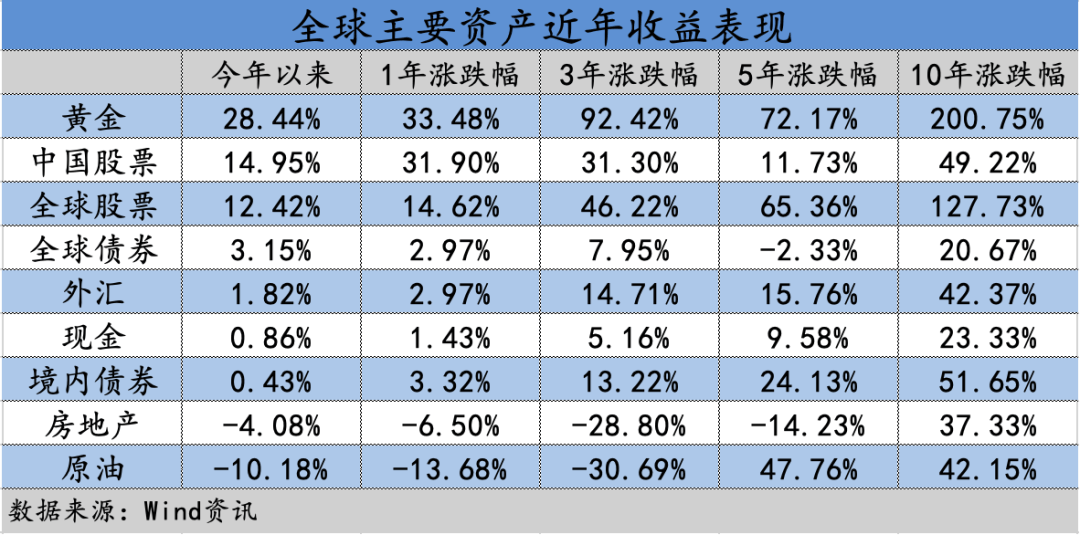
黄金涨疯了,但多数人已提前下车
Sou Hu Cai Jing· 2025-09-04 12:03
Core Insights - Bridgewater's products have achieved a remarkable return of 47% from early 2023 to the end of 2024, significantly outperforming the Shanghai Composite Index, which only rose by 7.3% during the same period [1] - Gold has played a crucial role in Bridgewater's all-weather strategy, contributing significantly to its performance amid rising inflation and low growth [2] Group 1: Bridgewater Fund Performance - Bridgewater's Chinese products have seen substantial returns, with gold contributing at least 21.62% to the fund's performance from mid-2022 to the end of 2023, while the Shanghai Composite Index fell by 12.51% [4] - The fund's gold holdings reached 14% in its recently listed ETF, serving as a hedge against inflation and economic downturns [4][5] Group 2: Gold Investment Trends - The global demand for gold investment surged, with a 118% year-on-year increase in total investment demand, reaching 1,029 tons in the first half of the year [15] - In China, gold bar and coin sales reached 239 tons, marking the strongest performance since 2013, while gold ETFs saw a significant increase of 86.02 tons [16] Group 3: Asset Allocation Strategies - A growing number of domestic asset management institutions are incorporating gold into their investment strategies, with nearly 45% of FOF products holding gold ETFs [10] - Insurance companies are also beginning to allocate funds to gold, with some private products allocating up to 30% to gold [11][12] Group 4: Market Outlook - UBS has raised its gold price forecast for mid-2026 from $3,500 to $3,700 per ounce, citing lower opportunity costs for holding gold amid U.S. inflation and interest rate expectations [19] - The long-term annualized return of gold over the past 20 years is approximately 10%, influenced by global GDP and wealth growth [8]