光模块

Search documents
中信、华泰、国泰、广发等最新高目标价个股来啦!
私募排排网· 2026-03-03 07:00
Core Viewpoint - The article discusses the "spring market excitement" in February, highlighting a shift from speculative trading to performance-driven investment opportunities as analysts adjust target prices for stocks ahead of annual reports [2]. Group 1: Analyst Reports and Target Prices - As of the end of February, 17 domestic brokerages covered 597 listed companies, with 184 stocks receiving target prices, and 14 stocks having target price upside exceeding 50% [2]. - Citic Securities identified price increases as a key investment theme for the first quarter, with a focus on companies like Huasheng Lithium Battery, which has a target price of 175 CNY compared to a closing price of 109.71 CNY, indicating a potential upside of 59.51% [3][4]. - Guotai Junan highlighted emerging technology as a main investment theme, with stocks like XGIMI Technology showing a target price of 153.19 CNY against a closing price of 95.15 CNY, representing a 61% upside [7][10]. Group 2: High Target Price Stocks - Huatai Securities reported that Fulian Precision has the highest target price upside at 63.49%, with a target price of 29.38 CNY compared to a closing price of 17.97 CNY [11][12]. - According to GF Securities, China Automotive Research has a target price of 30.3 CNY, with a closing price of 20 CNY, indicating a 51.50% upside potential [15][17]. - Huachuang Securities maintains a positive outlook on Kweichow Moutai, setting a target price of 2600 CNY against a closing price of 1455.02 CNY, suggesting a significant upside of 78.69% [18][19]. Group 3: Market Trends and Insights - The article notes that the A-share market is primarily driven by manufacturing and finance, with a relatively stable sentiment despite external pressures from AI impacts [3]. - Analysts expect the spring market rally to continue, with a focus on price increases and performance-driven investments as key themes for the upcoming period [3][11].


第一创业晨会纪要-20260303
First Capital Securities· 2026-03-03 04:05
Group 1: Industry Overview - The semiconductor industry is expected to maintain a high growth trend, driven by increased demand for optical modules, as evidenced by NVIDIA's investment of $2 billion each in Lumentum Holdings Inc. and another company to support new product development [4] - Price increases in the semiconductor sector are becoming widespread, with companies like STMicroelectronics raising prices by 20% for certain products due to rising raw material costs [4] Group 2: Company Performance - Ninebot Company reported a revenue of 21.325 billion yuan for 2025, a year-on-year increase of 50.2%, and a net profit of 1.755 billion yuan, up 61.8% year-on-year, driven by strong sales in electric two-wheelers and service robots [7] - The company faced temporary profit pressure in Q4 2025 due to currency exchange losses and tax provisions, but anticipates a recovery in Q2 2026 with plans to launch new electric products [7] Group 3: Cosmetics Industry Insights - The cosmetics industry in 2025 showed moderate domestic demand recovery and strong export performance, with retail sales reaching 465.3 billion yuan, a year-on-year increase of 5.1% [8] - The total import and export value of cosmetics was $24 billion, with exports at $7.82 billion, reflecting a year-on-year increase of 9.2%, indicating a robust growth trajectory in emerging markets [8]
大摩闭门会:全球AI与中国两会的新看点
2026-03-03 02:53
Summary of Key Points from the Conference Call Industry and Company Involvement - The conference discusses the impact of geopolitical tensions, particularly the U.S.-Iran military actions, on global oil markets and the implications for various industries, including technology and AI [1][2][3][4][5][6][7][8][9][10][11][12][13][14][15][16][17][18][19][20][21][22][23][24][25][26][27][28][29][30][31][32][33][34][35][36][37][38][39][40][41][42][43][44][45][46][47][48][49][50][51][52][53][54][55][56][57][58][59][60][61][62][63]. Core Insights and Arguments Geopolitical Impact on Oil Markets - The U.S.-Iran military actions are expected to create short-term risk premiums in oil prices but are not anticipated to lead to a long-term supply shock [2][3][4][5][6][7]. - The Strait of Hormuz remains operational, with only minor disruptions in oil transport, and the likelihood of a complete closure is low due to mutual interests in maintaining open trade routes [6][7][8][9][10]. - Current estimates suggest a potential reduction in global oil supply by 2 to 3 million barrels per day, but this is viewed as a manageable concern rather than a panic situation [9][10][11]. Economic Implications - Rising oil prices could increase global CPI by 0.3 to 0.7 percentage points, with varying impacts across Asian countries; Indonesia, Malaysia, and Thailand are expected to experience the most significant inflationary pressures [10][11][12]. - The U.S. Federal Reserve's interest rate policies may be influenced by rising inflation due to oil price increases, but a long-term easing trend is still expected [11][12][13][14]. - Asian central banks are likely to adopt a dovish stance, tolerating higher inflation without tightening monetary policy, while emerging markets like Indonesia and India may delay rate cuts due to inflation concerns [12][13][14]. AI and Geopolitical Dynamics - AI is becoming a central element in global geopolitical strategies, with the U.S. aiming to establish AI as a new anchor for global power dynamics, similar to the post-WWII dollar system [15][16][17][18][19]. - The U.S. is promoting a framework for AI sovereignty among its allies, emphasizing integration into the U.S. AI ecosystem to secure technological advantages and supply chain control [16][17][18]. - Concerns exist among developing countries regarding reliance on U.S. AI models due to data sovereignty issues, highlighting a potential divide in global AI adoption [17][18][19][20]. Investment Opportunities and Risks - The conference emphasizes the importance of focusing on companies that possess unique physical assets and technological advantages in the AI race, particularly in hardware and infrastructure [27][28]. - The Chinese market is currently facing challenges, with the Hang Seng Tech Index underperforming compared to other emerging markets, attributed to a lack of consumer growth and reliance on technology innovation [29][30][31][32][33][34]. - The upcoming Chinese Two Sessions are expected to set the tone for fiscal and industrial policies, with a focus on technology and infrastructure investment [57][58][59][60][61][62][63]. Other Important but Overlooked Content - The conference highlights the need for a nuanced understanding of market dynamics, particularly the differentiation between sectors and the impact of geopolitical events on investment strategies [25][26][27][28][29][30][31][32][33][34][35][36][37][38][39][40][41][42][43][44][45][46][47][48][49][50][51][52][53][54][55][56][57][58][59][60][61][62][63]. - The discussion also touches on the potential for a "super cycle" in semiconductor and storage sectors, driven by significant growth expectations in emerging markets [36][37][38][39][40].
AAOI暴涨的背后和光模块观点更新
2026-03-01 17:22
Summary of AOI Conference Call Company Overview - **Company**: AOI - **Fiscal Year**: 2025 - **Revenue**: Approximately $456 million, a year-on-year increase of about 83%, marking a historical high [1][2] Key Financial Highlights - **Q4 Revenue**: Over $130 million, a year-on-year increase of 34% and a quarter-on-quarter increase of 13% [1][2] - **Gross Margin**: Approximately 31.2%, exceeding the upper limit of the guidance range [1][2] - **Cable Network Revenue**: Approximately $245 million, with a growth rate close to 200%, driven by high-power amplifiers [1][4] - **Data Center Revenue**: Approximately $75 million in Q4, a year-on-year increase of 69% and a quarter-on-quarter increase of 70% [1][4] Growth Drivers - **100G Product Growth**: Approximately 54% increase [4] - **400G Product Growth**: Year-on-year growth of about 141%, a key driver of unexpected growth in the data center business [4] - **800G Revenue**: Slightly below expectations due to design optimization delays, but the company remains optimistic about future demand [1][4] Future Outlook - **800G and 1.6T Production**: Expected to ramp up in 2026, with a potential supply-demand imbalance by 2027 [1][5] - **Production Capacity**: Plans to exceed 500,000 units per month by the end of 2026, with annual production exceeding 6 million units [2][5] - **Investment**: Over $300 million invested in the Texas facility to triple laser chip production capacity [2][5] Customer Concentration - **Customer Base**: First major customer accounts for approximately 53% of revenue, with Microsoft contributing about 28.8% [6] - **New Customer Development**: Significant potential for new customer acquisition, with ongoing certification processes for 800G and 1.6T products [6] Short-term and Mid-term Guidance - **Next Quarter Revenue**: Expected to be between $150 million and $165 million, a year-on-year increase of about 60% [7] - **2026 Full Year Revenue**: Expected to exceed $1 billion, with operating profit over $120 million [7] Long-term Revenue Projections - **Monthly Revenue Potential**: Estimated monthly revenue of approximately $378 million, with 800G contributing about $217 million and 1.6T about $71 million [8] - **Annual Revenue Projection**: Potential annual revenue of about $7.5 billion, indicating a significant increase compared to 2026 guidance [8] Market Conditions - **North American Cloud Spending**: No signs of a slowdown; demand for computational power remains strong [9] - **Industry Iteration**: The optical module market is experiencing rapid iteration, with expectations for large-scale procurement of 1.6T modules [9] Competitive Landscape - **Market Position**: Leading companies remain well-positioned due to strong R&D and technology reserves [9] - **Valuation**: Current valuations for leading companies are around 10 times earnings, presenting a compelling investment opportunity [9] Investment Sentiment - **Positive Outlook**: The strong demand signals and favorable market conditions support a positive investment stance on leading optical module companies like AOI, Xuchuang, and New Yisheng [10]

光模块市场大爆发,CPO威胁被高估了吗?
傅里叶的猫· 2026-03-01 15:30
Core Viewpoint - The AI optical module market is experiencing unprecedented growth, with the total addressable market (TAM) expected to surge from $18 billion in 2025 to $50 billion by 2028, representing a threefold increase in three years [3][4]. Market Growth - The demand for high-end optical modules (800G and 1.6T) is projected to increase from 20 million units in 2025 to 80 million units by 2028, quadrupling in four years [4]. - Major cloud computing companies are expected to invest between $735 billion and $795 billion in capital expenditures this year, a 60% year-on-year increase, significantly contributing to data center construction and optical module demand [4]. CPO Technology - Co-Packaged Optics (CPO) integrates optical engines directly into switch chip packaging, offering benefits like faster transmission speeds and lower power consumption, but faces significant technical challenges [6][7]. - CPO's five major technical bottlenecks include low manufacturing yield, heat dissipation issues, high costs, an immature supply chain, and maintenance challenges [7][8]. Scenarios for CPO Impact - Morgan Stanley outlines three scenarios for CPO's impact on traditional optical modules: - **Base Case**: CPO achieves manufacturing breakthroughs by 2027, with minimal demand dilution for traditional modules (3% in 2026, 11% in 2027, 16% in 2028) [9][10]. - **Optimistic Case**: CPO's large-scale application is delayed beyond 2028, allowing traditional modules to maintain over 70% market share [10]. - **Pessimistic Case**: CPO achieves breakthroughs in late 2026, with demand dilution of 21% in 2026, 32% in 2027, and 38% in 2028, yet traditional modules still retain 79% market share [11]. NPO as a Response - Near Packaged Optics (NPO) serves as a middle ground for traditional optical module manufacturers, allowing them to enhance performance without the complexities of CPO [15][16]. Data Center Trends - Three major trends are reshaping data center architecture: Scale-out, Scale-up, and Scale-across, driving the demand for optical modules [17][18][19]. - Scale-out involves connecting multiple GPU racks, with high-end optical module demand expected to rise from 20 million units in 2025 to 53 million in 2026, a 166% increase [18]. - Scale-up focuses on GPU interconnects within racks, with significant opportunities arising as copper cables approach their physical limits [19]. - Scale-across addresses the need for interconnectivity between data centers, with traffic share increasing from 5% to 20%, necessitating high-speed optical modules [21]. OCS as a Growth Engine - Optical Circuit Switching (OCS) is creating new demand for optical modules, with a projected market size of $2 billion by 2030, complementing AI optical modules rather than competing with them [24][25]. Company Analysis - In the traditional optical module sector, Eoptolink and Coherent are expected to be the biggest winners, with significant price target increases reflecting their growth potential [27][28]. - Lumentum's stock has surged over 900% in the past year, but its valuation may be overly optimistic given the expected earnings growth [28]. - The CPO supply chain is beginning to take shape, with companies like TSMC and ASE positioning themselves to benefit from future CPO applications [31][32]. PCB and Connector Impacts - The rise of CPO presents a mixed bag for the PCB industry, with some companies facing structural headwinds while others, like Bizlink, stand to benefit from the transition to Active Electrical Cables (AEC) [37][38]. Cloud Vendor Attitudes - Major cloud vendors are actively pursuing CPO technology, indicating a serious commitment to its development, although large-scale applications remain in the pilot phase [41][43].


通信行业周报:旭创发布业绩快报,关注3月GTC大会-20260301
SINOLINK SECURITIES· 2026-03-01 10:22
Investment Rating - The report indicates a positive outlook for the industry, suggesting a "Buy" rating based on expected growth exceeding the market by over 15% in the next 3-6 months [63]. Core Insights - NVIDIA reported a strong Q4 2025 performance with earnings per share of $1.62, surpassing analyst expectations by 5.81%, and revenue of $68.127 billion, exceeding forecasts by 3.22% [2]. - The company provided optimistic guidance for Q1 2026, projecting revenue of $78 billion, which is above analyst expectations [2]. - AMD has made significant strides in AI chip competition by signing a multi-year agreement with Meta to provide up to 6GW of AI computing power, indicating a growing global demand for computing power [2][7]. - OpenRouter data shows that during the week of February 9-15, 2026, the token usage of Chinese models surpassed that of U.S. models for the first time, highlighting the rapid growth of AI capabilities in China [3][52]. Summary by Sections Server Sector - The server index increased by 3.65% this week and 3.39% for the month, driven by AMD's agreement with Meta for AI computing power [3][7]. Optical Modules - The optical module index rose by 4.84% this week and 4.14% for the month, with NVIDIA's performance and guidance exceeding expectations, although market reactions were muted due to competitive concerns [3][10]. IDC (Internet Data Center) - The IDC index increased by 2.41% this week and 2.44% for the month, with significant growth in token usage for Chinese AI models, indicating a robust demand for domestic AI infrastructure [3][13]. Telecommunications - Telecommunications revenue reached 1.75 trillion yuan in 2025, showing a year-on-year growth of 0.7%, with a notable increase in capital expenditures from major tech companies [4][16]. Investment Opportunities - The report suggests focusing on sectors such as servers and IDC driven by domestic AI development, as well as optical modules benefiting from overseas AI advancements [5].



未知机构:上证综合指数SHCOMP017-20260228
未知机构· 2026-02-28 02:45
Summary of Key Points from Conference Call Records Industry Overview - The conference call discusses the performance of various stock indices in the Chinese market, including the Shanghai Composite Index (SHCOMP), SSE 50, CSI 300, STAR50, ChiNext, and CSI 500, indicating a mixed performance with the ChiNext index down by 1.46% and CSI 500 up by 0.19% [1][1][1]. Core Insights and Arguments - The overall market showed volatility with the SHCOMP hovering around the flat line before slightly declining near midday [1]. - The semiconductor sector underperformed in the morning session, although specific stocks like Cambrian (688256.SH) and Weir (688521.SZ) managed to gain, with increases of 1.17% and 5.63% respectively [1]. - The optical module (CPO) and PCB sectors experienced a pullback influenced by the weakness in US tech stocks, with companies like Zhongji Xuchuang (300308.SZ) and Shenghong Technology (300476.SZ) declining by 6.4% and 5.41% respectively [2]. - The rare earth sector gained attention due to reports of supply shortages affecting US aerospace and semiconductor suppliers, resulting in an approximate 6% increase in this sector [2]. - The software sector saw significant capital inflow, particularly benefiting cloud computing stocks [2]. - The electric power sector remains in focus, especially following reports of demands from Trump for tech giants to self-power AI data centers [2]. - Conversely, the beverage sector faced setbacks after Bloomberg reported potential higher taxes on high-sugar drinks, leading to a decline of 5.96% for Dongpeng Beverage (605499.SH) [2]. Additional Important Content - The overall selling pressure in the market was noted to be 1.4 times greater than buying pressure, indicating a bearish sentiment [3]. - Investment strategies were outlined, with a focus on buying in the electrical equipment, consumer electronics, and gaming sectors, while selling was recommended in AI data centers, semiconductors, and beverages [3].
港股收盘,恒生指数收跌1.44%,恒生科技指数收跌2.87%
Mei Ri Jing Ji Xin Wen· 2026-02-26 08:28
每经AI快讯,2月26日,港股收盘,恒生指数收跌1.44%,恒生科技指数收跌2.87%,电力、光模块、光 通信和半导体板块走强,东方电气涨超15%,剑桥科技涨8%,豪威集团涨超6%,长飞光纤涨近3%,兆 易创新涨逾3%。互联网科技股普遍走低,哔哩哔哩跌超4.5%,快手跌4%,阿里巴巴跌逾3.5%,腾讯控 股跌超2%。 ...
天孚通信暴涨9%市值首超2900亿元!高“光”创业板人工智能ETF华宝(159363)连续4日吸金超5亿
Mei Ri Jing Ji Xin Wen· 2026-02-26 05:14
Group 1 - The core viewpoint of the article highlights the strong performance of optical modules, particularly the leading company Tianfu Communication, which saw its stock price surge by 9%, pushing its market value to over 290 billion yuan, a new historical high [1] - The Huabao AI ETF (159363) experienced a rise of over 1.6% during trading, indicating strong investor interest, with net purchases exceeding 530 million yuan over four consecutive days [1] - The fund manager of the Huabao AI ETF, Cao Xuchen, emphasized that optical modules represent a clear industrial trend, benefiting from a loose liquidity environment, which is likely to lead to upward performance in both earnings and valuations [1] Group 2 - The article notes that as AI development shifts from computing power construction to application implementation, the Huabao AI ETF and its related products are positioned to directly benefit from the commercial explosion of AI technology [1] - The investment strategy of the Huabao AI ETF allocates approximately 60% of its portfolio to computing power (including leading optical module and IDC companies) and about 40% to AI applications, indicating a balanced approach between core computing and actual AI application representation [1]

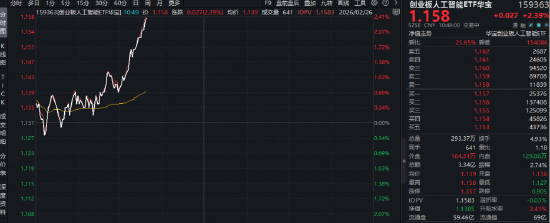
快速攀升!创业板人工智能ETF(159363)逆市上涨2%!英伟达财报大超市场预期,天孚通信再创历史新高!
Xin Lang Cai Jing· 2026-02-26 03:05
Group 1 - Nvidia's latest earnings report exceeded market expectations, with Q4 revenue for fiscal year 2026 reaching $68.1 billion, a significant year-on-year increase of 73%, surpassing the forecast of $65.684 billion [2][10] - The strong performance alleviated market concerns regarding an "AI bubble," demonstrating sustained demand for AI technologies [4][10] - Nvidia's CEO highlighted exponential growth in computing demand, indicating a pivotal moment for AI applications in enterprises [10] Group 2 - The AI-focused ETF (159363) saw a price increase of 2.39% on February 26, driven by preemptive investments, with a total inflow of 532 million yuan over the previous four days [1][7] - Key stocks within the ETF, such as Tianfu Communication, surged over 9%, reaching a new historical high, while other companies like Xingchen Technology and Runze Technology also posted significant gains [3][12] - The ETF's portfolio is approximately 60% allocated to computing power (including leading optical module companies) and 40% to AI applications, positioning it to benefit from the commercialization of AI technologies [10] Group 3 - The demand for high-speed, low-latency internal communication is experiencing explosive growth due to AI computing clusters, positively impacting domestic optical module leaders like Zhongji Xuchuang, Tianfu Communication, and Xinyi Sheng [10] - The ETF and its associated funds are expected to directly benefit from the growth dividends of AI technology commercialization [10]