
外贸

Search documents
新疆外贸何以实现“四连跳”?
Xin Lang Cai Jing· 2026-01-30 11:27
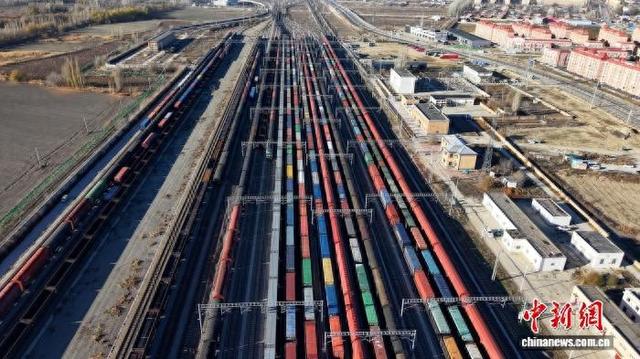
Core Viewpoint - Xinjiang's foreign trade has shown significant growth during the "14th Five-Year Plan" period, achieving milestones of 200 billion, 300 billion, 400 billion, and 500 billion yuan, with an average annual growth rate remaining high, indicating a positive trend and accelerated pace in foreign trade [1] Logistics Channel Efficiency - The logistics channels in Xinjiang have been enhanced, with the region being strategically positioned as a gateway for western openness, leading to improved traffic networks and customs efficiency [1] - A reform in the "road port + local direct access model" has reduced the time for vehicles to exit from the Urumqi International Land Port to the Alashankou Port from 2-3 days to as little as 4 hours, implemented in 13 road ports [2] - During the "14th Five-Year Plan," Xinjiang's import and export cargo volume has grown at an average rate of 7.8%, ranking first among the five provinces in Northwest China, with over half of the China-Europe freight trains departing from Xinjiang [2] Industrial Structure Optimization - Xinjiang's foreign trade growth is supported by an optimized industrial structure, shifting from energy and raw materials to high-tech and high-value-added processed products [2] - In 2025, Xinjiang is projected to export 186.5 billion yuan worth of electromechanical products, with significant growth in automotive parts (16.7%), electrical equipment (22.1%), and electronic components (48.1%) [3] Expansion of Trade Partnerships - Xinjiang's foreign trade network is expanding, with rapid customs clearance for agricultural products from Central Asian countries, enhancing the variety of goods available to consumers [6] - New foreign trade models, such as global bonded maintenance and market procurement, are emerging, leading to an optimized trade structure and a collaborative trend between industry and trade [6] Business Environment Improvement - The business environment in Xinjiang is being enhanced through reforms and digitalization, which improve service efficiency and facilitate international trade [7] - The establishment of a "single window" for international trade and various digital platforms has made foreign trade more convenient and efficient, reducing operational costs for businesses [7] - Xinjiang aims to transition towards a dual-driven model of "institutional openness" and "integrated trade and investment," promoting steady growth in foreign trade scale and diversity [7]

广东人大会议:各大省直部门一把手围绕“增创新优势、实现新突破”主题,总结十四五 展望十五五
Zhong Guo Fa Zhan Wang· 2026-01-29 07:05
Group 1: Economic Development and Employment - Guangdong aims to invest more in human resources, emphasizing that the greatest investment potential lies in people, with over 7 million new urban jobs created during the 14th Five-Year Plan period [1] - The province plans to implement a series of measures to enhance social welfare, including expanding employment support for key groups such as college graduates and veterans [1][2] - By 2025, Guangdong's foreign trade is projected to reach 9.49 trillion yuan, with a growth rate of 4.4%, maintaining its position as the largest in the country for 40 consecutive years [7][8] Group 2: Education and Health - Guangdong will improve the allocation of educational resources to adapt to population changes, expand inclusive preschool education, and enhance the quality of compulsory education [2] - The province is committed to strengthening healthcare infrastructure and expanding access to quality medical resources, while also addressing aging and declining birth rates [2] Group 3: Industrial Development - Guangdong is focusing on high-quality development in manufacturing, with over 76,000 industrial enterprises and an expected revenue exceeding 19 trillion yuan, contributing approximately 50% to GDP growth [2][3] - The province plans to support traditional, emerging, and future industries, with a focus on sectors like new energy, smart vehicles, and biotechnology, aiming to create significant industrial clusters [3][4] Group 4: Technological Innovation - Guangdong is enhancing cross-border collaboration in technology innovation, with over 6 billion yuan in research funding allocated to Hong Kong and Macau, and the establishment of high-level innovation platforms [4][5] - The province aims to build a globally competitive open innovation ecosystem, fostering collaboration in education and technology talent development with Hong Kong and Macau [5] Group 5: Agricultural Development - Guangdong has completed a comprehensive survey of agricultural genetic resources, collecting 368,000 samples, and is focusing on the revitalization of seed industries to support local economic development [6][7] - The province has achieved significant breakthroughs in key agricultural technologies, including the development of new rice varieties and advancements in aquaculture breeding [6] Group 6: Foreign Trade and Market Expansion - Guangdong is actively promoting high-quality foreign trade development, with plans to organize over 300 overseas exhibitions to help more than 26,000 companies explore international markets [8][9] - The province is also focusing on expanding imports and fostering new trade dynamics, with initiatives to strengthen major import bases and support small and medium-sized foreign trade enterprises in digital transformation [8][9]
代表委员热议广货:如何在全球市场中更具竞争力
Sou Hu Cai Jing· 2026-01-29 06:26
Core Insights - The article discusses the transformation of "Guangdong goods" from merely exporting products to exporting capabilities, emphasizing the need for localization and resilience in supply chains to enhance global competitiveness [1]. Group 1: Localization and Market Adaptation - Companies are encouraged to fully embrace localization by forming market teams that understand local environments, consumer habits, and aesthetic preferences to ensure products are well-suited for their markets [4]. - The shift from "going out" to "integrating in" is highlighted, with companies establishing R&D centers in countries like the USA and Japan, and production bases in Indonesia and Brazil to align with local market needs [4][5]. Group 2: Supply Chain Resilience - A resilient global supply chain is essential for companies to mitigate trade risks and ensure stable and efficient global supply [5]. - Logistics companies are advised to develop integrated, digital, and intelligent global supply chain networks to support the export of Guangdong products [10][11]. Group 3: Technological Innovation - The integration of AI technology in traditional products, such as smart air conditioners, is seen as a way to enhance the appeal of Guangdong goods in the global market [4]. - The 3D printing industry is identified as a rapidly growing sector, with predictions that its market size will exceed 70 billion yuan by 2025, indicating strong export potential [14]. Group 4: Industry Diversification and New Markets - Companies are encouraged to diversify their product lines and explore emerging markets, such as the Middle East and South America, to adapt to changing global demands [24]. - The article notes the importance of monitoring new industry trends, such as electric vehicles and artificial intelligence, to stay competitive in international markets [24]. Group 5: Financial Support and Risk Management - The Guangdong government is increasing support for export credit insurance to help companies manage risks and enhance their competitiveness in global markets [32]. - Financial strategies should focus on integrating risk management and financing to bolster companies' capabilities in international trade [32].

杭州海关数智赋能外贸新发展
Mei Ri Shang Bao· 2026-01-28 23:32
Core Insights - The "Red Boat Enterprise Navigation" service platform, developed by Hangzhou Customs, aims to address the pain points of enterprises in applying customs policies through a smart service system that integrates policy delivery, efficient response, and one-stop services [1] Group 1: Policy Delivery and Matching - The platform utilizes AI algorithms to create precise profiles of enterprises based on core data such as import/export goods and trade countries, enabling a shift from a traditional policy supply model to a proactive service model where policies are delivered directly to enterprises [2] - The platform has integrated 6,870 customs policies and has successfully reached over 90,000 enterprises, resolving nearly 200 urgent issues [1][2] - For example, the platform helped Yimei Daily Chemical Co., Ltd. navigate new certification processes in Indonesia, allowing them to avoid export complications [2] Group 2: Efficient Problem Resolution - The platform has established a mechanism for rapid response to enterprise requests, combining online intelligence and offline collaboration to resolve issues across regions and departments [3] - An example includes Su Bor's urgent request to avoid demurrage fees due to shipping delays, which was resolved within 24 hours through coordination with local customs [3] - The platform has also organized over 30 enterprise support activities, reaching more than 2,000 companies to extend its services throughout the foreign trade chain [3] Group 3: Integrated Service Features - The platform continues to evolve by integrating various service modules, such as a "service direct" feature and a "credit management" function that provides timely reminders for enterprises [4] - The "Customs Toolbox" feature allows enterprises to access various digital tools for customs-related queries, significantly improving the efficiency of customs processes [4] - Future plans for the platform include enhancing policy delivery accuracy, response speed, and service coverage to become a trusted digital partner for foreign trade enterprises in Zhejiang [4]
外部环境扰动南亚中小国家经济
Jing Ji Ri Bao· 2026-01-28 21:58
Economic Overview - Bangladesh and Nepal are set to hold elections in February and March 2026, respectively, with economic growth reforms being a primary focus for the new governments [1] - Sri Lanka is experiencing a mild economic recovery, but continues to face internal and external pressures [1] Bangladesh Economic Insights - Bangladesh's GDP growth rate is projected to reach 4.6% for the fiscal year 2025-2026, an increase of 0.9 percentage points from the previous fiscal year [1] - If structural reforms are effectively implemented by the new government, GDP growth could accelerate to 6.1% in the fiscal year 2026-2027 [1] - Exports are expected to reach $48 billion in fiscal year 2025, following two years of decline, but will face challenges in fiscal year 2026 due to global demand fluctuations and the effectiveness of government reforms [1] - Inflation decreased from 11% in August 2024 to 8% in December 2025, with the central bank targeting a reduction to 7% for fiscal year 2026 [1] Foreign Exchange Reserves - As of December 2025, Bangladesh's foreign exchange reserves increased to $32.57 billion, a 30% rise from $25 billion in August 2024, sufficient to cover three months of import payments [2] - Continued growth in remittances and exports, along with effective financial reforms, could stabilize foreign exchange reserves in fiscal year 2026 [2] Challenges Facing Bangladesh - Export pressures are evident due to weak global demand and increased tariffs from the U.S., leading to a 2.19% year-on-year decline in exports from July to December 2025 [3] - The banking sector is under strain, with non-performing loan rates exceeding 20% and reaching a historical peak of nearly 36% [3] - Government debt exceeds 20% of GDP, with projections indicating a potential rise above 40% if the local currency depreciates by 10% [3] Nepal Economic Insights - Nepal's GDP growth is expected to decline to 2.1% for the fiscal year 2025-2026 due to political instability and social unrest [4] - If the elections in March 2026 proceed smoothly, growth could rebound to 4.7% in the following fiscal year [4] - The tourism sector, a key economic pillar, has been severely impacted by recent unrest, affecting consumer and investor confidence [4] Inflation and Fiscal Situation in Nepal - Inflation is projected to remain below 3% in fiscal year 2026, which is below the central bank's target [4] - Increased government spending in preparation for the elections may lead to a wider fiscal deficit, but current debt levels remain manageable at around 45% of GDP [5] Sri Lanka Economic Insights - After a strong recovery in 2024, Sri Lanka's GDP growth rate fell to 3.5% in 2025, with a cautious outlook for 2026, projected at 3.1% [6] - Inflation has been controlled, with core inflation dropping from over 50% in September 2022 to 2.7% in December 2025, providing the central bank with more policy space [6] - Export growth for Sri Lanka is expected to decline to around 3.8% in 2026 due to global economic slowdowns and reliance on a narrow export base [7] Debt and Financial Management in Sri Lanka - Government debt reached 96% of GDP by the end of 2025, with significant repayment obligations ahead [7] - The IMF has committed $2.9 billion in loans, with ongoing negotiations for debt restructuring with various bilateral creditors [7] - A national productivity plan aims to shift the economy towards a productivity-driven, export-oriented growth model from 2024 to 2029 [8]
建睿智之言 尽务实之力为谱写中国式现代化青海篇章贡献更多聪明才智
Xin Lang Cai Jing· 2026-01-28 21:00
本报讯(记者 薛军)1月28日上午,省委副书记、省长罗东川参加省政协十三届四次会议工商联界经济 界联组讨论。强调要以习近平新时代中国特色社会主义思想为指导,全面贯彻落实党的二十届四中全会 和中央经济工作会议精神,按照省委工作要求,建睿智之言、尽务实之力,在围绕中心、服务大局、履 职为民中,为谱写中国式现代化青海篇章贡献更多聪明才智。 匡湧参加,张晓容主持。 罗东川说,过去一年,省政协团结带领广大委员做了大量卓有成效的工作,特别是在发展新质生产力、 高原康养品牌建设、枸杞产业发展、法治化营商环境打造等方面建言献策,作出了重要贡献。广大工商 联、经济界委员团结全省各类经营主体,形成了共同推进青海高质量发展的生动局面。希望大家始终保 持"懂感恩、有情怀、重实干"的精神状态,为青海改革发展稳定凝心聚力、多作贡献。 罗东川说,"十五五"时期是青海与全国同步基本实现社会主义现代化夯实基础、全面发力的关键时期。 要在把握时与势中坚定发展信心,把握更加积极有为宏观政策、更加精准聚焦的微观政策,在抢抓政策 机遇中实现更好发展。要在抓好谋与干中提升发展质效,坚持国家发展、青海发展、企业发展同频共 振,更好融入全省发展大局,更好推 ...
广州海关多措并举为外贸增长持续注入动力
Xin Lang Cai Jing· 2026-01-28 17:51
(来源:法治日报) 转自:法治日报 本报讯记者章宁旦通讯员关悦记者近日从广州海关获悉,2025年,广州海关先后出台两轮共计52条针对 性措施,覆盖特色产业培育、外贸新业态发展等关键领域,为"千年商都"广州的外贸增长持续注入动 力。 记者了解到,2025年,广州市进出口规模首次突破1.2万亿元,同比增长10.4%,创历史新高。其 中出口额达8000亿元,同比增长17.8%,增速位列广东省首位,增量超1200亿元,以强劲韧性为"十四 五"时期外贸发展画上圆满句号。亮眼的成绩单背后,离不开广州海关通过政策精准赋能与制度创新的 坚实支撑。 据广州海关有关负责人介绍,广州海关聚焦战略先导产业发展,精准施策优化通关服务。 围绕航空航天产业需求,深入调研飞机维修、航材分拨、飞机租赁等细分领域痛点,出台涵盖五个方面 的20条通关便利化措施,创新推出"减免税+两步申报""减免税+集中申报"等定制化方案,推行"一次审 核、多次使用"通关模式,大幅提升通关效率。统计显示,2025年广州海关关区维修用航空器材进口货 值增长超20%,单票通关时间平均缩短48小时。 便利化举措持续激活市场主体活力。2025年,广州市 有进出口记录的外贸 ...
今年如何进一步促消费?将围绕这3个方面开展→
Sou Hu Cai Jing· 2026-01-27 03:10
Core Viewpoint - The Chinese government aims to enhance consumer spending, targeting a 5 percentage point increase in the contribution of consumption to economic growth by 2025, with a retail sales target of 50.1 trillion yuan, reflecting a 3.7% year-on-year growth [7][8]. Group 1: Policy Initiatives - The Ministry of Commerce plans to implement a dual approach of "policy + activities" to stimulate consumption, focusing on enhancing supply in cultural, entertainment, tourism, and healthcare sectors [7][9]. - Specific policies include optimizing the "trade-in" program for consumer goods and promoting automotive consumption through pilot reforms [9][10]. Group 2: Consumption Activities - Over 20 "Buy in China" themed events will be organized, alongside city-specific activities to create a vibrant consumption atmosphere [9][10]. - The service sector is expected to see a 5.5% increase in retail sales, with significant growth in leisure, tourism, and transportation services [7][9]. Group 3: International Trade and Investment - In 2025, China's total goods import and export reached 45.47 trillion yuan, a 3.8% increase, with over 780,000 active trading entities [10][11]. - The government aims to attract foreign investment by expanding market access and supporting foreign enterprises in various economic activities [11][12]. Group 4: Global Economic Engagement - China has signed 24 free trade agreements with 31 countries, covering 45% of its total goods trade, and is actively participating in global economic cooperation initiatives [12][14]. - The "Belt and Road" initiative has led to a 6.3% increase in trade with partner countries, highlighting China's commitment to international collaboration [12][13].
【长图·政府工作报告解读】一图速览“十四五”甘肃答卷
Xin Lang Cai Jing· 2026-01-27 02:17
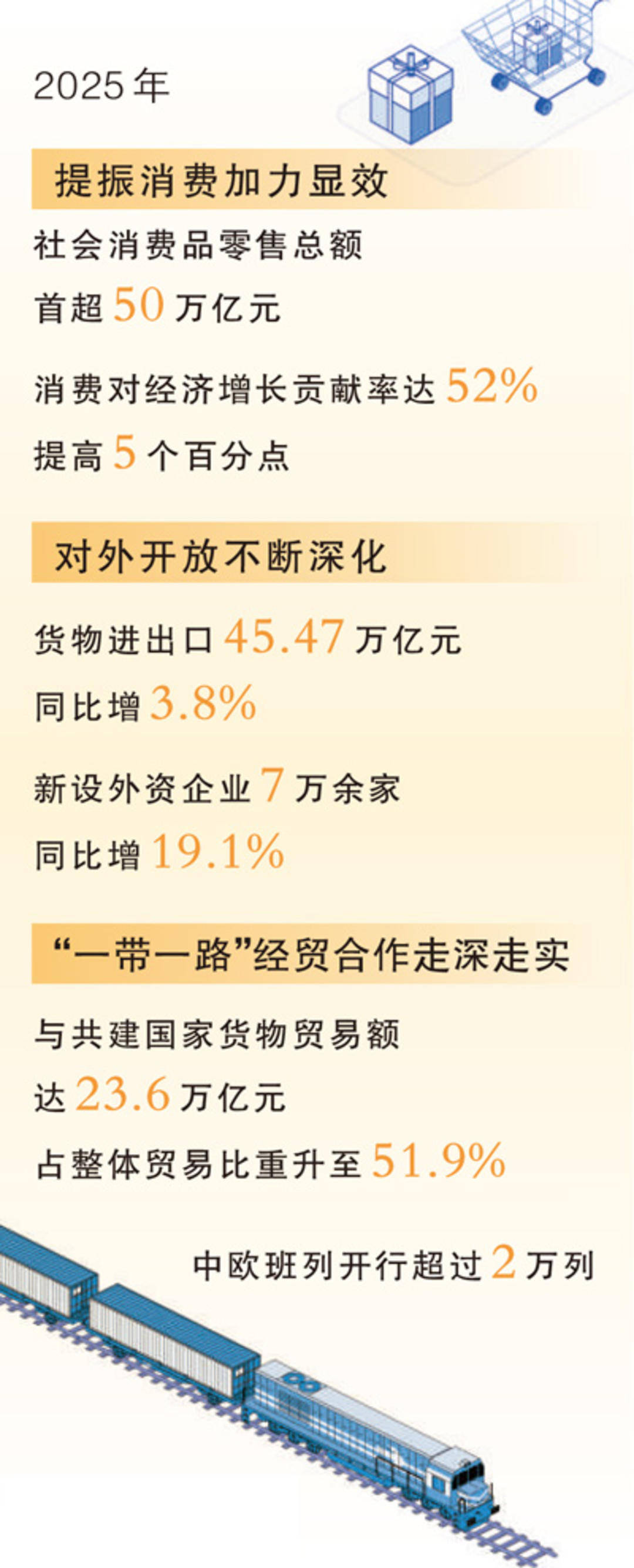
Core Viewpoint - The "14th Five-Year Plan" period is a significant and extraordinary time for Gansu's development, marked by strong leadership from the central government and a focus on modernizing the province's economy and infrastructure [1][2]. Economic Performance - Gansu's GDP reached 13,697.5 billion yuan, an increase of 4,374.4 billion yuan from the end of the "13th Five-Year Plan," representing a growth of 33.6% [3]. - The economic growth rate has been above the national average for 16 consecutive quarters since 2022 [3]. Industrial Growth - The number of large-scale industrial enterprises increased from 1,832 to 3,382 [6]. - Industrial investment has maintained double-digit growth for 54 consecutive months, contributing 36.1% to the province's economic growth [6]. Sectoral Contributions - The non-ferrous metallurgy industry saw an average annual growth of 17.8%, while the petrochemical industry grew by 4.8% [9]. - The new materials industry experienced a remarkable growth of 195.6%, and the biopharmaceutical industry grew by 83.5% [9]. Energy Sector - The total installed capacity of new energy reached 80.416 million kilowatts, a growth of 2.4 times [10]. - Gansu has established a complete industrial chain for photovoltaic, wind, and thermal energy [10]. Investment and Trade - The province signed external projects with an average annual funding growth of 26.4% [16]. - The total value of foreign trade and exports exceeded 70 billion yuan for the first time, with an annual growth of 13.2% [20]. Infrastructure Development - Transportation investments totaled 499.9 billion yuan, with 639 kilometers of new railway lines added, including 370 kilometers of high-speed rail [22]. - New highways and rural roads were constructed, significantly improving connectivity [23]. Social Development - The average disposable income of residents grew by 6.89% annually, with the growth rate ranking in the top ten nationally [29]. - The province has made significant strides in poverty alleviation, with a risk elimination rate of 78.8% for monitored households [37]. Environmental and Quality of Life Improvements - The water quality of the Yellow River has been maintained at a stable level, with significant improvements in air quality and soil safety [51]. - The province has built numerous facilities to enhance public services, including healthcare and social security [46][43].

出政策办活动优场景 促消费今年继续加力
Ren Min Ri Bao· 2026-01-27 01:36
2025年消费对经济增长的贡献率提高5个百分点 优场景,改善消费环境。加快国际消费中心城市培育建设,推进国际化消费环境建设试点和消费新业态 新模式新场景试点工作,打造一批带动面广、显示度高的消费新场景。 服务消费具有消费频次高、乘数效应强、增长可持续等特点,在扩大内需、增进民生福祉中发挥着重要 的作用。2025年,居民人均服务性消费支出同比增长4.5%,占居民人均消费支出的比重为46.1%。下一 步,商务部将继续实施服务消费提质惠民行动,会同相关部门推动提升文化娱乐、旅游休闲、餐饮住 宿、体育赛事、医疗健康等领域的供给水平。 出政策办活动优场景 促消费今年继续加力 1月26日,国务院新闻办举行新闻发布会,介绍2025年商务工作及运行情况,部署2026年提振消费、拓 展双向投资等方面举措。 "刚刚过去的2025年是很不平凡的一年。我们迎难而上、奋力拼搏,商务发展总体平稳、稳中有进。"商 务部副部长鄢东在会上表示。 提升文化娱乐、旅游休闲、餐饮住宿、体育赛事、医疗健康等领域供给水平 鄢东介绍,2025年,商务部坚持惠民生和促消费紧密结合,以"政策+活动"双轮驱动,打造"购在中 国"品牌,释放消费活力,全年社会消费 ...