
科技企业

Search documents
李家超:香港将通过“科企专线”协助内地科技企业来港融资
Nan Fang Du Shi Bao· 2025-09-17 08:34
Core Viewpoint - The Hong Kong Special Administrative Region (SAR) Chief Executive, John Lee, announced a new policy report aimed at enhancing financial support for technology enterprises from mainland China to facilitate their financing in Hong Kong [2] Group 1: Financial Support Initiatives - Hong Kong will assist mainland technology companies in financing through a "Tech Enterprise Direct Line" to strengthen financial support for the nation's goal of becoming a technology powerhouse [2] - The report includes plans to improve the main board listing and structured product issuance mechanisms [2] Group 2: Regulatory Optimizations - There will be a study to optimize the "same share, different rights" listing regulations [2] - The government is exploring the possibility of shortening the stock settlement cycle to T+1 [2] Group 3: Attracting Foreign Enterprises - Efforts will be made to encourage more foreign companies to list in Hong Kong for secondary offerings [2] - The report aims to assist Chinese concept stocks in returning to Hong Kong as their preferred listing location [2] Group 4: Currency and Trading Enhancements - The initiative includes promoting the inclusion of Hong Kong stock RMB trading counters in the "Stock Connect" southbound trading [2]


广东三类主体已发行科技创新债券441.05亿元
Zhong Guo Xin Wen Wang· 2025-08-21 12:39
Core Viewpoint - Guangdong Province is actively promoting the issuance of technology innovation bonds by financial institutions, technology enterprises, and equity investment institutions, achieving a total issuance of 441.05 billion yuan as of August 18, 2025 [1][2] Group 1: Issuance of Technology Innovation Bonds - A total of 2 financial institutions, 12 technology enterprises, and 4 equity investment institutions have issued technology innovation bonds in Guangdong Province [1] - TCL Technology Group Co., Ltd. issued two phases of technology innovation bonds totaling 30 billion yuan, while Jinfat Technology Co., Ltd. issued 10 billion yuan [1] - China Southern Power Grid Co., Ltd. issued two technology innovation bonds totaling 75 billion yuan, including one with both "green" and "technology innovation" attributes [1] Group 2: Market Development Initiatives - The People's Bank of China Guangdong Branch is promoting the establishment of a "technology board" in the bond market through various initiatives, including extensive promotion, research, and collaboration with banks [1] - The bank has guided local financial institutions to engage in over-the-counter trading of technology innovation bonds, including repurchase agreements and pledged loans [1] - Guangdong has seen the first over-the-counter transactions of technology innovation bonds and the first over-the-counter transactions of private enterprise technology innovation bonds in the country [1] Group 3: Market Liquidity - Currently, 40 legal financial institutions in Guangdong Province have engaged in over-the-counter trading of technology innovation bonds, with transaction amounts exceeding 700 million yuan [2] - Approximately 140 million yuan of technology innovation bonds have been used for repurchase agreements and pledged loans, enhancing market liquidity [2]
广东:科技创新债券发行实现三类主体“全覆盖”
Di Yi Cai Jing· 2025-08-21 06:52
Core Insights - The People's Bank of China Guangdong Branch has implemented various measures to support the issuance of technology innovation bonds by financial institutions, technology enterprises, and equity investment institutions, aiming to facilitate high-quality development in the technology innovation sector [1] Group 1: Bond Market Developments - The "Technology Board" in the bond market has been launched for three months, with a total of 441.05 billion yuan issued by 2 financial institutions, 12 technology enterprises, and 4 equity investment institutions as of August 18, 2025, achieving full coverage of the three categories [1] - The issuance of technology innovation bonds has focused on supporting private enterprises and key sectors, with TCL Technology Group Co., Ltd. issuing two phases of bonds totaling 3 billion yuan and Jinfat Technology Co., Ltd. issuing 1 billion yuan [1] Group 2: Green Technology Support - China Southern Power Grid Co., Ltd. issued two technology innovation bonds totaling 7.5 billion yuan, including one bond with dual attributes of "green + technology innovation," significantly supporting the development of the green technology sector [1]


【财经分析】债市“科技板”百日成绩单:双市场输血超9200亿元 风险缓释工具激活科创融资生态
Xin Hua Cai Jing· 2025-08-15 00:39
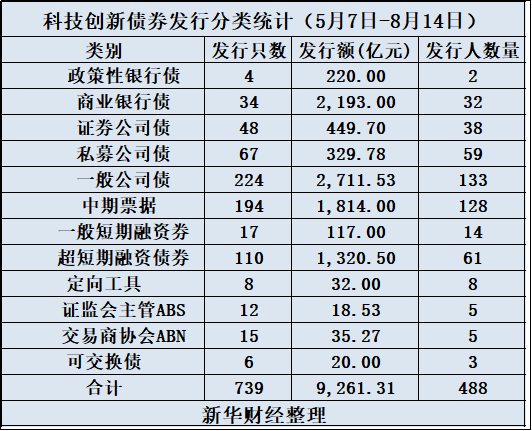
Core Viewpoint - The establishment of the "Technology Board" in the bond market has achieved significant milestones within its first hundred days, with a total issuance of 739 technology innovation bonds amounting to 926.13 billion yuan, reflecting a collaborative innovation effort among financial regulatory bodies, infrastructure, and market participants [1][2]. Group 1: Market Performance - The interbank market has dominated the issuance of technology innovation bonds, accounting for 62.14% of the total issuance, with 5,755.77 billion yuan issued [2]. - Commercial banks have been particularly active, with 32 commercial banks and 2 policy banks issuing a total of 2,413 billion yuan in technology innovation bonds [2]. - The Shanghai and Shenzhen stock exchanges have also contributed, with a total issuance of 3,467.01 billion yuan in technology innovation corporate bonds, primarily directed towards sectors like chip design, biomedicine, and artificial intelligence [2]. Group 2: Bond Issuance Characteristics - The issuance structure of technology innovation bonds has shown a significant lengthening of maturity, with over 75% of bonds having a maturity of more than 3 years, and over 30% exceeding 5 years [4][5]. - This maturity design addresses the long-cycle characteristics of technology research and development, providing stable funding for hard technology projects [5]. Group 3: Financial Innovation Tools - Over 300 of the issued bonds have special clauses, and nearly 60 have introduced innovative credit enhancement measures, such as credit risk mitigation certificates (CRMW) [6]. - These tools have been instrumental in reducing investor concerns by sharing 30%-50% of default risks, especially for technology companies with insufficient credit ratings [6]. - The use of blockchain technology has also been highlighted, with the issuance of the first blockchain-based technology board bond, ensuring traceability of funds [6][7]. Group 4: Evolving Investor Landscape - The investor structure for technology board bonds is changing, with insurance fund allocations increasing from 22% at the beginning of the year to 35% [8]. - The rapid growth of technology board bond ETFs indicates a strong interest from long-term funds, with the first ETF surpassing 100 billion yuan in just five trading days [8]. Group 5: Future Directions - The People's Bank of China has emphasized the need for optimizing the technology board mechanism and innovating risk-sharing tools [8][9]. - There are ongoing discussions about establishing a dual-track system for technology and credit ratings to better assess the value of technology companies [9]. - The development of innovative financing tools is expected to enhance the financing ecosystem for technology enterprises, addressing the historical imbalance between equity and debt financing [9].
重庆合川:金融助力科技企业勇闯创新“赛道”
Jin Rong Shi Bao· 2025-08-14 02:35
Group 1 - The People's Bank of China (PBOC) in Hechuan focuses on empowering the development of the modern industrial system through technology finance, implementing actions like financing connections and first-loan breakthroughs to support technology enterprises [1] - By May 2025, the loan balance for technology enterprises in the Hechuan area is projected to reach 36.4 billion yuan, effectively aiding over 1,200 technology enterprises [1] Group 2 - To assist early-stage technology enterprises, the PBOC in Hechuan has established a dual-driven model of policy incentives and market orientation, coordinating cross-department collaboration to create a financing platform [2] - Since 2024, four technology finance-themed financing connection meetings have been held, resulting in an additional loan balance of 8.8 billion yuan for technology enterprises in the area [2] - The PBOC has introduced innovative products like "Sci-Tech Loan" and "Sci-Tech e-Loan," with a maximum credit limit of 50 million yuan and disbursement within three working days [2] Group 3 - The PBOC guides commercial banks to create a three-system service framework for technology finance, addressing the different financial needs and risk characteristics of technology enterprises at various lifecycle stages [3] - A tailored financial service plan was developed for Longjian Machinery Manufacturing Co., which faced a funding gap of 130 million yuan due to traditional collateral limitations [3] - The plan included a comprehensive credit of 130 million yuan, incorporating various loan products to alleviate the company's financial pressure [3] Group 4 - The PBOC has established a government-bank-enterprise connection platform to innovate financing service models for technology enterprises [4] - The Postal Savings Bank of China in Tongliang has launched products like "Innovation Credit Loan" and "Sci-Tech Credit Loan," successfully obtaining the first batch of "Technology Branch" titles in Chongqing [4] - The bank facilitated rapid funding for Chongqing and Jing Carbon Material Co., a national high-tech enterprise, through a green approval channel, completing due diligence and disbursement within seven working days [4]

科创债新政落地近3个月 苏州市15家企业累计发债124.8亿元
Su Zhou Ri Bao· 2025-08-05 00:34
Core Insights - The issuance of technology innovation bonds (科创债) has seen significant growth, with over 650 bonds issued nationwide, amounting to nearly 800 billion yuan by the end of July [1] - Suzhou leads in the issuance of technology innovation bonds among provinces, with 15 companies issuing a total of 124.8 million yuan [1] - The expansion of eligible issuers for technology innovation bonds is a notable highlight of the recent market developments [1] Group 1: Policy and Market Developments - The People's Bank of China and the China Securities Regulatory Commission announced 13 measures to support the issuance of technology innovation bonds, focusing on enriching the product system and improving support mechanisms [1] - Following the new policy, various financial institutions, including banks and venture capital firms, have disclosed their plans for issuing technology innovation bonds by 2025 [1] - Suzhou was quick to implement the new policy, with three technology innovation bonds issued shortly after, including a 5 billion yuan bond from Hengli Group, marking the first issuance by a private enterprise in the province post-policy [1] Group 2: Issuance Trends and Financial Implications - Suzhou's private enterprises have a high proportion of convertible bonds issued, with 38 million yuan issued across the province, and 37 million yuan from Suzhou alone [2] - Yuanhe Holdings issued the first batch of technology innovation bonds in the interbank market with a 3-year term and a 1.92% coupon rate, setting a new low for similar bonds [2] - The bond market is becoming a new engine for supporting technology innovation, providing large-scale, low-cost funding without diluting existing shareholders' control [2] Group 3: Innovation Ecosystem in Suzhou - Suzhou has a robust innovation ecosystem, with 76 national-level technology incubators and over 24,300 technology-based SMEs [3] - The city has a reserve of 195 qualified issuers for technology innovation bonds, including 113 technology enterprises and 75 equity investment institutions [3] - The issuance of technology innovation bonds is expected to enhance Suzhou's innovation environment and support the development of a globally influential industrial technology innovation center [3]
跻身全国前十 2025上半年湖北存款余额突破10万亿
Chang Jiang Shang Bao· 2025-07-30 06:05
Core Viewpoint - The financial sector in Hubei Province is effectively supporting economic development, with significant growth in social financing and deposits, indicating a positive financial environment for high-quality economic growth [1][2]. Financial Performance - As of June, the social financing scale in Hubei reached 13.58 trillion yuan, a year-on-year increase of 9.6%, surpassing the national growth rate by 0.7 percentage points [2][3]. - The balance of domestic and foreign currency deposits in Hubei exceeded 10 trillion yuan, marking a 9.3% year-on-year growth, making it the 10th province in China to achieve this milestone [1][2]. - The balance of domestic and foreign currency loans stood at 9.29 trillion yuan, with a year-on-year growth of 7.9%, also higher than the national average [2][3]. Loan Distribution and Support - Hubei's financial institutions have increased support for key sectors, with medium and long-term loans to the manufacturing sector growing by 11.8% year-on-year, and loans to small and micro enterprises increasing by 15.8% [3][4]. - The province has implemented various structural monetary policy tools, with a total balance of 1.997 trillion yuan, up 37% year-on-year, to enhance credit allocation towards technology innovation and green development [4][5]. Policy Implementation - Since May 15, Hubei has fully implemented a reserve requirement ratio cut, releasing approximately 2.73 billion yuan for medium and long-term funding to support key sectors [4][5]. - The average interest rate for new corporate loans decreased by 48 basis points year-on-year to 3.2%, while personal loan rates fell by 46 basis points to 3.09% [3][4]. Sector-Specific Initiatives - Hubei has allocated 20 billion yuan specifically for agricultural and small enterprise re-loans, with 10 billion yuan directed towards supporting technology enterprises in the Wuhan East Lake High-tech Zone [6]. - The province has also facilitated the issuance of green bonds, with a total of 137 billion yuan issued, ranking first in Central China [3][5].
非公经济人士优秀建设者名单出炉,消费行业这些人受表彰
Bei Ke Cai Jing· 2025-07-30 04:31
Core Points - The sixth National Non-Public Economic Person Excellent Builder of Socialism with Chinese Characteristics Award ceremony was held, recognizing 100 individuals from various sectors including technology, pharmaceuticals, and consumer industries [1][3] - The event highlights the importance of private enterprises, which account for over 92% of all companies in China, and over 92% of national high-tech enterprises are private [3] Group 1: Technology Sector - Notable entrepreneurs from the technology sector were recognized, including Wang Xingxing, CEO of Hangzhou Yushu Technology Co., Li Xiang, founder and CEO of Li Auto, and Chen Tianshi, Chairman and General Manager of Cambricon Technologies [4] Group 2: Pharmaceutical Sector - Representatives from the pharmaceutical industry also received awards, including Xu Haoyu, Chairman and President of Yangtze River Pharmaceutical Group, Chen Baohua, President of Zhejiang Huahai Pharmaceutical Co., and You Hongtao, Chairman of Chongqing Huasen Pharmaceutical Co. [5] Group 3: Consumer Sector - The consumer sector gained attention, with awardees from traditional and emerging consumption fields, including snack foods, textiles, and grain and oil industries, such as Beida Cang, Wanshili, Mingming Hen Mang, and Hainan Oscar [6] - Wanshili Group, with over 40 years of history, has transformed its focus to silk cultural creativity, reflecting the upgrade of traditional consumption industries [6] - The emerging snack food industry, represented by "Mingming Hen Mang," is gaining traction among young consumers, emphasizing high frequency, low price, and experiential consumption [7][8]
昌平区搭建金融服务平台 打造“昌平 金立方”品牌
Zheng Quan Ri Bao Wang· 2025-07-11 14:30
Core Viewpoint - The event aims to enhance the understanding and application of technology innovation bonds (科创债) among market participants, facilitating financing for high-quality technology enterprises in Changping District, Beijing [1][2]. Group 1: Policy and Framework - The People's Bank of China and the China Securities Regulatory Commission issued a joint announcement in May 2023 to support the issuance of technology innovation bonds, indicating an acceleration in the support system for these bonds [2]. - The focus on technology innovation is identified as a core driver for high-quality development in Changping District, with technology innovation bonds serving as a specialized debt financing tool to effectively lower financing costs and optimize debt structures for enterprises [2]. Group 2: Financial Ecosystem Development - Changping District is leveraging the opportunity presented by the Zhongguancun technology finance reform pilot zone to create a first-class financial business environment by integrating resources and enhancing service efficiency [3]. - A "full-process service" mechanism for technology innovation bonds has been established to coordinate resources such as securities firms, analyze issuance cases, and provide one-stop solutions to reduce financing costs for technology enterprises [3]. Group 3: Engagement and Service Enhancement - The technology innovation bonds directly address the financing needs of technology enterprises, highlighting their innovative, flexible, and inclusive value [4]. - The event featured interactive sessions where enterprise representatives engaged with experts to discuss solutions for financing challenges, indicating a commitment to building communication platforms to address enterprise needs [4]. - Changping District aims to continuously improve the convenience, accessibility, and satisfaction of financial services for local enterprises, fostering a stable and sustainable financial service ecosystem [4].
聚焦科技创新 赋能新质生产力发展 资本市场“江西板块”科技含量更足
Zheng Quan Shi Bao Wang· 2025-07-11 03:23
Group 1 - The Jiangxi provincial government has emphasized the implementation of a comprehensive financial policy to support the economic recovery, achieving significant results in collaboration with the financial system [1] - Jiangxi's capital market is increasingly vibrant, with 4 new listed companies since 2025, 3 of which are high-tech enterprises, ranking 5th nationally [1] - The merger and acquisition market in Jiangxi is becoming more active, with 22 instances of mergers and acquisitions in the first five months, totaling 5.463 billion yuan [1] Group 2 - The issuance of technology innovation bonds in Jiangxi has seen a 25.42% year-on-year increase, with a total of 7.4 billion yuan issued in the first half of the year [2] - Since the implementation of the "Ying Shan Hong Action" in 2018, 34 new technology IPOs have been added, accounting for 87.18% of the total new listings [2] - In 2024, Jiangxi listed companies invested 23.322 billion yuan in R&D, with nearly 60% of them having an R&D intensity of over 4% [2] Group 3 - The Jiangxi Securities Regulatory Bureau plans to deepen central-local collaboration, focusing on nurturing technology enterprises for listing and promoting technology innovation bonds [3]