船舶

Search documents
机械行业2025年度业绩前瞻:AI引领成长崛起,反内卷周期反转,出海进一步提速
ZHESHANG SECURITIES· 2026-01-31 13:20
Group 1: Investment Strategy - The investment strategy for 2026 focuses on cyclical recovery in sectors like engineering machinery, industrial gases, and shipping[1] - Growth sectors include embodied intelligence, controllable nuclear fusion, photovoltaic equipment, lithium battery equipment, semiconductor equipment, AIDC, and PCB equipment[1] - Optimism towards the U.S. market strategy due to easing trade disputes and potential Federal Reserve interest rate cuts[1] Group 2: Engineering Machinery Market - The global engineering machinery market is projected to reach $213.5 billion in 2024, with a CAGR of 6% from 2024 to 2030[2] - Domestic excavator sales are expected to grow by 18% in 2025, reaching 118,518 units, while total excavator sales will increase by 17% to 235,257 units[2] - China's leading manufacturers are gaining global market share, with SANY's market value at approximately 10% of Caterpillar's as of January 2026[3] Group 3: Industrial Gases - The industrial gas market is expected to reach ¥1.3 trillion in 2026, with a CAGR of 6.8% over the next four years[19] - The competitive landscape is concentrated, with the top four global industrial gas companies holding a 54% market share[19] - Growth drivers include macroeconomic recovery and increased demand from sectors like semiconductors and renewable energy[19] Group 4: Semiconductor Equipment - The global semiconductor market is expected to grow by 9% in 2026, reaching $760.7 billion, driven by AI demand[14] - Domestic semiconductor equipment demand is expected to rise due to increased production capacity and a focus on self-sufficiency[14] - Key investment areas include etching and thin-film equipment, as well as the domestic production of photolithography machines[15]
中国中车严正声明
券商中国· 2026-01-31 12:40
1月31日,央企中国中车发布严正声明: 近期,中国中车集团有限公司(以下简称"中国中车集团"或"我公司")发现市场上有不法分子冒用我公司名 义,通过名为"中国中车CRRC""中国中车"和"中车风电"等的应用程序(APP),采用传销式运作模式,虚构 投资标的,宣扬每日付息、到期返本、高额回报等所谓理财项目,进行非法融资诈骗活动。此举严重侵害我公 司声誉及合法权益,对社会公众财产安全构成重大威胁。 严正声明如下: 一、我公司与名为"中国中车CRRC""中国中车"和"中车风电"的APP无任何关联 我公司从未开发、运营、授权或参与该APP及其运营方的任何活动,其发布的一切所谓"投资项目""内购股 权"及宣称的"高额回报"均属诈骗,与我公司无任何关联。 责编: 王璐璐 校对: 刘星莹 百万用户都在看 盘中暴涨25%!芯片巨头,释放重磅信号! AI,突传重磅!四大巨头,同时出手! 二、该APP具有显著非法特征,请公众务必提高警惕,切勿上当 该APP无法通过任何官方渠道(如苹果App Store、各大安卓应用市场)下载,只能借助微信群、朋友圈等社交 平台传播或私发链接、二维码下载获取,多租用域外服务器,以逃避国内监管体系。 ...



【每周经济观察】民间投资向新向优势不可挡
Sou Hu Cai Jing· 2026-01-30 23:06
Group 1 - The core focus of the recent policy package is to stimulate private investment, particularly through measures such as loan interest subsidies for small and micro enterprises, special guarantee plans for private investment, and risk-sharing mechanisms for private enterprise bonds [2] - The overall trend of private investment in China has shown a decline in growth and low performance since 2025, largely influenced by macroeconomic factors like the deep adjustment of the real estate market [2] - Despite the pressure on total private investment, there is a significant structural optimization, with a shift from traditional investment in real estate and general manufacturing to new technologies, new infrastructure, new services, and new livelihoods [2] Group 2 - Private investment is increasingly embracing new productive forces and modern industrial systems, with a 0.6% growth in manufacturing investment despite a 3.8% decline in overall fixed asset investment in 2025 [3] - Key sectors such as railway, shipbuilding, aerospace, and other transportation equipment manufacturing saw substantial investment growth, with increases of 17.5%, 12.3%, 11.7%, and 9.1% respectively [3] - The participation of private capital in infrastructure projects has deepened, with significant projects in transportation and energy being promoted to private investors, indicating that private capital is becoming a crucial force in construction [3] Group 3 - High-tech services and consumer sectors are emerging as new hotspots for private investment, with notable growth in information transmission and water management sectors, achieving increases of 28.4% and 16.9% respectively [4] - The structural transition in private investment is a result of precise macro policies and market opportunities, with various measures aimed at reducing barriers and enhancing the investment environment [4] - Recent policies, including the implementation of the Private Economy Promotion Law and measures to further promote private investment, have provided unprecedented support for private investment [4] Group 4 - To achieve high-quality development of private investment, deeper structural reforms are necessary, focusing on ensuring fair competition and innovative financial supply models [5] - The current market has seen a reduction in explicit barriers to entry, but hidden requirements and regulatory challenges still exist, necessitating a shift in policy focus to guarantee fair competition [5] - Innovations in financial supply and the establishment of profitable models are essential for overcoming obstacles faced by private capital, particularly in long-term investment projects [5]
雅迪取得控制器自匹配电机参数专利
Jin Rong Jie· 2026-01-30 05:55
国家知识产权局信息显示,雅迪科技集团有限公司取得一项名为"一种控制器自匹配电机参数的方法、 装置及电动车"的专利,授权公告号CN114839958B,申请日期为2022年5月。 天眼查资料显示,雅迪科技集团有限公司,成立于2010年,位于无锡市,是一家以从事铁路、船舶、航 空航天和其他运输设备制造业为主的企业。企业注册资本10000万人民币。通过天眼查大数据分析,雅 迪科技集团有限公司共对外投资了48家企业,参与招投标项目419次,财产线索方面有商标信息1117 条,专利信息1629条,此外企业还拥有行政许可236个。 声明:市场有风险,投资需谨慎。本文为AI基于第三方数据生成,仅供参考,不构成个人投资建议。 本文源自:市场资讯 作者:情报员 ...

雷尔伟1月29日获融资买入1332.21万元,融资余额2.55亿元
Xin Lang Cai Jing· 2026-01-30 01:42
Group 1 - The core viewpoint of the news is that 雷尔伟 (Railway Technology Co., Ltd.) experienced a decline in stock price and trading volume on January 29, with a drop of 4.03% and a trading volume of 124 million yuan [1] - As of January 29, 雷尔伟's financing balance reached 256 million yuan, accounting for 4.77% of its market capitalization, indicating a high level of financing activity compared to the past year [1] - The company reported a financing buy amount of 13.32 million yuan and a financing repayment of 16.35 million yuan on the same day, resulting in a net financing outflow of 3.03 million yuan [1] Group 2 - 雷尔伟's revenue for the period from January to September 2025 was 252 million yuan, reflecting a year-on-year growth of 5.66%, while the net profit attributable to shareholders decreased by 3.09% to 44.73 million yuan [2] - The company has distributed a total of 178 million yuan in dividends since its A-share listing, with 160 million yuan distributed over the past three years [2] - As of December 31, 雷尔伟 had 10,600 shareholders, a decrease of 5.81% from the previous period, while the average number of circulating shares per shareholder increased by 6.17% to 19,549 shares [2]

今日申购:林平发展、电科蓝天
Zhong Guo Jing Ji Wang· 2026-01-30 01:37
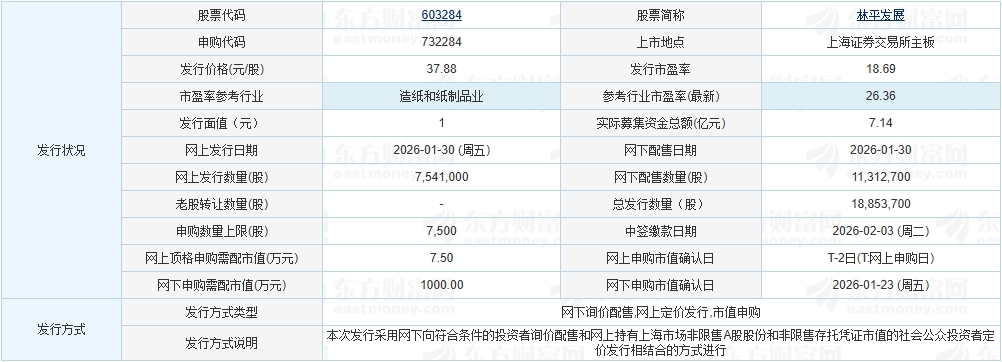
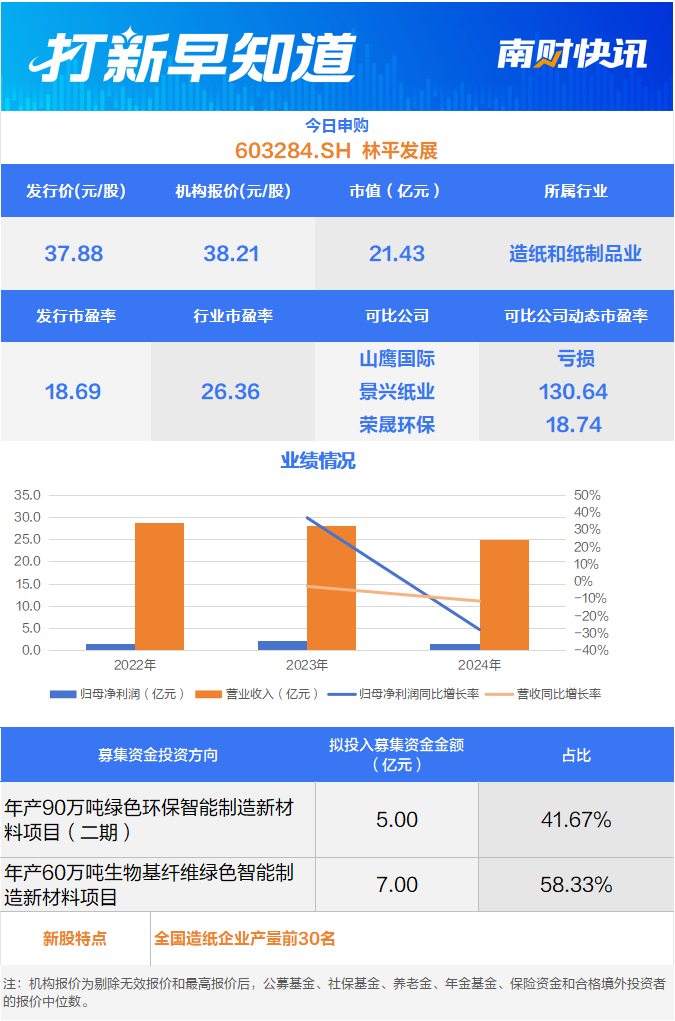
Group 1: Linping Development - Linping Development primarily engages in the research, production, and sales of packaging corrugated paper and boxboard products [2] - The company plans to raise a total of 714.18 million yuan through its initial public offering (IPO) at a price of 37.88 yuan per share, with a net fundraising amount of approximately 624.09 million yuan after deducting issuance costs [2] - The funds raised will be allocated to projects including the annual production of 900,000 tons of green environmental-friendly intelligent manufacturing new materials (Phase II) and 600,000 tons of bio-based fiber green intelligent manufacturing new materials [2] Group 2: Zhongdian Ke Lantian Technology - Zhongdian Ke Lantian focuses on the research, production, sales, and services of electric energy products and systems, offering comprehensive solutions for power generation, energy storage, control, and system integration [4] - The company aims to raise 1.6449 billion yuan through its IPO at a price of 9.47 yuan per share, with an expected net fundraising amount of approximately 1.5792 billion yuan after deducting issuance costs [5] - The funds raised will be used entirely for the industrialization of aerospace power systems (Phase I) [6]
造纸龙头、宇航电源核心供应商今日申购,宁德时代“小伙伴”上市丨打新早知道
2 1 Shi Ji Jing Ji Bao Dao· 2026-01-29 23:12
Group 1: Linping Development (603284.SH) - Linping Development primarily engages in the research, production, and sales of corrugated paper and boxboard products, recognized as a high-tech enterprise with independent R&D capabilities [1] - The company has a market capitalization of 21.43 billion yuan and an issuance price of 37.88 yuan per share, with an issuance P/E ratio of 18.69 [2] - Linping Development's production capacity is 1.15 million tons, ranking among the top 30 paper production companies in China, with a projected raw paper output of 1.0197 million tons in 2024 [3] - The company has established stable partnerships with well-known enterprises such as Hohsing Packaging and Xiamen Guomao, leveraging its brand influence and competitive advantages [3] Group 2: Electric Science Blue Sky (688818.SH) - Electric Science Blue Sky focuses on advanced electric energy systems and products, with a market capitalization of 148 billion yuan and an issuance price of 9.47 yuan per share [6] - The company has a strong technical foundation with 367 authorized patents, including 141 invention patents, and has received multiple national science and technology awards [9] - The company’s revenue is highly concentrated, with sales to its largest customer, Aerospace Science and Technology Group, accounting for 45.59% to 53.37% of total revenue from 2022 to mid-2025 [9] Group 3: Meidel (920119.BJ) - Meidel is a leading supplier of intelligent conveyor systems in China, focusing on the R&D, design, manufacturing, and sales of smart manufacturing equipment [11] - The company plans to invest 1.20 billion yuan in its Dalian Meidel Phase IV construction project and 2.00 billion yuan in high-end intelligent conveyor system R&D and production [13] - Meidel's products for the new energy battery sector generated significant revenue, accounting for 63.76% to 58.19% of its main business income from 2022 to mid-2025 [14]

云南圆周率科技发展有限公司成立,注册资本1000万人民币
Sou Hu Cai Jing· 2026-01-29 17:37
经营范围含自然生态系统保护管理;船用配套设备制造;娱乐船和运动船制造;船舶自动化、检测、监 控系统制造;金属结构制造;海洋能系统与设备制造;船舶拖带服务;海洋工程平台装备制造;船舶销 售;船舶租赁;船舶港口服务;国际船舶代理;国内船舶代理;国际船舶管理业务;从事国际集装箱 船、普通货船运输;海上风电相关装备销售;海上风力发电机组销售;发电机及发电机组销售;海洋工 程装备制造;海洋工程装备销售;金属结构销售。(除依法须经批准的项目外,凭营业执照依法自主开 展经营活动)许可项目:非金属船舶制造;金属船舶制造;船舶制造;船舶修理;船舶拆除;船舶改 装;船舶设计;国内船舶管理业务;船舶检验服务;船舶引航服务。(依法须经批准的项目,经相关部 门批准后方可开展经营活动,具体经营项目以相关部门批准文件或许可证件为准) 企业名称云南圆周率科技发展有限公司法定代表人李则余注册资本1000万人民币国标行业制造业>铁 路、船舶、航空航天和其他运输设备制造业>城市轨道交通设备制造地址云南省文山壮族苗族自治州富 宁县剥隘镇那律村企业类型有限责任公司(法人独资)营业期限2026-1-29至无固定期限登记机关富宁 县市场监督管理局 来源: ...
威奥股份发预增,预计2025年归母净利润同比上升26.23%到76.72%
Zhi Tong Cai Jing· 2026-01-29 13:29
威奥股份(605001)(605001.SH)发布公告,公司预计2025年年度实现归属于母公司所有者的净利润为 6,990.16万元到9,786.23万元,同比上升26.23%到76.72%。 ...

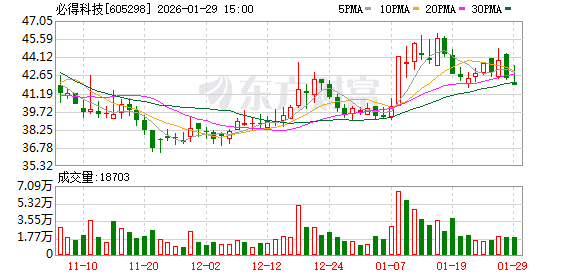
必得科技:2025年年度业绩预告
Zheng Quan Ri Bao· 2026-01-29 13:29
证券日报网讯 1月29日,必得科技发布公告称,公司预计 2025 年年度实现归属于上市公司股东的净利 润为 5,500.00 万元到 6,500.00 万元,与上年同期相比,将增加 1,614.46 万元到 2,614.46 万元,同 比增加 41.55%到 67.29%。 (文章来源:证券日报) ...