黑色金属冶炼和压延加工业

Search documents
2025年全国黑色金属冶炼和压延加工业出口货值为2000.6亿元,累计下滑3.5%
Chan Ye Xin Xi Wang· 2026-01-26 03:28
知前沿,问智研。智研咨询是中国一流产业咨询机构,十数年持续深耕产业研究领域,提供深度产业研 究报告、商业计划书、可行性研究报告及定制服务等一站式产业咨询服务。专业的角度、品质化的服 务、敏锐的市场洞察力,专注于提供完善的产业解决方案,为您的投资决策赋能。 2019年-2025年全国黑色金属冶炼和压延加工业出口货值统计图 数据来源:国家统计局,智研咨询整理 上市公司:中信特钢(000708),河钢股份(000709),中南股份(000717),本钢板材(000761), 三钢闽光(002110),久立特材(002318),金洲管道(002443),常宝股份(002478),盛德鑫泰 (300881),安阳钢铁(600569),八一钢铁(600581),新钢股份(600782),马钢股份(600808) 相关报告:智研咨询发布的《2026-2032年中国黑色金属矿采选业行业市场全景调查及投资前景预测报 告》 根据国家统计局数据可知:2025年12月全国黑色金属冶炼和压延加工业出口货值为159亿元,同比增长 0.1%;2025年全国黑色金属冶炼和压延加工业累计出口货值为2000.6亿元,累计同比下降3.5%。 ...


张家港扬子江申请一种消音系统专利,能够依据实际作业环境灵活调整自身消音能力
Sou Hu Cai Jing· 2026-01-22 10:31
江苏沙钢集团有限公司,成立于1996年,位于苏州市,是一家以从事黑色金属冶炼和压延加工业为主的 企业。企业注册资本450000万人民币。通过天眼查大数据分析,江苏沙钢集团有限公司共对外投资了 125家企业,参与招投标项目5000次,财产线索方面有商标信息86条,专利信息4072条,此外企业还拥 有行政许可65个。 江苏省沙钢钢铁研究院有限公司,成立于2007年,位于苏州市,是一家以从事科技推广和应用服务业为 主的企业。企业注册资本5000万人民币。通过天眼查大数据分析,江苏省沙钢钢铁研究院有限公司共对 外投资了1家企业,参与招投标项目5次,专利信息2606条,此外企业还拥有行政许可3个。 声明:市场有风险,投资需谨慎。本文为AI基于第三方数据生成,仅供参考,不构成个人投资建议。 来源:市场资讯 国家知识产权局信息显示,张家港扬子江冷轧板有限公司;江苏沙钢集团有限公司;江苏省沙钢钢铁研究 院有限公司申请一项名为"一种消音系统"的专利,公开号CN121363681A,申请日期为2025年10月。 专利摘要显示,本申请公开了一种消音系统,涉及消音设备技术领域,通过对现有技术中的消音器的结 构进行优化改进,使其消音结 ...

2025年1-11月黑色金属冶炼和压延加工业企业有6325个,同比下降0.02%
Chan Ye Xin Xi Wang· 2026-01-21 03:53
上市公司:中信特钢(000708),河钢股份(000709),中南股份(000717),本钢板材(000761), 三钢闽光(002110),久立特材(002318),金洲管道(002443),常宝股份(002478),盛德鑫泰 (300881),安阳钢铁(600569),八一钢铁(600581),新钢股份(600782),马钢股份(600808) 相关报告:智研咨询发布的《2026-2032年中国黑色金属矿采选业行业市场全景调查及投资前景预测报 告》 2025年1-11月,黑色金属冶炼和压延加工业企业数(以下数据涉及的企业,均为规模以上工业企业,从 2011年起,规模以上工业企业起点标准由原来的年主营业务收入500万元提高到年主营业务收入2000万 元)为6325个,和上年同期相比,减少了1个,同比下降0.02%,占工业总企业的比重为1.2%。 2016-2025年1-11月黑色金属冶炼和压延加工业企业数统计图 数据来源:国家统计局,智研咨询整理 知前沿,问智研。智研咨询是中国一流产业咨询机构,十数年持续深耕产业研究领域,提供深度产业研 究报告、商业计划书、可行性研究报告及定制服务等一站式产业咨询服务。专业 ...

宝钢取得高强度抗非均匀载荷石油套管专利
Sou Hu Cai Jing· 2026-01-20 05:35
Group 1 - The core point of the article is that Baoshan Iron & Steel Co., Ltd. has obtained a patent for a high-strength oil casing that can withstand non-uniform loads, indicating innovation in their product offerings [1] - The patent was granted with the announcement number CN119663108B, and the application date was September 2023 [1] - Baoshan Iron & Steel Co., Ltd. was established in 2000 and is located in Shanghai, primarily engaged in the black metal smelting and rolling processing industry [1] Group 2 - The registered capital of Baoshan Iron & Steel Co., Ltd. is approximately 2,226,220.0234 million RMB [1] - The company has invested in 30 enterprises and participated in 5,000 bidding projects [1] - Baoshan Iron & Steel holds 254 trademark registrations and 5,000 patent records, along with 9,284 administrative licenses [1]

2025年全国煤炭开采和洗选业产能利用率为69.8%
Guo Jia Tong Ji Ju· 2026-01-20 01:49
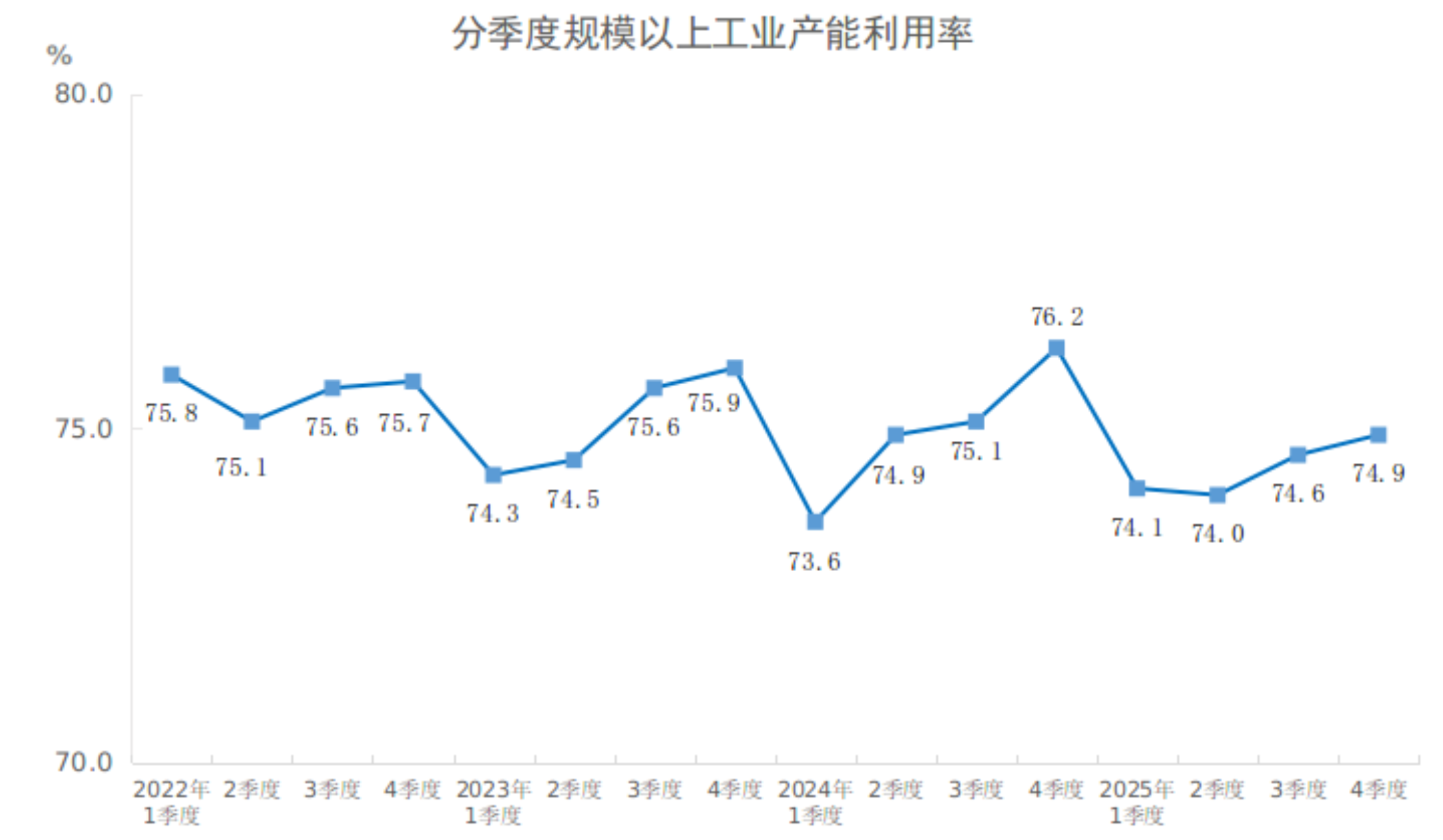
Core Viewpoint - The national industrial capacity utilization rate for large-scale enterprises in Q4 2025 is reported at 74.9%, showing a 0.3 percentage point increase from Q3 but a 1.3 percentage point decrease compared to the same period last year [1][4]. Group 1: Overall Industrial Capacity Utilization - The overall industrial capacity utilization rate for the entire year of 2025 is 74.4%, which is a decrease of 0.6 percentage points from the previous year [6]. - The Q4 capacity utilization rate for the mining industry is 71.7%, down 3.9 percentage points year-on-year [6]. - The manufacturing industry shows a Q4 capacity utilization rate of 75.2%, reflecting a decrease of 1.2 percentage points compared to the previous year [6]. - The electricity, heat, gas, and water production and supply industry has a Q4 capacity utilization rate of 74.0%, which is a decline of 0.8 percentage points year-on-year [6]. Group 2: Industry-Specific Capacity Utilization - In Q4 2025, the coal mining and washing industry has a capacity utilization rate of 69.1%, down 4.8 percentage points from the previous year [3][6]. - The food manufacturing industry reports a capacity utilization rate of 68.5%, a decrease of 2.2 percentage points year-on-year [6]. - The textile industry has a Q4 capacity utilization rate of 77.1%, down 1.7 percentage points compared to the previous year [6]. - The chemical raw materials and chemical products manufacturing industry shows a capacity utilization rate of 74.1%, down 2.3 percentage points year-on-year [6]. - The black metal smelting and rolling industry has a capacity utilization rate of 78.5%, which is an increase of 0.4 percentage points from the previous year [6]. - The automotive manufacturing industry reports a capacity utilization rate of 76.0%, down 1.2 percentage points year-on-year [6]. - The computer, communication, and other electronic equipment manufacturing industry has a capacity utilization rate of 79.7%, reflecting a slight increase of 0.3 percentage points compared to the previous year [6].
国家统计局:2025年12月原煤产量43703万吨
Guo Jia Tong Ji Ju· 2026-01-19 02:21
(文章来源:国家统计局) 国家统计局:2025年12月原煤产量43703万吨,同比减少1.0%,环比增长2.4%;1-12月产量为483178万 吨,同比增长1.2%。2025年12月焦炭产量4274万吨,同比增长1.9%,环比增长2.5%;1-12月产量为 50412万吨,同比增长2.9%。2025年12月水泥产量14416万吨,同比减少6.6%,环比减少6.6%;1-12月 产量为169314万吨,同比减少6.9%。 ...
2025年四季度全国规模以上工业产能利用率为74.9%
Guo Jia Tong Ji Ju· 2026-01-19 02:01
Core Viewpoint - The national industrial capacity utilization rate for large-scale industries in Q4 2025 is reported at 74.9%, showing a 0.3 percentage point increase from Q3 but a 1.3 percentage point decrease compared to the same period last year [1][4]. Group 1: Overall Industrial Capacity Utilization - The overall industrial capacity utilization rate for the entire year of 2025 is 74.4%, which is a decrease of 0.6 percentage points from the previous year [6]. - The Q4 capacity utilization rate reflects a mixed performance across different sectors, with some industries experiencing significant declines [6]. Group 2: Sector-Specific Capacity Utilization - In Q4 2025, the mining industry has a capacity utilization rate of 71.7%, down by 3.9 percentage points year-on-year [6]. - The manufacturing sector's capacity utilization rate stands at 75.2%, a decrease of 1.2 percentage points from the previous year [6]. - The electricity, heat, gas, and water production and supply sector shows a capacity utilization rate of 74.0%, down by 0.8 percentage points year-on-year [6]. Group 3: Detailed Industry Breakdown - Coal mining and washing industry has a capacity utilization rate of 69.1%, down by 4.8 percentage points year-on-year [6]. - The food manufacturing industry reports a capacity utilization rate of 68.5%, a decrease of 2.2 percentage points from the previous year [6]. - The textile industry has a capacity utilization rate of 77.1%, down by 1.7 percentage points year-on-year [6]. - The chemical raw materials and products manufacturing industry shows a capacity utilization rate of 74.1%, down by 2.3 percentage points [6]. - The black metal smelting and rolling industry has a capacity utilization rate of 78.5%, with a slight increase of 0.4 percentage points year-on-year [6]. - The automotive manufacturing industry reports a capacity utilization rate of 76.0%, down by 1.2 percentage points from the previous year [6]. - The computer, communication, and other electronic equipment manufacturing industry has a capacity utilization rate of 79.7%, showing a slight increase of 0.3 percentage points year-on-year [6].
我国用电量首次突破10万亿千瓦时
Sou Hu Cai Jing· 2026-01-19 01:13
Core Insights - China's total electricity consumption is projected to exceed 10 trillion kilowatt-hours by 2025, reaching 10.4 trillion kilowatt-hours, representing a year-on-year growth of 5% [1][5] - This milestone is unprecedented for a single country, equating to more than double the annual electricity consumption of the United States and surpassing the combined annual consumption of the EU, Russia, India, and Japan [6] Group 1: Factors Driving Electricity Consumption Growth - The growth in electricity consumption is driven by a stable macroeconomic environment and increased demand for residential electricity due to high temperatures and enhanced electrification [2][7] - Notably, it took China just over a decade to increase its annual electricity consumption from 5 trillion to 10 trillion kilowatt-hours, a growth rate unmatched by other major economies [2][7] Group 2: Sectoral Contributions to Electricity Demand - High-end manufacturing is becoming a key driver of electricity consumption growth, with electricity usage in the new energy vehicle and wind power equipment manufacturing sectors expected to grow by over 20% and 30%, respectively [3][8] - The rapid development of the digital economy and emerging technologies is creating new electricity demand points, with internet services and related sectors seeing over 30% growth, and the charging and swapping industry approaching a 50% increase in electricity consumption [3][8] Group 3: Electricity Supply and Infrastructure - A robust electricity supply system has been established, focusing on collaboration between power generation, grid management, and demand-side management [3][8] - On the generation side, coal, hydro, nuclear, and thermal power are working together to ensure a stable supply, while renewable energy sources are being rapidly deployed to manage fluctuations [3][8] - The construction of a unified national electricity market is accelerating, with policies like time-of-use pricing being implemented to align electricity demand with supply [3][8] Group 4: Trends in High Energy-Consuming Industries - While electricity consumption in emerging industries is rising, the overall growth rate in high energy-consuming sectors is declining, with specific industries like black metal smelting and non-metal mineral products experiencing decreases [4][9] - The shift towards energy efficiency and the exit of outdated production capacities are contributing to a continuous decline in energy consumption per unit of GDP, indicating a greener economic trajectory [4][9]
用电量首破10万亿千瓦时 见证中国经济的强劲活力
Xin Lang Cai Jing· 2026-01-17 22:51
Core Insights - China's total electricity consumption is projected to exceed 10 trillion kilowatt-hours by 2025, marking a historic milestone and reflecting the country's robust economic resilience and transition towards a greener economy [1][2]. Group 1: Electricity Consumption Growth - The total electricity consumption in China is expected to reach 10.4 trillion kilowatt-hours by 2025, representing a year-on-year growth of 5% [1]. - This figure is unprecedented for a single country, surpassing the annual electricity consumption of the United States by more than double and exceeding the combined total of the EU, Russia, India, and Japan [1]. - The rapid increase from 5 trillion to 10 trillion kilowatt-hours occurred in just over a decade, highlighting China's unique growth rate among major economies [2]. Group 2: Factors Driving Electricity Demand - The growth in electricity consumption is driven by a stable macroeconomic environment and increased demand for electricity due to high temperatures and enhanced electrification levels [2]. - New energy vehicles and wind power equipment manufacturing are projected to see electricity consumption growth rates exceeding 20% and 30%, respectively, by 2025 [3]. - The digital economy and emerging technologies are creating new electricity demand points, with internet services and related infrastructure seeing over 30% growth in electricity consumption [3]. Group 3: Energy Supply and Infrastructure - China has established a collaborative supply system involving power sources, grids, and demand management to support the anticipated electricity consumption [3]. - The energy supply system includes a mix of coal, hydro, nuclear, and renewable energy sources, with a focus on stabilizing output through advanced storage solutions [3]. - The construction of a unified national electricity market is progressing, with policies like time-of-use pricing being implemented to align electricity demand with supply [3]. Group 4: Structural Changes in Energy Consumption - While electricity consumption in emerging industries is steadily increasing, high-energy-consuming sectors are experiencing a slowdown, with some industries like black metal smelting showing a decline [4]. - The overall trend in high-energy industries is towards structural adjustment and energy-saving transformations, leading to a continuous decrease in energy consumption per unit of GDP [4]. - The achievement of 10 trillion kilowatt-hours reflects the solid foundation of China's manufacturing sector and the steady improvement in electrification levels, indicating a shift towards high-tech and high-value-added industries [4].
1月15日晚间重要公告一览
Xi Niu Cai Jing· 2026-01-15 10:25
Group 1 - Siyuan Electric reported a total operating revenue of 21.205 billion yuan for 2025, a year-on-year increase of 37.18%, with a net profit attributable to shareholders of 3.163 billion yuan, up 54.35% year-on-year [1] - VisiOn expects a negative net profit for 2025, indicating a loss in operating performance [2] - Chongqing Steel anticipates a net loss of 2.5 billion to 2.8 billion yuan for 2025, which is an improvement from a net loss of 3.196 billion yuan in the previous year [3] - Lianfa Co. forecasts a net profit of 280 million to 320 million yuan for 2025, representing a year-on-year growth of 38.92% to 58.77% [4] Group 2 - CICC announced that the audit work related to the absorption merger with Dongxing Securities and Xinda Securities has not yet been completed [5] - Dalong Real Estate's subsidiary won a project bid worth 763 million yuan [6] - Zhongchuang Zhiling plans to issue convertible bonds to raise no more than 4.35 billion yuan for various projects [7] - Jintong Co. intends to acquire a 24% stake in Jinsha Molybdenum for 1.731 billion yuan [8] Group 3 - Nami Technology expects a net profit of 128 million to 145 million yuan for 2025, an increase of 54.51% to 75.03% year-on-year [9] - China State Construction reported a new contract total of 4.5458 trillion yuan for 2025, a 1% increase year-on-year [12] - China Metallurgical Group's new contract amount for 2025 is expected to decrease by 10.8% to 1.1136 trillion yuan [13] Group 4 - Beiding Co. reported a net profit of 111 million yuan for 2025, a year-on-year increase of 59.05% [14] - Southwest Securities expects a net profit of 1.028 billion to 1.098 billion yuan for 2025, an increase of 47% to 57% [15] - China Eastern Airlines reported a 4.93% year-on-year increase in passenger capacity for December 2025 [20] Group 5 - *ST Aowei's stock may be delisted due to a closing price below par value [21] - Yilian Network expects a net profit of 2.542 billion to 2.648 billion yuan for 2025, a decrease of 0% to 4% year-on-year [22] - Huochen Co. anticipates a net profit of 420 million to 540 million yuan for 2025, recovering from a loss of 2 million yuan in the previous year [17] Group 6 - Guoli Electronics expects a net profit of 68 million to 80 million yuan for 2025, an increase of 124.89% to 164.57% [28] - Jinchuan Group forecasts a net profit of 11 billion to 12 billion yuan for 2025, a year-on-year increase of 73.57% to 89.34% [41] - Triangle Tire plans to invest 3.219 billion yuan in a new tire project in Cambodia [42]