芯片设计

Search documents
联芸科技9月10日获融资买入1157.05万元,融资余额2.70亿元
Xin Lang Cai Jing· 2025-09-11 02:21
Core Viewpoint - 联芸科技 has shown a mixed performance in the stock market, with a slight decline in share price and notable financing activities, indicating potential investor interest and market dynamics [1][2]. Financing Activities - On September 10, 联芸科技 experienced a financing buy-in of 11.57 million yuan, with a net financing buy of 1.66 million yuan, while the total financing and securities balance reached 270 million yuan [1]. - The current financing balance of 270 million yuan accounts for 8.59% of the circulating market value [1]. Company Overview - 联芸科技, established on November 7, 2014, is located in Hangzhou, Zhejiang Province, and specializes in platform-based chip design, focusing on data storage main control chips and AIoT signal processing and transmission chips [1]. - The revenue composition of the company includes 85.68% from data storage main control chips, 11.77% from AIoT signal processing and transmission chips, and 2.55% from other products [1]. Shareholder Information - As of August 29, the number of shareholders for 联芸科技 increased by 1.38% to 15,100, while the average circulating shares per person decreased by 1.36% to 4,633 shares [2]. - By June 30, 2025, the top ten circulating shareholders included a new entrant, 招商丰盈积极配置混合A, holding 320,800 shares, while 长城久嘉创新成长混合A exited the top ten list [2]. Financial Performance - For the first half of 2025, 联芸科技 reported a revenue of 610 million yuan, reflecting a year-on-year growth of 15.68%, and a net profit attributable to shareholders of 56.14 million yuan, which is a 36.38% increase compared to the previous year [2].
39.85亿元定增获批,寒武纪加码大模型芯片布局
Huan Qiu Lao Hu Cai Jing· 2025-09-10 10:40
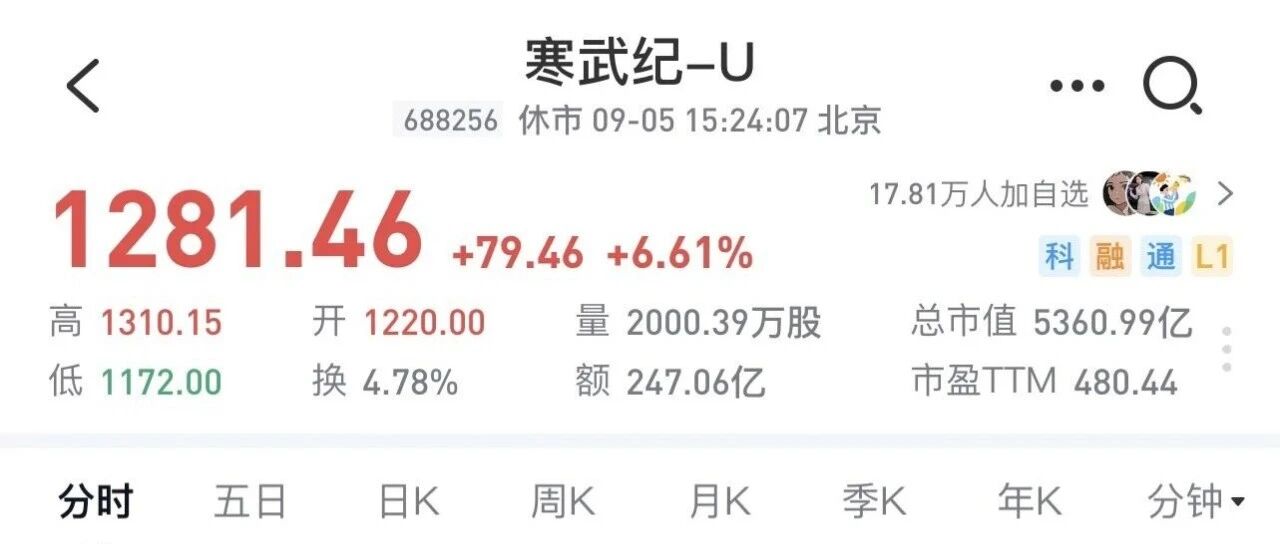
Group 1 - The core point of the news is that Cambrian has received approval from the CSRC for a stock issuance plan, which aims to raise up to 3.985 billion yuan to enhance its technological competitiveness in the AI chip market [1] - Cambrian's stock issuance plan has been adjusted to a total fundraising amount of no more than 3.985 billion yuan, with the number of shares to be issued increased to no more than 20.9175 million shares [1] - The funds raised will primarily be used for projects related to large model chip platforms and software platforms, reinforcing Cambrian's position in the competitive landscape [1] Group 2 - The demand for AI chips is experiencing explosive growth due to the evolution of large model technology, with domestic chip design manufacturers gradually increasing their market share [2] - Cambrian's SiYuan series chips are expected to benefit from the rising computational power demand across various industries and the trend of domestic substitution, potentially driving significant revenue growth and sustained profitability [2] Group 3 - Cambrian's stock price has reached new highs, approaching 1600 yuan, and has surpassed Kweichow Moutai to become the new "king of stocks" in A-shares [3] - As of October 10, Cambrian's stock has increased over 90% year-to-date, with a latest share price of 1273 yuan and a market capitalization of 532.6 billion yuan [3] - In the first half of the year, Cambrian achieved revenue of 2.88 billion yuan, a year-on-year increase of 4347.82%, and a net profit of 1.038 billion yuan, marking a turnaround to profitability [3]

华友钴业关于实施“华友转债”赎回暨摘牌的公告
Ju Chao Zi Xun· 2025-09-08 02:54
Core Viewpoint - Shanghai Nanchip Semiconductor Technology Co., Ltd. announced its fundraising plan aimed at technology innovation, with a total amount not exceeding 1,933.38 million yuan [2]. Group 1: Fundraising Overview - The total amount of funds raised will not exceed 1,933.38 million yuan, allocated to three main technology innovation projects [2]. Group 2: Project Summaries - **Intelligent Computing Power Management Chip R&D and Industrialization Project**: This project plans to invest 459.24 million yuan to develop power management products for high current applications, which will be used in PCs, data centers, and smart terminals, aiming to break foreign monopolies and enhance the company's industry position [3]. - **Automotive Chip R&D and Industrialization Project**: This project plans to invest 843.34 million yuan, focusing on various chip functions for automotive body systems, cockpit systems, and intelligent driving systems, aiming to establish a complete automotive chip ecosystem and promote domestic substitution in the automotive chip sector [4]. - **Industrial Application Sensor and Control Chip R&D and Industrialization Project**: This project plans to invest 630.80 million yuan, focusing on developing high-precision, low-power sensor and control solutions for industrial robots and smart sensing terminals, leveraging the company's capabilities in analog circuit design and control [5]. Group 3: Strategic Importance - The implementation of these projects is deemed necessary and feasible, aligning with national policy directions and market prospects, while enhancing the company's core technology and product competitiveness [5].


南芯科技加码车载芯片研发 拟发行可转债募资超19亿元
Zheng Quan Shi Bao· 2025-09-07 18:26
Group 1 - Company plans to issue up to 19.33 billion yuan in convertible bonds, with a maximum of 19.33 million bonds at a face value of 100 yuan each, to be used for R&D and industrialization in smart power management chips, automotive chips, and industrial sensor and control chips [1] - The net proceeds from the bond issuance will be allocated as follows: 4.59 billion yuan for smart power management chip R&D, 8.43 billion yuan for automotive chip R&D, and 6.31 billion yuan for industrial application chips [1] - Company reported revenue growth from 13.01 billion yuan in 2022 to 25.67 billion yuan in the first half of 2025, with net profit increasing from 2.46 billion yuan to 3.07 billion yuan during the same period [1] Group 2 - The automotive chip industry in China faces low domestic production rates, primarily due to high entry barriers and the need for long-term technological accumulation [2] - The rise of electric vehicles and smart driving applications is expected to drive growth in the automotive chip market, creating new opportunities [2] - The automotive chip R&D and industrialization project by the company is a key focus, with an investment of over 8 billion yuan and a construction period of three years [2] Group 3 - The project aims to develop a complete ecosystem of automotive chips, covering power supply, charging management, transmission, perception, decision-making, and execution [3] - The company has a strong foundation in the automotive chip sector, with 756 R&D personnel, accounting for 68.35% of total employees, and over 150 team members dedicated to automotive chip development [3] - The core team in the automotive field has an average of over 10 years of R&D experience [3]
南芯科技: 关于向不特定对象发行可转换公司债券摊薄即期回报、采取填补措施及相关主体承诺的公告
Zheng Quan Zhi Xing· 2025-09-07 08:17
Core Viewpoint - The company plans to issue convertible bonds to unspecified investors, analyzing the impact on immediate returns and proposing measures to mitigate dilution effects on shareholders [1][2][3] Financial Impact Analysis - The company estimates a maximum issuance of 1,933.38 million yuan in convertible bonds, with the actual amount depending on regulatory approvals and market conditions [2] - The projected net profit for the parent company is estimated at 306.90 million yuan for 2025, with scenarios considering a 0%, 10%, and 20% growth compared to the previous year [2][4] - The total share capital is expected to increase from 425,457,743 shares to 466,097,682 shares if all bonds are converted [3][4] Measures to Mitigate Dilution - The company will implement various measures to ensure effective use of raised funds and to minimize the dilution of immediate returns for shareholders [6][8] - The company emphasizes the importance of maintaining a robust governance structure and enhancing operational management to protect shareholder interests [9][10] Necessity and Feasibility of the Issuance - The projects funded by the bond issuance are deemed necessary and feasible, aimed at optimizing product structure and expanding business scale [6][7] - The investment projects will focus on power management chips, automotive chips, and industrial application sensors, aligning with market demand and technological trends [7] Commitment from Stakeholders - The controlling shareholders and management have made commitments to uphold the measures designed to mitigate the dilution of immediate returns [10][11] - The board of directors and senior management have pledged to avoid actions that could harm the company's interests and to ensure the execution of the proposed measures [10][11]
南芯科技: 南芯科技向不特定对象发行可转换公司债券方案论证分析报告
Zheng Quan Zhi Xing· 2025-09-07 08:17
Core Viewpoint - Southchip Semiconductor Technology (Shanghai) Co., Ltd. plans to issue convertible bonds to meet funding needs, expand operations, enhance competitiveness, and improve profitability [2][10]. Group 1: Necessity of Issuing Securities - The company aims to raise funds through the issuance of convertible bonds to support projects that will enhance its core competitiveness and sustainable development [2][3]. - The convertible bonds will be convertible into the company's A-share stock and will be listed on the Shanghai Stock Exchange's Sci-Tech Innovation Board [2]. Group 2: Selection of Issuance Objects - The issuance will target a wide range of investors, including individuals, legal entities, and investment funds, who hold accounts with the China Securities Depository and Clearing Corporation [3][4]. - Existing shareholders will have priority in the allocation of the bonds, with the specific allocation ratio to be determined based on market conditions [3][5]. Group 3: Pricing Principles and Methods - The pricing of the convertible bonds will be determined based on market conditions and the company's specific situation, with the bond interest rate subject to adjustment if bank deposit rates change [5][8]. - The initial conversion price will not be lower than the average trading price of the company's A-shares over the previous twenty trading days [6][8]. Group 4: Feasibility of the Issuance - The company has a well-functioning organizational structure and meets the legal requirements for issuing convertible bonds, including having sufficient average distributable profits to cover interest payments [10][11]. - The funds raised will be used for projects in the smart computing power sector, including the development of power management chips and automotive chips, aligning with national industrial policies [11][19]. Group 5: Compliance with Regulations - The issuance complies with the relevant provisions of the Securities Law and the Registration Management Measures, ensuring that the funds will not be used for non-productive expenditures [12][19]. - The company has established a sound internal control system and has received unqualified audit opinions for its financial statements over the past three years [16][17].
突发!芯片设计员工从中国被划归新加坡!
是说芯语· 2025-09-07 02:34
Core Viewpoint - ByteDance is restructuring its chip design team by transferring employees to its Singapore subsidiary, which may help the company navigate the geopolitical tensions between the US and China while seeking advanced semiconductor technologies [1]. Group 1: Company Restructuring - Many chip design employees at ByteDance have been unexpectedly reassigned to a new organization under the Singapore subsidiary, discovered through internal communication tools [1]. - The move to have chip design personnel report to the Singapore division is seen as a strategic response to US regulations that restrict Chinese companies from using TSMC for advanced AI chip production [1]. Group 2: Chip Development and Strategy - ByteDance has not outsourced chip manufacturing to TSMC but has been collaborating with Broadcom to develop an advanced AI chip that will be produced by TSMC [1]. - The company has been actively hiring for chip-related positions since 2022, although the number of chips launched remains lower than competitors like Alibaba and Baidu [4]. - Currently, the chips released by ByteDance are primarily for inference tasks, with lower computational power compared to AI training chips [4]. - The company is also exploring chip development in areas such as video decoding and networking, with a dedicated team focusing on AI applications [4].

每周股票复盘:峰岹科技(688279)拟取消监事会并开展15亿元外汇套期保值
Sou Hu Cai Jing· 2025-09-06 23:35
Core Points - The stock price of Fengcai Technology (688279) closed at 195.1 yuan, down 5.47% from last week [1] - The company has a total market capitalization of 22.226 billion yuan, ranking 61st out of 163 in the semiconductor sector and 826th out of 5152 in the A-share market [1] Company Announcements - Fengcai Technology held its third extraordinary general meeting of shareholders in 2025, where four proposals were reviewed, including the cancellation of the supervisory board and the revision of the company's articles of association [2] - The company plans to grant the board general authorization to issue H-shares, not exceeding 20% of the total issued H-shares, which amounts to a maximum of 4,311,200 shares [2] - The company intends to conduct foreign exchange hedging activities with a limit of up to 1.5 billion yuan or equivalent foreign currency, valid for 12 months from the date of approval [2] Performance Disclosure - Fengcai Technology will participate in the "2025 Semi-Annual Chip Design Industry Collective Performance Briefing" hosted by the Shanghai Stock Exchange on September 8, 2025 [3] - Key executives, including the chairman and general manager, will attend the meeting to address investor questions [3] Shareholder Changes - As of August 31, 2025, there were no changes in the legal/registered capital of both H-shares and A-shares [4] - The total legal/registered capital at the end of the month was 113.919 million yuan, with no changes in the number of issued shares [4]

继续聊聊国家集成电路大基金(原创)
叫小宋 别叫总· 2025-09-06 12:46
Investment Strategy - The first phase of the National Integrated Circuit Industry Investment Fund (大基金一期) was established in 2014 with a registered capital of 98.7 billion, and actual funds received were approximately 120 billion [3] - The second phase (大基金二期) was established in 2019 with a registered capital of 204.2 billion, and actual funds received were around 220 billion [3] - Significant investments from both phases were directed towards wafer manufacturing, including companies like SMIC, Hua Hong Semiconductor, and Changjiang Storage [3] - Investments also extended to packaging segments, with companies such as Tongfu Microelectronics and Jiangsu Changjiang Electronics Technology [5] - The strategy focused on addressing the largest gaps in the semiconductor industry, particularly in manufacturing, while also investing in chip design, exemplified by companies like Huawei's HiSilicon [6][7] Management - The management of both phases is handled by Huaxin Investment Management Co., Ltd. (华芯), established in 2014 specifically for managing the fund [9] - The largest shareholder of Huaxin is the National Development Bank, which is also a significant contributor to the fund [9] - In the first phase, the Ministry of Finance was the largest contributor (36%), followed by the National Development Bank (22%), while in the second phase, the Ministry of Finance contributed 11.02% and the National Development Bank 10.78% [10] - The management structure raised questions about the dual role of the National Development Bank as both a manager and a major limited partner, reflecting a high level of trust from the state [10] - The first phase involved collaboration with other semiconductor investment institutions to mitigate risks, while the second phase saw a more mature investment capability with no additional management entities [10][11]
那些「不务正业」的公司,靠炒股赚钱了
36氪· 2025-09-06 10:00
Core Viewpoint - The article discusses how many listed companies in China have shifted their focus from their core businesses to stock trading, often relying on stock investments for significant portions of their profits, especially during the current bull market [4][6]. Group 1: Companies Engaging in Stock Trading - Seven Wolves, originally a men's clothing company, reported a net profit of 160 million yuan in the first half of the year, with only 30 million yuan from clothing sales and the remaining 130 million yuan primarily from stock investments [7][8]. - Zhejiang Yongqiang, a furniture manufacturer, saw its net profit grow eightfold to 462 million yuan last year, with one-third of that profit coming from stock trading [8][20]. - Companies like Jiangsu Guotai have also entered the stock market, planning to use 138.3 billion yuan for investment, including 18 billion yuan for stock trading [13][20]. Group 2: Market Trends and Performance - The current bull market has seen significant gains, with the Shanghai Composite Index rising from just over 3000 points to nearly 3900 points, marking a ten-year high [8][9]. - The stock price of Cambricon, a company specializing in AI chip design, surged from 520.67 yuan to over 1500 yuan per share, becoming a market sensation [9][10]. - Companies like Liou Co. and Two Sides Needle have faced losses due to poor stock performance, highlighting the risks associated with heavy reliance on stock trading [10][12]. Group 3: Shifts in Business Strategy - Many companies have transitioned from traditional business models to include significant investment strategies, often driven by the need to adapt to changing market conditions [19][20]. - Seven Wolves shifted its focus to investment in 2015, moving away from pure manufacturing to a model that combines both industry and investment [19][20]. - Jiangsu Guotai's core business has been affected by geopolitical factors, leading the company to invest heavily in the stock market as a means of generating returns [20][21]. Group 4: Risks and Consequences - Companies that have become overly reliant on stock trading may face challenges in their core operations, as seen with Seven Wolves and Jiangsu Guotai, where R&D investments have declined significantly [36][38]. - The article notes that while stock trading can provide quick returns, it can also lead to a decline in traditional business performance and increased regulatory scrutiny [14][36]. - The experience of companies like Two Sides Needle, which relied on stock gains to offset operational losses, illustrates the precarious nature of such strategies [31][34].