AI

Search documents
计算机行业周报:小红书Video-Thinker打破工具依赖,DeepSeek推出mHC-20260106
Huaxin Securities· 2026-01-06 12:34
Investment Rating - The report maintains a "Buy" rating for several companies in the AI and computing sectors, including Weike Technology (301196.SZ), Nengke Technology (603859.SH), Hehe Information (688615.SH), and Maixinlin (688685.SH) [9]. Core Insights - The report highlights the introduction of the Video-Thinker model by Xiaohongshu, which breaks the dependency on external tools for video reasoning, achieving state-of-the-art (SOTA) performance with a 7B parameter version [3][22]. - DeepSeek's new architecture, mHC, shows significant performance improvements with only a 6.7% increase in training time, marking a breakthrough in model efficiency [31][32]. - Kimi, a Chinese AI startup, completed a $500 million Series C funding round, with a post-money valuation of $4.3 billion, focusing on the development of its K3 model and talent incentives for 2026 [4][44]. Summary by Sections 1. Computing Dynamics - The report notes stable pricing in computing power leasing, with specific rates for various configurations [21]. - Xiaohongshu's Video-Thinker model integrates key capabilities such as temporal grounding and visual description, achieving new benchmarks in video reasoning [22][23]. - The model's training paradigm includes a two-stage process that enhances its reasoning capabilities while reducing reliance on external tools [26][27]. 2. AI Application Dynamics - Character.AI experienced an 8.32% increase in weekly traffic, indicating growing interest in AI applications [30]. - DeepSeek's mHC architecture addresses traditional bottlenecks in model efficiency, providing a robust framework for enhancing model capabilities [31][32]. 3. AI Financing Trends - Kimi's recent funding round will support the development of its K3 model and expansion of its talent pool, following significant technological advancements in 2025 [4][44]. - Meta's acquisition of Manus for $4-5 billion underscores the strategic importance of AI applications and the integration of advanced AI capabilities into its ecosystem [5][6]. 4. Market Performance - The report provides comparative performance metrics for various AI models, showcasing the advancements made by Video-Thinker over existing solutions [28][29]. - The overall market sentiment remains positive, with a focus on the long-term growth potential of AI applications and computing technologies [7].
银河证券首次给予商汤科技“增持” 目标价3.18港元 47%上涨空间
Zhi Tong Cai Jing· 2026-01-06 08:07
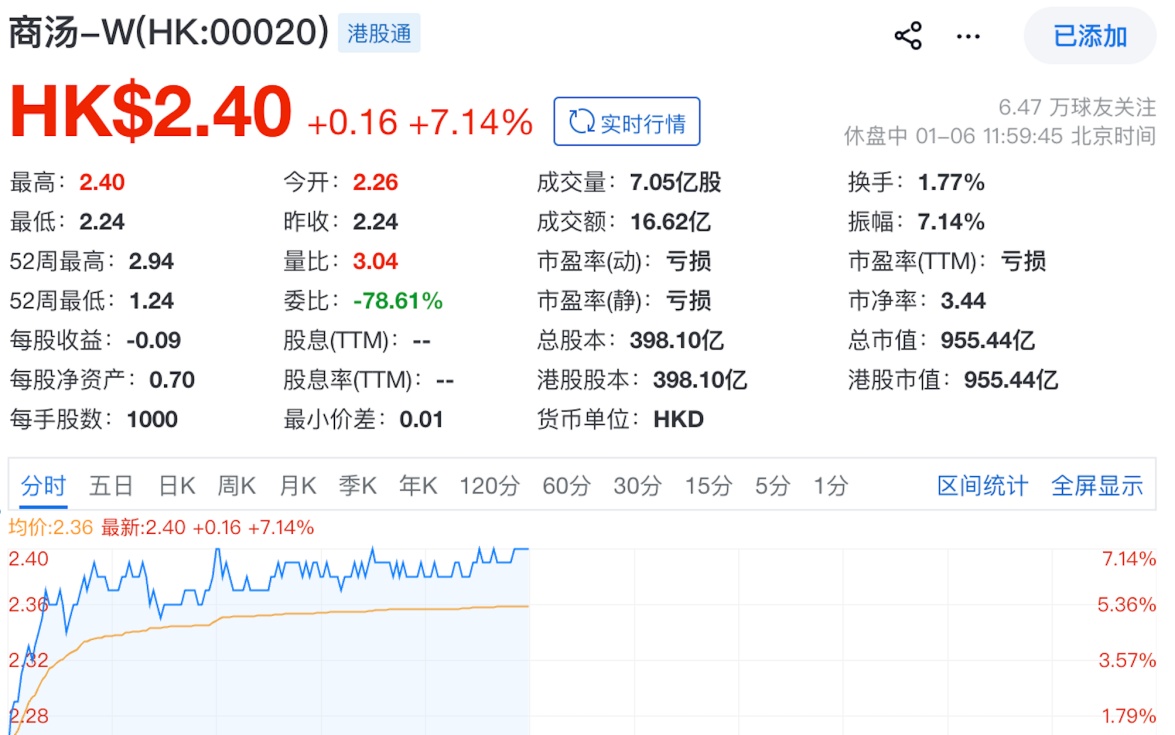
Core Viewpoint - SenseTime's stock price surged to HK$2.40, reflecting a 7.14% increase, driven by short-term catalysts in the "robotics, AI" sector and long-term improvements in its fundamentals, supported by institutional ratings and increased trading volume [1][2] Stock Performance - The stock reached a high of HK$2.40 with a trading volume of 705 million shares and a total turnover of HK$16.62 billion [2] - The stock opened at HK$2.26 and had a trading range between HK$2.24 and HK$2.40, with a market capitalization of HK$955.44 billion [2] Institutional Support - Galaxy Securities initiated coverage on SenseTime with a target price of HK$3.18, indicating a potential upside of 47% from the closing price of HK$2.16 on December 10, 2025 [2] Product Launches - SenseTime's recent "Product Launch Week" introduced several innovative AI products, including the Seko2.0 multi-episode generation agent and various AI applications for office and e-commerce [3][5] - The Seko2.0 can create and organize content simultaneously, while the AI assistant Xiaohuanxiong 3.0 and the marketing agent "Like Shadow" enhance operational efficiency [3][5] Growth Projections - Galaxy Securities forecasts a compound annual growth rate (CAGR) of 30% for SenseTime from 2024 to 2027, with revenue expected to rise from RMB 3.8 billion to RMB 8.3 billion, and profitability anticipated by 2027 [4] - The company's strategy focuses on independent market operations in various innovative sectors, optimizing resource allocation and financial structure [4] Technological Advancements - SenseTime's new products address industry challenges and enhance operational efficiency, with the Seko2.0 achieving significant upgrades and the AI office assistant demonstrating high accuracy in enterprise scenarios [5] - The open-source multi-modal NEO architecture requires only 3.9 million training data to achieve top performance, showcasing the company's technological capabilities [5] Valuation Insights - The launch of new products is seen as a key driver for valuation recovery, with Galaxy Securities noting that the current enterprise value/sales ratio of 13 times for the 2026 fiscal year does not fully reflect the growth potential of generative AI [6] - The combination of continuous technological breakthroughs, clear strategic focus, and positive capital ratings creates a resonant effect that positions SenseTime for sustained growth [6]

Chinese Stocks Rally to Four-Year High in Strong Start to 2026
Yahoo Finance· 2026-01-06 07:38
Bloomberg Chinese stocks climbed to multi-year highs, fueled by sustained optimism over the country’s AI advances and emerging signs of an economic recovery. The benchmark CSI 300 Index advanced 1.6% to close at its highest level in four years, while the Shanghai Composite Index rose 1.5% to its strongest since July 2015. Materials and technology shares were among the day’s best performers. Buoyed by upbeat manufacturing activity, President Xi Jinping’s positive assessment of the economy and a continue ...
ACDC 2026嘉宾解锁|李锦威:定义市场所需的“超级产品”
Xin Lang Cai Jing· 2026-01-06 05:03
Core Insights - The article emphasizes the importance of aligning technological advancements with market needs, questioning whether the "super products" being developed are truly what the market requires and users are willing to adopt continuously [1][2] Group 1: Event Overview - The ACDC 2026 conference will focus on the transition from technology potential to commercial success, featuring a dialogue on "super computing creating super products" led by Refly.AI's CMO, Li Jinwei [1] - Li Jinwei will discuss how to define core product value, validate user needs, and build sustainable business models in the context of AI applications [1][2] Group 2: Market Relevance - The dialogue aims to bridge the gap between internal development and external market recognition, providing insights on converting technological strength into market acceptance and growth [2] - This discussion is crucial for technology decision-makers and entrepreneurs, as it addresses the challenges of moving from demonstration to widespread adoption of products [2]
金鹰基金杨晓斌:关注科技变革、出海优势、供给受限三大主线
Xin Lang Cai Jing· 2026-01-06 02:19
专题:2026年度投资策略|顶级基金公司、基金经理展望马年投资机会 经历了过去半年市场的上涨,去年年底时段A股在3900点附近高位震荡,出现了明显的主题轮动和阶段 性畏高情绪,尽管股市短期滞涨,但来自国内外的不确定性因素自去年四季度以来都有所下降,我们认 为A股市场在2026年或依然大有可为。 放眼历史和全球股市,目前A股的估值尚处在历史中枢下方,国际比较下A股的"估值洼地"优势较为突 出。虽然2025年A股表现较好,但整体上看股市走得非常理性,更多体现了对过去几年过度悲观预期的 修复,这种修复只在局部景气上行的成长和周期行业当中,而非全部行业,因此我们不认为股市目前存 在系统性高估风险。 随着后续我们看到更多行业基本面见底,或有更多行业和个股出现估值修复,因此,站在2026年初的时 点,我们倾向认为A股市场的慢牛或还处在上半场。在地产逐步出清的大背景下,A股将是未来居民最 重要的可配置资产,在这个过程中我们会逐步见证股市波动率下降(吸引更多老百姓长期配置)和宏观 基本面见底(推动A股的戴维斯双击逐步兑现)。不仅仅是实际GDP,名义GDP以及上市公司利润增速 在2026年都大概率会经历前低后高的过程,这也意味 ...
FRMI CLASS ACTION NOTICE: Glancy Prongay & Murray LLP Files Securities Fraud Lawsuit On Behalf Of Fermi Inc. Shareholders
Businesswire· 2026-01-06 01:07
Core Viewpoint - A class action lawsuit has been filed against Fermi Inc. for allegedly making materially false and misleading statements regarding its business operations and prospects during its IPO and subsequent trading period [1][6]. Group 1: Lawsuit Details - The lawsuit is filed in the United States District Court for the Southern District of New York, under the case name Lupia v. Fermi, Inc., and is on behalf of individuals and entities that purchased Fermi's common stock during the IPO and the class period from October 1, 2025, to December 11, 2025 [1]. - The lawsuit claims violations of Sections 10(b) and 20(a) of the Securities Exchange Act of 1934 [1]. Group 2: IPO and Stock Performance - Fermi conducted its IPO on October 1, 2025, selling 37,375,000 shares at a price of $21.00 per share [3]. - Following the announcement of a significant tenant's termination of a $150 million funding agreement, Fermi's stock price dropped by $5.16, or 33.8%, closing at $10.09 on December 12, 2025 [4]. - By the time the lawsuit commenced, Fermi's stock had fallen to as low as $8.59 per share, representing a 59% decline from the IPO price [5]. Group 3: Allegations Against Defendants - The complaint alleges that Fermi's Registration Statement and statements made during the class period contained materially false and misleading information, including an overstatement of tenant demand for the Project Matador campus and reliance on a single tenant's funding commitment [6]. - It is claimed that the defendants failed to disclose the significant risk of the tenant terminating its funding commitment, which misled investors regarding the company's business and operational prospects [6].

A股罕见12连阳,原因找到了
21世纪经济报道· 2026-01-06 00:41
记者丨易妍君 编辑丨张星 2026年,A股旗开得胜,三大股指在首个交易日(即1月5日)悉数上涨。 这一天,上证指数重返4000点之上,日线更是迎来罕见的12连阳,为"春季躁动"预期下的A股市场再添"一把火"。 市场热点轮番活跃,脑机接口、保险、存储器等题材相对强势;CRO、模拟芯片、基因检测、虚拟人等概念也有不错的表现。 展望后市,前海开源基金首席经济学家、基金经理杨德龙判断,2026年科技牛行情有望延续。 多因素助推A股"开门红" 1月5日,A股市场高开高走,喜迎2026年"开门红"。 截至当日收盘,上证指数涨1.38%,报4023.42点;深证成指涨2.24%,报13828.63点;创业板指的涨幅接近2.9%,报3294.55点。科 创50指数则大涨4.41%,北证50指数上涨1.8%。 当天,全部A股成交额达2.57万亿元,较前一个交易日增加了5000多亿元。全市场近4200只个股上涨。 在业内人士看来,A股"开门红"得益于多重积极因素的共振。 "节后市场情绪在假期港股走强的带动下显著回暖; 资金层面,市场对年内保险资金等长期增量资金入市抱有期待,同时全球流动 性宽松预期也提振了风险偏好;更深层次的驱动 ...

太空光伏超高壁垒铸就蓝海市场 | 券商晨会
Sou Hu Cai Jing· 2026-01-06 00:31
Group 1 - The geopolitical tensions have intensified due to the large-scale military action by the US against Venezuela, leading to increased demand for safe-haven assets like gold and reinforcing the bullish trend in precious metals [1] - In the base metals sector, the beginning of the year saw strikes among copper mine workers, exacerbating existing supply issues; there are also concerns about potential production cuts in electrolytic aluminum, which has led to a price increase [1] - Indonesian nickel miners have proposed reducing nickel ore quotas, and Vale's Indonesian operations have paused mining due to delays in production plans, supporting a rebound in nickel prices [1] Group 2 - The A-share market is expected to trend towards a more balanced style by 2026, driven by the ongoing capacity reduction and the macroeconomic environment [2] - Three main investment themes are suggested: 1) Growth in AI technology and related sectors, with a focus on domestic applications; 2) Opportunities in overseas markets, particularly in home appliances, engineering machinery, and non-ferrous metals; 3) Cyclical recovery in industries like chemicals and renewable energy [2] - The real estate sector and broader consumer market may still be in a left-side position, with macroeconomic changes and policy reforms expected to balance the "temperature difference" between new and old economies [2] Group 3 - The report highlights "space photovoltaics" as a key investment theme for the future, emphasizing its unique and urgent investment logic [3] - Photovoltaics are identified as the only viable and reliable power solution for long-term operation of spacecraft, with no alternative technology available [3] - The urgency is driven by the International Telecommunication Union's rules on near-Earth orbit and spectrum resources, which make the speed of satellite deployment critical for national space strategy and commercial advantage [3]
NVIDIA (NasdaqGS:NVDA) 2026 Conference Transcript
2026-01-05 22:02
Summary of NVIDIA Conference Call Company Overview - **Company**: NVIDIA (NasdaqGS: NVDA) - **Event**: 2026 Conference at CES - **Date**: January 05, 2026 Key Industry Insights - **Platform Shifts**: The computing industry is experiencing two simultaneous platform shifts: the transition to AI and the development of applications built on AI [2][3] - **Investment Trends**: Approximately $10 trillion of computing from the last decade is being modernized, with hundreds of billions in venture capital funding directed towards AI advancements [3][4] - **AI Evolution**: The introduction of large language models and agentic systems has transformed AI capabilities, allowing for real-time reasoning and decision-making [5][6][16] Core Technological Developments - **Agentic Systems**: These systems can reason, plan, and simulate outcomes, significantly enhancing problem-solving capabilities in various domains [6][7] - **Open Models**: The rise of open-source AI models has democratized access to AI technology, leading to rapid innovation and widespread adoption across industries [8][12] - **Physical AI**: Advances in physical AI are enabling machines to understand and interact with the physical world, which is crucial for applications in robotics and autonomous vehicles [25][26] Product Innovations - **AlphaMyo**: NVIDIA's new autonomous vehicle AI, capable of reasoning and decision-making based on real-time data, is set to revolutionize self-driving technology [33][34] - **Cosmos**: A foundation model for physical AI that integrates various data types to enhance AI's understanding of the physical world [31][32] - **Vera Rubin Supercomputer**: A new AI supercomputer designed to meet the increasing computational demands of AI, featuring advanced architecture and high-speed data processing capabilities [55][56] Strategic Partnerships - **Collaboration with Siemens**: NVIDIA is integrating its technologies into Siemens' platforms to enhance industrial automation and simulation capabilities [49][50] - **Enterprise Integration**: Partnerships with companies like Palantir, ServiceNow, and Snowflake are transforming enterprise AI applications, moving towards more intuitive user interfaces [24][25] Market Outlook - **Autonomous Vehicles**: The transition to autonomous vehicles is anticipated to accelerate, with a significant percentage of cars expected to be autonomous within the next decade [42][43] - **AI in Industries**: The integration of AI into various sectors, including manufacturing and design, is expected to drive a new industrial revolution [50][51] Additional Insights - **Investment in R&D**: A significant portion of R&D budgets is shifting towards AI, indicating a long-term commitment to AI development across industries [3][4] - **Customization of AI**: Companies can now customize AI models to fit specific needs, enhancing their operational efficiency and effectiveness [19][20] This summary encapsulates the key points discussed during the NVIDIA conference, highlighting the company's strategic direction, technological advancements, and market implications.

Wall Street Lunch: Fox's FanDuel Call Option Emerges As Hidden Growth Lever
Seeking Alpha· 2026-01-05 17:43
Group 1: Fox and Flutter's FanDuel - Fox has the option to acquire an 18.6% stake in Flutter's FanDuel, which holds over 30% market share in U.S. sports betting [2][3] - The option originated from Fox's 2019 investment in The Stars Group, which was later folded into FanDuel after Flutter's acquisition [3] - CEO Lachlan Murdoch confirmed Fox's intention to exercise the option, with a potential FanDuel valuation around $35 billion [4] Group 2: Market Reactions and Other News - Analysts view the FanDuel option as a hidden asset value for Fox, with varying opinions on the timing for exercising the option [5] - LifeMD and GoodRx stocks rose after adding Novo Nordisk's Wegovy weight-loss pill to their offerings, priced at $149 per month [5] - Samsung and SK hynix are expected to raise server memory prices by up to 70% in Q1 due to increased AI demand [6]