化妆品

Search documents
毛戈平涨超5% 公司线上销售增长强劲 计划于26年一季度推出多元化产品
Zhi Tong Cai Jing· 2026-01-20 03:19
Core Viewpoint - The company 毛戈平 (01318) has seen a significant stock increase of over 5%, attributed to strong sales performance and strategic growth plans [1] Group 1: Sales Performance - The company reported online sales growth of over 40% year-on-year and offline sales growth of approximately 20% for the last quarter, driven by the Double Eleven promotion and strong December performance [1] - The management anticipates that by the end of 2025, offline membership will increase by about 25% annually, reaching 6 million members [1] Group 2: Future Growth Plans - 毛戈平 plans to launch diversified products in the first quarter of 2026, with projected sales growth of 35% online and 20% offline starting in 2026 [1] - The company expects to maintain low double-digit same-store sales growth, with stable gross and operating profit margins, and a net profit margin exceeding 20% [1] Group 3: Long-term Projections - The company aims to achieve sales of 10 billion RMB by 2028, indicating a compound annual growth rate of 27% from 2024 to 2028 [1]
港股异动 | 毛戈平(01318)涨超5% 公司线上销售增长强劲 计划于26年一季度推出多元化产品
智通财经网· 2026-01-20 03:17
Core Viewpoint - The company Mao Geping (01318) has seen a stock increase of over 5%, attributed to strong sales performance during the Double Eleven promotion and December, with online and offline sales growth of over 40% and approximately 20% year-on-year respectively [1] Group 1: Sales Performance - The company reported online sales growth of over 40% and offline sales growth of about 20% year-on-year [1] - The management anticipates that by the end of 2025, offline membership will increase by approximately 25% to 6 million [1] Group 2: Future Plans - Mao Geping plans to launch diversified products in the first quarter of 2026 [1] - The management expects sales growth of 35% for online and 20% for offline channels starting in 2026, driven by volume growth [1] Group 3: Financial Projections - The company aims to achieve sales of 10 billion RMB by 2028, indicating a compound annual growth rate of 27% from 2024 to 2028 [1] - The management projects that same-store sales growth will remain in the low single digits, with stable gross and operating profit margins, and a net profit margin exceeding 20% [1]
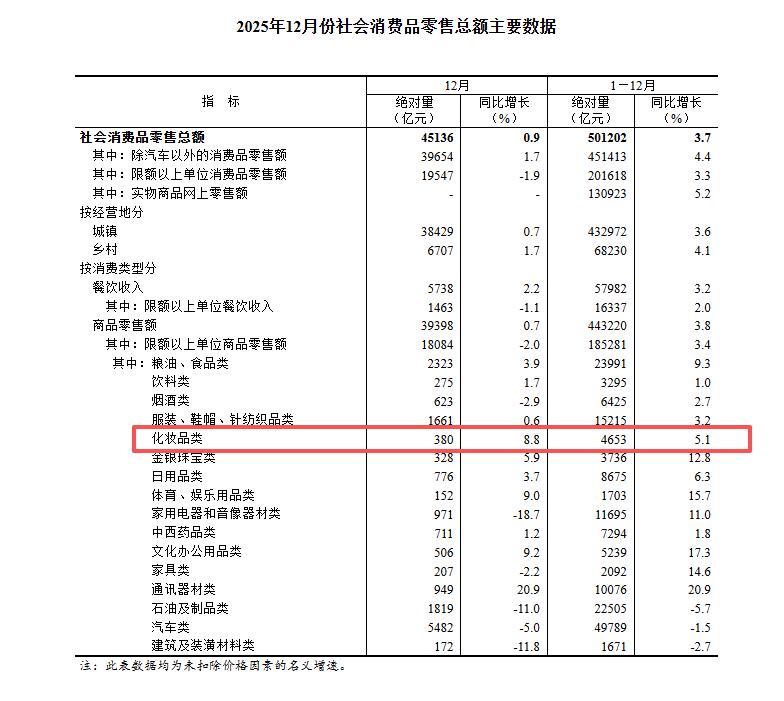
4653亿,化妆品卖爆了
3 6 Ke· 2026-01-20 01:12
Group 1 - The core viewpoint of the articles indicates that the cosmetics retail sector in China has shown signs of recovery, with retail sales increasing after a decline in previous years [1][4][10] - In December 2025, cosmetics retail sales reached 38 billion yuan, marking an 8.8% year-on-year growth, while the total retail sales for the year amounted to 465.3 billion yuan, reflecting a 5.1% increase [1][4][6] - The overall retail sales of consumer goods in China for 2025 were reported at 501.2 billion yuan, with a growth rate of 3.7%, indicating that the cosmetics sector outperformed the broader market [2][4][6] Group 2 - The cosmetics retail sector has demonstrated resilience, with a consistent upward trend in sales since July 2025, achieving six consecutive months of year-on-year growth [7][10] - The growth in cosmetics retail sales is attributed to a combination of factors, including a relatively low base from the previous year and the impact of promotional events like Double Eleven [2][4][6] - The market share of domestic brands in the cosmetics sector has increased to 57.03%, while foreign brands have seen a decline to 42.97% [11][12] Group 3 - The online sales channel for cosmetics has grown by 9.36%, accounting for 56.06% of total sales, while offline sales increased by 2.38% [11] - The skincare and makeup categories are leading in market size, with sales of 472.48 billion yuan and 169.25 billion yuan respectively, both showing growth [12] - The import of beauty and personal care products has shown a decline in total value, indicating a shift in consumer preference towards domestic products [13] Group 4 - The cosmetics industry is facing challenges, with a significant number of companies going bankrupt or ceasing operations, highlighting a competitive market environment [16][17] - Despite the challenges, there is optimism for 2026, with industry experts emphasizing the importance of innovation and product quality for growth [16][18] - Companies are increasingly looking to expand into overseas markets, particularly in Southeast Asia, to mitigate domestic competition [16][18]

抖音30+她经济:三类品牌抢走欧莱雅们的生意
3 6 Ke· 2026-01-20 00:28
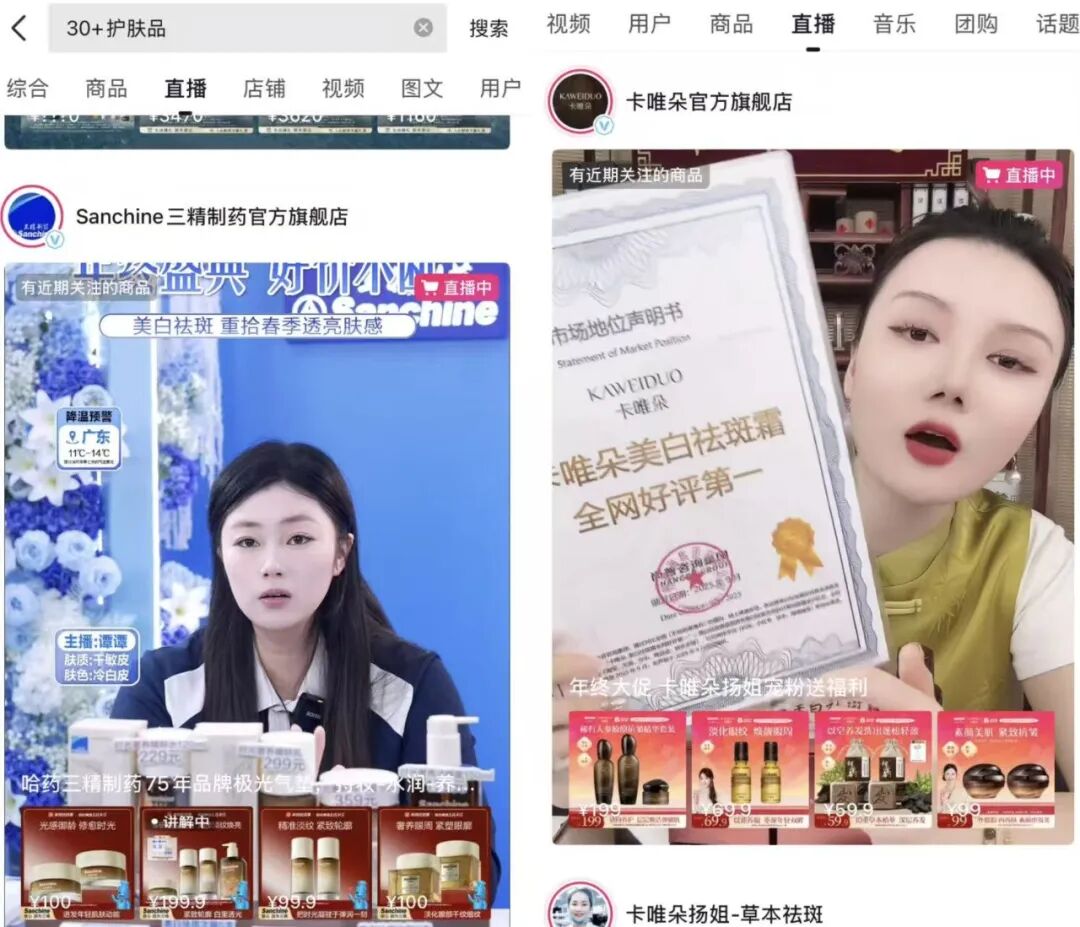
Core Insights - The article discusses the competitive landscape of the beauty market on Douyin, highlighting that L'Oréal has fallen out of the top ten rankings, while lesser-known brands are rapidly gaining market share [1][3] - The rise of brands targeting the 30+ demographic, particularly middle-aged women, is identified as a significant growth driver in the cosmetics industry [3][7] Market Trends - The 30+ age group accounts for nearly 90% of skincare consumption on Douyin, with the 31-40 age bracket being the largest segment at 35.05% [7] - The skincare needs of this demographic focus on anti-aging, spot removal, and medical beauty recovery, indicating a mature consumer decision-making ability and willingness to pay [9][47] Brand Performance - New brands like MEICHIC and Aiposa have entered the market and achieved significant sales, with MEICHIC's flagship product, a 99 yuan luxury cream, becoming a bestseller [10][12] - Pharmaceutical brands such as Mayinglong and Sanjing Pharmaceutical are also performing well in the eye cream category, with Mayinglong ranking third in the top five eye creams [13][39] Emerging Brands and Strategies - A variety of new brands are emerging, focusing on the 30+ demographic and achieving monthly GMV of over 10 million yuan, with some surpassing 100 million yuan [20][22] - These brands employ different strategies, including leveraging founder IPs, offering affordable luxury products, and utilizing targeted marketing to address specific consumer pain points [23][24] Competitive Landscape - Three main strategies are identified among brands targeting the 30+ demographic: 1. Brands using founder IPs and affordable luxury products to attract middle-aged consumers [24][29] 2. Korean brands positioning themselves as high-end skincare options, often utilizing celebrity endorsements [32][34] 3. Pharmaceutical and white-label brands focusing on eye care products, leveraging scientific credibility and targeted marketing [37][39] Consumer Insights - The demand for anti-aging products is becoming a necessity rather than an option, driven by the economic empowerment and health consciousness of the 30+ demographic [47][54] - The anti-aging market in China is projected to reach 178.6 billion yuan by 2030, indicating substantial growth potential [47] Challenges and Considerations - Despite the rapid rise of these brands, their growth heavily relies on high-frequency live streaming and significant advertising investments, raising concerns about sustainability [55] - Transitioning from a focus on explosive sales to long-term brand value will require improvements in research and development, user engagement, and quality control [55]
彩妆品牌合伙人离职、超八成收入来自韩束 上美股份如何解决结构难题?
Zhong Guo Jing Ying Bao· 2026-01-20 00:19
Core Viewpoint - The recent departure of Gu Mai, a partner of NAN beauty under Shangmei Co., has raised concerns about the company's reliance on a single brand and its overall business strategy in the beauty industry [1][2]. Group 1: Company Overview - Shangmei Co. has a diverse portfolio of brands, including skincare and maternal and infant products, but over 80% of its revenue still comes from the Han Shu brand [1][4]. - As of the first half of 2025, Han Shu generated revenue of 33.44 billion yuan, accounting for 81.4% of the total revenue, with a year-on-year increase of 14.3% [4][6]. - Other brands under Shangmei, such as newpage, Yiyezi, and Hongse Xiaoxiang, contributed significantly less, with revenues of 3.97 billion yuan, 0.89 billion yuan, and 1.59 billion yuan, respectively [4]. Group 2: Market Position and Challenges - The company has a strong presence on Douyin, with over 90% of its revenue coming from online channels, primarily from Douyin, indicating a high sensitivity to platform traffic [1][5]. - The departure of Gu Mai, who had expertise in the Tmall channel, highlights a gap in Shangmei's strategy, as the brand has struggled to gain traction on Tmall despite its strong performance on Douyin [2][5]. - The brand NAN beauty, launched in September 2025, has not shown significant growth in its follower count on platforms like Xiaohongshu, indicating challenges in brand performance [2]. Group 3: Financial and Operational Insights - Shangmei's marketing expenses remain high, with sales and distribution costs accounting for 56.9% of total revenue in the first half of 2025, although this is a slight decrease from 57.6% in the previous year [6]. - The company has been exploring new growth avenues, but the success of these initiatives remains uncertain [7]. - The recent controversy surrounding Han Shu's products, which were found to contain questionable ingredients, has negatively impacted the company's stock price, which fell from 85.3 HKD to 57 HKD before recovering slightly to 73.95 HKD [6].
林清轩(02657):首次覆盖报告:以油养肤开创者,产品渠道拓展加速
Haitong Securities International· 2026-01-19 14:26
Investment Rating - The report gives the company an "Outperform" rating with a target price of 118.57 HKD, corresponding to a 2025 PE of 26x and a reasonable valuation of 149 billion RMB (approximately 166 billion HKD) [1][7]. Core Insights - The company has been deeply engaged in the oil-based skincare sector for many years, leveraging platforms like Douyin to drive the explosive growth of its flagship products. The expansion of product categories and channels is expected to lead to sustained rapid growth [1][7]. - The company has established itself as a leader in the oil-based skincare market, with a significant market share in facial essence oils, projected to reach 12.4% in 2024, significantly ahead of competitors [3][37]. - The financial forecasts indicate substantial revenue growth, with total revenue expected to reach 23.16 billion RMB in 2025, representing a year-on-year increase of 91.5% [2][12]. Company Overview - The company, Lin Qingxuan, was founded in 2003 and has evolved from offering handmade soaps and aloe vera gels to becoming a pioneer in oil-based skincare with its flagship product, Camellia Oil Essence, launched in 2014 [3][17]. - The management team is experienced and stable, with the founder holding over 70% of the shares, ensuring concentrated ownership and strategic direction [22][26]. Business Performance - The flagship product, the Camellia Oil Essence, has seen rapid growth, with revenue from this category increasing by 176% year-on-year in the first half of 2025, accounting for 46% of total revenue [3][28]. - Online sales have surged, with Douyin driving a 137% increase in online revenue in the first half of 2025, contributing to a 65% share of total revenue [3][36]. Industry Insights - The oil-based skincare segment is experiencing high demand, with the market for facial essence oils projected to grow to 5.3 billion RMB in 2024, reflecting a year-on-year increase of 43% [3][37]. - The overall anti-aging skincare market is expected to reach 119.9 billion RMB in 2024, with a significant portion attributed to high-end products [37][39].
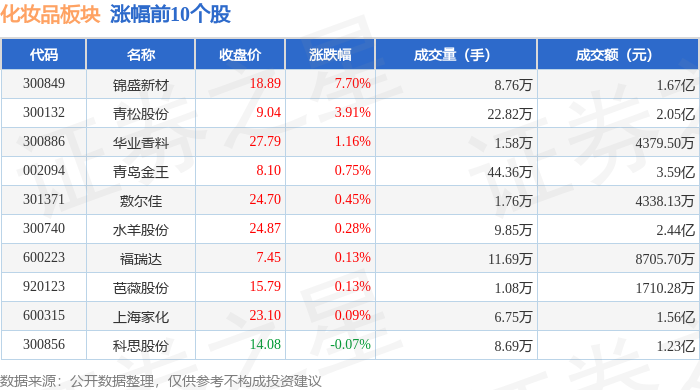
化妆品板块1月19日涨0.09%,锦盛新材领涨,主力资金净流出5088.16万元
Zheng Xing Xing Ye Ri Bao· 2026-01-19 08:58
Group 1 - The cosmetics sector experienced a slight increase of 0.09% on January 19, with Jinsheng New Materials leading the gains [1] - The Shanghai Composite Index closed at 4114.0, up by 0.29%, while the Shenzhen Component Index closed at 14294.05, up by 0.09% [1] - Jinsheng New Materials saw a closing price of 18.89, with a significant increase of 7.70%, and a trading volume of 87,600 shares, amounting to a transaction value of 167 million yuan [1] Group 2 - The cosmetics sector faced a net outflow of 50.88 million yuan from institutional investors, while retail investors saw a net inflow of 42.92 million yuan [2] - The trading data indicates that LaFang Family, with a closing price of 22.58, experienced a decline of 3.30%, with a trading volume of 70,600 shares and a transaction value of 161 million yuan [2] - The individual stock performance shows that Beitaini had a net inflow of 25.48 million yuan from institutional investors, but a net outflow of 39.58 million yuan from retail investors [3]


社零数据点评:12月社零+0.9%,化妆品持续复苏
HUAXI Securities· 2026-01-19 08:49
Investment Rating - Industry rating: Recommended [4] Core Insights - The retail sales of consumer goods in December 2025 showed a year-on-year increase of 0.9%, which was below the expected 1.5%. The total retail sales for the year 2025 increased by 3.7% year-on-year, with specific categories such as furniture, cultural office supplies, cosmetics, and gold and silver jewelry showing growth rates of 14.6%, 17.3%, 5.1%, and 12.8% respectively [1][2] - The real estate sector faced significant challenges, with new housing starts, completed areas, sales areas, and investment in residential development all declining year-on-year by 18.8%, 20.6%, 18.9%, and 36.5% respectively in December 2025 [2][3] Summary by Category Home Furnishing - The home furnishing industry is expected to stabilize due to dual support from policies and the economy. The real estate market is showing signs of gradual recovery, which is anticipated to improve the demand for home furnishings [2] - The implementation of trade-in subsidies for durable consumer goods starting in Q4 2024 is expected to significantly activate consumer demand for home furnishings [2] Cosmetics - The cosmetics industry is experiencing steady recovery, with retail sales reaching 465.3 billion yuan in 2025, a year-on-year increase of 5.1%. December sales alone were 38 billion yuan, reflecting an 8.8% year-on-year growth [3][6] - The demand for cosmetics is shifting towards quality, efficacy, and brand value, with consumers willing to pay a premium for high-end skincare and professional makeup products [3][6] Gold and Jewelry - The gold and jewelry sector saw retail sales of 373.6 billion yuan in 2025, a year-on-year increase of 12.8%. In December, sales were 32.8 billion yuan, with a 5.9% year-on-year growth [7] - Despite pressure on sales volumes due to rising gold prices, the increase in prices has positively impacted retail sales, indicating a potential for continued growth in the market [7] Investment Recommendations - For home furnishing, focus on leading companies with strong channel capabilities and diversified product lines, such as Oppein Home and Kuka Home. Also, consider companies like Sensun Holdings that are expected to benefit from the recovery in the North American real estate market [8] - In the cosmetics sector, pay attention to high-end brands with Eastern cultural characteristics, such as Mao Geping and Lin Qingxuan, as well as companies like Marubi and Dengkang Oral that show clear improvement trends [8] - In the gold and jewelry sector, companies with high brand premium capabilities and differentiated pricing models, such as Laopu Gold, are recommended due to the ongoing upward trend in gold prices [8]
江苏省特殊化妆品质量检验检测中心正式获批成立
Yang Zi Wan Bao Wang· 2026-01-19 07:24
下一步,江苏省特殊化妆品质量检验检测中心将持续发挥"技术规范协同者""产学研转化枢纽"和"检测 认证服务者"三重角色,努力打造具有省内引领力和行业影响力的特殊化妆品技术服务平台,为江苏特 殊化妆品产业高质量发展提供坚实的技术支撑与服务保障,更好助力"美丽经济"高质量发展。 校对 陶善工 近日,由无锡市检验检测认证研究院筹建的江苏省特殊化妆品质量检验检测中心获批成立,标志着无锡 在特殊化妆品检验检测综合服务能力迈上新台阶,为全省乃至长三角地区特殊化妆品产业高质量发展提 供强有力的技术支撑。 江苏省特殊化妆品质量检验检测中心自获批筹建以来,不断推进实验场地建设,建成运行化妆品理化成 分分析、微生物检测、人体安全和功效评价以及动物替代试验等多个检测平台,检测范围涵盖了化妆品 的理化指标、微生物、禁限用物质等多个方面,能够满足不同类型化妆品的检测需求。能为企业提供包 括产品上市前合规与注册备案支持、型式检验/全项目检验、备案检测、监督抽检、风险物质筛查与监 测、产品研发与原料验证服务、配方协助开发、产品性能优化测试、原料和产品的功效验证、成分标注 符合性审核、法规咨询与标准服务、产品宣传设计等服务项目。中心"皮肤芯片 ...
化妆品“唯成分论”乱象 检测屡陷“罗生门”
经济观察报· 2026-01-19 07:22
Core Viewpoint - The ongoing disputes regarding cosmetic ingredient content reflect a marketing battle driven by single-ingredient concept marketing [5] Group 1: Disputes and Detection Challenges - Recent controversies have arisen over the ingredient content in cosmetics, with brands like Han Shu and Ke Fu Mei facing scrutiny in 2025 due to differing detection results from various institutions [2] - The complexity of cosmetic formulations leads to varying detection results, influenced by the matrix of ingredients and the methods used for testing [6] - The lack of standardized testing methods contributes to discrepancies in results, with some institutions using inappropriate methods that amplify result deviations [6] Group 2: Consumer Trust and Understanding - Consumers are left confused by conflicting information, raising questions about the precision of ingredient content detection and the significance of small variations in ingredient amounts [3][11] - The rise of ingredient-conscious consumers has prompted brands to disclose more product information, making detection results a key factor in assessing product value [12][13] Group 3: Scientific and Regulatory Insights - The detection of active ingredients like peptides and proteins faces challenges due to their low concentrations and susceptibility to degradation during testing [7] - Current effective detection technologies, such as LC-MS/MS, provide high sensitivity and specificity, enabling accurate measurement of active ingredients [9] - The establishment of credible group standards requires a diverse range of stakeholders, including hospitals, research institutions, and regulatory bodies, to ensure transparency and inclusivity [16] Group 4: Recommendations for Industry Development - The industry should shift towards a foundation of skin science and evidence-based medicine, moving away from a focus solely on ingredient content [17] - Collaboration among regulatory bodies, research institutions, and companies is essential to integrate evidence-based logic into industry standards and practices [17]