
流媒体

Search documents
Netflix法国下场,全球电视步入“网感”时代
3 6 Ke· 2025-07-14 01:29
Core Insights - Netflix has entered a content distribution agreement with TF1, starting in summer 2026, enhancing their collaboration following the production of the French series "舞台追光" [1] - The relationship between traditional TV stations and streaming platforms is evolving globally, shifting from competition to a more collaborative model [1] Group 1: Japan - Content Distribution Collaboration - Japanese TV stations maintain control over content production and distribution despite the rise of streaming platforms [2][5] - Major TV networks like NTV, TBS, and Fuji TV are actively expanding their own streaming services to create a closed copyright loop and brand exclusivity [2] - The strategy emphasizes "enhanced content supply and resource integration," allowing traditional TV to coexist with streaming services [5] Group 2: UK - Platform Alliance Experiment - The UK television industry, led by entities like BBC and ITV, is exploring integration with streaming platforms to adapt to changing viewer habits [6][8] - Previous attempts to create joint ventures for video-on-demand services have been made, with BritBox successfully entering international markets [6] - The new service "Freely" aims to combine traditional broadcasting with streaming, reflecting a strategy of maintaining control while innovating [8] Group 3: South Korea - Co-production Cycle - South Korea exhibits a dynamic relationship between traditional media and streaming platforms, with major TV networks still controlling content supply [9][10] - Local streaming services like Wavve and TVING are rapidly growing, backed by traditional media groups [10] - Netflix's significant investment in local content creation has led to a unique model where platforms contribute to content development while preserving local industry characteristics [12] Group 4: USA - Platform Monopoly Formation - The U.S. market has seen traditional TV networks transitioning to platform operators, leading to a "platform explosion" with services like Disney+ and HBO Max [13][15] - High content costs and declining ad revenues have caused many platforms to enter a correction phase, with some struggling to survive [15] - The U.S. is now characterized by a "platform content ecosystem monopoly," where platforms control the entire content chain, relegating traditional TV to a branding role [15] Conclusion - The global trend indicates a fierce competition for user engagement and advertising share between streaming platforms and traditional TV, with each country adopting different strategies to adapt [16] - The evolving landscape suggests a redefinition of boundaries between television and streaming services, with a clear shift towards platform dominance in content distribution [16]


一周展望:CPI审判日即将到来!黄金仍需重磅催化剂
Jin Shi Shu Ju· 2025-07-13 05:58
Group 1: Tariffs and Trade - The U.S. President Trump announced a 35% tariff on Canadian imports starting next month, an increase from the previously set 25% [1] - Trump suggested raising tariffs on other countries to 15% or 20%, up from the current 10% [1] - Market participants are facing uncertainty as the August 1 tariff implementation date approaches, with ongoing negotiations between the U.S. and other countries [1] Group 2: Market Reactions - The market reacted more calmly to the new tariff announcements compared to the sharp declines seen after the "liberation day" in April [2] - Major U.S. stock indices experienced slight declines, with the S&P 500 and Nasdaq down, while the Dow Jones broke its longest three-week winning streak since January [2] - Nvidia became the first company to reach a market capitalization of $4 trillion, with its stock hitting a historical high [2] Group 3: Economic Indicators - The upcoming U.S. CPI data and retail sales figures are expected to influence the Federal Reserve's decisions on interest rate cuts [4][10] - The June CPI is anticipated to rise from 2.4% to 2.7% year-on-year, which could impact the Fed's rate cut considerations [11] - The June PPI and retail sales data will also be released, providing further insights into inflation and consumer spending [12] Group 4: Company Earnings - The second-quarter earnings season is set to begin, with major companies like JPMorgan, Morgan Stanley, Citigroup, Goldman Sachs, Netflix, and TSMC reporting [17] - Netflix's upcoming earnings report is particularly significant, as its stock recently reached an all-time high, necessitating impressive results to maintain its upward trend [17] - The financial sector is expected to provide positive signals, while tech giants, especially Nvidia, may drive further market gains [17]
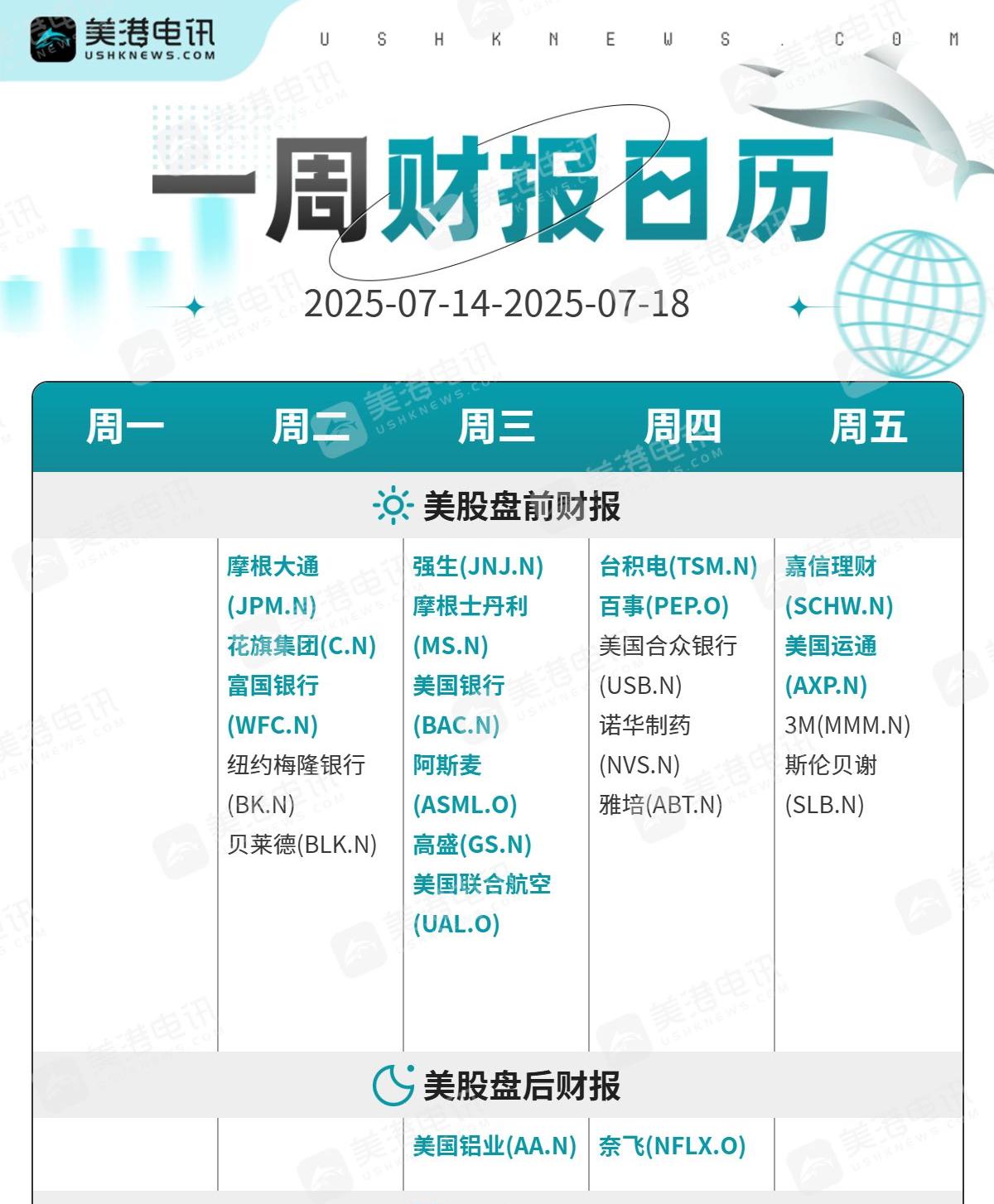
【下周财报日历】下周Q2财报来袭,摩根大通(JPM.N)、摩根士丹利(MS.N)、花旗集团(C.N)、高盛(GS.N)、奈飞(NFLX.O)、台积电(TSM.N)等多个重要个股将于下周放榜。经济数据方面,中国第二季度GDP年率、中国6月贸易帐、6月规上工业增加值同比数据;美国6月CPI、PPI、美国至7月12日当周初请失业金人数将于下周公布。此外,国新办将于下周就2025年上半年国民经济运行情况举行新闻发布会;美联储将公布经济状况褐皮书,多位美联储官员将于下周发表讲话,敬请留意。完整个股财报日历请前往美港电
news flash· 2025-07-11 09:18
Earnings Reports - Major companies such as JPMorgan Chase (JPM.N), Morgan Stanley (MS.N), Citigroup (C.N), Goldman Sachs (GS.N), Netflix (NFLX.O), and TSMC (TSM.N) are scheduled to release their Q2 earnings next week [1]. Economic Data - Key economic data to be released next week includes China's Q2 GDP year-on-year, June trade balance, and June industrial output year-on-year [1]. - In the U.S., June CPI, PPI, and initial jobless claims for the week ending July 12 will be published [1]. Federal Reserve Activities - The Federal Reserve will release its Beige Book on economic conditions, and several Fed officials are scheduled to speak next week [1].

花旗:外汇顺风将利好奈飞(NFLX.US)Q2业绩 维持“中性”评级
智通财经网· 2025-07-10 07:39
Core Viewpoint - Netflix is expected to report its Q2 2025 earnings on July 17, with Citigroup predicting slightly higher revenue and EBIT due to favorable foreign exchange factors, while investors will focus on updates regarding advertising, subscriber trends, and live content strategy [1] Financial Guidance - Netflix previously guided Q2 revenue at $11.035 billion and EBIT at $3.675 billion, with market consensus aligning closely with this guidance. Citigroup forecasts a 1.0% increase in both revenue and EBIT compared to the guidance [2] - The market consensus anticipates Netflix will guide Q3 2025 revenue at $11.3 billion and EBIT at $3.43 billion, corresponding to a profit margin of approximately 30.4% [2] - For the full year 2025, Netflix previously indicated a revenue range of $43.5 billion to $44.5 billion, with an EBIT margin of around 29%, based on January 2025 foreign exchange rates. The favorable current foreign exchange environment suggests the company may exceed its guidance [2] Cash Flow and Spending - Netflix has previously guided for cash content spending of $18 billion in 2025, with free cash flow projected at $8 billion [3] Short Interest - According to FactSet data, short interest in Netflix is low, with only about 1.7% of its shares outstanding being shorted [4] Key Focus Areas - Netflix launched its proprietary advertising technology platform in the U.S. in April, and investors will be keen on updates regarding the effectiveness of this platform and potential expansion into other markets [5] - In Q2, Netflix reached a broadcasting agreement with French broadcaster TF1, allowing it to provide live broadcasts and content. Management may view this agreement as a test for future collaborations with other broadcasters, and investors will look for comments on this strategic direction [5] - Investors will pay attention to any comments from Netflix regarding subscriber trends, including churn rates or changes in subscription tiers, especially following price adjustments earlier in the year [5] - Reports indicate that Netflix is exploring partnerships with Spotify to expand its live content offerings, which may include live music award shows or concert series. Citigroup believes investors will continue to monitor the company's latest developments in live content strategy, particularly in sports, as approximately 5% of U.S. national sports rights are set to expire in the next 12 months [5]
《F1》告捷 苹果的影视野心不止于此
Bei Jing Shang Bao· 2025-07-09 15:44
Core Viewpoint - Apple is increasingly entering the film industry, exemplified by its recent release of the film "F1: Drive to Survive," which has achieved significant box office success despite the high production and marketing costs [3][4]. Group 1: Film Release and Performance - "F1: Drive to Survive" was released on June 27 and has grossed $293 million globally, with $60 million from IMAX theaters, accounting for 20% of total revenue [3][4]. - The film's production cost is estimated between $200 million and $300 million, with an additional $100 million for marketing [4]. - The film has received positive reviews, with an 83% approval rating from critics and 97% from audiences on Rotten Tomatoes [3]. Group 2: Strategic Moves and Market Position - Apple is negotiating to acquire broadcasting rights for F1 events in the U.S., as the current contract with ESPN expires, indicating a strategic move to integrate its film content with live sports [5]. - Unlike traditional film companies, Apple relies less on box office revenue and views films as a marketing tool for its technology and streaming service, Apple TV+ [5][6]. - Apple's unique promotional strategies include placing movie trailers on its streaming service and using its Wallet app to offer ticket discounts [6]. Group 3: Industry Context and Financial Comparison - Apple's film strategy is still evolving, lacking a fixed distribution network in Hollywood compared to competitors like Amazon, which has established a more traditional film distribution model [8]. - The film industry is relatively small compared to Apple's overall revenue, with Disney's projected revenue for 2024 at $91.36 billion and Netflix's at $39 billion, while Apple's revenue is projected at $391.04 billion [9]. - Analysts suggest that Apple's investment in films could yield returns beyond just box office revenue, as integrating hardware sales with F1 broadcasting rights could enhance its content ecosystem [9].


外卖电商平台补贴,咖啡茶饮和广告渠道直接受益
SINOLINK SECURITIES· 2025-07-06 13:53
Investment Rating - The report maintains an optimistic outlook for the Hong Kong stock market, particularly for new IPOs and sectors like new consumption and innovative pharmaceuticals [8]. Core Insights - The report highlights that the recent subsidies from food delivery e-commerce platforms directly benefit coffee, tea, and advertising channels [8]. - The education sector remains robust, with leading institutions expanding market share and developing AI products for international education [3][19]. - The luxury goods sector is experiencing slight pressure from macroeconomic factors, but brands with strong innovation capabilities are still seeing growth [20]. - The coffee and tea industry is in a growth cycle, with coffee demand remaining strong, while tea faces short-term challenges due to increased competition [27]. - E-commerce is under pressure with slowing growth rates, but instant retail is emerging as a new battleground [31]. - The travel and OTA sectors are seeing limited impact from recent subsidies, with a focus on undervalued leading players [8]. - Music streaming platforms are identified as quality internet assets driven by domestic demand, with ongoing developments in subscription services [36]. - The virtual asset market is on an upward trend, supported by traditional financial institutions entering the space [40]. - The real estate market is under pressure, particularly in major cities, with a focus on opportunities in companies like Beike [8]. - The automotive service market is experiencing a decline, with a continued focus on ecosystem changes [8]. Summary by Sections 1. Education - The K12 education sector remains highly prosperous, with leading institutions reporting good summer enrollment progress and a focus on AI product development [3][19]. - The education index saw a decline of 1.78% during the reporting period, outperforming the Hang Seng Technology Index but underperforming other major indices [10]. 2. Luxury Goods - The luxury goods sector is slightly pressured by macroeconomic factors, with notable growth in brands with strong innovation [20]. - Key luxury stocks showed positive performance, with Samsonite and Prada increasing by 5.61% and 6.09% respectively [20]. 3. Coffee and Tea - The coffee sector remains in a growth cycle, with strong demand and a high frequency of consumption [27]. - The tea sector faces short-term challenges due to increased competition and supply growth [27]. 4. E-commerce - The e-commerce sector is experiencing a slowdown, with significant competition impacting profitability [31]. - Instant retail is becoming a new focus, with major platforms launching aggressive subsidy plans [31]. 5. Travel and OTA - The travel sector is seeing limited impact from subsidies, with a focus on undervalued leading players [8]. 6. Music Streaming - Music streaming platforms are identified as high-quality assets driven by domestic demand, with ongoing developments in subscription services [36]. 7. Virtual Assets - The virtual asset market is on an upward trend, with traditional financial institutions increasingly entering the space [40]. 8. Real Estate - The real estate market is under pressure, particularly in major cities, with a focus on opportunities in companies like Beike [8]. 9. Automotive Services - The automotive service market is experiencing a decline, with a continued focus on ecosystem changes [8].



和不同阶层的人沟通,有一种百试不爽的法则
洞见· 2025-07-03 11:44
洞见 ( DJ00123987 ) —— 不一样的观点,不一样的故事, 3000 万人订阅的微信大号。点击标题下 蓝字 " 洞见 " 关注,我们将为您提供有价值、有意思的延伸阅读。 作者: 洞见Moon 层次不同,沟通的语言也不同。 ♬ 点上方播放按钮可收听 洞见主播安东尼朗读音频 卡耐基年轻时,参加过一场慈善晚宴。 宴会宾客如云,各行各业的人三五成群,忙着高谈阔论。 卡耐基却没有着急参与其中,而是暗暗打听宾客的背景。 摸清每个人的情况后,卡耐基才走近人群开始攀谈。 面对普通民众,他就用自己的糟糕经历引起共情; 面对职场精英,他就和他们聊金融、经济走势; 面对政府要员,他就和他们探讨政策、社会。 一场宴会下来,无论权贵还是普通人,都觉得与他交谈如沐春风。 卡耐基把这段经历写进自传,还说: 成功的人际关系在于,捕捉对方的需求,而非表达自己的 需求。 说白了就是:见什么人,说什么话。 和底层人用情绪说话 底层社会的运行法则,是情绪而非理性。 为什么奶头乐、短剧爽片在底层更盛行? 因为它们提供的是即时情绪反馈,而非复杂思考。 为什么罔顾事实,非黑即白的极端言论在底层更有市场? 因为情绪化的解释比复杂的现实更容易接受 ...

据华尔街日报:Netflix正在与Spotify进行洽谈,旨在扩大其直播电视内容。
news flash· 2025-07-02 10:50
Group 1 - The core point of the article is that Netflix is in discussions with Spotify to expand its live television content [1] Group 2 - The collaboration aims to enhance Netflix's offerings in the competitive streaming market [1] - This move reflects a strategic effort by Netflix to diversify its content and attract more subscribers [1]

谷歌削减Google TV项目预算5亿美元并裁员25% 官方称仍“致力于生态发展”
Huan Qiu Wang· 2025-06-25 02:19
Core Insights - Google is making significant adjustments to its streaming platform Google TV, cutting its budget by approximately $500 million and laying off about 75 employees, which constitutes 25% of the team [1][2][3] - The budget cuts will affect various areas including content procurement, hardware development, and marketing, as user growth and advertising revenue have not met expectations since the platform's integration in 2020 [2][3] - Google plans to redirect resources towards AI-driven personalized recommendations and cross-device content integration, indicating a strategic shift in response to competitive pressures in the streaming market [2][3] Company Adjustments - The layoffs primarily impact content operations, user growth, and hardware engineering departments, marking the second round of significant layoffs for Google in 2025, following a previous reduction of about 300 employees in its cloud computing division [3] - Despite the budget cuts, Google maintains a long-term commitment to the Google TV ecosystem and continues to invest in integrating the Gemini AI model to enhance user experience [2][3] Industry Context - The adjustments to Google TV are closely linked to changes in the streaming market landscape, where competitors like Roku and Amazon Fire TV have gained market share through low-cost hardware and content partnerships [2] - Platforms such as Netflix and Disney+ are strengthening their own hardware development, reducing reliance on third-party systems, while Apple TV+ is leveraging original content and device ecosystem integration to further challenge Google TV [2]


海外2025中期策略:稳定币跑步入场,虚拟资产趋势已成
SINOLINK SECURITIES· 2025-06-23 05:24
Group 1: Virtual Assets and Stablecoins - The trend of virtual assets is continuously improving due to the enhancement of regulatory frameworks and increased institutional participation, with expectations of liquidity easing [2][18][25] - The global stablecoin market is projected to grow significantly, from approximately $5 billion in 2020 to around $200 billion by the end of 2024, indicating a clear expansion path for trading scenarios [25][26] - Various regions are implementing stablecoin policies, such as the U.S. passing the "Genius Act" and Hong Kong enacting the "Stablecoin Ordinance," which will take effect on August 1, 2025 [25][29] Group 2: Streaming Platforms - Music streaming platforms are identified as high-quality internet assets driven by domestic demand, with continuous scale effects driving profit leverage [2] - The market for music subscriptions is expected to grow, with major players like Spotify and Tencent Music holding significant market shares [33] Group 3: O2O Service Platforms - The trend of strong players becoming stronger is evident, with major platforms like Beike and Tuhu expected to increase market share amid a shrinking real estate and automotive aftermarket demand [2][39] - The used housing transaction volume in key cities showed a month-on-month decline, indicating a buyer's market, which may benefit established platforms [39] Group 4: Coffee, Tea, and E-commerce Delivery Platforms - The online retail sales of physical goods grew by 6.3% year-on-year from January to May 2025, indicating a competitive landscape where marketing expenses are rising [2][56] - The coffee and tea segment is highlighted as a key beneficiary in the delivery battle, with significant growth in order volumes and city coverage [68][75] Group 5: K12 Education and Training - The K12 education sector is experiencing a resurgence in non-subject training demand, with a significant reduction in subject-based training institutions, leading to a scarcity of quality compliant products [2][86] - Major players in the K12 sector, such as New Oriental and TAL Education, are showing strong performance with revenue growth exceeding 20% year-on-year [91]

