
装备制造业

Search documents
经济的三个温度——10月经济数据点评
Huachuang Securities· 2025-11-16 09:46
Group 1: Economic Performance Overview - The economic data for October highlights three temperature levels: strong, moderate, and weak[2] - The production service industry and equipment manufacturing showed strong performance, with the production index for the information industry growing by 13% and equipment manufacturing by 8%[4] - Essential consumption grew by 4.2% in October, surpassing the previous value of 3.4%, while cumulative growth for the first ten months was 4.4%, better than last year's 4.0%[19] Group 2: Investment and Construction Trends - Manufacturing investment saw a decline, with a year-on-year decrease of 6.7% in October, down from -1.9% previously, and a cumulative growth of 2.7% for the first ten months[22] - Infrastructure and real estate investments continued to decline, with real estate investment down by 23% in October compared to the previous month[44] - The overall growth rate for subsidy-related durable goods consumption dropped to -2.6% in October, down from 3.9%[7] Group 3: Policy Implications and Future Outlook - The government is expected to support technology innovation sectors where sentiment is better than economic performance, while consumption sectors may see further growth opportunities[2] - If economic growth deviates from annual targets, policies may flexibly increase support for subsidy-related consumption and construction chains[2]
薛鹤翔:新动能驱动 转型显韧性
Sou Hu Cai Jing· 2025-11-16 06:06
Group 1: Industrial Production - Industrial production in October continued to show steady growth, with the industrial added value of large-scale enterprises increasing by 4.9% year-on-year, and a cumulative growth of 6.1% from January to October, highlighting the characteristics of "new quality productivity leading and structural optimization upgrading" [1][6][18] - The equipment manufacturing and high-tech manufacturing sectors led the growth with rates exceeding 8% and 7% respectively, while new products like 3D printing equipment and electric vehicles maintained double-digit growth, becoming the core engines of industrial growth [1][6][18] - The industrial economy is accelerating its transition from scale expansion to quality and efficiency, but attention is needed on the insufficient vitality of small and medium-sized private enterprises, which requires targeted financing support and policy measures to unlock growth potential across the entire industrial chain [1][7][18] Group 2: Consumer Market - The consumer market in October continued to expand in scale and improve in quality, characterized by "service-led growth and structural optimization upgrading," with total retail sales increasing by 2.9% year-on-year and a cumulative growth of 4.3% from January to October [2][8][23] - The growth rate of service retail accelerated to 5.3%, with significant increases in experiential service consumption such as cultural, sports, and transportation services, indicating a shift in consumer demand from goods to services [2][8][23] - The rural market showed a notable growth rate higher than urban areas, supported by the improvement of the county commercial system and rural revitalization strategies, reflecting the continuous release of rural consumption potential [2][8][23] Group 3: Investment Structure - From January to October, fixed asset investment decreased by 1.7%, with the core characteristic of "real estate dragging down significantly while new momentum breaks through," indicating a structural change in investment dynamics [3][11][25] - Manufacturing investment continued to grow by 2.7%, becoming a key pillar for stabilizing investment, particularly in high-tech industries such as information services and aerospace equipment [3][11][25] - The residential market remains in deep adjustment, with both sales area and sales volume declining, but structural changes are noteworthy, such as the increasing proportion of existing home sales and the stabilization of housing prices in core urban areas [3][11][25] Group 4: Employment Market - The employment situation in 2025 is characterized by "overall stability with progress, prominent structural differentiation, and urgent quality improvement," with the urban survey unemployment rate averaging 5.2% from January to October [13] - Employment policies have effectively stabilized the job market, with significant reductions in costs for enterprises, but structural mismatches and low employment quality remain concerns [13] - The average weekly working hours for employees reached 48.4 hours, indicating hidden employment pressures as companies prefer to extend existing employees' hours rather than create new positions [13]


10月经济:新动能加快塑造,政策持续加力
2 1 Shi Ji Jing Ji Bao Dao· 2025-11-15 23:39
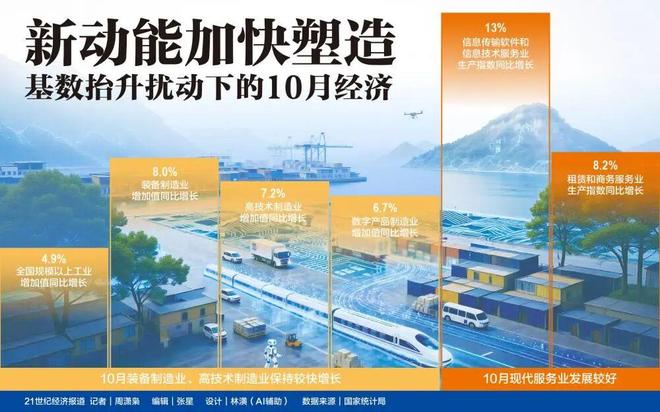
Economic Overview - In October, some economic indicators showed a downward trend due to last year's high base, deep adjustments in the real estate sector, and weak domestic demand [2][6] - Despite the downturn, there were positive signs such as a rebound in service retail sales driven by the National Day and Mid-Autumn Festival holidays, indicating significant consumption potential [2][6] Industrial Performance - The industrial added value for October grew by 4.9% year-on-year, a decline of 1.6 percentage points from the previous month, marking the lowest monthly growth this year [6][12] - The manufacturing sector is transitioning towards high-end production, with equipment manufacturing increasing by 8%, outpacing overall industrial growth [6][10] Investment Trends - From January to October, fixed asset investment (excluding rural households) decreased by 1.7%, with infrastructure investment down by 0.1% and real estate development investment down by 14.7% [7][14] - High-tech sectors such as aerospace and information services saw significant investment growth, with aerospace manufacturing up by 19.7% and information services up by 32.7% [7][12] Trade Dynamics - In October, the total import and export volume grew by 0.1% year-on-year, with exports declining by 0.8% and imports increasing by 1.4% [8][9] - The trade growth slowdown was attributed to last year's high base, with some exports delayed from September due to typhoons [9][10] Policy Measures - The government is implementing policies to enhance the adaptability of supply and demand in consumer goods, aiming to stimulate consumption and investment [3][13] - Recent policies include the introduction of 500 billion yuan in new policy financial tools and the acceleration of local government bond usage to support effective investment [13][14] Economic Outlook - Despite the challenges, the overall economic operation remains stable, with a GDP growth of 5.2% in the first three quarters, laying a solid foundation for achieving the annual target of around 5% [12][15] - Analysts suggest that additional policy measures may be necessary to counteract weak demand and support economic recovery, particularly in the real estate sector [14][15]
10月份国民经济运行总体平稳—— 转型升级扎实推进 发展新动能继续壮大
Sou Hu Cai Jing· 2025-11-15 12:34
Core Insights - The overall economic operation in October remained stable, with solid progress in transformation and upgrading, and new growth drivers continuing to strengthen [1] Economic Performance - In October, the industrial production remained stable, with the added value of industrial enterprises above designated size increasing by 4.9% year-on-year [2] - The equipment manufacturing sector saw an 8% increase in added value, significantly outpacing the overall industrial growth [2] - Social retail sales of consumer goods increased by 2.9% year-on-year, with notable growth in communication equipment (23.2%) and cultural office supplies (13.5%) [2] - The consumer price index (CPI) rose by 0.2% year-on-year, with the core CPI (excluding food and energy) increasing by 1.2% [2] High-Tech and Green Manufacturing - The added value of high-tech manufacturing increased by 7.2% year-on-year, continuing to outpace overall industrial growth [3] - The production of green products, such as new energy vehicles and lithium-ion batteries, grew by 19.3% and 30.4% respectively [3] New Growth Drivers - The digital economy and new industries are rapidly developing, with online retail of physical goods accounting for 25.2% of total retail sales from January to October [4] - Investment in high-tech sectors, including aerospace and information services, saw significant growth, with increases of 19.7% and 32.7% respectively [4] Manufacturing Sector Dynamics - The added value of equipment manufacturing increased by 9.5%, contributing 58.7% to the growth of industrial added value [5] - The digital economy is expanding, with the added value of digital industry manufacturing rising by 9.5% [5] Economic Resilience - The economy is characterized by a stable foundation, multiple advantages, strong resilience, and significant potential [6] - The GDP growth for the first three quarters was 5.2%, placing it among the top global economies [7] - The total import and export volume increased by 3.6% year-on-year from January to October [7] Innovation and Policy Support - The integration of technological and industrial innovation is accelerating, with new industries and growth drivers emerging [8] - Proactive macroeconomic policies and the construction of a unified national market are enhancing demand and production, stabilizing the economy [8]
10月份国民经济运行总体平稳——转型升级扎实推进 发展新动能继续壮大
Sou Hu Cai Jing· 2025-11-15 12:34
Core Viewpoint - The overall economic operation in October remained stable, with solid progress in transformation and upgrading, and the new driving forces for development continued to grow [1] Group 1: Economic Performance - In October, the industrial production remained stable, with the added value of industrial enterprises above designated size increasing by 4.9% year-on-year [2] - The added value of the equipment manufacturing industry grew by 8%, significantly outpacing the overall industrial growth [2] - The total retail sales of consumer goods increased by 2.9% year-on-year, with notable growth in communication equipment and cultural office supplies retailing by 23.2% and 13.5% respectively [2] Group 2: High-tech Manufacturing and Green Transition - The added value of high-tech manufacturing above designated size increased by 7.2% year-on-year, continuing to outpace overall industrial growth [3] - The production of green products such as new energy vehicles and lithium-ion batteries for automobiles grew by 19.3% and 30.4% respectively [3] - The digital product manufacturing industry saw a year-on-year increase of 6.7% in added value [3] Group 3: New Economic Drivers - The digital economy and platform economy are expanding, with online retail of physical goods accounting for 25.2% of total retail sales from January to October, up 0.2 percentage points from the previous period [4] - Investment in high-tech sectors such as aerospace and information services grew by 19.7% and 32.7% year-on-year respectively [4] - The export of electromechanical products accounted for 60.7% of total exports from January to October, indicating strong support for foreign trade [4] Group 4: Manufacturing and Economic Resilience - The added value of equipment manufacturing from January to October increased by 9.5%, contributing 58.7% to the growth of industrial added value [5] - The digital manufacturing and intelligent manufacturing sectors are growing rapidly, with increases of 9.5% in added value for digital industries [5] - Emerging industries such as quantum technology and biomanufacturing are expected to become new pillar industries, supporting the growth of new driving forces [5] Group 5: Macroeconomic Stability - The GDP grew by 5.2% year-on-year in the first three quarters, placing China among the top global economies [6] - The urban unemployment rate continued to decline, and the consumer price index turned from decline to increase, showing positive changes [6] - The total import and export volume increased by 3.6% year-on-year from January to October, with foreign trade resilience evident [6] Group 6: Innovation and Policy Support - The integration of technological and industrial innovation is accelerating, with significant growth in smart product manufacturing, such as a 54.7% increase in smart drones [7] - Proactive macro policies and the construction of a unified national market are driving demand and production, stabilizing the economy [7] - The economic foundation remains strong, with multiple favorable factors supporting continued stable growth [7]
10月份我国生产供给基本平稳 国民经济保持稳中有进发展态势
Yang Guang Wang· 2025-11-15 01:49
Economic Overview - The national economy of China showed steady growth in October 2025, with a stable employment situation and ongoing transformation and upgrading trends [1] - The industrial production maintained resilience, with the industrial added value of large-scale enterprises increasing by 4.9% year-on-year and 0.17% month-on-month [1] Industrial Performance - The added value of the mining industry grew by 4.5%, manufacturing increased by 4.9%, and the electricity, heat, gas, and water production and supply industries rose by 5.4% [1] - Equipment manufacturing and high-tech manufacturing sectors were significant contributors to growth, with increases of 8.0% and 7.2% respectively [1] Service Sector - The service industry also demonstrated robust performance, with business activity indices in sectors such as railway transport, air transport, postal services, accommodation, and cultural and sports entertainment remaining above 60.0%, indicating a high level of economic activity [1] Consumer Market - The total retail sales of consumer goods reached 46.291 billion yuan in October, marking a year-on-year increase of 2.9% and a month-on-month increase of 0.16% [2] - Consumer prices turned from a decline to an increase, with a year-on-year rise of 0.2%, while the core Consumer Price Index (CPI), excluding food and energy, rose by 1.2%, an increase of 0.2 percentage points from the previous month [1]
前10个月新需求不断扩大、新兴产业发展提速 我国经济转型升级态势持续
Jing Ji Ri Bao· 2025-11-15 01:35
Core Insights - The overall economic operation remains stable, with steady growth in production and demand, stable employment and prices, and ongoing transformation and upgrading of the economy [1][2][7] Economic Performance - In October, industrial production maintained stability, with the industrial added value of large enterprises increasing by 4.9% year-on-year [2] - The service sector's production index grew by 4.6% year-on-year, although the growth rate slightly declined due to a high base from the previous year [2] - Retail sales of consumer goods increased by 2.9% year-on-year in October, supported by holiday economic activities [2] Employment and Prices - The urban unemployment rate was 5.1% in October, marking a decrease for two consecutive months, with specific groups showing improved employment rates [2] - The consumer price index (CPI) turned from decline to growth in October, with the core CPI rising by 1.2% year-on-year, indicating a positive price trend [3] Structural Adjustments and New Growth Drivers - The economy is undergoing structural adjustments, with new growth drivers such as the digital economy and platform economy expanding rapidly [4][6] - The proportion of advanced manufacturing and modern services is increasing, with the added value of equipment manufacturing growing by 9.5% year-on-year [5] Future Outlook - The economic foundation remains strong, with favorable conditions for achieving annual targets, including a GDP growth of 5.2% year-on-year in the first three quarters [7][8] - The government is implementing proactive macro policies to stimulate demand and production, including a new policy financial tool worth 500 billion yuan [8]
10月国民经济运行总体平稳稳中有进
Xin Hua She· 2025-11-15 01:14
Core Insights - The national economy in October showed overall stability with steady progress in transformation and upgrading, and the growth of new economic drivers continued to strengthen [1] Economic Performance - In October, the industrial production increased by 4.9% year-on-year, with the equipment manufacturing sector growing by 8.0% and high-tech manufacturing by 7.2% [1] - The service sector production index rose by 4.6% year-on-year in October [1] - Retail sales of consumer goods reached 46,291 billion yuan, marking a 2.9% year-on-year increase [1] - From January to October, the retail sales in the service sector grew by 5.3%, with a slight acceleration of 0.1 percentage points compared to the first three quarters [1] - Manufacturing investment increased by 2.7% from January to October [1] - The total value of goods imports and exports in October was 37,028 billion yuan, reflecting a 0.1% year-on-year growth [1] Employment and Prices - The urban surveyed unemployment rate in October was 5.1%, a decrease of 0.1 percentage points from the previous month [1] - The Consumer Price Index (CPI) rose by 0.2% year-on-year in October, indicating a shift from decline to growth in consumer prices [1] Challenges and Future Outlook - The external environment remains unstable and uncertain, and there are significant pressures from domestic structural adjustments [2] - The focus moving forward will be on expanding domestic demand, stabilizing employment, businesses, markets, and expectations, while promoting effective macroeconomic policies and deepening reforms [2]
10月经济数据出炉 服务消费成重要增长点
Zheng Quan Shi Bao Wang· 2025-11-15 00:03
Group 1 - The core viewpoint of the articles indicates that China's economy is showing a steady improvement, with industrial production growing by 4.9% year-on-year in October, and a notable expansion in the consumption market, particularly in high-end industries [1][2] - In the agricultural sector, both the area and yield of autumn grain have increased, supporting expectations for a good harvest and reinforcing food security [1] - The industrial sector demonstrates characteristics of overall stability and structural optimization, with the value added of industrial enterprises above designated size increasing by 4.9% year-on-year in October [1] - The equipment manufacturing industry saw a year-on-year increase of 8.0% in value added, while high-tech manufacturing increased by 7.2%, both outpacing the overall industrial growth by 3.1 and 2.3 percentage points respectively [1] - The recovery of the service industry is closely linked to the holiday economy, with the accommodation and catering industry production index growing by 3.9% year-on-year, accelerating by 2.6 percentage points compared to September [2] - From January to October, the service retail sales increased by 5.3% year-on-year, slightly faster than the growth rate of commodity retail sales by 0.9 percentage points [2]
我国经济转型升级态势持续
Xin Hua Wang· 2025-11-14 23:50
Core Viewpoint - China's economic transformation and upgrading continue to show positive trends, with stable growth in production and demand, and overall stability in employment and prices [1][2][3] Economic Performance - In October, industrial production maintained stability with a year-on-year increase of 4.9% in the added value of large-scale industries [2] - The service sector's production index grew by 4.6% year-on-year, although the growth rate slightly decreased due to a high base from the previous year [2] - Retail sales of consumer goods increased by 2.9% year-on-year in October, with significant growth in the sales of products related to consumption upgrades [2][4] Employment and Prices - The urban unemployment rate was 5.1% in October, marking a decline for two consecutive months, with specific improvements in employment for migrant agricultural workers [2][3] - The consumer price index (CPI) turned positive in October, with the core CPI rising by 1.2% year-on-year, indicating a continuous expansion in inflation [3] New Economic Drivers - The digital economy and emerging industries are expanding, with significant growth in online retail, which accounted for 25.2% of total retail sales in the first ten months [4][6] - Investment in high-tech sectors is increasing, particularly in renewable energy, new materials, and artificial intelligence, contributing to overall economic stability [4][6] Industrial Upgrading - The advanced manufacturing and modern service sectors are gaining a larger share of the economy, with the added value of equipment manufacturing increasing by 9.5% year-on-year [5] - The integration of modern services with advanced manufacturing is showing positive trends, with significant contributions to the third sector's growth [5] Future Outlook - Despite challenges, the long-term positive trends in China's economy remain intact, supported by macroeconomic policies and expanding market potential [7][8] - The government is implementing proactive macro policies to stimulate demand and production, with new financial tools introduced to enhance local government financing and investment [8]