经济数据分化

Search documents
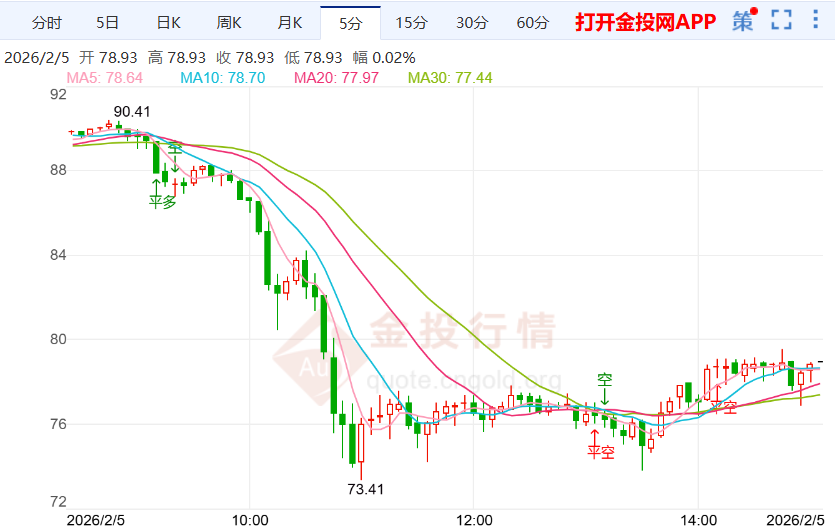
投机资金过度介入国际银动荡
Jin Tou Wang· 2026-02-05 07:24
Group 1 - The core point of the article highlights the significant volatility in silver prices, primarily driven by speculative funds rather than fundamental changes in physical demand [3] - Analysts indicate that the accumulation of leveraged positions, the amplification effect of options trading, and the flow of speculative funds are key factors driving price fluctuations, detaching the market from fundamentals [3] - A senior expert emphasizes that a large number of speculative positions have not been fully cleared, suggesting that the market may face further adjustments in the short term [3] Group 2 - Recent trading saw silver prices drop after failing to break the critical resistance level of $90.00, leading to increased selling pressure [4] - The decline occurred under a prevailing short-term bearish correction trend, exacerbated by the failure to maintain above the 50-day Exponential Moving Average (EMA) and negative signals from the Relative Strength Index (RSI) [4] - Unless prices stabilize above the current support level, there is a tendency for further weakness in the market [4] Group 3 - Economic data released shows that January ADP employment figures revealed only 22,000 new jobs in the private sector, significantly below the market expectation of 48,000 and lower than the revised previous value of 41,000, indicating a slowdown in the labor market [3] - The ISM services index remained stable at 53.8, slightly above the expected 53.5, indicating continued expansion in the services sector, but highlighting structural disparities in economic growth [3] - Overall, the combination of hawkish Federal Reserve policies and strong dollar expectations, alongside mixed economic data, supports a short-term upward trend for the dollar, although weak employment growth may limit its long-term strength [3]

国债期货周报:部分止盈并关注风险资产走势-20260126
Yin He Qi Huo· 2026-01-26 02:35
Group 1 - Report Title: Treasury Bond Futures Weekly: Partially Take Profits and Pay Attention to the Trend of Risk Assets [1] - Researcher: Shen Chen CFA [1] - Futures Practitioner Certificate Number: F3053225 [1] - Investment Consulting Certificate Number: Z0015885 [1] Group 2 - Report Industry Investment Rating: Not provided - Core View: The economic data released this week showed that the GDP deflator repaired faster, and the production side had sufficient resilience, but the improvement on the domestic demand side was limited, with investment and consumption both weaker than expected. The economic data was not necessarily negative for the bond market. After the central bank made it clear that there was still some room for overall easing this year and the yields at the medium - short end had fallen first, more allocation funds entered the market this week, driving the yields at the long end to start a compensatory decline. The current attitude of the central bank towards liquidity injection was warm, and the risks at the medium - short end were relatively controllable, but before the expectation of a policy rate cut significantly increased, the odds of going long at the medium - short end were still limited. The yield of 30Y treasury bonds had fallen by nearly 9bp from the previous high. Considering factors such as the improvement of the domestic "re - inflation" expectation and the concern about the supply of government bonds not being completely eliminated, the stage when the yield at the ultra - long end declined most smoothly might have passed. In the short term, the performance of the ultra - long end would largely depend on the trend of risk assets. [5] - Strategy Recommendation: - Unilateral: Partially take profits on the previous long positions of TL contracts at high prices [6] - Arbitrage: Moderately pay attention to the transaction of shorting the basis of the 30Y active bonds [6] Group 3: First Part - Weekly Core Points Analysis and Strategy Recommendation Economic Data - The Ministry of Finance Deputy Minister Liao Min stated that in 2026, a more proactive fiscal policy would continue to be implemented, and the specific details of subsequent fiscal policies to expand domestic demand were worth close attention [8] - The economic data for December last year and the fourth quarter showed differentiation. The fourth - quarter GDP deflator was - 0.65%, still in the negative range but up 0.44 percentage points from the third quarter. In December, supported by external demand, industrial production had sufficient resilience, and the industrial capacity utilization rate in the fourth quarter rose 0.3 percentage points to 74.9%. However, as a nominal indicator, the repair momentum on the domestic demand side was still weak. In December, the growth rate of domestic fixed - asset investment continued to decline, with the year - on - year growth rates of manufacturing and broad infrastructure investment at - 10.5% and - 16.0% respectively, down 6.1 and 4.1 percentage points from the previous month. The improvement in consumer goods retail was also limited, with the year - on - year growth rate of durable goods consumption by units above the designated size at - 4.3%, also continuing the negative growth trend [13][14] Central Bank's Liquidity Support - The central bank's attitude towards protecting liquidity was clear. On Friday, it over - renewed the due MLF by 70 billion yuan this month. Together with the outright reverse - repurchase operation, it had net injected 1 trillion yuan of medium - and long - term liquidity in a single month, and smooth cross - month of funds was still expected [16] Market Capital Situation - This week, the overall market capital situation was still balanced, and the disturbances caused by the tax period and the increased supply of local bonds were limited. As of Friday's close, DR001 and DR007 were at 1.3983% and 1.4935% respectively. The overnight and 7 - day non - bank capital spreads were 6.71bp and 4.25bp respectively. In terms of long - term funds, the issuance rate of 1Y inter - bank certificates of deposit by joint - stock banks fluctuated and declined this week, and as of Friday, it had fallen to around 1.61%. Next week, as it was the cross - month period and the issuance and payment of government bonds would further increase (more than 515 billion yuan), it was expected that the market capital situation would tighten [23] Futures Bond Valuation - Calculated according to the ChinaBond valuation and the futures settlement price, as of Friday's close, the IRRs of the TS, TF, T, and TL main contracts were 1.4223%, 1.5724%, 1.4680%, and 0.9765% respectively. Statically, the IRR of the TL main contract was relatively low, and the valuations of the main contracts for other tenors were relatively reasonable [29] Ultra - long Bond Spread - Last week, it was suggested that investors could use a moderate reverse thinking for potential negative factors such as the supply pressure of ultra - long bonds and not be overly pessimistic. After the bond market sentiment eased, as of Friday, the spread between the CTD bond of the TL main contract and the active bond of the same tenor (including tax) fell to 5.9bp, down 1.35bp from last Friday. However, affected by factors such as different trading times, the valuation of the TL contract had relatively large fluctuations compared with the spot bonds recently, and the basis had not significantly converged according to the ChinaBond valuation and the futures settlement price [33] Group 4: Second Part - Related Data Tracking Treasury Bond Futures Contract Spreads - It includes the spreads between TS, TF, T, and TL contracts [37] Trading Volume and Open Interest - It shows the trading volume and open - interest data of TS, TF, T, and TL contracts [40] Spot Bond Yields and Spreads - It involves the treasury bond spot yield curve (ChinaBond), treasury bond term spreads (ChinaBond), spreads between treasury bonds and local bonds (ChinaBond), and spreads between 10Y treasury bonds and China Development Bank bonds (ChinaBond) [43] US Treasury Bond Yields and Exchange Rates - It includes the 10 - year US treasury bond yield, the spread between Chinese and US 10 - year treasury bonds, the US dollar index, and the offshore US dollar - to - RMB exchange rate [46]
TMGM外汇平台:日本经济数据表现分化,日元周五承压
Sou Hu Cai Jing· 2026-01-09 09:10
Core Viewpoint - The Japanese yen is weakening against major currencies, reaching a near three-week low against the US dollar, driven by uncertainties regarding the Bank of Japan's policy path and mixed economic data [1][4]. Currency Performance - The yen is trading at 183.38 against the euro, up from 182.91; 211.39 against the pound, up from 210.83; and 196.89 against the Swiss franc, up from 196.35. It has also declined against the Australian and New Zealand dollars, trading at 105.40 and 90.39 respectively [3]. - The yen fell from 156.88 to 157.44 against the US dollar and from 113.16 to 113.53 against the Canadian dollar. Potential technical support levels are observed at 184.00 for euro/yen, 212.00 for pound/yen, 199.00 for Swiss franc/yen, 106.00 for Australian dollar/yen, 91.00 for New Zealand dollar/yen, 158.00 for dollar/yen, and 115.00 for Canadian dollar/yen [3]. Economic Data Insights - November household average spending in Japan increased by 2.9% year-on-year to 314,242 yen, significantly exceeding the market expectation of a 1.0% decline, with a month-on-month increase of 6.2% against a forecast of 2.7% [3]. - Conversely, the average monthly income decreased by 2.2% year-on-year to 519,304 yen, raising concerns about the sustainability of consumer spending amid rising expenditures [3]. - The Cabinet Office reported that the leading economic index rose to 110.5 in November, the highest since May 2024, indicating potential future economic activity improvement. However, the coincident index slightly declined from 115.9 to 115.2, suggesting short-term economic momentum remains unstable [3][4]. Market Sentiment - Asian stock markets are mostly rising as investors await the US employment report to assess the Federal Reserve's policy direction. There is a prevailing expectation that the Fed may cut interest rates at least twice by 2026, which supports the US dollar and puts pressure on the yen [4]. - The $200 billion mortgage bond purchase program initiated by the US is influencing market liquidity and interest rate expectations, indirectly affecting currency markets [4]. - The core driver of the yen's movement remains the Bank of Japan's policy decisions, with significant market uncertainty regarding potential interest rate adjustments and ongoing concerns about Japan's fiscal health [4].

澳洲联储鹰派转向支撑澳元
Jin Tou Wang· 2025-12-22 02:40
Core Viewpoint - The Australian dollar (AUD) has shown a moderate upward trend against the US dollar (USD), with a current exchange rate of 0.6617, driven by differences in monetary policy, economic data divergence, and global risk sentiment [1] Monetary Policy - The interest rate differential expectations have become the core driver of the exchange rate. The Federal Reserve restarted its rate-cutting cycle in September 2025, implementing three cuts within three months, with the current policy rate at 3.5%-3.75%. Despite hawkish signals from Fed officials in December, market expectations indicate at least two additional rate cuts in 2026, with the terminal rate expected to fall to 3.00%-3.25% [2] - The Reserve Bank of Australia (RBA) has maintained a hawkish stance, pausing adjustments since lowering the cash rate to 3.60% in August 2025. The RBA's December statement emphasized the possibility of rate hikes to address inflation pressures, with the October CPI rising to 3.8% [2] Economic Data - Economic data divergence has intensified short-term exchange rate volatility. Australia's December manufacturing PMI rose to 52.2, indicating expansion, while the services PMI fell to 51.0, dragging the composite PMI to a seven-month low. Consumer confidence dropped significantly by 9% to 94.5, indicating a pessimistic outlook [3] - The US economy also showed mixed signals, with November non-farm payrolls slightly exceeding expectations but the unemployment rate rising to 4.6%, the highest since 2021. Retail sales stagnated, highlighting a slowdown in consumer spending [3] Technical Analysis - The AUD/USD remains in an upward channel, with a neutral short-term momentum. Key support is at 0.6620, with potential declines to 0.6414. Resistance levels are at 0.6685 and the previous high of 0.6707, with a breakthrough potentially targeting the 0.6740 range. Institutions have differing views, with some predicting a rise to 0.69 in the next three months due to ongoing policy differences [3] Market Outlook - Short-term focus should be on the upcoming Australian Q4 CPI data, Fed officials' speeches, and commodity price fluctuations. In the medium to long term, the leadership change at the Fed in May 2026, the effectiveness of Australia's inflation control, and economic recovery resilience will be key variables determining the exchange rate direction [4]
多空决战前夜?政策分化油价暴击加元破局信号浮现!
Jin Tou Wang· 2025-12-22 02:39
Core Viewpoint - The USD/CAD exchange rate is experiencing fluctuations due to diverging monetary policies between the US and Canada, alongside low oil prices, mixed economic data, and geopolitical risks, leading to an unclear short-term direction [1][2]. Monetary Policy Divergence - The Bank of Canada maintained its interest rate at 2.25% on December 10, signaling a halt in rate cuts after four reductions this year, with a neutral to hawkish stance supported by a 2.6% annualized GDP growth in Q3 and a drop in unemployment to 6.5% with 53,000 new jobs added in November [1]. - In contrast, the Federal Reserve lowered its rate to 3.6% on December 11, marking its third cut of the year, with a dovish outlook from Chairman Powell and rising risks in the US labor market, leading to market expectations of further easing by 2026 [1]. Economic Data Disparity - US economic indicators show a mixed picture, with existing home sales rising by 0.5% in November, but consumer confidence slightly declining, and inflation expectations increasing to 4.2% [2]. - Canadian economic data is less supportive for the CAD, with retail sales falling by 0.2% in October and core retail sales down by 0.6%, although the CPI rose by 2.2% year-on-year in November, providing some support for the central bank's policy [2]. Commodity Influence on CAD - The CAD is negatively impacted by declining oil prices, which have dropped by 15.2% in 2025, affecting Canadian crude export revenues and consequently pressuring the CAD against the USD [2]. - Geopolitical factors, including US sanctions on Venezuela and Russia, have heightened supply concerns, increasing demand for the USD as a safe haven and further suppressing the CAD [2]. Technical Analysis - The USD/CAD pair is currently in a bearish trend, with the price consistently closing below key moving averages and facing resistance above 1.3800, indicating potential for further declines [2]. - Technical indicators such as MACD and RSI suggest continued bearish momentum, with the possibility of further downside movement [2]. Short-term and Long-term Outlook - Short-term volatility is expected to remain within the range of 1.3740 to 1.3830, with support at 1.3720-1.3680 and resistance at 1.3830 and 1.3890 [3]. - Future movements will depend on the sustainability of policy divergence, oil price recovery, and the economic progress in Canada, with global uncertainties likely to exacerbate volatility [3].
STARTRADER:澳元连跌五日,受加息预期与国内数据影响
Sou Hu Cai Jing· 2025-12-17 03:18
Group 1 - The Australian dollar (AUD) has declined against the US dollar (USD) for the fifth consecutive day, fluctuating around 0.6630 [1] - Expectations for an interest rate hike by the Reserve Bank of Australia (RBA) are rising, which may limit the decline of the AUD and provide support [3] - The Commonwealth Bank of Australia and National Australia Bank have raised their interest rate hike expectations, suggesting that the RBA will initiate tightening policies earlier than previously predicted [3] Group 2 - Market pricing indicates a 28% probability of an RBA rate hike in February and nearly 41% in March, with the August hike fully priced in [3] - Economic data shows a mixed picture: the manufacturing PMI rose from 51.6 to 52.2, while the services PMI fell from 52.8 to 51.0, indicating resilience in the industrial sector but a weakening overall economic growth momentum [3] - November employment data revealed a stable unemployment rate of 4.3%, below the 4.4% market expectation, but a decrease of 21,300 jobs, significantly lower than the expected increase of 20,000 [3] Group 3 - The AUD/USD exchange rate is significantly influenced by the USD, which is currently fluctuating around 98.20 [4] - Divergent economic data from the US shows non-farm payrolls increased by 64,000, slightly above expectations, but the unemployment rate rose to 4.6%, the highest since 2021 [4] - The mixed economic data has led to internal disagreements within the Federal Reserve regarding the policy path for 2026, affecting the USD and indirectly impacting the AUD [4] Group 4 - China's economic data also indirectly affects the AUD, with November retail sales growing by 1.3%, below the 2.9% expectation, and fixed asset investment declining by 2.6%, greater than the anticipated 2.3% [4] - The AUD/USD is currently within an upward channel, maintaining a bullish structure [5] - The exchange rate is fluctuating near the nine-day exponential moving average (EMA), with short-term momentum appearing neutral [7] Group 5 - If the exchange rate holds above the support level of 0.6620, a rebound is possible; however, a drop below this support may lead to testing the six-month low of 0.6414 [7] - Key resistance levels include the three-month high of 0.6685 and the high of 0.6707 since October 2024, with a potential test of the upper boundary of the upward channel at 0.6740 [7]
广发期货日评-20251126
Guang Fa Qi Huo· 2025-11-26 05:08
Industry Investment Ratings - There is no explicit overall industry investment rating provided in the report. Core Views - The domestic stock index is resilient, with overall volatility decreasing and waiting for stabilization. After the third - quarter reports, A - shares are in a repricing adjustment, with short - term periodic callbacks and rebounds, and limited downside risks. The market volume is shrinking, and it is recommended to wait and see [2]. - The short - term bond market is in a box - type shock stage. For 10 - year treasury bonds, the active bond 250016.IB may fluctuate in a narrow range of 1.8% - 1.83%. Different treasury bond futures contracts have their respective expected fluctuation ranges. Unilateral, migration, and cash - futures strategies are recommended accordingly [2]. - Gold is currently oscillating in the range of $4050 - $4150, and may rise to over $4200 if it breaks through the resistance. Silver follows gold but has a larger amplitude, oscillating in the range of $50 - $52.5. Short - term light - position long positions can be tried if volatility increases [2]. - The container shipping index (European Line) is in short - term shock downward movement [2]. - Steel prices are expected to stabilize with the recovery of apparent demand. Iron ore is oscillating with a bullish bias, while coking coal and coke are viewed as bearish in the shock [2]. - Copper prices have risen and then fallen due to stronger interest - rate cut expectations. Other non - ferrous metals have their own expected price ranges and trends [2]. - In the energy and chemical sector, various products such as PTA, short - fiber, and others have different market trends and trading strategies recommended [2]. - In the agricultural products sector, different products like soybean meal, pigs, and others have different supply - demand situations and corresponding trading suggestions [2]. Summary by Category Financial - **Stock Index**: Domestic stock index is resilient. After the third - quarter reports, A - shares are repricing. Short - term periodic fluctuations with limited downside. Market volume shrinking, recommended to wait and see [2]. - **Treasury Bonds**: Short - term box - type shock. Different contracts have specific expected fluctuation ranges. Unilateral, migration, and cash - futures strategies are recommended [2]. - **Precious Metals**: Gold oscillates between $4050 - $4150, may rise above $4200 if breaking resistance. Silver fluctuates more with gold, in the range of $50 - $52.5. Short - term light - position long positions can be tried if volatility increases [2]. Black - **Steel**: Steel prices are expected to stabilize due to apparent demand recovery. Recommend to pay attention to support levels for rebar and hot - rolled coils [2]. - **Iron Ore**: Oscillating with a bullish bias, in the range of 750 - 820 [2]. - **Coking Coal**: Viewed as bearish in the shock, in the range of 1050 - 1150 [2]. - **Coke**: Viewed as bearish in the shock, in the range of 1550 - 1700 [2]. Non - ferrous Metals - **Copper**: Prices rise and then fall due to stronger interest - rate cut expectations, with a reference range of 85500 - 87500 [2]. - **Aluminum**: With a confrontation between strong expectations and weak reality, prices may decline further if the position continues to be reduced, with a reference range of 21100 - 21700 [2]. - **Other Non - ferrous Metals**: Each has its own expected price range and trading suggestions [2]. Energy and Chemical - **Petrochemical Products**: Different products such as PX, PTA, and short - fiber have different supply - demand situations and trading strategies [2]. - **Plastics and Chemicals**: Products like LLDPE, PP, and methanol have their own market trends and recommended operations [2]. - **Building Materials**: Glass rebounds with the cold - repair of production lines in Hubei, and other building materials have different trends and trading suggestions [2]. - **Rubber**: Natural rubber oscillates with limited short - term drivers, and synthetic rubber is expected to face pressure above [2]. Agricultural Products - **Grains and Oils**: Different products such as soybean meal, corn, and palm oil have different supply - demand situations and trading strategies [2]. - **Livestock and Poultry**: Pigs have supply pressure, and eggs have a slow de - capacity process [2]. - **Cash Crops**: Products like cotton, sugar, and apples have different market trends and trading suggestions [2].
经济的三个温度——10月经济数据点评
Huachuang Securities· 2025-11-16 09:46
Group 1: Economic Performance Overview - The economic data for October highlights three temperature levels: strong, moderate, and weak[2] - The production service industry and equipment manufacturing showed strong performance, with the production index for the information industry growing by 13% and equipment manufacturing by 8%[4] - Essential consumption grew by 4.2% in October, surpassing the previous value of 3.4%, while cumulative growth for the first ten months was 4.4%, better than last year's 4.0%[19] Group 2: Investment and Construction Trends - Manufacturing investment saw a decline, with a year-on-year decrease of 6.7% in October, down from -1.9% previously, and a cumulative growth of 2.7% for the first ten months[22] - Infrastructure and real estate investments continued to decline, with real estate investment down by 23% in October compared to the previous month[44] - The overall growth rate for subsidy-related durable goods consumption dropped to -2.6% in October, down from 3.9%[7] Group 3: Policy Implications and Future Outlook - The government is expected to support technology innovation sectors where sentiment is better than economic performance, while consumption sectors may see further growth opportunities[2] - If economic growth deviates from annual targets, policies may flexibly increase support for subsidy-related consumption and construction chains[2]
中信证券:9月经济数据在产需两端分化进一步加大
Xin Lang Cai Jing· 2025-10-21 00:13
Core Viewpoint - The economic data for September shows a significant divergence between production and demand, with production remaining resilient while demand indicators have notably declined [1] Demand Side Analysis - Investment growth in September continues its rapid downward trend, falling below market consensus expectations [1] - Retail sales growth in September has decreased slightly, influenced by the overdraw effect of previous subsidies and a higher base, also falling short of market expectations [1] Outlook for Q4 - There is an expectation for a mild improvement in fixed asset investment growth in Q4, driven by the implementation of new policy financial tools [1] - Attention is drawn to the potential decline in export and retail sales growth in Q4 compared to Q3, due to high base effects [1] Policy Measures - The Ministry of Finance has announced two measures to consolidate and expand the positive momentum of economic recovery [1] - There is a recommendation to monitor the impact of subsequent policies aimed at expanding service consumption on boosting household spending [1]

黄金:中美经济数据分化下的避险港湾
Sou Hu Cai Jing· 2025-08-03 07:04
Core Viewpoint - The significant rise in gold prices is attributed to contrasting economic reports from the US and China, indicating a potential shift in market dynamics [1] Economic Reports Impact - The US Labor Department reported that non-farm employment increased by only 73,000 in July, significantly below the market expectation of 110,000 [1] - Concurrently, China's National Bureau of Statistics announced a manufacturing PMI of 49.3, marking the second consecutive month below the growth threshold [1] Market Reaction - The spot gold price surged from $3,268 per ounce to $3,363 per ounce, achieving a single-day increase of 2.23%, the largest daily gain in nearly a month [1] - This price movement reflects a reconfiguration of pricing logic influenced by the "US recession alarm" and "Chinese policy easing" [1]