资本市场

Search documents
如何理解“增强国内资本市场的吸引力和包容性”
Sou Hu Cai Jing· 2025-08-08 14:41
Group 1 - The core viewpoint emphasizes the need to enhance the attractiveness and inclusiveness of the domestic capital market to consolidate its recovery and positive momentum [1][2] - The investment and financing functions of the capital market are interdependent, and healthy development relies on their coordination [2] - The recent political bureau meeting highlights the importance of improving investor attraction, market stability, and the quality of listed companies [2][5] Group 2 - There are concerns about whether enhancing inclusiveness will lead to a large-scale expansion of IPOs, but regulatory authorities will maintain strict entry controls [3] - The capital market has shown resilience against external shocks, with a series of policies aimed at stabilizing and invigorating the market [5][6] - Positive factors are accumulating, with foreign capital showing increased willingness to invest in Chinese assets, as evidenced by a net increase of $10.1 billion in foreign holdings of domestic stocks and funds [5] Group 3 - Comprehensive deepening of capital market reforms is essential to address existing issues of insufficient attractiveness and inclusiveness [8] - Recent reforms have focused on facilitating long-term capital inflows and enhancing the quality of public funds, with over 200 billion yuan net bought by long-term funds in A-shares [8] - The introduction of inclusive reforms in the Sci-Tech Innovation Board aims to attract more resources to innovative sectors [8][9] Group 4 - The China Securities Regulatory Commission plans to further deepen reforms to enhance market attractiveness and inclusiveness, while also focusing on investor rights protection [9] - Measures will include improving market monitoring and risk response capabilities, as well as promoting innovation in bond and futures products [9]
新华解码丨如何理解“增强国内资本市场的吸引力和包容性”
Xin Hua Wang· 2025-08-08 13:45
Group 1 - The core viewpoint emphasizes the importance of enhancing the attractiveness and inclusiveness of the domestic capital market to consolidate its recovery and positive momentum [1][3] - The capital market's investment and financing functions are interdependent, and a series of important policies have been established to support high-quality development [1][5] - The focus on improving investor protection and enhancing the quality and investment value of listed companies is crucial for increasing market stability [2][4] Group 2 - The capital market has shown resilience against external shocks, with a series of measures taken to stabilize and invigorate the market [3][4] - Positive factors are accumulating, including the implementation of new policies that enhance market stability and attract investors [3][6] - The net inflow of foreign capital into domestic stocks and funds reached $10.1 billion in the first half of the year, indicating a growing willingness to allocate capital to RMB assets [3] Group 3 - Comprehensive deepening of capital market reforms is essential to address existing issues related to attractiveness and inclusiveness [5][6] - The China Securities Regulatory Commission (CSRC) is actively promoting reforms to facilitate long-term capital inflow and enhance the inclusiveness of the financing side [6][7] - Future reforms will focus on enhancing market monitoring, risk response, and investor rights protection while promoting innovation in various financial products [7]
新华解码|如何理解“增强国内资本市场的吸引力和包容性”
Sou Hu Cai Jing· 2025-08-08 13:44
Group 1 - The core viewpoint emphasizes the need to enhance the attractiveness and inclusiveness of the domestic capital market to consolidate its recovery and positive momentum [1][3] - The investment and financing functions of the capital market are interdependent, and a healthy development of the market relies on their coordination [1][5] - Recent policies aim to improve market stability, enhance the quality and investment value of listed companies, and protect investors' rights [2][4] Group 2 - The capital market has shown resilience against external shocks, with a series of measures taken to stabilize and invigorate the market [3][4] - There is a growing willingness among global capital to allocate assets in RMB, as evidenced by a net increase of $10.1 billion in foreign investment in domestic stocks and funds in the first half of the year [3] - The focus on enhancing the capital market's inclusiveness is aimed at better supporting technology innovation and meeting the needs of tech-oriented enterprises [2][6] Group 3 - Comprehensive reforms in the capital market are essential to address existing issues related to attractiveness and inclusiveness [5][6] - The China Securities Regulatory Commission (CSRC) is advancing reforms to facilitate long-term capital inflow and improve the investment environment [6][7] - Future reforms will focus on enhancing market monitoring, risk response, and investor rights protection while promoting innovation in financial products [7]
吴清:充分发挥多层次资本市场枢纽功能 推动科技创新和产业创新融合发展
Jin Rong Shi Bao· 2025-08-08 07:57
Group 1 - The core viewpoint emphasizes the importance of enhancing the financial service system to better support technological innovation and industrial transformation, highlighting the capital market's role in providing comprehensive services for companies at various stages of development [1] - The China Securities Regulatory Commission (CSRC) aims to improve the inclusiveness and adaptability of regulations, focusing on deepening reforms in the Sci-Tech Innovation Board and the Growth Enterprise Market to create a more attractive and competitive market system [1][2] - The CSRC plans to implement a series of reforms, including the introduction of a growth layer in the Sci-Tech Innovation Board and the resumption of listing standards for unprofitable companies, to better serve high-quality technology enterprises [2] Group 2 - The CSRC is committed to strengthening the linkage between equity and debt financing to support technological innovation, promoting the development of Sci-Tech bonds and related financial products [3] - The initiative includes the approval of the first two data center REITs in China, aiming to support technology companies in utilizing new asset types for financing [3] - The focus is on cultivating patient and long-term capital by enhancing the participation of social security funds, insurance funds, and industrial capital in private equity investments [3] Group 3 - The CSRC emphasizes the need for listed technology companies to enhance their competitiveness and operational performance, ensuring that listing is viewed as a starting point rather than an end goal [4] - Regulatory measures will be improved to facilitate mergers and acquisitions, and to enhance the flexibility of stock incentive programs for listed companies [4] - The CSRC aims to create a more open and inclusive capital market ecosystem, encouraging foreign investment and participation in the Chinese capital market [5] Group 4 - Upcoming measures include optimizing the Qualified Foreign Institutional Investor (QFII) system and expanding the range of products available for foreign investors [5] - The CSRC plans to enhance the convenience for global investors to participate in the Chinese capital market, allowing them to share in the opportunities presented by China's innovation and development [5]


央行将推出10项政策加大宏观调控强度
Zhong Guo Jing Ji Wang· 2025-08-08 07:24
Core Viewpoint - The People's Bank of China (PBOC) is implementing a comprehensive set of monetary policy measures to stabilize the market and expectations, focusing on maintaining liquidity and supporting economic growth through various targeted initiatives [1][2]. Group 1: Monetary Policy Measures - The PBOC will enhance macroeconomic control by introducing a package of ten specific monetary policy measures, categorized into quantity-based, price-based, and structural policies [1][2]. - Quantity-based policies include a 0.5 percentage point reduction in the reserve requirement ratio, expected to provide approximately 1 trillion yuan in long-term liquidity [2]. - Price-based policies involve a 0.1 percentage point reduction in the policy interest rate, lowering the 7-day reverse repurchase rate from 1.5% to 1.4%, which is anticipated to lead to a similar decrease in the Loan Prime Rate (LPR) [2]. - Structural policies aim to improve existing tools and create new ones to support sectors like technology innovation, consumption expansion, and inclusive finance [1][3]. Group 2: Specific Policy Details - The reserve requirement ratio for auto finance and financial leasing companies will be reduced from 5% to 0% [2]. - The interest rates for various structural monetary policy tools will be lowered by 0.25 percentage points, including a reduction from 1.75% to 1.5% for special structural tools and from 2.25% to 2% for pledged supplementary loans (PSL) [2]. - The personal housing provident fund loan rate will decrease by 0.25 percentage points, with the five-year rate for first-time homebuyers dropping from 2.85% to 2.6% [2]. - An additional 300 billion yuan will be allocated for technology innovation and technical transformation re-loans, increasing the total from 500 billion yuan to 800 billion yuan [3]. - A new 500 billion yuan re-loan for service consumption and elderly care will be established to encourage banks to increase credit support in these areas [3]. - The agricultural and small business re-loan quota will be increased by 300 billion yuan, complementing the interest rate reductions to support lending to agriculture, small, and private enterprises [3]. - The optimization of capital market support tools will merge 500 billion yuan for securities, funds, and insurance company swaps with 300 billion yuan for stock repurchase loans, totaling 800 billion yuan [3]. - A new risk-sharing tool for technology innovation bonds will be created, allowing the central bank to provide low-cost re-loan funds to purchase these bonds, thereby supporting long-term financing for technology innovation enterprises [3].
七部门:加快构建科技金融体制
Zhong Guo Zheng Quan Bao· 2025-08-08 07:24
Core Viewpoint - The "Policy Measures" focus on addressing issues and breakthroughs in supporting national major technology strategies, aiming to build a technology finance system that aligns with technological innovation, enhancing financial support for major national technology tasks and technology-oriented SMEs [1][2][3] Group 1: Key Financial Support Mechanisms - The measures emphasize the role of venture capital in supporting technological innovation, including the "National Venture Capital Guidance Fund" and encouraging the development of private equity secondary market funds (S funds) [1][2] - Monetary credit is highlighted as a crucial support for technological innovation, with structural monetary policy tools like re-loans for technological innovation and encouraging banks to explore long-term performance assessment schemes for innovation loans [1][2] - The capital market is identified as a key hub for supporting technological innovation, prioritizing the listing and financing of technology-oriented enterprises that achieve breakthroughs in core technologies [2][3] Group 2: Insurance and Fiscal Policies - Technology insurance is positioned as a stabilizing force for innovation, with plans to develop high-quality technology insurance and explore risk-sharing mechanisms in key areas [2] - Fiscal policies are set to guide and support technology finance, utilizing tools like loan interest subsidies and risk compensation to support enterprise innovation [2][3] - The measures advocate for central-local collaboration to promote national technology finance work and encourage regional innovation practices [2] Group 3: Overall Impact - The introduction of these measures is expected to effectively coordinate various technology finance tools, directing more financial resources into the technology innovation sector and addressing existing challenges in financial support for technological innovation [3]
生态重塑与制度革新:A股向上的核心引擎
Qi Huo Ri Bao Wang· 2025-08-07 23:48
中国近期在光伏、锂电、电动车等终端制造业推进的"反内卷"行动,已超越单纯产业调控范畴,深刻体 现了国家经济发展战略导向。这一导向在政策层面得到清晰延续:今年4月召开的中共中央政治局会议 提出"规范竞争秩序",7月召开的中共中央政治局会议进一步深化导向,明确提出"推动市场竞争秩序持 续优化",同时聚焦"增强国内资本市场的吸引力和包容性,巩固资本市场回稳向好势头",构建了从产 业端到资本市场的完整政策体系。从逻辑内核看,理解资本市场的吸引力与包容性,需以"反内卷"为基 石,进而巩固资本市场回稳态势,实现资本与企业的良性循环。 "反内卷"优化市场生态 "反内卷"通过系统性优化市场生态,为资本市场夯实基本面支撑,核心体现为四方面协同发力。 一是破除市场分割,需纵深推进全国统一大市场建设,打破地方保护主义,促进要素跨区域自由流动。 这一举措能从空间维度减少同质化竞争,让要素在更广域市场实现最优配置,避免局部资源低效堆积, 为企业创造公平竞争的底层环境。 二是规范竞争行为,要以法治手段治理企业无序竞争。以多晶硅行业为例,通过行业自律与监管协同, 针对部分企业为抢占市场份额而实施的低于成本价倾销等乱象,依据《中华人民共和国 ...
21评论丨持续增强资本市场的吸引力和包容性
2 1 Shi Ji Jing Ji Bao Dao· 2025-08-07 22:43
7月底召开的中央政治局会议提出,要增强国内资本市场的吸引力和包容性,巩固资本市场回稳向好势 头,一方面肯定了我国资本市场在今年复杂严峻形势下经受住了考验,另一方面也指明了下一阶段资本 市场改革发展的重点任务。 力""从资产端、资金端进一步固本培元",这些对于进一步增强资本市场吸引力和包容性具有重要意 义。 首先是多层次市场体系对科技创新的覆盖面有效拓展。主板、科创板、创业板、北交所和新三板以及私 募创投等层次分明的资本市场体系,共同促进科技企业发展。其次是耐心资本赋能科技创新的作用更加 突出。私募股权创投基金参与投资了九成的科创板和北交所上市公司、过半数的创业板上市公司。再 次,设置科创板科创成长层,增强科技创新的制度包容性。2025年6月证监会发布《关于在科创板设置 科创成长层 增强制度包容性适应性的意见》,深化资本市场投融资综合改革,增强科创板制度包容性 和适应性,更好服务科技创新和新质生产力发展。《意见》在持续抓好"科创板八条"落地实施的基础 上,以设置专门层次为抓手,重启未盈利企业适用科创板第五套标准上市,推出一揽子更具包容性、适 应性的制度改革。 百尺竿头须再攀。上半年中国资本市场回稳向好,投资者的 ...
金融支持新型工业化 信贷保险资本市场齐上阵
Bei Jing Shang Bao· 2025-08-05 16:29
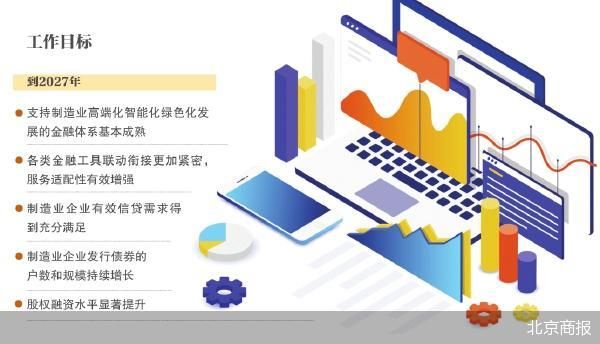
Core Viewpoint - The People's Bank of China and six other departments issued guidelines to enhance financial support for new industrialization, aiming to accelerate the development of high-quality financial services and prevent excessive competition in industries [1][3]. Group 1: Financial Support Measures - The guidelines propose 18 financial support measures across five key areas to enhance technological innovation and supply chain resilience in industries [1][3]. - By 2027, the financial system supporting the high-end, intelligent, and green development of manufacturing is expected to be well-established, with a focus on diverse financial products and effective risk prevention [3][4]. Group 2: Integration of Technology and Finance - The initiative emphasizes "integrated technology and industry finance," promoting long-term capital investment and the transformation of technological achievements [4][5]. - The guidelines include plans for monthly investment roadshows and nurturing small and medium-sized enterprises (SMEs) with specialized technologies to facilitate their listing [4][5]. Group 3: Cross-Border Financial Services - The guidelines aim to enhance cross-border financial services, including expanding the use of RMB for international trade and supporting pilot projects for cross-border cash pooling [4][5]. - The focus is on improving the convenience of cross-border settlements and upgrading foreign exchange hedging services to strengthen the competitiveness of "Made in China" in global supply chains [5]. Group 4: Implementation and Future Steps - The People's Bank of China and the Ministry of Industry and Information Technology will work with relevant departments to ensure the implementation of these guidelines, enhancing the financial support system for new industrialization [5][6].
信贷、保险、资本市场齐上阵!七部门打出金融“组合拳”支持新型工业化
Bei Jing Shang Bao· 2025-08-05 13:08
Core Viewpoint - The People's Bank of China and several government departments have jointly issued guidelines to enhance financial support for new industrialization, focusing on improving technological innovation and supply chain resilience in the manufacturing sector [1][4]. Financial Support Measures - The guidelines propose 18 financial support measures across five key areas, aiming to establish a mature financial system for high-end, intelligent, and green manufacturing by 2027 [4]. - Emphasis is placed on the integration of various financial tools, including structural monetary policy and macro credit policy, to provide long-term stable funding for advanced manufacturing [4][5]. Technology-Industry Financial Integration - The initiative includes the "Technology-Industry Financial Integration" project, which aims to attract long-term capital and facilitate the transformation of technological achievements [5]. - The project will implement monthly investment roadshows and cultivate small and medium-sized enterprises for listing, enhancing the evaluation system for hard technology attributes [5]. Cross-Border Financial Services - The guidelines aim to enhance the convenience of cross-border financial services, including facilitating cross-border settlements and upgrading foreign exchange hedging services [6]. - Support for enterprises in conducting cross-border fund pool pilot projects is also included, which will facilitate the management of domestic and foreign fund transfers [5][6]. Systematic Development of Financial and Industrial Collaboration - The issuance of these guidelines marks a significant step in the systematic deepening of financial and industrial collaboration in China, focusing on addressing the challenges faced by the real economy [6]. - The framework aims to direct financial resources precisely to areas where they are most needed in the industrial upgrade process, enhancing the ability of financial services to support high-quality development of the real economy [6].