
科技行业

Search documents
A股牛市韧性展现,7月28日,明天将迎来更大的变盘?
Sou Hu Cai Jing· 2025-07-28 01:39
一、央行突击降准的牛市!央行开展1.4万亿元买断式逆回购操作,其中,3个月(91天)期操作量8000亿元,6个月(182天)期操作量6000亿元。只不过更 多的后续刺激,可能要在美联储三四季度正式开始降息,我们这边的进一步宽松刺激才会落地。 在目前低利率的宏观环境下,如果财政和货币刺激先后落地,我们后续很可能会迎来924的2.0版本。因为从结构性分化到盈利效应带动增量资金进入,其实 也就差了中间财政刺激和货币宽松这把火。 当然了,这里还是那句话,不管是回顾历史还是对比现在,里面很多都是个人的主观看法和记录。这些看法和记录本身并不一定对,未来也会随着实际情况 的变化,不断的进行修正。 二、A股市场整体行情还是比较乐观的,到目前为止都没有一根大阴线,如果有是不错的上车机会。 关于后市,A股周线已经五连阳,下周收月线,月线也是阳线,月线三连阳,这都是后市长期多头的形态。 质疑牛市的声音不多了,但涨的并不快,3674高点可能8月份就过去了。7月底还有重要的消息面,下周四之前应该会出公告,也是个潜在利好催化。 但是,跌到最近的关键点位后,依旧有望在增量资金入场和板块轮动时期继续拉升。加上,大盘的2024年至今的高点虽在 ...

标普500指数屡创新高,大型科技公司本周陆续发财报
Sou Hu Cai Jing· 2025-07-27 23:34
Market Performance - The US stock indices collectively rose over the past week, with the Dow Jones Industrial Average increasing by 1.26% to 44,901.92 points, the Nasdaq Composite rising by 1.02% to 21,108.32 points, and the S&P 500 gaining 1.46% to 6,388.64 points [1] - Year-to-date, the Dow Jones has increased by 5.54%, the Nasdaq by 9.31%, and the S&P 500 by 8.62% [1] Earnings Reports - Over 82% of the 169 S&P 500 companies that have reported earnings exceeded market expectations [1] - Approximately 30% of S&P 500 companies have released their earnings, with an expected overall growth of 7.7% in Q2 earnings compared to the previous year [4] Sector Analysis - There is a notable divergence in the performance of major tech stocks, with Nvidia and Microsoft reaching new highs, while Tesla and Intel have seen declines of 21% and 10.39% respectively [2] - The S&P 500's price-to-earnings ratio stands at 22.6, significantly above the long-term average of 15.8 [2] Federal Reserve and Economic Indicators - The Federal Reserve is expected to maintain interest rates in the range of 4.25% to 4.5% during its upcoming meeting, as officials seek more data to assess the impact of tariffs on inflation [4] - Recent inflation data shows an increase in the Consumer Price Index (CPI) from 2.3% in April to 2.7% in June, indicating rising inflationary pressures [4]
美国34万亿外债或将暴雷?中国割不动,欧洲已警惕,拿什么还债?
Sou Hu Cai Jing· 2025-07-26 06:16
Group 1 - The core issue is the unprecedented scale of the US national debt, which has surpassed $34.5 trillion, leading to concerns about the long-term ability to repay this debt [1][4] - The annual interest payment on the national debt exceeds $1 trillion, and the debt is increasing at a rate of $1 million per day, potentially reaching $50 trillion by 2030 [2][4] - The US federal government's total debt has reached $166 trillion, excluding corporate debt, indicating a severe debt crisis that cannot be remedied merely by selling national assets [2][4] Group 2 - The US has been attempting to shift the burden of debt repayment onto other countries, particularly China and Europe, but these efforts have not yielded the desired results [6][11] - China has been gradually reducing its holdings of US debt while increasing its gold reserves, indicating a shift towards greater economic independence [11] - The US's high-interest rate policy is seen as a means to extract wealth from Japan and South Korea, which are critical allies in the US strategy to contain China [13][15] Group 3 - The relationship between the US and its European allies has been strained, with Europe realizing that it has been used for US interests without receiving substantial benefits [10] - The ongoing geopolitical tensions, such as the Russia-Ukraine conflict and the Middle East situation, have further complicated the economic landscape for Europe [10] - If the US debt crisis were to escalate, it could lead to a loss of dollar hegemony and a significant decline in US global influence, potentially relegating it to a second-tier power [16]
高华科技: 高华科技第四届董事会薪酬与考核委员会关于公司2025年限制性股票激励计划激励对象名单的审核意见及公示情况说明
Zheng Quan Zhi Xing· 2025-07-25 16:14
Core Viewpoint - The company has approved the 2025 Restricted Stock Incentive Plan and has publicly disclosed the list of incentive recipients, confirming compliance with relevant regulations and internal guidelines [2][4]. Disclosure and Review - The company held its seventh meeting of the fourth board of directors on July 14, 2025, where it reviewed and approved the draft of the 2025 Restricted Stock Incentive Plan and related proposals [2]. - The incentive recipient list was publicly disclosed for a period of 11 days, allowing employees to provide feedback on any objections [2][3]. - No objections were received from employees regarding the proposed list of incentive recipients by the end of the public disclosure period [3]. Review Committee's Opinion - The review committee confirmed that all individuals listed as incentive recipients meet the qualifications set forth by relevant laws, regulations, and the company's internal guidelines [4]. - The incentive recipients do not include independent directors, shareholders holding 5% or more of the company's shares, or the actual controller and their immediate family members [4].
【下周财报日历】下周科技股财报密集来袭,苹果(AAPL.O)、Meta Platforms(META.O)、亚马逊(AMZN.O)、微软(MSFT.O)、高通(QCOM.O)等个股将于下周公布财报。经济数据方面,中国7月官方制造业PMI;美国7月PCE、非农、小非农就业人数,美国7月标普全球制造业PMI终值等数据将于下周公布。此外,美联储将于下周公布利率决议;香港《稳定币条例》将于下周实施。敬请留意。完整个股财报日历请前往美港电讯APP-日历查看。点击查看>>
news flash· 2025-07-25 10:07
| · LU.JU | | | | | --- | --- | --- | --- | | 美国第二 | | | | | 心PCE物t | | | | | 年率初值 | | | | | · 22:00 | | | | | 美国6月成 | 约销售指 | | | | · 22:30 | | | | | 美国至7月 | 当周EIA原 | | | | 存(万桶) | | | | | · 22:30 | | | | | 美国至7月 | 当周EIA战 | | | | 油储备库? | | | | | 桶) | | | | | 등 1970년 1월 1일 19일 10월 1 | | | | | | | | | | | | | | | | | | | | | -162 | A-13 | 212 12 31 | | | | | | | | | | | | | | | | | | | | | | | | | | | · LU.JU | 白阴白郎十十 | · La | | --- | --- | --- | | 美国第二季度核 | · 16:30 | 美国 | | 心PCE物价指数 | 中国香港6月零 | 大 | | 年率初值 | ...

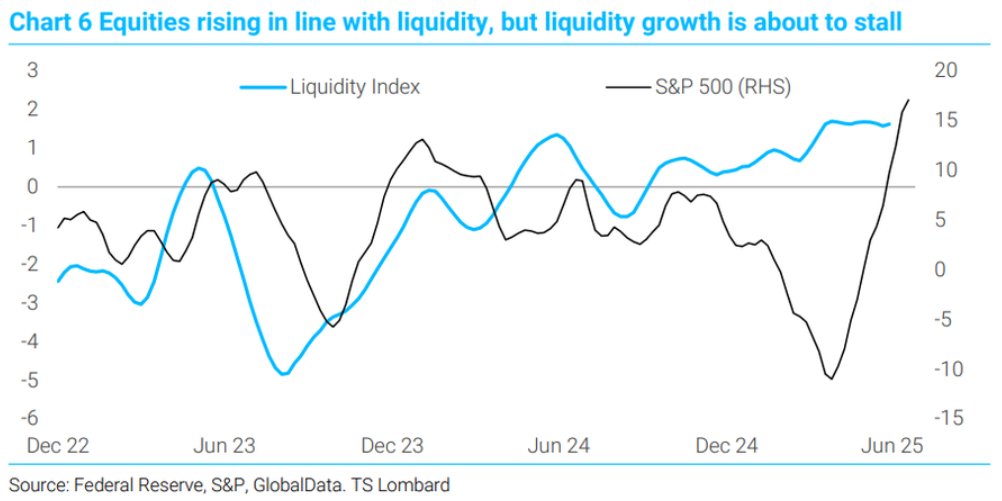
美股创新高狂潮暗藏崩盘信号:美联储+财政部合奏下的“流动性狂想曲”即将终结
智通财经网· 2025-07-25 01:49
Group 1 - The core argument of the report is that the massive excess liquidity released by the Federal Reserve and the U.S. Treasury has been the primary driver of the bull market in U.S. and global stock markets, raising concerns about how long this support can maintain high valuations [1][2] - The report questions the sustainability of the current high valuations in the stock market, particularly in light of the significant gap between the S&P 500 index and actual corporate profits, which has historically led to negative annualized returns [5][6] - The analysis indicates that the relationship between stock market valuations and productivity growth is distorted due to liquidity effects rather than fundamental economic strength, suggesting a potential risk for risk assets in the near term [2][5] Group 2 - The report highlights that the current market environment is characterized by complacency, with a significant number of earnings downgrades exceeding upgrades, raising the risk of increased volatility and potential declines in the stock market [7][8] - Analysts from JPMorgan warn that the global stock market, particularly the U.S. market, may face significant cracks despite recent highs, as the market sentiment appears overly optimistic amid tightening liquidity and deteriorating corporate earnings outlooks [7][8] - The report anticipates that the S&P 500 index may experience a notable decline, with projections suggesting a potential drop of around 15% by the end of the year, reflecting concerns over high valuations and economic slowdown [8]
显盈科技: 监事会关于公司2025年限制性股票激励计划授予激励对象名单(授予日)的核查意见
Zheng Quan Zhi Xing· 2025-07-24 16:33
Core Viewpoint - Shenzhen Xianying Technology Co., Ltd. has approved the grant of 890,400 shares of restricted stock to 29 eligible incentive objects as part of its 2025 restricted stock incentive plan, with the grant date set for July 24, 2025 [1][3]. Group 1: Incentive Plan Details - The company held its 26th meeting of the third Supervisory Board on July 24, 2025, to review and approve the grant of restricted stock [1]. - The incentive plan involves granting 890,400 shares of the second category of restricted stock to eligible participants [1][3]. - The list of incentive objects is consistent with the publicly disclosed list, and all have a valid employment or labor relationship with the company or its subsidiaries [1]. Group 2: Compliance and Eligibility - The incentive objects do not include independent directors, supervisors, or shareholders holding 5% or more of the company's shares, including their spouses, parents, and children [2]. - The company confirms that the incentive objects meet the eligibility criteria set forth in relevant laws, regulations, and the company's incentive plan [3].
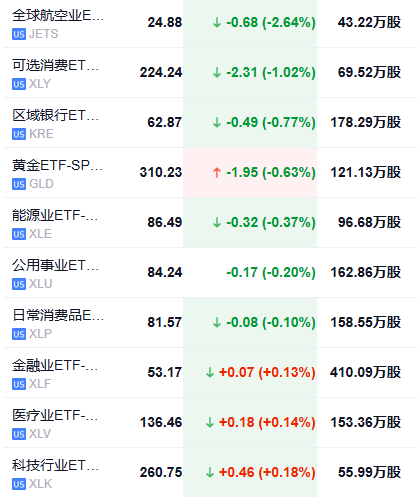
美股盘初,主要行业ETF涨跌不一,全球航空业ETF跌超2%,可选消费ETF、区域银行ETF跌幅居前。
news flash· 2025-07-24 14:00
Group 1 - Major industry ETFs showed mixed performance in early trading, with the global airline industry ETF declining over 2% [1] - The consumer discretionary ETF and regional bank ETF experienced the largest declines, with the consumer discretionary ETF down 1.02% and the regional bank ETF down 0.77% [1][2] - The gold ETF saw a slight increase of 0.63%, while the energy sector ETF and utility ETF both experienced minor declines [2] Group 2 - The global airline ETF (US JETS) closed at 24.88, down 2.64% with a trading volume of 432,200 shares [2] - The consumer discretionary ETF (US XLY) closed at 224.24, down 1.02% with a trading volume of 695,200 shares [2] - The regional bank ETF (US KRE) closed at 62.87, down 0.77% with a trading volume of 1,782,900 shares [2]
美国总统特朗普:人工智能竞赛需要硅谷的爱国主义,敦促科技公司“把美国放在第一位”。
news flash· 2025-07-23 21:55
美国总统特朗普:人工智能竞赛需要硅谷的爱国主义,敦促科技公司"把美国放在第一位"。 订阅人工智能动态 +订阅 ...
特朗普承诺采取措施刺激人工智能的使用和出口
news flash· 2025-07-23 17:29
金十数据7月24日讯,特朗普政府表示将削减繁文缛节,并采取措施促进美国科技公司的出口,以加速 美国对人工智能的使用。在周三发布的人工智能"行动计划"中,美国政府列出了一些举措,称这些举措 将使科技公司更容易建立训练人工智能模型所需的数据中心,并获得这些中心所需的电力。该计划包括 三个支柱:加速创新,在美国建立人工智能基础设施,使美国的硬件和软件成为全球人工智能创新 的"标准"平台。预计特朗普将于周三晚些时候在华盛顿的一个科技行业活动上签署行政命令,使该计划 生效。 特朗普承诺采取措施刺激人工智能的使用和出口 ...