金融租赁

Search documents
环球医疗(02666)发布中期业绩 股东应占溢利约12.28亿元 同比增长8%
智通财经网· 2025-08-27 04:07
Core Viewpoint - The company, Universal Medical (02666), reported a revenue of RMB 7.581 billion for the six months ending June 30, 2025, representing a year-on-year growth of 15.9% [1] - The profit attributable to ordinary shareholders was approximately RMB 1.228 billion, reflecting an 8% increase compared to the previous year [1] - Basic earnings per share were reported at RMB 0.65 [1] Group 1 - The company operates 68 comprehensive and specialized medical institutions, providing quality medical services to the public [1] - The company is engaged in full-cycle management of medical equipment and health technology businesses, including smart health and wellness services [1] - The company offers comprehensive financial solutions centered around financing leasing for its clients [1]
五矿资本: 五矿资本股份有限公司2025年半年度报告
Zheng Quan Zhi Xing· 2025-08-26 16:57
Core Points - The company reported a net profit of 34.77 million yuan for the first half of 2025, with a total distributable profit of 300.71 million yuan by the end of June 2025 after accounting for dividends paid [2][3] - The proposed cash dividend for the first half of 2025 is 0.06 yuan per share, amounting to a total of 26.99 million yuan, which represents 5.14% of the net profit attributable to shareholders [3] - The company’s total revenue for the first half of 2025 was 3.33 billion yuan, a decrease of 14.11% compared to the previous year, while the net profit attributable to shareholders decreased by 41.47% to 525.45 million yuan [6][19] Financial Performance - The total operating income for the first half of 2025 was 3,330,247,455.83 yuan, down from 3,877,202,735.45 yuan in the same period last year, reflecting a decline of 14.11% [6] - Interest income decreased by 26.44% to 1,646,826,829.46 yuan, while commission income fell by 23.39% to 1,060,076,439.76 yuan [6][7] - The total profit for the first half of 2025 was 759,048,496.43 yuan, a significant drop of 48.80% compared to the previous year [6] Industry Overview - The trust industry is experiencing a phase of stabilization and transformation, with total trust assets reaching 29.56 trillion yuan by the end of 2024, a year-on-year increase of 23.58% [9][10] - The financial leasing industry has entered a phase of steady development, with total assets growing by 16.51% to 4.87 trillion yuan by the end of 2024 [11][12] - The securities industry maintained a stable growth trend, with total assets reaching 12.93 trillion yuan, a year-on-year increase of 9.30% [12][13] Business Operations - The company operates through its wholly-owned subsidiary, Minmetals Capital Holdings, which manages various financial licenses including Minmetals Trust, Foreign Trade Financial Leasing, Minmetals Securities, and Minmetals Futures [15][16] - Minmetals Trust focuses on trust business and proprietary business, with total assets of 33.92 billion yuan and a net profit of -2.67 million yuan for the reporting period [23][24] - Foreign Trade Financial Leasing reported total assets of 52.94 billion yuan and a net profit of 50.48 million yuan, with a focus on financing leasing projects [26] Strategic Focus - The company is committed to transforming its business model towards "industrial finance, technology finance, and green finance," aiming to enhance its service capabilities for the real economy [19][20] - The company emphasizes the importance of governance and compliance, continuously improving its operational efficiency and market recognition [21] - The company actively engages in green finance initiatives, with Minmetals Trust managing 28 green trust projects totaling 5.34 billion yuan [22]

底仓再审视(二):如何做到攻守兼备配底仓
Guoxin Securities· 2025-08-26 14:48
1. Report Industry Investment Rating No information about the industry investment rating is provided in the report. 2. Core Views - Layout of the bottom - position is as important as flexible offense. A basket of "high - dividend × low - volatility" dividend assets can provide a natural "shock absorber" for the portfolio, and the combination can withstand extreme market conditions by suppressing volatility with stable cash flows and low β and then capturing market mismatches with the remaining positions [3]. - To amplify returns in the dividend pool, a dual - screening approach is more reliable than relying solely on the "high - dividend" indicator. Adding a second filter such as low - volatility, earnings quality, or institutional holdings can eliminate potential risks and further increase the returns of general dividend assets [3]. - On top of the dividend bottom - position, there are systematic excess opportunities from the left - to - right shift of the industrial cycle. Priority should be given to companies with stable cash flows despite pressured profits. Industries such as cement, silicone, and phosphate chemicals are currently in the preferred range, while the photovoltaic chain is still in a state of "double losses in profit and cash flow". The overall allocation strategy involves initially establishing an observation position, increasing the position after confirming the leading indicators of the profit inflection point, and exiting when profits weaken again or the gross margin is inverted [3]. 3. Summary by Relevant Catalogs 3.1 Bottom - Position Allocation Necessity: "Pure Left" and "Pure Right" Are Not Desirable - In a market with an increasing industry rotation center, it is crucial to build a long - term core position first. A 15 - year quarterly rotation experiment on 31 Shenwan primary industries shows that both extreme left - side bottom - fishing and extreme right - side chasing result in single - digit annualized returns and significant drawdowns. In contrast, a dividend portfolio characterized by "high - dividend × low - volatility" can provide double - digit annualized returns and keep drawdowns within an acceptable range. Therefore, increasing the exposure of "high - dividend + low - β" in the bottom - position can provide a safety cushion for the portfolio [7]. - Dividend assets are the optimal core bottom - position in terms of return - to - drawdown. Historical stress tests show that the dividend index has shallower drawdowns, a stable 3 - year rolling Sharpe ratio, and does not require market timing in the long - term perspective. It also has higher probabilities of achieving positive returns in different holding periods compared to most broad - based and style indices [10][12][21]. 3.2 Dividend Yield Single - Factor Trap - Selecting stocks based solely on the "high - dividend" factor often leads to choosing high - volatility stocks with limited return increases and large drawdowns. Adding a second filter such as low - volatility or earnings quality can improve the overall cost - effectiveness. Statistical regression shows that the dividend yield alone has a weak explanatory power for future returns [29]. - Several case studies illustrate different types of "false high - dividend" traps. For example, some companies rely on one - time gains to support high dividends, some have high dividends due to falling stock prices rather than improved profitability, and some have high dividends at the peak of the business cycle or due to high leverage. To avoid these traps, specific financial and operational criteria need to be set [37][40][44]. 3.3 High - Dividend Smart - Beta's Distortion Risk - Modified dividend indices such as "Dividend Quality" and "Dividend Potential" have larger fluctuations and deeper drawdowns than the CSI Dividend Index. Their style drift and uncontrolled risk exposure lead to higher volatility, especially in bear markets. The main reasons are their high - concentration weighting, high - valuation requirements, and frequent chasing of market highs [60][64]. - The CSI Dividend Index selects 100 stocks based on a three - year dividend yield with a diversified weighting, while the Dividend Quality and Dividend Potential indices select 50 stocks by adding factors such as ROE and EPS growth, with a more concentrated and high - chasing weighting. As a result, they are more likely to suffer from double - kills of earnings and valuation when the market weakens [64]. 3.4 Potential Ways to Enhance Dividend Low - Volatility - **Dividend + Pricing Power Approach**: Traditional high - dividend indices have several drawbacks, including style drift, inclusion of high - risk high - dividend stocks, and right - side trading characteristics. A comprehensive scoring system based on pricing power, price - to - earnings ratio, and stability can be used to select the top 20 stocks for a portfolio. A ten - year back - test shows that this combination has better performance in terms of cumulative return, annualized return, and drawdown control compared to the CSI Dividend Index [83][84]. - **Considering Institutional Participation Rate**: Incorporating institutional holdings into high - dividend screening reveals that stocks with high institutional participation (≥20%) from stable - cash - flow industries have better risk - return profiles, including higher cumulative returns, greater upside potential, and controlled drawdowns. In contrast, stocks with low institutional participation (<20%) from cyclical industries perform less well. Therefore, combining high - dividends with institutional recognition can build a safer and more sustainable dividend portfolio [89]. 3.5 Bottom - Position Is Not Just Dividends: Quality Low - Volatility and Cash Cows - The "quality + low - volatility" dual - screened bottom - position established in June 2020 can achieve a balance between offense and defense. By filtering out high - leverage and low - resilience companies and compressing risk thresholds, it has achieved a five - year rolling net value increase of about 1.6 times, with stable single - digit annualized returns and significantly reduced volatility and drawdowns compared to ordinary low - volatility strategies [94]. - The long - term returns of dividend assets mainly come from stable dividends and profits rather than valuation increases. From 2014 - 2025, the annualized total returns of Dividend Low - Volatility and CSI Dividend after reinvestment were 13.9% and 13.2% respectively, with dividend contributions exceeding 9 percentage points and accounting for over 70% of the total returns [98]. - The cash - cow enhancement framework uses six dimensions to examine potential risks in high - dividend portfolios and provides corresponding enhancement measures. These measures include equal - weighting industries and quality sorting to address concentration risks, using free - cash - flow and growth thresholds to eliminate "high - dividend traps", and implementing valuation gates and hedging strategies to manage valuation risks [108]. 3.6 Industrial Cycle Reversal: From Left to Right - At the inflection point of the industrial cycle, multi - dimensional indicators such as fundamentals, inventory, price, valuation, and funds often show concurrent inflection points. The consistency in the industry dimension, from raw material prices to mid - stream production and downstream demand, can improve the reliability of inflection - point signals. For example, the anti - involution market rhythm is often in line with this "consistency chain" [111][112]. - At the company level, by dividing samples into leading, mid - stream, and tail companies, monitoring the second - order derivatives of 10 key indicators can help identify the acceleration of marginal improvements in demand, pricing, or cash flows. When at least three indicators in any two of the three sample layers show positive second - order derivatives, it can be regarded as a company - level consistency inflection point [114]. - The industrial cycle reversal framework uses a "three - light" approach to determine investment opportunities. When the three conditions of valuation repair, profit - cash flow resonance improvement, and completion of inventory reduction and demand expansion are met simultaneously, it indicates a three - dimensional resonance of supply - demand, profit, and sentiment, and investors can make aggressive investments. Otherwise, they should continue to hold the dividend bottom - position [115].
五矿资本:8月26日召开董事会会议
Mei Ri Jing Ji Xin Wen· 2025-08-26 13:53
2024年1至12月份,五矿资本的营业收入构成为:租赁公司占比39.12%,信托公司占比23.33%,期货公 司占比21.06%,证券公司占比14.49%,其他业务占比2.0%。 每经AI快讯,五矿资本(SH 600390,收盘价:6.44元)8月26日晚间发布公告称,公司第九届第二十六 次董事会会议于2025年8月26日在北京市东城区朝阳门北大街3号五矿广场C1119会议室以现场会议及视 频会议的方式召开。会议审议了《关于 <公司2025年半年度报告> 及其摘要的议案》等文件。 每经头条(nbdtoutiao)——能给主人"打电话"的宠物智能手机也来了!宠物产业3000亿元市场大爆 发,行业上市公司"涨"声一片 截至发稿,五矿资本市值为290亿元。 (记者 王晓波) ...
国银金租(01606)已就滞俄飞机收到合计约1.4亿美元保险和解款
智通财经网· 2025-08-26 11:36
Core Viewpoint - The company reported on its 2022 annual report, highlighting the financial handling of aircraft leasing stranded in Russia and the receipt of insurance settlement funds totaling approximately $140 million [1] Group 1 - The company disclosed that its wholly-owned subsidiary, Guoyin Aviation Financial Leasing Co., Ltd., reached an insurance settlement agreement regarding the aircraft stranded in Russia [1] - The total amount received from the insurance settlement to date is approximately $140 million [1] - The receipt of the insurance settlement and funds was conducted in full compliance with all applicable laws, sanctions, and regulations [1]
国银金租已就滞俄飞机收到合计约1.4亿美元保险和解款
Zhi Tong Cai Jing· 2025-08-26 11:27
Core Viewpoint - The company reported on its 2022 annual report, highlighting the financial handling of aircraft leasing and related issues concerning planes stranded in Russia, along with the receipt of insurance settlement funds totaling approximately $140 million [1] Group 1: Financial Performance - The company has received a total of about $140 million in insurance settlement payments related to aircraft stranded in Russia [1] - The insurance settlements and the receipt of funds were conducted in full compliance with all applicable laws and sanctions regulations [1] Group 2: Operational Context - The report pertains to the company's wholly-owned subsidiary, Guoyin Aviation Financial Leasing Co., Ltd., and its dealings with relevant parties regarding the stranded aircraft [1]
申华控股: 申华控股2025年半年度报告
Zheng Quan Zhi Xing· 2025-08-26 11:09
Core Viewpoint - The company reported a decline in net profit and total profit for the first half of the year, indicating challenges in the automotive market and the need for strategic adjustments to maintain sales performance [2][3][5]. Financial Performance - The company's operating income for the first half of the year was approximately 2.31 billion yuan, a 3.13% increase compared to the same period last year [2]. - Total profit was reported at -84.09 million yuan, a decrease of 88.44% year-on-year [2]. - The net profit attributable to shareholders was -59.31 million yuan, down 52.37% from the previous year [2]. - The net cash flow from operating activities was 9.33 million yuan, a significant decrease of 80.74% compared to the previous year [2]. Business Overview - The company operates in four main sectors: automotive consumer services, new energy, real estate, and financial services [3]. - The automotive sales segment focuses on high-end brands like BMW, with a network of 4S stores for retail and service [3]. - The company has been actively adjusting its sales strategies in response to market trends, particularly in the face of declining sales in the automotive sector [3][5]. Market Conditions - The automotive market in China has faced challenges, with BMW's sales in the first half of 2025 down 15.5% year-on-year [3]. - The company is adapting to these market conditions by implementing proactive strategies to stabilize sales and adjust to new product launches [3]. Operational Developments - The company has successfully opened 30 new 4S stores in the passenger car market and has increased the utilization of its exhibition halls for various automotive-related activities [3][5]. - The company is also enhancing customer satisfaction through facility upgrades and improved service offerings in its office building [5]. Asset and Liability Analysis - The company's total assets decreased by 9.65% to approximately 2.99 billion yuan compared to the end of the previous year [2]. - The net assets attributable to shareholders were reported at approximately 760.73 million yuan, a decrease of 7.33% [2]. - The company has reduced short-term borrowings by 25.93% as part of its efforts to optimize its financial structure [6].

江苏金租(600901)2025年中报点评:业绩稳健增长 资产质量稳定
Xin Lang Cai Jing· 2025-08-26 02:35
Core Insights - The company reported a net operating income of 3.006 billion yuan, an increase of 14.91% year-on-year, and a net profit attributable to shareholders of 1.564 billion yuan, up 9.04% year-on-year [1] - The company maintains a stable asset quality with a non-performing loan ratio of 0.91% and a provision coverage ratio of 401.49% [2] - The company is focusing on a "retail + technology" dual-leading strategy, targeting core areas such as clean energy and high-end equipment, with projected revenue growth for 2025-2027 [3] Financial Performance - The company achieved a net interest income of 3.041 billion yuan, reflecting an 18.51% increase year-on-year, while maintaining a stable net interest margin of 3.71% [2] - The cost-to-income ratio was 9.68%, up 0.22 percentage points year-on-year, indicating ongoing investments in the "retail + technology" strategy [2] - The total assets reached 156.808 billion yuan, a 14.25% increase from the beginning of the year, with financing lease assets growing by 15.88% [1] Asset Quality and Risk Management - The company reported a stable asset quality with a focus on risk mitigation, as evidenced by a provision for bad debts of 581 million yuan, a 36.73% increase year-on-year [2] - The attention rate decreased to 2.36%, down 39 basis points from the end of the previous year, indicating improved asset quality [2] - The company has optimized its liabilities, with interest-bearing liabilities reaching 126.277 billion yuan, a 19.27% increase from the beginning of the year [1] Strategic Outlook - The company is expected to generate revenues of 6 billion yuan, 6.557 billion yuan, and 7.073 billion yuan for the years 2025, 2026, and 2027, respectively, with net profits projected at 3.248 billion yuan, 3.594 billion yuan, and 3.928 billion yuan [3] - The earnings per share (EPS) are forecasted to be 0.56 yuan, 0.62 yuan, and 0.68 yuan for the same period, with corresponding price-to-earnings (PE) ratios of 10.29, 9.30, and 8.51 [3]

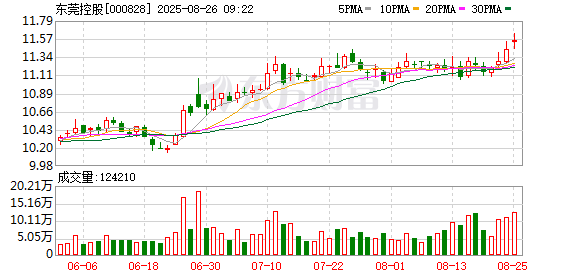
东莞控股:上半年业绩增逾两成,中期分红1.56亿元
Zheng Quan Shi Bao Wang· 2025-08-26 01:21
Group 1 - The company reported a net profit attributable to shareholders of 532 million yuan for the first half of 2025, representing a year-on-year increase of 20.51% [2] - The company's net assets attributable to shareholders reached 10.028 billion yuan by the end of the reporting period, an increase of 1.95% from the beginning of the year [2] - The revenue from highway tolls was 627 million yuan, remaining stable compared to the same period last year, accounting for 81.86% of total operating revenue [2] Group 2 - The company has initiated the expansion and renovation project for the Dongguan-Shenzhen Expressway, expected to be completed and operational by December 2028, which will effectively extend the toll collection period [2] - Revenue from financing leasing and commercial factoring was 81 million yuan, accounting for 10.60% of total operating revenue, with a decrease attributed to strict project risk control [2] - Revenue from the new energy vehicle charging and swapping business totaled 42 million yuan, accounting for 5.45% of total operating revenue, with a year-on-year increase of approximately 10% and a reduction in losses by 9.93% [2] Group 3 - The company announced an interim dividend of 1.5 yuan per 10 shares, totaling 156 million yuan, maintaining a stable and sustainable dividend policy [3] - The calculated dividend yield based on the most recent closing price is 4.11%, positioning the company among the industry leaders [3]


ST泉为: 关于新增诉讼事项的公告
Zheng Quan Zhi Xing· 2025-08-25 17:27
Core Viewpoint - The company is currently involved in multiple legal disputes, with significant financial implications, and the outcomes remain uncertain, potentially affecting its future profits. Group 1: Legal Disputes Overview - The company is a defendant in several lawsuits, including a financing lease contract dispute with Su Yin Financial Leasing Co., Ltd., involving a claim of approximately RMB 16,408,445.33 [1][2] - Another lawsuit involves a construction contract dispute with Shandong Taikai Electric Power Equipment Co., Ltd., with a claim amounting to RMB 754.5988 million [3][4] - A third dispute is with Xiamen Guomao Group Co., Ltd., where the company faces a claim of RMB 4,099,999.86 [5] Group 2: Financial Implications - The total amount involved in the ongoing lawsuits is significant, with the largest claim being RMB 16,141,334.62 for unpaid lease payments and associated penalties [2][3] - The company acknowledges that the impact of these legal matters on its current and future profits is uncertain, and it will continue to monitor the situation closely [5] - The company is actively seeking reasonable resolutions and enhancing communication with relevant parties to address these legal challenges [5]