
加密货币

Search documents
NCE平台:年终税务清算致加密市场回调
Xin Lang Cai Jing· 2025-12-24 10:48
Core Viewpoint - The cryptocurrency market is experiencing volatility, with Bitcoin trading below the $88,000 mark, influenced by year-end financial pressures and liquidity challenges [1][2]. Group 1: Market Performance - Despite strong performance in traditional commodities and a slight increase in the Nasdaq index, the cryptocurrency sector is facing liquidity and valuation tests due to unique year-end financial pressures [1][2]. - The perpetual contract positions for BTC and ETH have decreased by approximately $3 billion and $2 billion, respectively, indicating a significant drop in leverage and increased market vulnerability to price fluctuations [3]. Group 2: Investor Behavior - QCP Capital identifies "tax loss harvesting" as a key driver of recent declines in cryptocurrency-related stocks, as institutional investors seek to optimize balance sheets and offset tax liabilities before year-end [1][2]. - Seasonal capital withdrawal is not attributed to fundamental deterioration but rather to routine compliance and financial optimization actions by asset managers at year-end [1][2]. Group 3: Market Outlook - Analysts express caution regarding market sentiment due to concerns over inflation and uncertainty surrounding interest rate cuts in the coming year [4]. - The NCE platform suggests that any significant volatility caused by holiday liquidity depletion is likely to revert in January, with clearer market value support emerging as the new year funding allocation cycle restarts [4].


Mhmarkets迈汇:萨尔瓦多经济稳步增长 比特币策略压力缓解
Xin Lang Cai Jing· 2025-12-24 10:48
Core Insights - The exploration of cryptocurrencies by sovereign nations is reaching a new turning point as global digital asset allocation evolves [1] - The International Monetary Fund (IMF) has positively acknowledged El Salvador's economic situation, indicating a thaw in the long-standing tension between the country and the financial authority due to its Bitcoin holdings [1] Economic Performance - El Salvador's economic performance demonstrates the effectiveness of its macroeconomic policies, with a projected real GDP growth rate of around 4% for this year and a "very optimistic" outlook for 2026, supported by returning market confidence, record remittance income, and strong investments [3][4] Cryptocurrency Strategy - El Salvador has shown a decisive strategy in its cryptocurrency reserves, increasing its national stockpile by over 1,000 Bitcoins during market volatility in November, bringing its total holdings to nearly 7,500 BTC, valued at approximately $660 million [4] - The country maintains open communication channels with the IMF, with advanced negotiations regarding the sale of the government crypto wallet Chivo, focusing on enhancing transparency, public resource security, and effective risk hedging [2][4] Future Outlook - El Salvador is finding a delicate balance between traditional financial aid and digital asset reserves, potentially improving its regulatory framework for digital assets while ensuring economic growth as discussions on the Extended Fund Facility (EFF) program continue [2][4]
NCE外汇:年终税务效应诱发加密震荡
Xin Lang Cai Jing· 2025-12-24 10:43
Group 1 - The cryptocurrency market is undergoing a correction driven by liquidity and financial liquidation, with Bitcoin hovering below $88,000 and significant declines in related stocks [1][2] - The atypical sell-off is attributed to "tax loss harvesting," where investors liquidate underperforming positions to offset capital gains for tax purposes [1][2] - The seasonal rebalancing behavior is amplified in a low liquidity environment, causing even small outflows to lead to significant price volatility [1][2] Group 2 - The perpetual contract positions for BTC and ETH have recently shrunk by approximately $5 billion, indicating an acceleration in the market's deleveraging process [3] - As leveraged funds exit the market, the ability to defend against price fluctuations is weakening [3] - The total market capitalization of approximately $2.6 trillion would require a lengthy recovery period and substantial fundamental support to return to its peak of $4 trillion [3] Group 3 - Despite strong economic growth resilience, investor concerns about inflation rebound and interest rate paths are limiting risk appetite [4] - The options market still retains bullish bets on the $100,000 level, but the market is more inclined to technical consolidation around the mean before new liquidity returns in January [4] - Investors are advised to monitor the dynamic rotation between safe-haven assets and risk assets during the year-end period to prepare for potential mean reversion [4]
特朗普的资本重构:一场万亿美元级别的资金流向大转移
华尔街见闻· 2025-12-24 04:01
Core Viewpoint - The article discusses the significant policy shifts under the Trump administration that are reshaping capital flows in various sectors, particularly in banking, housing finance, cryptocurrency, and energy, indicating a major reallocation of investment opportunities and risks. Group 1: Banking Regulation and Liquidity Release - The Federal banking regulators are relaxing key capital rules, specifically lowering the "enhanced supplementary leverage ratio" (eSLR) from 5% to between 3.5% and 4.25%, effective in early 2026, which is expected to release up to $219 billion in capital for major banks like JPMorgan Chase & Co. and Citigroup Inc. [2] - Following the regulatory easing, the largest four U.S. banks nearly doubled their stock buybacks to $21 billion and increased dividend payments by about 10% in the first full quarter after passing the Federal Reserve's annual stress tests [2] - Concerns have been raised about the potential risks of this policy, with warnings that it could make the banking system more vulnerable and increase industry concentration [2] Group 2: Housing Finance Privatization - A controversial proposal aims to end government control over Fannie Mae and Freddie Mac, leading to a significant rise in their stock prices, with Fannie Mae's shares soaring from under $2 to over $15 [3] - Bill Ackman, a prominent hedge fund manager, advocates for the public listing of these companies, while the Treasury holds $360 billion in preferred equity, complicating the privatization discussions [5] - Research indicates that even if the conservatorship is not ended, an IPO could raise borrowing costs, potentially increasing mortgage rates by 0.2 to 0.8 percentage points, which could add $200,000 in interest costs over the life of a $1 million mortgage [5] Group 3: Institutionalization of Cryptocurrency - The Trump administration has shifted its stance on digital assets, signing the GENIUS Act to provide a legal framework for stablecoins, which is expected to mainstream their use [6] - Citigroup projects that the stablecoin market could grow from approximately $310 billion to $4 trillion by 2030, with major banks like JPMorgan actively entering this space [6] - The new law mandates stablecoin issuers to maintain reserves at a 1:1 ratio and allows the use of U.S. Treasury securities as reserve assets, which may increase demand for U.S. government bonds [6] Group 4: Energy Investment Landscape Shift - The Trump administration's "Big Beautiful" plan has led to the cancellation or postponement of clean energy projects worth nearly $29.3 billion by ending tax credits for electric vehicles and renewable energy [8] - Companies like Pine Gate Renewables have announced closures and layoffs, while Fortescue Ltd. has abandoned a $210 million battery factory project, reflecting the drastic capital flow reversal in the energy sector [8] - The federal government is refocusing its efforts on supporting fossil fuels and nuclear energy development, indicating a significant shift in energy investment priorities [8] Group 5: New Channels for Pension Fund Investment - The Trump administration is attempting to tap into the $13 trillion retirement savings market by requiring agencies to reassess guidelines on alternative asset investments in retirement plans [10] - This move is seen as a major benefit for the private equity industry, potentially releasing billions in new funds as traditional pension funds approach their investment limits in private markets [10] - Despite warnings from figures like Senator Elizabeth Warren about the risks to ordinary Americans, private equity firms argue that this will provide broader access to previously exclusive financial products [10]


加密四年周期新论:我问了七位资深从业者现在是什么阶段
3 6 Ke· 2025-12-24 03:48
Core Viewpoint - The "four-year cycle" theory in the cryptocurrency market, which has been a foundational belief since Bitcoin's inception, is being questioned as macroeconomic factors and institutional involvement become more significant than the traditional supply-driven narratives [1][9][18]. Group 1: Four-Year Cycle Discussion - The "four-year cycle" is traditionally driven by Bitcoin's halving events, which reduce supply and influence price dynamics [8]. - Some experts argue that the cycle is now influenced more by political and liquidity cycles rather than just halving events, suggesting a shift in how market participants view Bitcoin's role as a macro asset [9][10]. - The consensus among experts is that while the four-year cycle had a strong supply basis in the past, it is now transitioning to a model influenced by market narratives and macroeconomic factors [11][12]. Group 2: Market Dynamics and ETF Impact - The current market's reduced price volatility and growth are attributed to diminishing marginal effects of halving events and the significant influx of institutional capital through ETFs [12][13]. - Experts note that the previous cycle was driven by retail liquidity, while the current cycle sees over $50 billion in ETF funds entering the market, leading to a more gradual price increase rather than explosive growth [12][13]. - The consensus is that the halving remains a relevant factor but is now secondary to institutional flows and macroeconomic conditions [13][14]. Group 3: Current Market Phase - There is a divergence in expert opinions regarding the current market phase, with some viewing it as a bear market's early stage, while others see it as a correction within a broader bull market [14][15][16]. - The current market is characterized by a technical bear phase, but macroeconomic conditions have not yet confirmed a full bear market [15][16]. - Many experts believe that as long as global liquidity continues to expand, the upward trend in crypto assets is likely to persist [16][17]. Group 4: Future Market Structure - The future of the crypto market may not follow traditional bull-bear cycles but could enter a prolonged period of upward movement with compressed bear markets, driven by institutional adoption and macroeconomic factors [19][20]. - Experts emphasize the importance of stablecoins and institutional investment as key drivers of future market growth, suggesting a shift towards a more integrated financial ecosystem [19][20]. - The market structure is evolving from a retail-driven model to one dominated by institutional investment, which may lead to different dynamics in asset price movements [24]. Group 5: Altcoin Season and Market Behavior - The absence of a traditional "altcoin season" in the current cycle is attributed to Bitcoin's dominance and a more selective investment approach by institutions [23]. - Experts suggest that while new altcoin seasons may emerge, they will likely focus on a few high-utility tokens rather than a broad-based rally [23][24]. - The market's structure has shifted from a retail-driven attention economy to an institution-driven performance economy, impacting how altcoins are perceived and valued [24]. Group 6: Positioning and Investment Strategies - Many experts have reduced their altcoin holdings and are focusing on Bitcoin and Ethereum, reflecting a defensive and long-term investment strategy [25][26]. - The consensus is to avoid leverage and frequent trading, emphasizing disciplined investment approaches in the current market environment [27]. - Some experts believe that while aggressive bottom-fishing may not be advisable, gradual accumulation during this period could be beneficial [27].
2025年资产格局大逆转:贵金属与美股“吸金”,加密货币跌回高风险阵营
智通财经网· 2025-12-24 02:20
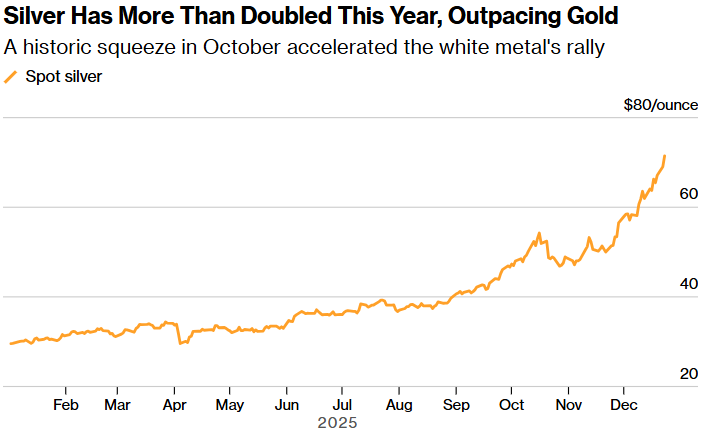
Core Insights - In 2025, cryptocurrencies experienced a significant decline, losing their status as a defensive or alternative asset, while traditional assets like gold and silver thrived, highlighting a shift in investor preferences towards safer, more predictable investments [1][8][16] Group 1: Performance of Assets - Precious metals, particularly silver and gold, saw remarkable gains in 2025, with silver prices rising approximately 140% and gold prices increasing around 70%, both reaching historical highs [1][2] - The U.S. stock indices also performed well, with the Nasdaq up 19%, S&P 500 up 17%, and Russell 2000 up 14%, supported by expectations of easing monetary policy and a focus on artificial intelligence investments [5][8] Group 2: Cryptocurrency Market Dynamics - The cryptocurrency market initially benefited from the launch of the U.S. spot Bitcoin ETF, leading to a surge in Bitcoin prices, but this momentum faded in the second half of the year due to weak liquidity and high regulatory risks [8][12] - Bitcoin ended 2025 with a price around $88,000, reflecting a decline of about 6% from the beginning of the year, indicating that even with the ETF, overall demand for risk assets remained weak [12][9] Group 3: Ethereum and Altcoins - Ethereum struggled to convert its technological advantages into price growth, experiencing a decline of approximately 12% throughout the year, as it lacked strong market demand catalysts compared to Bitcoin [13] - The altcoin market was the weakest segment, with an average value drop of about 42%, as investors shifted focus to more liquid assets, leading to a significant reduction in the total market capitalization of altcoins [14][15] Group 4: Investor Behavior and Market Trends - Investors increasingly favored assets with clear regulatory frameworks and high liquidity, leading to a preference for traditional investments over cryptocurrencies, which are viewed as high-volatility risk assets [1][16] - The initial excitement surrounding ETFs could not sustain ongoing demand, resulting in a market shift towards profit-taking and consolidation, as investor attention moved to more transparent risk profiles [15][16]
Analyst rules out 'nuclear' dollar printing but Bitcoin still not safe
Yahoo Finance· 2025-12-23 18:03
The U.S. Dollar Index (DXY) fell to 97.96 on Dec. 23, the lowest level in eleven weeks after Oct. 3. Source: U.S. Dollar Index (DXY), MarketWatch The DXY is an index that measures the value of the USD relative to a basket of foreign currencies. The index's decline indicates the weakening of the dollar. Generally, such news is considered bullish for Bitcoin (BTC) because the cryptocurrency is considered a hedge asset during times of dollar devaluation. But there is one analyst who thinks there is no pr ...
美股异动 | 加密货币概念股走弱 Robinhood(HOOD.US)跌超4%
智通财经网· 2025-12-23 15:08
Core Viewpoint - Bitcoin has experienced a short-term decline, dropping below $87,000, with a daily decrease of over 3%, while Ethereum has seen a nearly 5% drop in the same period [1] Cryptocurrency Market Performance - Bitcoin's price fell below $87,000, marking a daily decline of more than 3% [1] - Ethereum's price decreased by nearly 5% during the same trading day [1] Impact on Cryptocurrency-Related Stocks - Bitmine Immersion Technologies (BMNR.US) saw a decline of over 6.8% [1] - Circle (CRCL.US) experienced a drop of 5.9% [1] - Robinhood (HOOD.US) fell by more than 4% [1] - Strategy (MSTR.US) and Coinbase (COIN.US) both declined by over 3% [1]





美股异动丨比特币向下触及约8.7万美元,加密货币概念股普跌
Ge Long Hui· 2025-12-23 14:50
Group 1 - Cryptocurrency concept stocks experienced a broad decline, with Bullish dropping over 4% [1] - Circle fell by 3.5%, while Canaan Creative and Robinhood both decreased by over 2% [1] - Strategy declined by 1.7%, and Coinbase saw a drop of 1.4% [1] Group 2 - Bitcoin briefly fell by 1.8%, reaching approximately $87,000 per coin [1]

Bitcoin bulls eye possible tailwind as U.S. dollar index continues to leg lower
Yahoo Finance· 2025-12-23 14:47
Core Viewpoint - The U.S. dollar index (DXY) is experiencing a decline, trading near its 2025 low, following a significant drop in the first half of 2025 after a strong gain post the November 2024 election of Donald Trump [1][2]. Group 1: Dollar Performance - The dollar's substantial drop in 2025 was initially accompanied by a broader market reaction, with stocks, gold, and bitcoin rising sharply to new records [2]. - Despite the dollar's weakness, gold, silver, and copper have reached new record highs, while bitcoin and the broader crypto markets have faced significant declines [2]. Group 2: Technical Analysis - The DXY index is currently trading just above a critical long-term support level established since the 2008 global financial crisis, which has been tested multiple times [3]. - The potential for the dollar to fall below this major support level is heightened as foreign central banks, including the Bank of Japan, move towards tighter monetary policies, contrasting with pressure on the U.S. Federal Reserve to lower interest rates [4]. Group 3: Implications for Crypto - A break below the long-term support level of the dollar could potentially trigger a reversal in the downtrend of the cryptocurrency market, which has not yet benefited from the weak dollar this year [5].