科技股泡沫

Search documents
历史上四轮科技股泡沫-回顾与启示
2026-03-01 17:23
Summary of Key Points from the Conference Call Industry or Company Involved - The discussion revolves around the technology sector, particularly focusing on the U.S. and A-share markets driven by AI trends and historical technology bubbles. Core Insights and Arguments - **Current Market Conditions**: The S&P 500's forward valuation is approximately 25.4 times, significantly higher than the 10-year median of about 20 times, indicating elevated valuation concerns in the market [3][24]. - **Market Concentration**: As of early February, the top ten companies in the U.S. stock market accounted for about 32% of the total market capitalization, reflecting a high concentration level despite a slight decrease from previous years [3][24]. - **Capital Expenditure Trends**: Leading tech companies, especially in cloud computing, are experiencing significant increases in capital expenditures. For instance, the "Seven Sisters" and Broadcom's Kubernetes-related investments are projected to rise from $167.5 billion in 2023 to approximately $670 billion by 2028, which may impact cash flow and limit the ability to enhance EPS through buybacks [5][24]. - **Historical Technology Bubbles**: The analysis includes a framework for understanding historical technology bubbles, such as the British Canal Boom, Railway Boom, the Roaring Twenties, and the Dot-com Bubble, focusing on their triggers, financial environments, market expansions, and collapse mechanisms [4][24]. - **Investment Intensity**: The investment intensity in the current AI-driven market is projected to reach 7.3% of GDP by Q3 2025, surpassing the previous peak of 6.4% during the Dot-com era, although the absolute increase is less pronounced compared to historical trends [24][25]. Other Important but Possibly Overlooked Content - **Historical Context**: The British Canal Boom was driven by the Industrial Revolution, leading to significant returns on early canal projects, with dividend yields reaching as high as 10.6% in the later years [6][24]. - **Market Dynamics**: The analysis of the Railway Boom highlights how macroeconomic conditions, such as low interest rates and economic expansion, facilitated speculative investments, leading to significant market volatility [9][24]. - **Regulatory Environment**: The current regulatory stance towards AI is generally supportive, which may mitigate risks associated with potential market corrections in the tech sector [26][27]. - **Investment Strategies**: Suggested strategies for mitigating risks in the current market include increasing allocations to value stocks, small-cap stocks, and sectors like consumer goods, finance, and healthcare, which may perform better during downturns [27][24]. This summary encapsulates the key points discussed in the conference call, providing insights into the current state of the technology sector, historical comparisons, and strategic recommendations for investors.
资本开支超GDP!硅谷巨头6600亿美元押注AI,市场却越烧钱越恐慌
硬AI· 2026-02-06 06:44
Group 1 - The core viewpoint of the article highlights that major US tech companies plan to invest a record $660 billion in AI infrastructure by 2026, which exceeds Israel's GDP and represents a 60% increase from $410 billion in 2025 and 165% from $245 billion in 2024 [2][3][6] - The massive capital expenditure plans have led to a significant market reaction, with Amazon, Google, and Microsoft collectively losing $900 billion in market value following their quarterly earnings reports [3][4][6] - Apple's strategy of minimal capital expenditure has allowed it to avoid the sell-off, reporting record revenue of $144 billion, while its capital spending decreased by 17% to $2.4 billion in the last quarter [10][11] Group 2 - Investors are increasingly anxious about the long-term return on investment from AI, as rising capital expenditures suggest that achieving AI's full potential may require more time and resources [8][9] - The market sentiment has shifted, with the Nasdaq index dropping 4% over five days, reflecting concerns about the sustainability of tech stocks amid rising capital expenditures [9][13] - Despite strong revenue growth, companies like Microsoft and Amazon face pressure to demonstrate that their significant spending will yield attractive returns, as investor patience wanes [9][10] Group 3 - Nvidia, as the highest-valued public company, is expected to face a turbulent market when it releases its earnings report, with investors looking for signs that the escalating capital expenditures will translate into revenue growth [13][14] - Meta has also announced plans to double its capital expenditures to $135 billion, but its stock gains were short-lived amid broader market sell-offs [13][14] - Overall, the combined annual revenue growth of the four companies reached 14% to $1.6 trillion, which is insufficient to alleviate the prevailing market pessimism [13]






2026年海外经济五大风险关注点
Sou Hu Cai Jing· 2026-01-23 05:43
Group 1: Geopolitical Risks - Geopolitical risks are expected to remain high, with the U.S. continuing to be a major risk point due to the unpredictable nature of its policies under the Trump administration [7][19] - The ongoing Russia-Ukraine conflict and internal political pressures in Europe may lead to increased difficulties in achieving policy coordination [19] - The expansion of geopolitical risks into technology, economy, and trade sectors is noted, indicating a broader impact on global economic and trade networks [16][19] Group 2: Tariff Policies - Tariff policies are anticipated to have a continued impact on international trade, with potential for easing but still significant disruptions expected [21][30] - The U.S. tariff rate is projected to decrease from a theoretical value of 16.8% to 9.3% if the IEEPA tariffs are deemed unconstitutional, which could improve inflation and GDP outlooks [23][28] - Global trade growth is forecasted to slow down, with the WTO predicting a decline in trade growth rate to 0.5% in 2026 [30][32] Group 3: Federal Reserve Independence - The independence of the Federal Reserve is under scrutiny, particularly with potential candidates for the next chair being more aligned with Trump’s policies, which could undermine its autonomy [8][38] - Historical trends suggest that a loss of independence could lead to increased inflation risks and market volatility [34][45] - The market is closely monitoring the nomination of the next Federal Reserve chair, with candidates like Kevin Hassett and Kevin Warsh having significant implications for monetary policy [38][41] Group 4: Technology Sector Bubble Risks - The technology sector, particularly driven by AI, has seen significant stock price increases, leading to concerns about potential bubbles due to high valuations [2][48] - As of January, the S&P 500 PE ratio is at 25.6, indicating elevated valuation levels compared to historical averages [48][50] - The concentration of market capitalization among the top tech companies remains high, with the top ten companies accounting for 32.8% of the market, raising concerns about market fragility [49][51] Group 5: Fiscal Sustainability Concerns - Concerns regarding fiscal sustainability have intensified, with long-term debt rates remaining high and fiscal deficits expected to persist [9][46] - The trend of expansive fiscal policies is likely to continue, driven by economic pressures from trade wars and increased defense spending [9][46] - The K-shaped recovery in the stock market is anticipated to persist, with interest rate-sensitive sectors facing ongoing pressure [9][46]

杨德龙:盘点2025年全球股市表现 2026年依然大有可为
Xin Lang Cai Jing· 2026-01-01 06:16
Group 1: Global Market Performance - The global capital markets showed resilience in 2025, with many stock markets continuing the upward trend from 2024, despite a significant adjustment in April due to Trump's tariff policies [1][6] - The MSCI global index achieved a two-digit increase of approximately 20% in 2025, marking the third consecutive year of growth exceeding 15%, largely driven by the ongoing AI revolution [1][6] - The A-share and Hong Kong markets performed well, with the Shanghai Composite Index rising nearly 20% and the ChiNext Index soaring by 50%, indicating a strong tech bull market [1][6] Group 2: Asia-Pacific Market Dynamics - The MSCI Asia-Pacific index surged by about 28% in 2025, marking the first time since 2020 that Asian markets outperformed major US and European indices in a single year [2][7] - Japan's Nikkei 225 index broke the 50,000-point barrier with a 30% annual increase, demonstrating strong performance despite the Bank of Japan's interest rate hikes [2][7] - The Asia-Pacific region holds 75% of global semiconductor manufacturing capacity and is expected to maintain its leading position in the next five years due to cost advantages and a complete industrial chain [2][7] Group 3: Future Market Outlook - The logic supporting global stock market growth remains unchanged, with expectations of at least two more rate cuts by the Federal Reserve in 2026, potentially boosting market liquidity [8] - A potential shift in leadership at the Federal Reserve could lead to more aggressive rate cuts, further supporting global stock markets [8] - A-shares and Hong Kong stocks are projected to rise by 10% to 20% in 2026, driven by policy support, foreign capital inflows, and a shift of household savings into capital markets [9][10] Group 4: Sector Performance and Investment Opportunities - The market structure in 2025 was characterized by a "barbell" approach, with low-valuation, high-dividend bank stocks rising significantly alongside strong performance in technology growth stocks [4][10] - The technology sector, particularly in humanoid robots, semiconductor chips, advanced algorithms, and solid-state batteries, is expected to continue its upward trajectory in 2026 [4][10] - As market funds increase and household savings shift towards capital markets, A-shares are likely to transition from a structural bull market to a comprehensive bull market, presenting more investment opportunities [10]
欧洲股市:今年涨16%,2026年或迎利好
Sou Hu Cai Jing· 2025-12-30 08:36
Core Viewpoint - The European stock market has experienced a strong rise in 2023, driven by soaring metal prices and robust defense spending prospects, with the Stoxx Europe 600 index up 16% and reaching record highs [1] Group 1: Market Performance - The Stoxx Europe 600 index has achieved a cumulative increase of 16% this year, consistently setting new highs [1] - The banking sector has led the gains, surging 65% year-to-date, potentially marking the largest annual increase since 1997, supported by strong earnings and substantial shareholder returns [1] Group 2: Future Outlook - Strategists indicate that several favorable factors exist for the European stock market in the coming year, with a lower exposure to technology stock bubble risks [1] - Concerns over a weaker dollar, valuation gaps, and a positive macroeconomic environment are expected to benefit the European stock market through 2026, although corporate earnings need to improve for the market to perform well again [1]
金属价格飙升、国防支出推动欧股屡创新高 银行股强势领涨
Ge Long Hui A P P· 2025-12-30 07:46
Group 1 - The European stock market has experienced a strong upward trend in 2023, with the Stoxx 600 index rising by 16% and reaching record highs, outperforming the S&P 500 in dollar terms [1] - The banking sector has led the gains, surging by 65% this year, potentially marking the largest annual increase since 1997, driven by robust earnings and substantial shareholder returns [1] - Strategists believe that several favorable factors will support the European stock market in 2024, including concerns over further dollar weakness, attractive valuation differences compared to the U.S., and a generally positive macroeconomic environment [1] Group 2 - For the European stock market to continue its strong performance, corporate earnings must rebound in the coming year [1]
泡沫隐忧与稳健标的:2026年科技股走势前瞻
Xin Lang Cai Jing· 2025-12-19 16:20
Core Insights - 2025 is expected to be a pivotal year for investors, with the expansion of the artificial intelligence (AI) trend and increasing market concerns about potential bubbles in tech stocks and the disruptive impact of AI technology [1][9] - Despite strong stock price increases for tech giants like Alphabet and Nvidia, sectors such as memory chips and hard drives are emerging as superior investment opportunities [1][8] - The sustainability of massive investments in AI computing power and the ability to generate reasonable returns are under unprecedented scrutiny as the US stock market enters its fourth year of a bull run [9] New Cloud Service Providers' Anxiety - New cloud service providers focused on AI-customized services are expected to be market focal points in 2025, but by 2026, they may become indicators of AI bubble risks [2][10] - OpenAI's ongoing inability to achieve profitability raises doubts about its capacity to fulfill substantial spending commitments, including a $300 billion cloud computing agreement with Oracle [2][10] - Oracle's stock has dropped over 45% since peaking in September, primarily due to risks associated with OpenAI, although it saw a 6% increase following news of a TikTok acquisition [2][10] Decline of New Cloud Service Providers - CoreWeave's market value has shrunk by about two-thirds since its peak in June, while Nebius Group's stock has fallen over 42% from its October high [3][11] Undervalued "Traditional Tech" - Investors are discovering new investment avenues by following the flow of hundreds of billions in capital expenditures in the AI sector, with companies like SanDisk, Western Digital, and Seagate leading the S&P 500 annual gainers [4][12] - The trend of increasing capital expenditures is expected to continue into 2026, with more investors focusing on undervalued software stocks [4][12] - The emergence of investment highlights in edge technology is noted, as a complete ecosystem around AI infrastructure is gradually forming [4][12] Software Sector's Struggles - Despite attractive valuations, software stocks have not effectively attracted investors, particularly SaaS companies, which have faced significant declines due to fears of being disrupted by AI [5][12] - The introduction of AI tools like ChatGPT and Google's Gemini is eroding market demand and pricing power for traditional software products [5][12] - Analysts indicate that AI poses an existential competitive threat to certain software companies, with the battle for dominance among AI chatbots and intelligent agents becoming a core industry battleground [5][13] Continued Weakness in Software Sector - The decline in the software sector may persist into 2026, with some analysts suggesting that the current downturn has been excessive, as SaaS companies are trading at a 30% to 40% discount to their fundamental value [14] Strong Performers: High Valuation Stocks Reaching New Highs - Concerns that high valuation stocks would stagnate in 2025 have proven unfounded, as companies like Palantir have seen stock price increases despite high P/E ratios exceeding 200 [6][15] - Palantir's stock ranks eighth in the S&P 500 with a nearly 150% increase, and analysts expect a 43% revenue surge in 2026 [6][15] - Tesla, despite facing valuation controversies and challenges, has reached historical highs, driven by investor confidence in its future prospects [6][15] Outlook for 2026 - The overall landscape of the tech industry in 2026 is expected to resemble that of the previous year, with high valuations but real growth opportunities [7][16] - The ability of companies to deliver on performance promises will be crucial for driving stock prices higher, as market expectations are already elevated [7][16]


美联储三次降息75基点影响全球资本流动
Sou Hu Cai Jing· 2025-12-14 00:36
Group 1: Direct Impact on Individuals - Lower consumption costs due to reduced interest rates and appreciation of RMB against USD, making overseas education, travel, and cross-border shopping cheaper, saving families over ten thousand yuan annually [1] - Decrease in prices of imported goods such as luxury items and electronics, providing short-term benefits to consumers [2] - Decline in yields of dollar deposits, US Treasury bonds, and dollar-linked financial products, necessitating adjustments in asset allocation [3] - Support for safe-haven assets like gold and silver due to a weaker dollar, but caution advised as gold prices are at historical highs [4] - Eased mortgage pressure with potential reductions in monthly payments for loans, such as a decrease of 150 yuan for a 1 million yuan mortgage over 30 years [5] Group 2: Differentiated Impact on Enterprises - Positive effects for import enterprises as procurement costs in RMB decrease, leading to short-term profit increases [6] - Companies with dollar-denominated debts benefit from lower overseas financing costs and reduced interest expenses on existing dollar debts [7] - Emerging industries may see increased foreign investment, potentially boosting valuations in sectors like new energy and semiconductors [8] - Negative impact on dollar-denominated export companies as rising commodity prices weaken international competitiveness, particularly in labor-intensive sectors like textiles and home appliances [9] - Increased costs for raw material import companies due to rising international commodity prices, affecting sectors such as chemicals and air logistics [10] Group 3: Investment Market Opportunities and Risks - Anticipation of foreign capital inflow into A-shares and Hong Kong stocks, benefiting technology growth stocks (AI, semiconductors) and interest-sensitive sectors (brokerage, real estate) [11] - Caution advised regarding the risk of "good news being fully priced in," which may lead to increased short-term volatility [11] - Narrowing interest rate differentials between China and the US alleviating depreciation pressure on RMB, with a trend of increased foreign allocation to Chinese bonds [12] - RMB exchange rate expected to stabilize and trend upwards, with recent offshore rates surpassing 7.06, though rapid appreciation may impact exports [13] - Weaker dollar driving capital towards emerging markets, with Chinese assets viewed as "value traps," but caution against rapid inflow and outflow of speculative capital [14] Group 4: Long-term Policy and Economic Linkages - Expansion of domestic policy space with reduced external constraints, allowing for more flexible monetary policy, supporting a "moderately loose" stance through 2026 [15] - Coordination of fiscal and monetary policies to stabilize growth as indicated by the Central Political Bureau meeting [15] - Potential systemic risks if the US aggressively lowers interest rates due to political pressure, which could lead to technology stock bubbles or stagflation risks [15] - Possible acceleration of RMB internationalization if the dollar's global status is undermined by diminished independence of the Federal Reserve [15]
股指黄金周度报告-20251205
Xin Ji Yuan Qi Huo· 2025-12-05 12:53
1. Report Industry Investment Rating - No information provided 2. Core Viewpoints of the Report - In the short - term, domestic economic data shows marginal weakness, corporate profits have not significantly improved, and the stock index's short - term rebound should be viewed with caution; the Federal Reserve's interest rate decision is approaching, a 25 - basis - point rate cut is likely, and gold will continue to oscillate at a high level and may face a directional choice [38]. - In the medium - to - long - term, the stock index's valuation will still be dragged down by the decline in corporate profit growth at the molecular end, while the support at the denominator end mainly comes from the recovery of risk appetite, including the intensification of domestic counter - cyclical adjustment policies and the easing of international trade situations, and the stock index will maintain a wide - range oscillation pattern; concerns about the uncertainty of US tariff policies have subsided, the Russia - Ukraine situation is expected to ease, and the expectation of a December rate cut by the Federal Reserve has been fully digested, so there is a risk of a deep adjustment in the gold market [38]. 3. Summary by Relevant Catalog Industry Data - In November 2025, the official manufacturing PMI was 49.2, up 0.2 percentage points from the previous month, and has been in the contraction range for 8 consecutive months. Industrial production has warmed up, but demand is weak, external demand is under great downward pressure, and the business climate of small and medium - sized enterprises remains weak [3]. Stock Index Fundamental Data - Due to weak terminal demand, downstream enterprises still face great operating pressure, production costs are difficult to pass on to consumers, the phenomenon of increasing revenue without increasing profits persists, and some industries are still in the active inventory reduction stage [15]. - The margin trading balance of Shanghai and Shenzhen Stock Exchanges slightly declined to 2457.665 billion yuan. The central bank conducted 663.8 billion yuan of 7 - day reverse repurchase operations this week, resulting in a net withdrawal of 848 billion yuan [17]. Gold Fundamental Data - In October, the ADP employment in the US unexpectedly decreased, further strengthening the market's expectation of a rate cut in December. According to the CME "FedWatch" tool, the probability of a 25 - basis - point rate cut in December has risen to 89.2% [22]. - The warehouse receipts and inventory of Shanghai gold futures have slowed down, and the inventory of New York COMEX gold has continued to decline, reflecting a cooling of the market's bullish sentiment [36]. Strategy Recommendation - In November, the official manufacturing PMI rebounded slightly but has been in the contraction range for 8 consecutive months. The domestic economic development is unbalanced with insufficient endogenous growth momentum and weak demand. The expectation of a December rate cut by the Federal Reserve is strengthening, the external market is warming up, and concerns about the bursting of the technology stock bubble have temporarily eased. As the time window for the Central Economic Work Conference approaches, the market expects more growth - stabilizing policies. The stock index's short - term rebound should be viewed cautiously; the unexpected decline in US ADP employment in October has strengthened the market's expectation of a December rate cut by the Federal Reserve. The Federal Reserve's interest rate decision will be announced on December 11. Given that the rate - cut expectation has been digested by the market, focus on the monetary policy statement, Powell's speech, and the change in the interest rate dot - plot. In the short term, Trump's statement about announcing the next Fed chairperson early next year has put pressure on the US dollar index, and gold is in a high - level oscillation [37]. Next Week's Focus - Important US data for November, such as imports and exports and CPI annual rate, as well as the Federal Reserve's December interest rate decision [39]
关键数据来了,黄金静待破局!
Jin Tou Wang· 2025-12-05 11:16
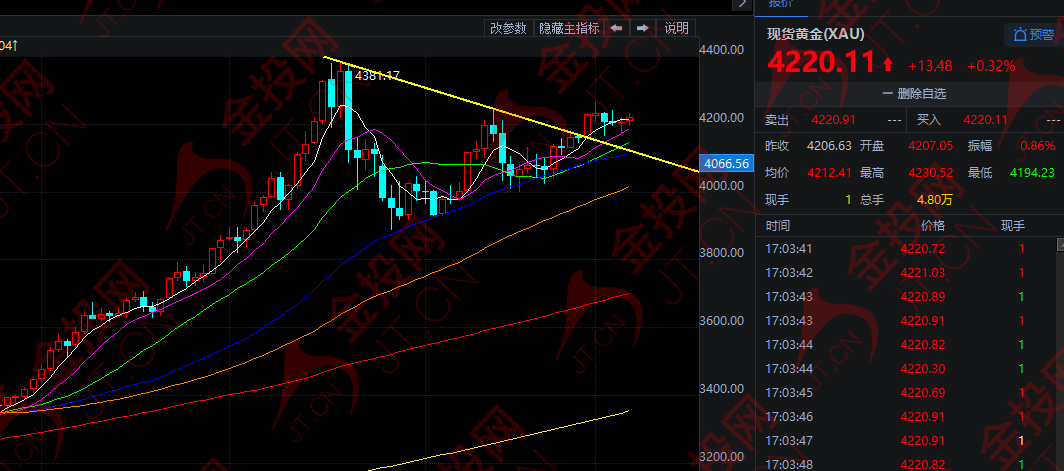
Group 1: Gold Market - Spot gold experienced a slight increase of 0.13%, with a low of $4,175 and a rebound to a high of $4,219, closing at $4,208.60 [1] - Currently, gold is trading around $4,218 in the European market [1] Group 2: U.S. Labor Market and Federal Reserve - The U.S. Labor Department reported a decrease of 27,000 in initial jobless claims to 191,000, the lowest level in over three years, below the expected 220,000 [3] - The number of continuing claims remains above 1.9 million, indicating structural pressures in the labor market [4] - Revelio Labs reported a decrease of 9,000 in non-farm payrolls for November, with October's data revised to a loss of 15,500 jobs, leading traders to bet on further rate cuts by the Federal Reserve [5] - Goldman Sachs indicated that the labor market is showing signs of cooling, with a 25 basis point rate cut by the Fed in December being highly likely [5][6] - The next Federal Reserve meeting is scheduled for December 9-10, with an 87% probability of a 25 basis point cut [6] Group 3: Inflation Data and Market Outlook - The upcoming PCE inflation data is considered crucial, with expectations for core PCE to rise by 0.2% and maintain an annual rate close to 3% [7] - A stable inflation reading would suggest "inflation is stable," while a higher reading could lead to a market re-evaluation [7] - The outlook for the stock market suggests a lower risk of a tech bubble burst compared to 2000, but emphasizes the need for balanced asset allocation to mitigate potential risks [7] Group 4: Military Developments - The Iranian Revolutionary Guard conducted military exercises in the Persian Gulf, showcasing new defense and offensive capabilities, including AI technology for target identification [8] - The U.S. Central Command announced the formation of a squadron of one-way attack drones in the Middle East, based on the Iranian "Witness-136" drone [10] - The U.S. military conducted an attack on a vessel in the Eastern Pacific, resulting in four fatalities, as part of a broader anti-drug operation in the region [11][12]