
乡村旅游

Search documents
统筹做大“蛋糕”与分好“蛋糕”
Jing Ji Ri Bao· 2025-08-12 22:15
Core Viewpoint - Huzhou is implementing the concept of "Green Water and Green Mountains are as Valuable as Mountains of Gold and Silver" through innovative reforms and mechanisms, aiming to achieve ecological civilization and common prosperity [1][2]. Group 1: Reform and Innovation - Huzhou has been exploring reforms to activate ecological resources, such as initiating the "Two Mountains" cooperative pilot reform in 2019, achieving full coverage of cooperatives by June 2023, and generating a cumulative income of 147 million yuan for village collectives [1]. - The city is also pioneering property rights reform for mountain ponds and reservoirs, with the first national ecological product value transformation project set to launch in March 2024 [1]. Group 2: Business Model Innovation - Huzhou is transforming ecological resources into vibrant business models, such as "village coffee + leisure" and "camping + cultural tourism," which have attracted youth to rural areas and upgraded traditional industries to new formats like coffee economy and live-streaming e-commerce [1]. - The "Deep Blue Plan" in Anji set a national record with a single store selling 8,818 cups of coffee in one day, showcasing the potential of innovative business models [1]. Group 3: Benefit Distribution Mechanism - Huzhou has innovated a benefit distribution mechanism to ensure equitable sharing of ecological wealth, exemplified by Anji's bamboo forest carbon trading platform, which allows villagers to earn stable returns while investing in sustainable projects [2]. - The model ensures that villagers receive 60% of the bamboo forest's value-added income, while village collectives retain 40% for community welfare and development projects, promoting a cycle of resource utilization and benefit return [2]. Group 4: Broader Implications - Huzhou's practices reflect a commitment to balancing high-quality development with environmental protection, creating a replicable model for ecological common prosperity that can be promoted across the province and nation [2].
【铭记历史 缅怀先烈】浙江长兴:红色热土展新颜 传承发展添活力
Yang Shi Wang· 2025-08-12 11:48
Core Insights - The article highlights the transformation of Coal Mountain Town in Zhejiang, which has leveraged its historical significance and ecological resources to develop tourism and new energy industries [1][2] - The region has seen a revival of its revolutionary heritage, attracting nearly 800,000 tourists annually to its historical sites [1] - Environmental restoration efforts have been implemented alongside the development of new industries, including a 10 MW solar power project generating an average of 11 million kWh per year [2] Group 1: Historical Significance - Coal Mountain Town was a key command center for the New Fourth Army during the Anti-Japanese War, coordinating efforts across several regions [1] - The establishment of the New Fourth Army Suzhou-Zhejiang Military Region in Coal Mountain Town marked a significant point in the resistance against Japanese forces [1] Group 2: Economic Development - The town has developed a rich revolutionary site cluster, enhancing its appeal for red tourism and creating new economic opportunities for local residents [1] - Villagers have diversified their income by opening guesthouses and serving as tour guides, contributing to the local economy [1] Group 3: Environmental Initiatives - The town has undertaken environmental remediation and land reclamation projects, restoring the ecological balance of the area [2] - The shift from coal mining to green energy initiatives reflects a broader trend towards sustainable development in the region [2] Group 4: Emerging Industries - Longxing County is focusing on the development of emerging industries such as smart vehicles, new energy, and intelligent equipment, creating a comprehensive industrial chain [2] - The local economy is evolving from traditional coal mining to innovative sectors, enhancing overall economic resilience [2]
美丽乡村“点绿成金”
Xin Hua Wang· 2025-08-12 09:16
Group 1 - The article highlights the transformation of rural areas in Zhejiang Province through the development of "green economy" and sustainable agricultural practices, showcasing the integration of ecological systems in farming [1][2][8] - Lin Keng Village's "梅-茶-鸡-蜂" (plum-tea-chicken-bee) agricultural system is recognized as a global important agricultural cultural heritage by the FAO, emphasizing the benefits of biodiversity and ecological balance [1][8] - The "兴林益农" (Xinglin Yinnong) cooperative workshop in Qingtian County has developed a hand-made soap product using tea oil and coffee grounds, creating job opportunities for local residents [1][2] Group 2 - Qingtian County has a long history of oil tea production, with 306,700 acres of oil tea trees, the largest area in Zhejiang Province, but faced challenges like fragmented management [2] - Recent reforms in Qingtian County have led to the establishment of a cooperative model involving state-owned enterprises, strong village companies, cooperatives, and private enterprises, with an investment of 15 million yuan to create a shared service center [2] - The first year of operation for the oil tea workshop produced 120,000 pounds of oil, generating nearly 10 million yuan in revenue and increasing the average income of over 100 households by 12,000 yuan [2][8] Group 3 - The historical village of Tantai in Wuyi County has revitalized its economy through ecological restoration and cultural tourism, transforming from a degraded area to a model for wetland protection and cultural empowerment [4][7] - Tantai Village has successfully restored 21 ancient buildings, creating cultural venues such as art galleries and museums, which attract over 200,000 visitors annually [7][8] - From 2017 to 2024, Tantai Village's collective economic income increased from 240,000 yuan to 1.92 million yuan, while per capita disposable income rose from 13,000 yuan to 35,000 yuan [8]


江宁区龙尚村入选全国乡村振兴典型案例
Nan Jing Ri Bao· 2025-08-12 02:24
Core Insights - Longshang Village has been recognized as a typical case for promoting rural revitalization, being the only village selected from the city in the "Typical Cases for Promoting Comprehensive Rural Revitalization 2025" published by the Central Rural Work Leading Group Office [1] Group 1: Development and Planning - The village underwent a transformation from an underdeveloped area to an advanced cultural tourism village, with a pivotal change occurring in 2017 when it invited Nanjing University to create a development plan [1] - The development plan, known as the Longshang Mangu Development Plan, focused on reshaping the village's image and leveraging its natural resources for tourism [1] Group 2: Infrastructure and Environment - Systematic improvements were made to the local environment, including the restoration of the Jiuxiang River and management of 100,000 acres of forest [2] - Infrastructure upgrades included the completion of Longshang Avenue and enhancements to the Bantan Line, connecting Longshang Village with other beautiful villages in Jiangning [2] Group 3: Economic Growth and Community Engagement - The introduction of diverse business models, such as rural homestays and ecological farms, has attracted over 500 million yuan in social capital investment [2] - The "Lais Village Shared Courtyard+" project has successfully engaged new investors, resulting in an average annual rental income of over 60,000 yuan for original homeowners and an increase in collective income of 2.419 million yuan [2] Group 4: Tourism and Revenue Generation - Longshang Village is projected to receive 500,000 tourists in 2024, generating approximately 78 million yuan in total revenue and creating around 600 job opportunities for local residents [3] - The average annual income for villagers is estimated at 54,000 yuan, with collective operational income reaching about 6.8 million yuan [3]
舟山泼墨绘“绿”奔赴“新”程
Zhong Guo Huan Jing Bao· 2025-08-12 01:36
Core Viewpoint - Zhoushan Islands are exemplifying the concept of "Lucid waters and lush mountains are invaluable assets" through various ecological and sustainable development practices, marking the 20th anniversary of this philosophy's introduction [1]. Group 1: Ecological Development - The establishment of the first local standard for ecological product value accounting in a marine area in Zhoushan provides a model for realizing ecological product value [1]. - Zhoushan is committed to high-level construction of a marine garden city, promoting the brand "Green Development Looks at Zhoushan" [1]. - The transformation of the Dihai Bay area from an industrial port to a beautiful ecological park illustrates the successful implementation of the "Two Mountains" concept [2]. Group 2: Environmental Management - Comprehensive water environment governance has turned previously polluted rivers into clean waterways, showcasing effective ecological resource management [4]. - Zhoushan ranks among the top cities in air quality in China, with a centralized sewage collection rate of 86.45% and a waste classification rate of 86.1% as of 2024 [4]. - The city has implemented a "no leaf sweeping" initiative to enhance seasonal aesthetics and established a real-time monitoring platform for environmental data [4]. Group 3: Rural Transformation - The transformation of rural areas, such as the New Village and Milin Village, demonstrates successful rural environmental improvement and the development of new tourism and hospitality industries [7][8]. - The "One Village, One Product" initiative has led to the creation of garden-like villages, enhancing local tourism and community engagement [8]. - Zhoushan has achieved a 50% coverage rate for beautiful rural areas, with significant investments in modernizing small towns and villages [8]. Group 4: Marine and Ecological Protection - Zhoushan has established a comprehensive marine sanitation mechanism to manage marine waste effectively, contributing to the protection of its marine ecosystem [10]. - The city has completed 113 out of 149 ecological infrastructure projects aimed at enhancing biodiversity and environmental quality [10]. - Community involvement in environmental protection is evident, with local volunteer groups actively participating in beach clean-ups and conservation efforts [11].

故乡山水丨萤火微光点亮乡村振兴梦
Yang Guang Wang· 2025-08-12 00:58
Core Viewpoint - The article highlights the successful integration of ecological restoration and rural tourism in Wu Bohao Village, Hubei Province, showcasing the revival of the rare water-dwelling fireflies known as "Wuhan Fireflies" and its positive impact on local community and economy [1][2][3]. Group 1: Ecological Restoration - The Liangzi Lake area has undergone significant ecological improvements since 2013, with a complete withdrawal from general industrial activities over a 500 square kilometer area, leading to better water quality and environment [2]. - The introduction of ecological projects such as wetland restoration and comprehensive sewage treatment has created an ideal habitat for the "Wuhan Fireflies" [2]. Group 2: Economic Impact - The establishment of a rural tourism project in Wu Bohao Village has led to an increase in collective economic income by over 200,000 yuan annually since 2022, benefiting local residents and promoting job creation [4]. - The village has seen a return of migrant workers who now take on roles such as forest rangers and camp service staff, contributing to a better living environment and increased income [4]. Group 3: Community Engagement - The village committee has formed cooperatives to manage idle land, enabling 15 impoverished households to work at the tourism base and increase their income [4]. - The local leadership emphasizes transforming ecological value into economic value through sustainable tourism practices [4].
以“村+企”“村+宿”“村+民”合作模式激活农文旅融合 直播带货点燃村民热情 问主播:镜头前紧张咋办
Si Chuan Ri Bao· 2025-08-12 00:15
Core Viewpoint - The article highlights the innovative approaches taken by rural areas in Sichuan, particularly Qilong Village, to leverage digital platforms for agricultural and tourism development, thereby enhancing local economies and promoting rural revitalization [1][2][4]. Group 1: Digital Transformation in Agriculture - Qilong Village has established a media company, "Haoshi Media," with a shareholding structure of 42% for the village collective, 38% for university students, and 20% for villagers, aiming to promote local agricultural products and tourism through digital channels [2][3]. - The initial challenges faced by the media company included financial constraints, leading to a pivot from traditional promotional content to live-streaming sales, which proved successful with sales reaching 121,300 yuan in a single session [2][3]. Group 2: Community Engagement and Economic Growth - The combination of "village collective + villagers + university students" has fostered a collaborative environment for cultural dissemination and economic revitalization in Qilong Village [2][3]. - Local residents have shown increased interest in digital marketing, with some, like the deputy village head, adopting social media to promote their products, indicating a shift towards a "traditional + online" sales model [3]. Group 3: Tourism and Hospitality Development - Qilong Village has developed 13 unique homestays that attract visitors, enhancing the local tourism experience by integrating tea culture and agricultural activities [3][4]. - The village is implementing a "village + enterprise" and "village + homestay" model to optimize resource utilization and stimulate economic growth, including the establishment of a logistics service company to support homestay operations [3][4].
8月11日晚间央视新闻联播要闻集锦
Yang Shi Xin Wen Ke Hu Duan· 2025-08-11 13:56
Group 1 - The core viewpoint emphasizes the importance of developing specialty agricultural products and rural tourism as part of the rural revitalization strategy in the new era, as highlighted by General Secretary Xi Jinping [1][3] - The rural tourism market has been thriving this year, with various regions promoting the deep integration of agriculture, culture, and tourism to attract visitors to rural areas [3] Group 2 - The Central Committee of the Communist Party has issued a revised work regulation for Party schools and administrative colleges, mandating strict adherence by all regions and departments [4] - The first batch of five national parks in China has completed the registration of natural resource rights, marking a significant step in ecological conservation efforts [9] Group 3 - The "Mother River" initiative has shown significant ecological recovery in the Yangtze and Yellow Rivers, which are crucial for ecological civilization construction, with notable achievements since the 18th National Congress [5] - The "Solid Border and Prosperous Border" initiative in Tibet has improved living conditions and boosted local industries, enhancing the overall well-being of border residents [6]
【牢记嘱托·看见美好中国】“红绿”生金 绘就老区新景
Yang Guang Wang· 2025-08-11 12:06
Core Viewpoint - The development of rural tourism in Tianpu Dazhuang, leveraging rich red cultural and ecological resources, has significantly boosted the local economy and improved the livelihoods of residents [2][4]. Group 1: Rural Tourism Development - Tianpu Dazhuang, located in a famous revolutionary area, attracts tourists seeking historical and natural experiences [1][4]. - The village has preserved its traditional architecture and historical features while promoting local red stories, avoiding large-scale construction [2][5]. - In 2024, Tianpu Dazhuang is expected to receive 660,000 visitors, generating over 32 million yuan in tourism revenue [7]. Group 2: Economic Impact on Residents - Local residents have transformed their homes into guesthouses and restaurants, with some earning 120,000 to 200,000 yuan annually from tourism-related activities [4][7]. - The establishment of over 20 specialty shops, 23 guesthouses, and 11 farmhouses has created diverse income sources for the community [7]. - Young entrepreneurs are creating cultural products that reflect local heritage, further enhancing community income and cultural awareness [4][6].
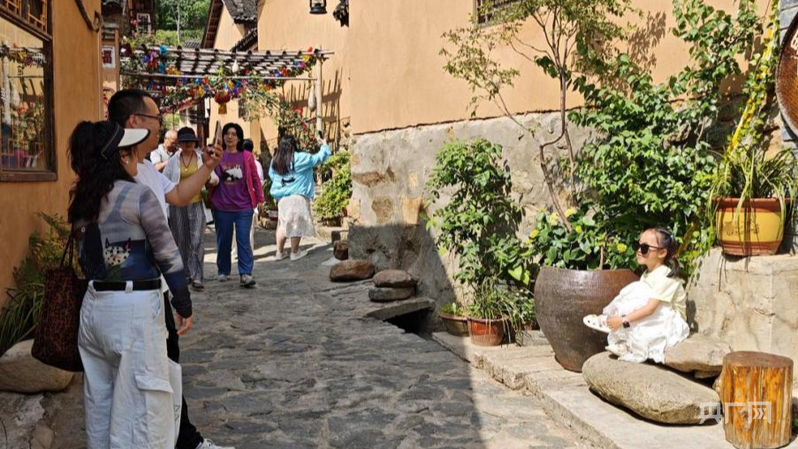
【新思想引领新征程】乡村旅游蓬勃发展 助力乡村全面振兴
Yang Shi Wang· 2025-08-11 11:59
Core Insights - The core viewpoint emphasizes the importance of integrating特色农产品 (specialty agricultural products) and乡村旅游 (rural tourism) for rural revitalization in China, as highlighted by President Xi Jinping [1] Group 1: Rural Tourism Development - The rural tourism market in China has been thriving this year, with a total of 707 million visitors and revenue of 412 billion yuan in the first quarter [2] - The "May Day" and "Duanwu" holidays saw continued popularity in rural tourism, becoming a significant highlight of holiday consumption [2] - Various regions are innovating rural tourism models, upgrading products, and optimizing services to capture development opportunities [2] Group 2: Cultural and Economic Integration - The integration of agriculture and tourism is being emphasized, with regions like 奇台县 (Qitai County) leveraging their agricultural landscapes to attract tourists [2] - New industries and business models are emerging, such as乡村避暑游 (rural summer vacation) and乡村康养游 (rural health tourism), contributing to local employment and economic growth [2] - The development of "village brands" like "村晚" (village evening shows) and "村咖" (village cafes) is enhancing the income potential for farmers [2] Group 3: Infrastructure and Accessibility - By the end of 2024, over 30,000 towns and 500,000 villages in China are expected to have paved roads, with rural tap water coverage reaching 94% and sanitary toilet coverage around 75% [3] - The rapid deployment of digital infrastructure in rural areas, including internet and mobile payment systems, is improving the comfort and convenience of rural tourism [3] - The number of key rural tourism villages and towns has reached 1,399 and 198 respectively, injecting new vitality into rural revitalization efforts [3]