油气

Search documents
“十四五”能源成就·油气篇 | 我国油气行业进入量效齐增与绿色开发新阶段
Zhong Guo Dian Li Bao· 2025-12-18 06:36
Core Insights - The article highlights the significant advancements in China's oil and gas industry, marking a new phase of simultaneous growth in quantity and quality, alongside a transition towards green development [2][4][30]. Group 1: Quantity Growth - Domestic crude oil production has surpassed 200 million tons, reaching a historical high, while natural gas production has achieved a continuous increase of over 10 billion cubic meters for nine consecutive years [2][13]. - The industry has added 10 new oil fields with over 1 billion tons and 19 gas fields with over 100 billion cubic meters in the past five years, with geological reserves increasing by approximately 43% for oil and 40% for gas compared to the previous five-year plan [2][11]. Group 2: Quality Improvement - Key technologies have seen systematic breakthroughs, transitioning from traditional extraction methods to a focus on technology-driven, clean, and low-carbon development [2][15]. - The exploration approach has evolved from random attempts to systematic evaluations of underground resources, enhancing the understanding of oil and gas systems [21]. Group 3: Technological Advancements - The industry has made significant strides in autonomous technology, with the successful development of deep-water oil and gas fields, exemplified by the "Deep Sea No. 1" project, which showcases China's capabilities in design, construction, and operation [9][10]. - Advanced drilling technologies, such as automated drilling rigs capable of reaching depths of 12,000 meters, have been developed to tackle complex geological challenges [22]. Group 4: Green Development - The integration of renewable energy sources into oil and gas production has been emphasized, with initiatives like the construction of green low-carbon production systems in oil fields [31]. - Carbon capture, utilization, and storage (CCUS) technologies have been implemented to reduce emissions, with significant projects underway that demonstrate the potential for carbon reduction while enhancing production [34]. Group 5: Future Outlook - The oil and gas industry is positioned for sustainable growth, with a focus on self-reliance and technological independence, ensuring energy security amid global challenges [4][18]. - The ongoing efforts to enhance production efficiency and explore unconventional resources, such as shale oil, are expected to play a crucial role in meeting future energy demands [27][28].
纳指、标普500指数跌逾1%,甲骨文跌超5%,中概指数跌0.73%
Ge Long Hui· 2025-12-18 01:17
美股三大指数集体收跌,道指跌0.47%,纳指跌1.81%,标普500指数跌1.16%,大型科技股普跌,甲骨 文跌超5%,特斯拉、博通跌超4%,英伟达、谷歌跌超3%,Meta、苹果跌超1%。 储能概念、半导体、计算机硬件跌幅居前,康特科技跌超7%,超微电脑、阿斯麦、AMD、Arm跌超 5%,科磊跌超4%。油气、能源、贵金属板块走高,康菲石油涨超4%,埃克森美孚、英国石油涨超 2%。 (原标题:纳指、标普500指数跌逾1%,甲骨文跌超5%,中概指数跌0.73%) 纳斯达克中国金龙指数收跌0.73%,热门中概股多数下跌,拼多多、蔚来、理想汽车跌超3%,爱奇艺、 小鹏汽车跌超2%,阿里巴巴、网易跌超1%。 ...
深夜,美股大跳水!特朗普:全面封锁!油价拉升!LME明年7月起实施持仓限额新规,有何影响
Xin Lang Cai Jing· 2025-12-18 00:24
Group 1: Market Overview - The US stock market experienced a collective decline, with the Dow Jones down 0.47%, Nasdaq down 1.81%, and S&P 500 down 1.16% [2][15] - Major technology stocks fell, with Oracle dropping over 5%, Tesla and Broadcom over 4%, and Nvidia, Google over 3% [2][15] - Energy and precious metals sectors saw gains, with ConocoPhillips up over 4% and ExxonMobil, British Petroleum up over 2% [2][15] Group 2: Commodity Prices - Spot silver prices increased by 4.01%, reaching $66.3146 per ounce, while COMEX silver futures rose by 5.19% to $66.610 per ounce, hitting a historical high [2][15] - COMEX copper futures rose by 1.29%, priced at $5.4280 per pound, and spot platinum prices increased by 2.98%, reaching $1900.18 per ounce [2][15] - WTI January crude oil futures closed up $0.67 per barrel, a 1.21% increase, at $55.94 per barrel, while Brent February crude oil futures rose $0.76 per barrel, a 1.29% increase, to $59.68 per barrel [2][15] Group 3: Venezuela Oil Situation - The situation in Venezuela is critical as oil storage facilities are nearing capacity, expected to reach maximum storage limits in about 10 days due to US sanctions and oil tanker seizures [5][17] - The Venezuelan state oil company, which produces nearly 1 million barrels per day, may be forced to shut down some oil wells if storage capacity is reached [5][17] Group 4: LME New Regulations - The London Metal Exchange (LME) announced new position limit regulations to be implemented starting July 2026, aimed at enhancing market risk management and compliance with UK financial regulatory requirements [19][22] - The new rules will allow LME to directly manage position limits based on market dynamics, covering key metal futures contracts including aluminum, copper, lead, nickel, tin, and zinc [22][24] - The adjustments are designed to improve risk exposure management, allowing for stricter controls on volatile contracts while maintaining flexibility for liquid contracts [23][24]


油气股盘前普涨 特朗普封锁委内瑞拉油轮刺激油价反弹
Ge Long Hui· 2025-12-17 10:11
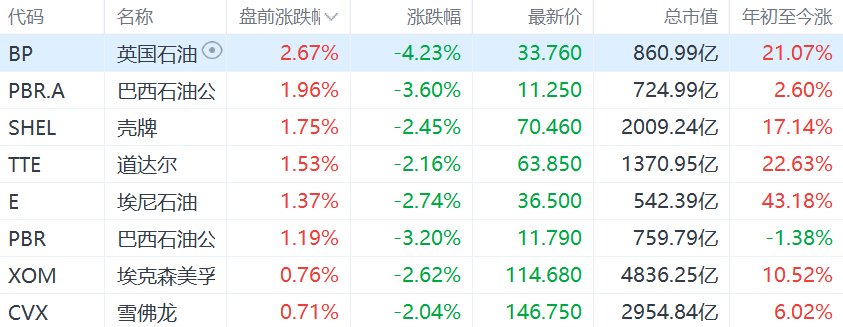
Core Viewpoint - US oil and gas stocks are experiencing a pre-market rally, driven by increased pressure on Venezuela from President Trump, leading to a rebound in oil prices from their lowest levels since 2021 [1] Group 1: Stock Performance - BP (British Petroleum) is up by 2.67%, with a current price of $33.760 and a market cap of $86.099 billion, showing a year-to-date increase of 21.07% [2] - Shell (SHEL) has risen by 1.75%, priced at $70.460, with a market cap of $200.924 billion and a year-to-date gain of 17.14% [2] - Total (TTE) increased by 1.53%, trading at $63.850, with a market cap of $137.095 billion and a year-to-date rise of 22.63% [2] - Eni (E) is up by 1.37%, with a price of $36.500 and a market cap of $54.239 billion, reflecting a year-to-date increase of 43.18% [2] - ExxonMobil (XOM) has seen a 0.76% rise, priced at $114.680, with a market cap of $483.625 billion and a year-to-date increase of 10.52% [2] - Chevron (CVX) is up by 0.71%, trading at $146.750, with a market cap of $295.484 billion and a year-to-date gain of 6.02% [2]




邀请函!发起搭建“零碳园区建设联合体”
中国能源报· 2025-12-17 10:03
Core Viewpoint - The article discusses the establishment of a "Zero Carbon Park Construction Alliance" aimed at promoting the development of zero carbon parks through collaboration among various stakeholders, including government, industry, academia, and research institutions [2]. Group 1: Alliance Work Focus - The alliance will focus on four core areas: research, service, cooperation, and communication [7]. - A high-end expert think tank will be formed to provide professional guidance and intellectual support for the alliance's initiatives [7]. - A standard system framework will be developed to create guidelines and evaluation systems for zero carbon park construction, addressing existing gaps in industry standards [7]. - A resource integration platform will be established to connect zero carbon technologies, financial capital, professional services, and high-end talent, offering comprehensive services to parks [7]. - Pilot demonstration projects will be initiated in representative parks to create replicable models for zero carbon park construction [7]. - Regular industry exchanges and brand promotion activities will be organized to enhance the influence of the alliance and its member units [7]. Group 2: Recruitment Scope - The recruitment scope includes key stakeholders in the zero carbon transformation value chain, such as government departments, energy companies, consulting and construction firms, major energy-consuming enterprises, certification agencies, and financial institutions [8]. Group 3: Application Process - Interested units are invited to fill out a participation form to join the alliance and submit it to the designated email address [9][11]. Group 4: Contact Information - Contact details for the China Energy News and the China Development Zone Association are provided for further inquiries regarding the alliance [13].

美股异动丨油气股盘前普涨 特朗普封锁委内瑞拉油轮刺激油价反弹
Ge Long Hui· 2025-12-17 09:21
Group 1 - U.S. oil and gas stocks experienced a pre-market rally, with British Petroleum (BP) rising over 2%, Shell, Total, and Eni increasing by more than 1%, and ExxonMobil and Chevron gaining over 0.7% [1] - Oil prices rebounded from their lowest levels since 2021 following U.S. President Trump's intensified pressure on Venezuela through oil tanker blockades [1] Group 2 - The pre-market performance of major oil companies includes: - BP: up 2.67%, latest price at $33.76, market cap at $86.099 billion, year-to-date increase of 21.07% - Shell: up 1.75%, latest price at $70.46, market cap at $200.924 billion, year-to-date increase of 17.14% - Total: up 1.53%, latest price at $63.85, market cap at $137.095 billion, year-to-date increase of 22.63% - Eni: up 1.37%, latest price at $36.50, market cap at $54.239 billion, year-to-date increase of 43.18% - ExxonMobil: up 0.76%, latest price at $114.68, market cap at $483.625 billion, year-to-date increase of 10.52% - Chevron: up 0.71%, latest price at $146.75, market cap at $295.484 billion, year-to-date increase of 6.02% [1]
ETF今日收评 | 通信、人工智能相关ETF涨超5%,巴西ETF跌超3%
Sou Hu Cai Jing· 2025-12-17 07:21
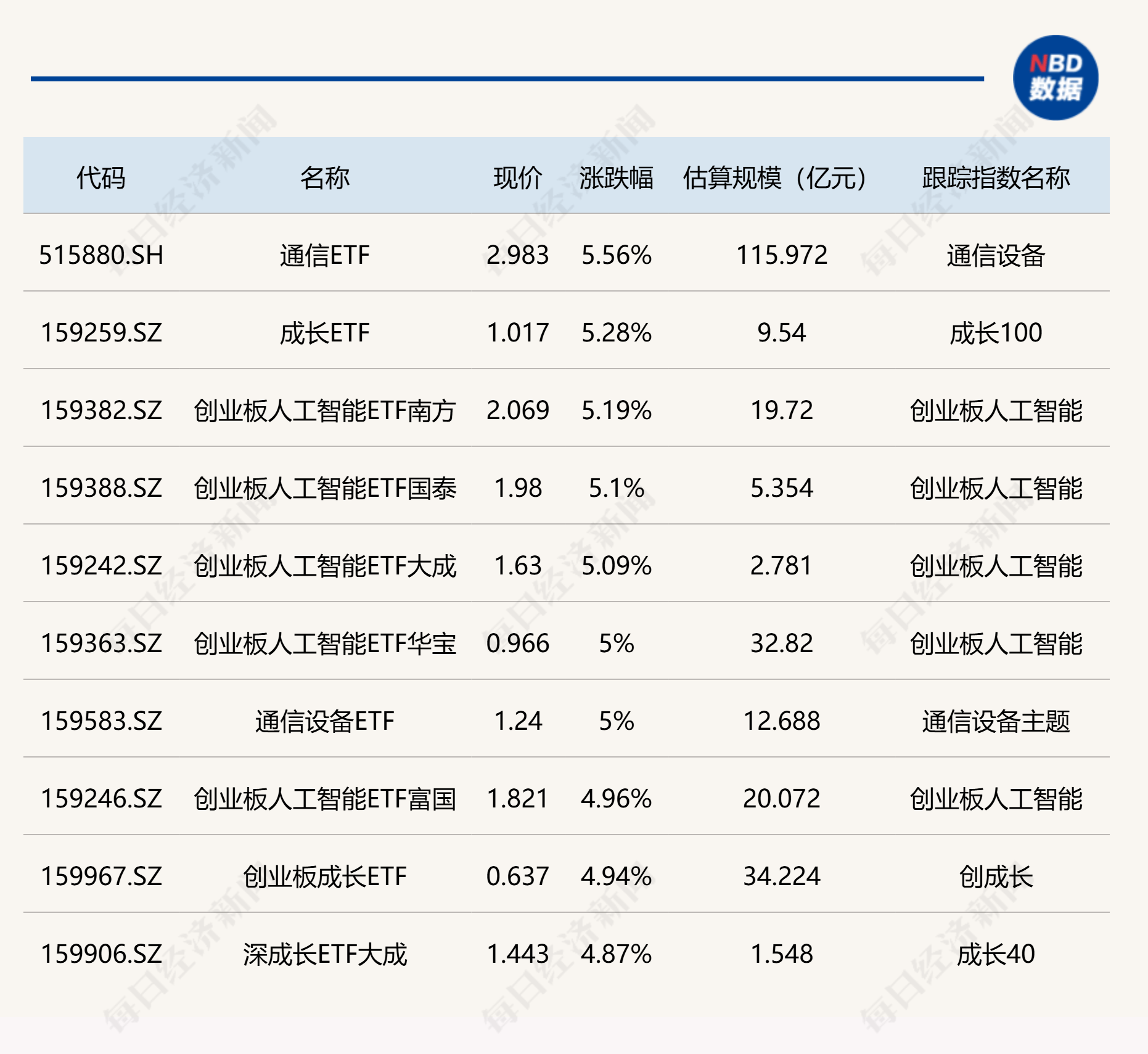
Market Performance - The market experienced a significant rebound in the afternoon, with the Shanghai Composite Index rising over 1% and the ChiNext Index increasing by more than 3% [1] - The computing hardware sector showed active performance, while the lithium battery supply chain strengthened, and the financial sector gained momentum in the afternoon [1] - The communication and artificial intelligence-related ETFs rose by over 5% [1] ETF Performance - The following ETFs showed notable gains: - Communication ETF (515880.SH) increased by 5.56% to 2.983 - Growth ETF (159259.SZ) rose by 5.28% to 1.017 - ChiNext AI ETF (159382.SZ) increased by 5.19% to 2.069 - Other AI-related ETFs also saw gains ranging from 4.94% to 5.1% [2] Industry Insights - Analysts indicate that artificial intelligence is the core driving force of a new technological revolution, with its greatest value lying in creating new possibilities rather than merely enhancing efficiency [4] - The development of large model technology is expected to profoundly reshape the global industrial landscape, potentially bringing incremental commercial value worth trillions of yuan to the financial industry [4] - The low-altitude economy has been recognized as a strategic emerging industry in government work reports, with significant supportive policies from various levels of government [6] - The market potential for the low-altitude economy is accelerating, with projections indicating that by 2035, the drone low-altitude market could exceed 3.1 trillion yuan, and the eVTOL market could surpass 500 billion yuan [6]
石油ETF(561360)涨超1.1%,机构称原油供需格局或迎边际改善
Mei Ri Jing Ji Xin Wen· 2025-12-17 06:55
Group 1 - The core viewpoint indicates that the oil market will transition from a clear surplus to marginal tightening by 2026, while remaining in a loose environment overall [1] - On the supply side, OPEC+ is shifting to a moderate production increase model, and the growth of U.S. shale oil marginal production is weak [1] - On the demand side, global oil demand is entering a peak plateau period, with slow but resilient growth expected at approximately 800,000 to 1,000,000 barrels per day [1] Group 2 - It is anticipated that the average oil price will fluctuate within the range of $55 to $65 per barrel in 2026 [1] - The downstream refining industry is experiencing accelerated optimization of its supply structure, with the government promoting the "anti-involution" initiative in the petrochemical sector since 2025, leading to the elimination of outdated capacity [1] - Domestic demand for refined oil is expected to peak, while chemical oil demand remains in a long-term growth channel, with a slow recovery in demand for petrochemical products becoming the main theme [1] Group 3 - The oil ETF (561360) tracks the oil and gas industry index (H30198), which selects listed companies involved in the entire oil and gas industry chain, including exploration, development, transportation, and refining [1] - This index exhibits significant cyclical characteristics, with its performance closely related to fluctuations in international oil prices [1]
伍德麦肯兹:五大趋势重塑全球能源资源格局
Zhong Guo Hua Gong Bao· 2025-12-17 06:01
其三,英国北海油气资产遭遇严重价值折损。因两年半内五次调整财税体系且监管政策不明,该地区油 气资产隐含长期油价(ILTOP)仅约40美元/桶,较经合组织(OECD)70美元/桶的平均水平折价40%,投资 者信心崩塌,资本投入停滞。 中化新网讯 近日,伍德麦肯兹发布最新《地平线》报告称,2025年,五大趋势重塑了全球能源资源领 域,其背后是地缘格局变动、产业战略重构与技术迭代加速的共同驱动。 其一,美国LNG实现颠覆性逆转。短短10年间,美国从LNG进口国蜕变为全球最大出口国,预计2030 年其LNG产量将占全球30%;同时美国还领跑全球油气生产,产量占全球五分之一,远超沙特和俄罗 斯。 其二,稀土成全球贸易核心焦点。稀土广泛应用于可再生能源、高端武器、半导体等关键领域,仅磁体 用途就占其总需求近半。 其四,欧洲石化产业出现大规模产能清退。为减排推进的去工业化,导致欧洲乙烯产能持续关停,2022 年至2027年相关产能退出每年造成40亿美元的总附加值损失。 其五,AI成为电力需求增长的核心引擎。数据中心半数运营成本来自电力,电价成为AI竞争关键变 量。美国电力市场受AI驱动,2030年前电力需求复合增长率将达2 ...
中石油点亮“E-Light”:能源丝路上的文化远征如何“缅”获人心
Sou Hu Cai Jing· 2025-12-17 05:05
Group 1 - The core message of the news is the launch of the "E-Light" brand by China National Petroleum Corporation (CNPC) in Myanmar, symbolizing a shift in the company's overseas strategy from infrastructure development to cultural integration and community connection [1][3][6] - The "E-Light" brand was introduced during the 75th anniversary of China-Myanmar diplomatic relations and marks a significant milestone in the long-standing friendship between the two nations [1][3] - The China-Myanmar oil and gas pipeline project, which has been operational for 15 years, has not only served as an economic artery but also as a bridge of friendship, contributing millions of dollars to social responsibility projects in education, healthcare, and water supply [3][4] Group 2 - The "E-Light" brand emphasizes precise communication and humanistic care, aiming to build trust and cultural recognition through various activities, including film screenings and cultural exhibitions [4][5] - The initiative represents a systematic international communication strategy, moving from a broad approach to a more targeted one, with plans for ongoing cultural projects and community engagement [5][6] - The choice of Myanmar as the first location for the "E-Light" brand reflects a deep understanding of local culture and bilateral relations, providing a model for other Chinese enterprises looking to expand internationally [5][6]