进出口贸易

Search documents
河北省前三季度对共建“一带一路”国家进出口同比增长13%
Zhong Guo Jing Ying Bao· 2025-11-13 05:29
Core Insights - In the first three quarters of this year, Hebei Province's import and export to countries involved in the Belt and Road Initiative reached 299.36 billion yuan, a year-on-year increase of 13%, accounting for 62.5% of the province's total import and export value, an increase of 4.9 percentage points compared to the same period last year [1] Trade Performance - Exports amounted to 175.9 billion yuan, growing by 8.4%, while imports reached 123.46 billion yuan, increasing by 20.2% [1] Transportation Connectivity - Hebei Province has established waterway connections to 156 countries, road connections to 124 countries, railway connections to 42 countries, and air connections to 149 countries involved in the Belt and Road Initiative [1] Product Diversification - The variety of exported goods to Belt and Road countries expanded to 332 types, including food, chemicals, and machinery transportation equipment [1] High-tech Product Exports - High-tech product exports showed strong momentum, with computer integrated manufacturing technology, computer and communication technology, and aerospace technology exports reaching 1.62 billion yuan, 1.24 billion yuan, and 410 million yuan respectively, with growth rates of 47%, 34%, and 41.9% [1]
对拉美、非洲市场增长迅猛
Nan Jing Ri Bao· 2025-11-13 02:47
今年前10个月,南京外贸结构持续优化,内生动力不断增强,对新兴市场贸易增长迅猛,主要体 现在以下亮点: 一是一般贸易支撑外贸基本盘。前10个月,我市一般贸易进出口3562.1亿元,增长2.4%,占全市 进出口总值的79%,上拉我市外贸1.9个百分点。 二是对共建"一带一路"国家进出口占比提升。前10个月,我市对共建"一带一路"国家进出口2376.2 亿元,增长7.9%,占52.7%,占比提升3.5个百分点。主要贸易伙伴中,对欧盟、东盟、拉美、非洲分 别进出口769.8亿元、700.7亿元、358.7亿元、241.5亿元,分别增长3.8%、9.4%、26.2%、13.7%。 据金陵海关统计,今年前10个月,南京外贸进出口总值4510.5亿元,同比(下同)增长0.7%,占 同期全省进出口总值的9.2%,排名全省第三。其中,出口总值2950.8亿元,增长5%。 三是民营企业拉动外贸增长。前10个月,我市民营企业进出口1896.4亿元,增长3.2%,占全市进 出口总值的42%,为拉动我市外贸增长的主力。同期,国有企业进出口1356.8亿元,占30.1%;外商投 资企业进出口1255.8亿元,占27.8%。 四是机电产 ...
下滑到7年前水平!对美出口连续大跌,中国出口总额却创新高
Mei Ri Jing Ji Xin Wen· 2025-11-12 22:41
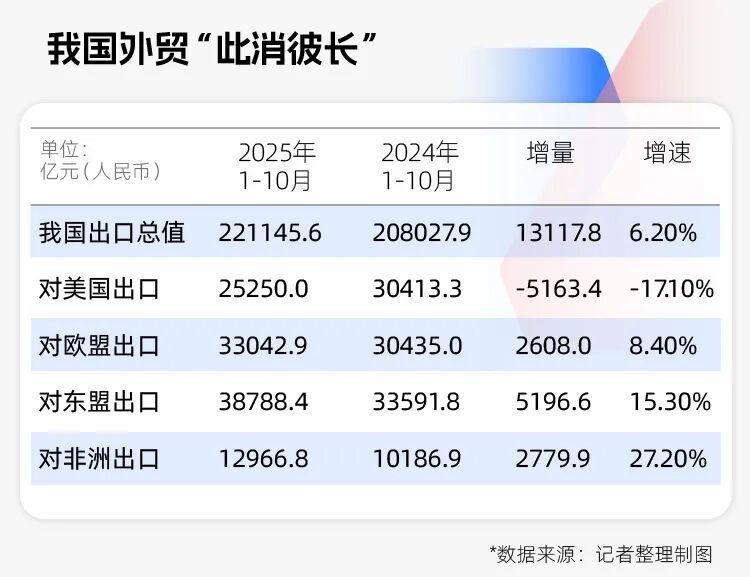
Core Insights - China's foreign trade showed unexpected resilience in the face of U.S. tariffs, with total trade value reaching 37.31 trillion yuan, a 3.6% year-on-year increase [1][2] - Exports to the U.S. declined significantly, dropping 17.1% year-on-year, while exports to the EU and ASEAN countries saw substantial growth [10][19][28] - The overall export growth was supported by diversification into new markets and an increase in high-tech product exports [9][41] Trade Performance - Total trade value for the first ten months of 2025 was 37.31 trillion yuan, with exports at 22.12 trillion yuan (up 6.2%) and imports at 15.19 trillion yuan (essentially flat) [1][2] - Exports to the U.S. fell to 2.52 trillion yuan, a decrease of 17.1%, while exports to the EU rose to 3.30 trillion yuan, an increase of 8.4% [10][19] - Exports to ASEAN countries reached 38.79 trillion yuan, marking a 15.3% increase, surpassing U.S. exports for the first time [28] Monthly Trends - Despite a 0.8% year-on-year decline in October exports, the overall trend for the year showed a V-shaped recovery with significant monthly growth [3][6] - Monthly exports exceeded 2.3 trillion yuan from June to September, with September alone seeing an 8.4% increase [3][6] Market Diversification - The decline in U.S. exports has been offset by increased exports to emerging markets, particularly in Southeast Asia and Africa [9][34] - Exports to Africa surged by 27.2%, with a notable increase in demand for industrial machinery and telecommunications products [34][40] Product Structure - The export structure is evolving, with high-end manufacturing products like industrial robots and new energy vehicles driving growth [41][46] - Exports of mechanical and electrical products accounted for over 60% of total exports, with integrated circuits and automotive exports showing significant increases [46]

万亿多(上海)贸易有限公司成立 注册资本10万人民币
Sou Hu Cai Jing· 2025-11-12 21:15
Core Insights - A new company named "Wanyiduoshu (Shanghai) Trading Co., Ltd." has been established with a registered capital of 100,000 RMB [1] Company Overview - The legal representative of the company is Wang Jiao Jiao [1] - The company is engaged in a wide range of business activities including import and export of goods, technology import and export, and various sales activities [1] Business Activities - The company’s operational scope includes: - Import and export agency services - Sales of household appliances, daily necessities, home goods, and baby products - Wholesale and retail of cosmetics - Internet sales (excluding licensed goods) - Research and development of household appliances - Installation services for household appliances - Repair services for daily electrical appliances [1] Additional Services - The company also offers: - Business management and corporate image planning - Marketing planning and information consulting services (excluding licensed information consulting) - Technical services including development, consulting, and transfer - Software development and data processing support services - Cultural creation and professional design services - Conference and exhibition services - Domestic cargo transportation agency [1]
“十四五”期间江西与东盟国家贸易规模年均增速达6.6%
Zhong Guo Xin Wen Wang· 2025-11-12 17:28
Core Insights - During the "14th Five-Year Plan" period, Jiangxi Province's trade with ASEAN countries has achieved an average annual growth rate of 6.6% [1][2] Group 1: Trade Growth and Strategies - Jiangxi has promoted rational and orderly cross-border layout for enterprises, with leading companies establishing a presence in Belt and Road Initiative countries [1] - A number of small and medium-sized export enterprises have invested in Southeast Asia, setting up small processing plants and building overseas marketing networks [1] Group 2: Export Performance - Key products from Jiangxi have seen rapid export growth, with average annual export growth rates for computer and communication technology, automotive parts, copper materials, lithium batteries, and fireworks being 3.2%, 44.5%, 13.1%, 39.6%, and 19.1% respectively [2] - The average annual growth rate of imports and exports for production-oriented enterprises in Jiangxi is 13.5%, with their share of the province's foreign trade increasing by 25.5 percentage points [2] Group 3: Trade Expansion with Specific Regions - Trade with Belt and Road Initiative countries and Latin American countries has further expanded, with average annual growth rates of 5.3% and 14.5% respectively during the "14th Five-Year Plan" period [2]
辛识平:中国市场强大“磁吸力”从何而来
Xin Hua Wang· 2025-11-12 14:57
Core Insights - China's market exhibits strong "magnetic attraction" due to its vast scale and potential for cooperation and mutual benefit with global partners [1][2][3] Group 1: Market Size and Opportunities - The China International Import Expo (CIIE) showcased 461 new products, technologies, and services, with over 200 being global debuts, highlighting the country's innovation capacity [1] - The Canton Fair attracted over 310,000 foreign buyers from 223 countries and regions, with nearly a 10% increase in buyers from Belt and Road Initiative countries [1][2] - China's retail sales of consumer goods are expected to exceed 50 trillion yuan this year, reinforcing its position as the world's second-largest consumer and import market [2] Group 2: Foreign Investment and Business Environment - In the first nine months of the year, China established 48,921 new foreign-invested enterprises, marking a 16.2% year-on-year increase, indicating a robust foreign investment climate [3] - The reduction of the negative list for foreign investment and the expansion of visa-free travel for foreign businesses reflect China's commitment to creating a favorable business environment [3] Group 3: Global Cooperation and Future Growth - The ongoing collaboration between China and global businesses is seen as a pathway to shared opportunities and growth, with many foreign companies expressing confidence in the Chinese market [3][4] - Major foreign investment projects have been successfully launched in China this year, demonstrating the country's appeal as a destination for international business [3]
瑞丽市鹏智商贸有限公司成立 注册资本50万人民币
Sou Hu Cai Jing· 2025-11-12 12:27
Core Viewpoint - Recently, the establishment of Ruili City Pengzhi Trading Co., Ltd. has been registered, indicating a new player in the trading sector with a focus on food and beverage sales [1] Company Summary - The legal representative of the newly established company is Zhong Gang [1] - The registered capital of the company is 500,000 RMB [1] - The company's business scope includes licensed projects such as liquor sales and food sales, which require approval from relevant authorities [1] Business Activities - The company is involved in various general projects including: - Import and export of goods and technology [1] - Internet sales (excluding items requiring licenses) [1] - Wholesale and retail of edible agricultural products, fresh fruits, and vegetables [1] - Sales of daily necessities and clothing [1] - Manufacturing and inspection services related to clothing and accessories [1] - Labor services (excluding labor dispatch) [1]
中汽全联国际贸易(四川)有限公司成立 注册资本100万人民币
Sou Hu Cai Jing· 2025-11-12 10:20
天眼查App显示,近日,中汽全联国际贸易(四川)有限公司成立,法定代表人为韩煜蓉,注册资本 100万人民币,经营范围为一般项目:汽车销售;新能源汽车整车销售;汽车零配件零售;汽车零配件 批发;货物进出口;技术进出口;贸易经纪;进出口代理;采购代理服务;国内贸易代理;信息咨询服 务(不含许可类信息咨询服务);技术服务、技术开发、技术咨询、技术交流、技术转让、技术推广; 翻译服务;小微型客车租赁经营服务;知识产权服务(专利代理服务除外);普通货物仓储服务(不含 危险化学品等需许可审批的项目);机械设备租赁;办公设备租赁服务;会议及展览服务;项目策划与 公关服务;非居住房地产租赁;组织文化艺术交流活动;体育竞赛组织;电子产品销售;通讯设备销 售;计算机软硬件及辅助设备零售;五金产品零售;家用电器销售;农副产品销售;珠宝首饰零售;建 筑材料销售;服装服饰零售;日用百货销售;文具用品零售;工艺美术品及收藏品零售(象牙及其制品 除外);体育用品及器材零售;机动车修理和维护;商务代理代办服务。(除依法须经批准的项目外, 凭营业执照依法自主开展经营活动)。 ...
2025年这一行业人才需求爆发,有岗位年薪最高可达80万元
第一财经· 2025-11-12 09:00
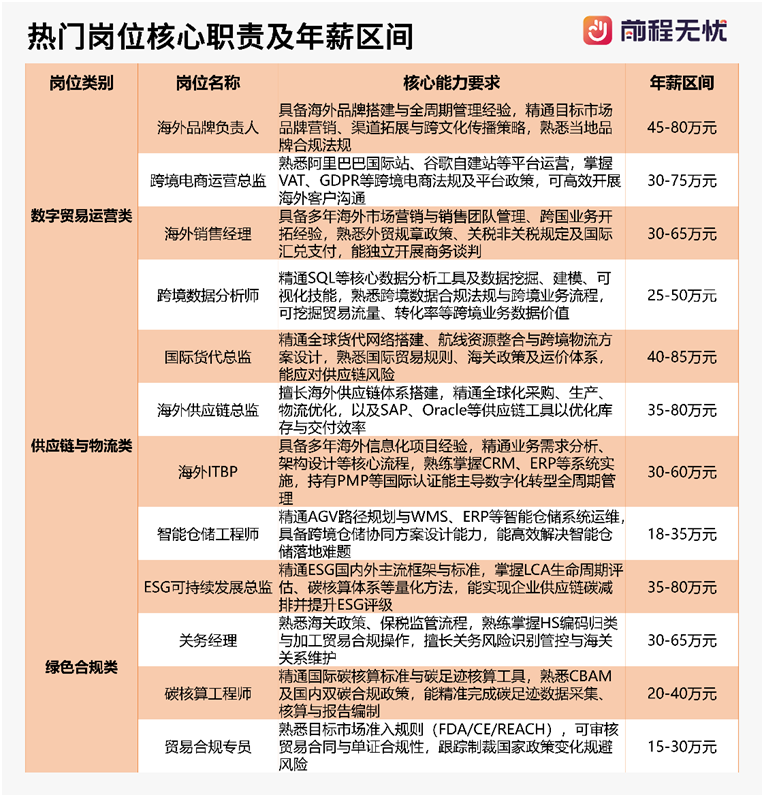
Core Insights - The article discusses the urgent demand for specialized composite talents in China's import and export trade sector, driven by the deep integration of digital technology and the acceleration of green transformation [2][3] Talent Demand and Trends - The report highlights that the digitalization of the entire import and export trade chain is accelerating, with government policies and market growth fostering diverse talent needs [2] - The State Council plans to add 15 new cross-border e-commerce pilot zones by 2025, enhancing the policy framework to support this sector [2] - Cross-border e-commerce is identified as a significant engine for trade growth, with import and export volumes projected to rise from 19.2 trillion yuan in 2021 to 23.8 trillion yuan in 2024, reflecting an annual growth rate exceeding 7% [2] Salary Insights - The report indicates that composite talents with skills in platform operation, AI tool application, data analysis, and compliance are in high demand, leading to significant salary premiums compared to traditional roles [2] - Specific salary ranges for various roles include: - Overseas Brand Manager: 450,000 - 800,000 yuan - Overseas ITBP: 300,000 - 600,000 yuan - ESG Sustainability Director: 350,000 - 800,000 yuan - Carbon Accounting Engineer: 200,000 - 400,000 yuan [3][4] Green Compliance and International Standards - The tightening of global green trade rules is creating a "hard threshold" for companies entering international markets, making green compliance talent a core necessity for competitive advantage [3] - The EU's carbon border adjustment mechanism (CBAM) will be implemented in 2026, requiring companies to accurately calculate and report their carbon footprints [3] - Domestic regulations, such as the Corporate Sustainability Disclosure Guidelines, necessitate the establishment of ESG governance frameworks that align with international standards [3] Role-Specific Requirements - The article outlines specific roles and their core competencies, emphasizing the need for expertise in international rules and carbon accounting tools, particularly for key export sectors like new energy vehicles and photovoltaics [3][4] - Key roles include: - Cross-Border Data Analyst: Requires proficiency in data analysis tools and compliance regulations, with salaries ranging from 250,000 to 500,000 yuan - Carbon Accounting Engineer: Focuses on carbon footprint calculation and reporting, with salaries between 200,000 and 400,000 yuan [4]

2025年中国进出口贸易人才需求爆发,哪些岗位缺口大哪些岗位赚得多?
Di Yi Cai Jing· 2025-11-12 08:07
Core Insights - The demand for cross-border data analysts has surged as companies seek specialized talent to navigate the digital transformation and green transition in international trade [1][2] - The report by 51job highlights the urgent need for composite talents skilled in platform operations, AI tools, data analysis, and compliance [1] - The cross-border e-commerce sector is projected to grow significantly, with import and export volumes expected to rise from 19.2 trillion yuan in 2021 to 23.8 trillion yuan in 2024, reflecting an annual growth rate exceeding 7% [1] Talent Demand - Companies are increasingly in need of professionals who can manage the entire lifecycle of carbon management and digital monitoring, particularly in sectors like new energy vehicles and photovoltaics [2] - The tightening of global green trade regulations has made green compliance talent a critical requirement for businesses aiming to enter international markets [2] Salary Trends - The report indicates that salaries for digital trade operation roles vary significantly, with overseas brand managers earning between 450,000 to 800,000 yuan annually, while cross-border data analysts can expect salaries ranging from 250,000 to 500,000 yuan [2][4] - Emerging roles in green compliance, such as ESG sustainability directors, can command salaries between 350,000 to 800,000 yuan, reflecting the high demand for expertise in this area [2][4] Job Roles and Responsibilities - Key positions include overseas brand managers, cross-border e-commerce operation directors, and cross-border data analysts, each requiring specific skills in brand management, data analysis, and compliance with international regulations [4] - The report outlines various job categories, including digital trade operations, supply chain and logistics, and green compliance, detailing the core competencies and salary ranges for each role [4]