
卫星互联网

Search documents
政协1号提案 让科研离产业更近一点
Xin Lang Cai Jing· 2026-01-25 17:15
Core Viewpoint - The proposal emphasizes the need for deep integration of the innovation chain and the industrial chain in Chongqing to foster new productive forces and enhance economic development [5][6][12]. Group 1: Proposal Background - The proposal, initiated by the Chongqing Municipal Committee of the Jiusan Society, aims to address the integration of innovation and industry, reflecting current economic priorities [5][6]. - In 2025, over 20 research outcomes were produced by various democratic parties focusing on the integration of innovation and industry [6][9]. Group 2: Research and Findings - The research identified over ten key issues related to the integration of innovation and industry, including the need for enhanced local industrial ecosystems to support high-value and high-tech sectors [10][12]. - The research highlighted successful case studies, such as the collaboration between universities and enterprises, which demonstrated effective models for innovation and market application [11]. Group 3: Recommendations - The first recommendation is to enhance the supply capacity of high-quality innovation outcomes by building high-level innovation platforms and focusing on original innovation and key technology breakthroughs [13][14]. - The second recommendation emphasizes the need to strengthen the role of leading technology enterprises and improve mechanisms for their participation in technological decision-making [14][15]. - The third recommendation focuses on creating a supportive ecosystem for the integration of innovation and industry, including establishing pilot centers and enhancing intellectual property services [15].


美国卫星互联网竞争加剧:技术赛道与太空资源的博弈
Sou Hu Cai Jing· 2026-01-24 03:15
Core Viewpoint - Blue Origin has announced the launch of its multi-orbit satellite communication network plan named "TeraWave," marking a new phase in the competition among U.S. companies in the satellite internet sector [1] Group 1: Industry Overview - The rapid development of satellite internet is attributed to advancements in communication technology since the 1990s, transitioning from a sci-fi concept to real-world applications [3] - The demand for network coverage in remote and geographically complex areas represents the largest market potential for satellite internet [3] - The competition in the satellite internet market has intensified with the entry of major tech companies, indicating a shift from early technological exploration to substantial global competition [3] Group 2: Key Players and Strategies - SpaceX's "Starlink" is currently the largest satellite internet system, with over 9,000 satellites in orbit and more than 9 million users, focusing on providing services to households and small businesses in remote areas [3] - Amazon's "Low Earth Orbit Satellite Plan" aims to serve enterprise markets and government agencies, deploying over 3,000 satellites and emphasizing synergy with its cloud computing services [4] - Blue Origin's TeraWave project utilizes a combination of low and medium Earth orbit satellites to create a multi-orbit architecture, targeting enterprise users and government clients with high throughput and network redundancy [6] Group 3: Market Opportunities and Challenges - The global digital divide presents unprecedented market opportunities for satellite internet, with approximately 2.6 billion people lacking adequate internet access, primarily in rural and low-income areas [7] - The rapid growth of satellite numbers in low Earth orbit (LEO) and medium Earth orbit (MEO) has led to increasing congestion and risks associated with space debris, posing challenges for sustainable development in satellite communications [9] - The competition among companies for orbital and frequency resources is becoming a critical issue, with the need for coordination to avoid collisions and manage space debris [9] Group 4: Future Implications - The competition in satellite internet is not just about market share but also impacts global communication infrastructure, national security, and international cooperation [10] - As global internet demand grows, satellite internet is expected to integrate further with terrestrial networks, creating a more diversified global communication system [10] - The ability to balance commercial interests with international cooperation and address space resource allocation will be essential for the future of satellite internet [10]

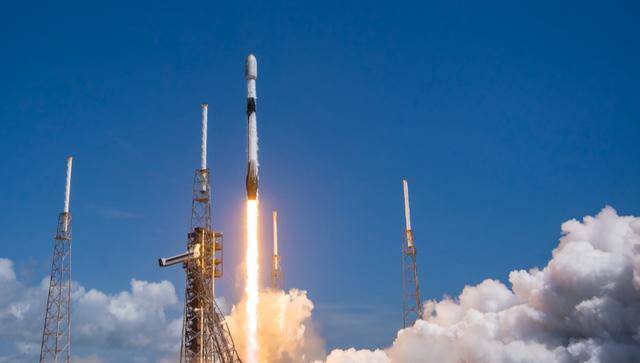
美企竞逐卫星互联网,太空新赛道博弈升温
Xin Lang Cai Jing· 2026-01-23 06:33
Core Insights - The competition for near-Earth orbital resources is intensifying, with U.S. companies significantly increasing their investments in satellite internet infrastructure [1][2] - Blue Origin has announced its "TeraWave" project, which aims to provide high-speed data connectivity for enterprise users through a multi-orbit satellite network [1][3] Company Developments - Blue Origin's "TeraWave" will consist of 5,408 satellites, including 5,280 low Earth orbit satellites and 128 medium Earth orbit satellites, offering data speeds of up to 6 terabits per second [1][3] - SpaceX's "Starlink" project has over 9,000 satellites in orbit and serves more than 9 million users, focusing on the mass market and underserved areas [3] - Amazon's "Low Earth Orbit Satellite Plan" plans to deploy over 3,000 satellites, targeting enterprise clients and government agencies [3] Industry Trends - Satellite internet is emerging as a crucial supplement to traditional ground-based communication networks, especially in areas with challenging geographical conditions [2][5] - The global market for satellite internet is expanding, driven by the need for better connectivity in underserved regions, with approximately 2.6 billion people lacking adequate internet access [5] Competitive Landscape - Various U.S. companies are entering the satellite internet space, each with distinct user targets and technological approaches, leading to a diverse competitive environment [3][4] - Companies like AST SpaceMobile are developing satellite networks that connect directly to smartphones, aiming to provide 4G and 5G coverage in remote areas [4] Opportunities and Challenges - The satellite internet sector offers significant market potential due to its global coverage capabilities and redundancy advantages over traditional networks [5] - The competition for orbital positions and spectrum resources is becoming a critical factor in the development of space infrastructure, with challenges related to orbital congestion and space debris management [5]
综述|美企竞逐卫星互联网 太空新赛道博弈升温
Xin Hua She· 2026-01-23 06:04
Core Viewpoint - The competition for satellite internet among U.S. companies is intensifying, with multiple firms launching projects aimed at providing high-speed internet services through satellite networks, marking a shift from conceptual exploration to large-scale competition in space communication [1][2]. Group 1: Company Initiatives - Blue Origin announced its satellite internet project "TeraWave," which aims to provide up to 6 terabits per second of symmetrical data connectivity through a network of 5,408 satellites, including 5,280 low Earth orbit satellites and 128 medium Earth orbit satellites, targeting enterprise, data center, and government users [1][2]. - SpaceX's "Starlink" project has over 9,000 satellites in orbit and serves more than 9 million users, focusing on the mass market and small institutions, particularly in remote areas and emergency communication scenarios [2][3]. - Amazon's "Low Earth Orbit Satellite Plan" plans to deploy over 3,000 low Earth orbit satellites, primarily targeting enterprise customers, government agencies, and remote communities, with a more measured rollout [2][3]. Group 2: Market Dynamics - The satellite internet sector is characterized by varying technical paths and strategic focuses among U.S. companies, with some emphasizing high throughput and redundancy for enterprise users, while others target broader consumer markets [3]. - The global market for satellite internet is expanding due to the limitations of traditional ground-based networks, with approximately 2.6 billion people lacking adequate internet access, particularly in rural and low-income areas [3][4]. - The competition for orbital positions and frequency resources is becoming a critical factor in the future of space infrastructure, with the rapid increase in satellite numbers leading to concerns about orbital congestion and space debris [4].
卫星互联网商业化提速!睿创微纳20%涨停,著名演员黄景瑜官宣将上太空,SpaceX2027年推第二代星链系统
Jin Rong Jie· 2026-01-23 03:15
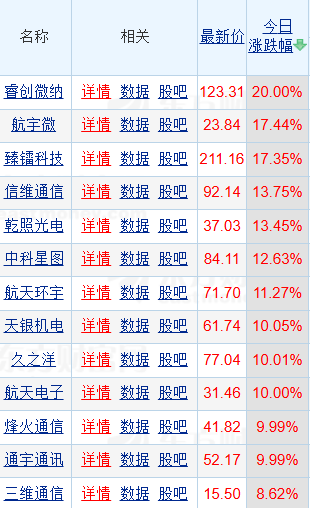
Market Performance - The satellite internet sector experienced a significant increase, with the sector rising by 4.72% as of the report's publication [1] - Leading stocks included Ruichuang Micro-Nano, which surged by 20.00%, and several others such as Tongyu Communication and Aerospace Electronics, which hit the daily limit [1][2] Industry Trends - The core market speculation is driven by the accelerated commercialization of satellite internet, with expectations for new developments from overseas giants and steady progress in domestic low-orbit satellite networks [2] - The third Beijing Commercial Space Industry High-Quality Development Promotion Conference and the 2026 Beijing International Commercial Space Exhibition will take place from January 23 to 25, featuring over 300 global companies [3] Technological Developments - SpaceX plans to launch its second-generation Starlink system in 2027, with the approval to deploy 7,500 new satellites capable of achieving internet speeds of up to 1 Gbps [4] - Blue Origin announced its TeraWave satellite communication network, consisting of 5,408 satellites, set to launch in Q4 2027, offering symmetrical data transmission speeds of up to 6 Tbps [4] Related Industries - The demand for low-orbit satellite networks is increasing, with domestic satellite production capabilities improving, leading to a potential expansion of the industry scale [6] - There is a pressing need for high-performance RF chips for satellite communication, particularly those supporting direct satellite connections for mobile devices, benefiting from technological advancements [6] - Ground terminal equipment is essential for the commercialization of satellite internet, with companies capable of developing and manufacturing these devices expected to see growth opportunities [6] - The satellite internet sector can address communication gaps in remote areas, with increasing demand for high-bandwidth services from enterprises and government users, indicating a broad long-term growth potential for companies in this space [6]


商业航天两大巨头,卫星互联网新消息
Xin Lang Cai Jing· 2026-01-23 02:01
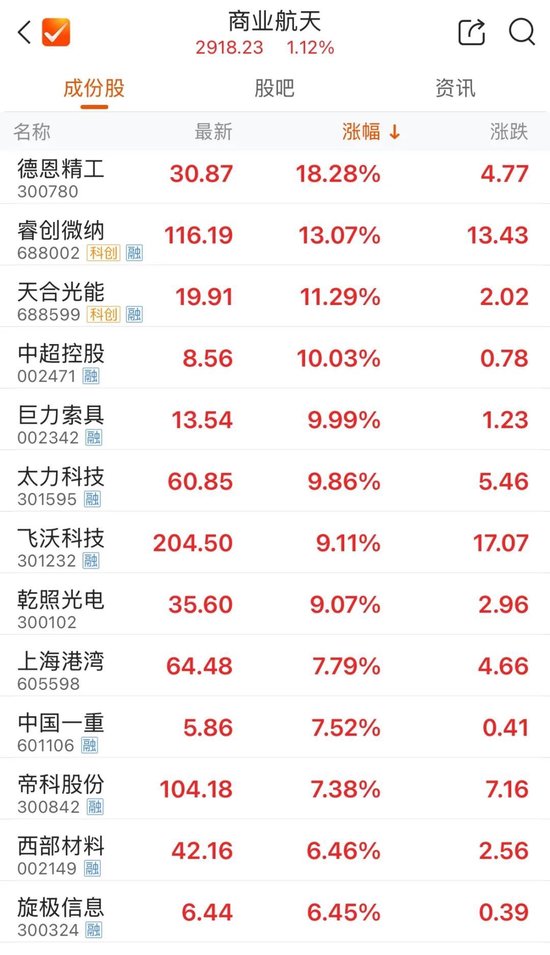
Core Viewpoint - The commercial aerospace sector is experiencing strong momentum, with significant stock price increases for key companies following announcements from major players SpaceX and Blue Origin regarding new satellite internet initiatives [1][11]. Group 1: Stock Performance - As of January 23, key stocks in the commercial aerospace sector have shown substantial gains, with Deen Precision Engineering rising over 18% and other companies like Jushi Holdings and Feiwo Technology also experiencing notable increases [1][11]. - The stock performance highlights a broader trend in the commercial aerospace market, with the index for commercial aerospace up by 1.12% [2]. Group 2: SpaceX Developments - SpaceX plans to launch its second-generation Starlink satellite communication system by 2027, which is expected to significantly enhance its service capabilities [3][4]. - The first-generation Starlink service currently covers over 400 million people, with more than 6 million monthly users, indicating a strong user base that could expand with the new system [4][14]. - SpaceX has acquired spectrum rights for $17 billion, which will improve the performance of its satellite communication services [6][16]. Group 3: Blue Origin Initiatives - Blue Origin announced the TeraWave satellite communication network, consisting of 5,408 satellites, aimed at providing high-speed data transmission for enterprises and government users, with deployment expected to start in Q4 2027 [7][10]. - TeraWave is designed to offer symmetrical data transfer speeds of up to 6 Tbps and will serve a wide range of users, including data centers and government entities [17][20]. - The architecture of TeraWave includes satellites in both low Earth orbit (LEO) and medium Earth orbit (MEO), enabling high-speed connections, particularly in remote areas [17][20].
上海松江:去年社会消费品零售总额增长11.8%,增幅居全市第一
Xin Lang Cai Jing· 2026-01-23 01:59
Core Insights - The report highlights the commitment of Shanghai's Songjiang District to high-quality development, focusing on advanced manufacturing, new productivity, modern urban construction, and rural revitalization [1][3] Economic Performance - The district's GDP is expected to grow by 4.3%, with local fiscal revenue reaching 20.879 billion, a 2.1% increase year-on-year [3] - Industrial output is projected at 376.703 billion, while service sector revenue is expected to rise by 25.3% to 104.5 billion [3] - The total import and export volume is anticipated to reach 273.96 billion, reflecting a 4.5% year-on-year growth [3] - Retail sales are expected to increase by 18% and 11.8% for total commodity sales and social consumer goods, respectively, both leading the city [3] New Growth Drivers - R&D expenditure is projected to account for 6.39% of GDP, surpassing the city average [3] - Strategic emerging industries like smart terminals and life health are expected to see double-digit growth, with software and information services growing by 88.6% [3] - The district aims to add 21 "little giant" enterprises and 11 foreign-funded R&D centers [3] Infrastructure and Urban Development - 70 key industrial projects are set to commence, with 85 expected to be completed [4] - The district is developing a "2+4" industrial system, focusing on two leading industries and four hundred billion-level characteristic industries [4] - Urban construction initiatives include enhancing city space quality and accelerating key area functionality [6] Social Welfare and Governance - The average disposable income for residents is expected to grow by 4.2% [3] - The district has completed 24 public service projects and has been recognized as a "National Civilized City" [3] - Social governance improvements include a 93% online service completion rate and the introduction of 135 reform measures to enhance the business environment [6][8] Future Goals - For 2026, the district aims for a GDP growth of around 4.5% and a fiscal revenue increase of 1.5% [8] - The focus will be on expanding effective demand, promoting industrial upgrades, enhancing regional innovation, and improving urban governance [8]

贝佐斯发大招了,马斯克星链霸主不保?
Xin Lang Ke Ji· 2026-01-23 01:17
Core Insights - The article discusses the contrasting work ethics and business strategies of Elon Musk and Jeff Bezos, highlighting Musk's intense work schedule compared to Bezos's semi-retirement and leisure lifestyle [1] - Bezos's company Blue Origin announced an ambitious satellite network plan, TeraWave, which aims to deploy 5,408 satellites to provide high-speed data transmission, significantly surpassing SpaceX's Starlink [3][4] - The competition between Musk and Bezos in the space industry is evolving, with both now seen as allies in promoting space exploration despite their historical rivalry [3][27] Company Strategies - TeraWave will deploy 5,408 satellites, including 5,280 low Earth orbit satellites and 128 medium Earth orbit satellites, using a dual-orbit design to achieve data transmission speeds of up to 6 Tbps [4][6] - In contrast, Starlink currently has over 9,400 satellites in orbit, with plans to expand to between 12,000 and 50,000 satellites, primarily targeting the consumer market with speeds of 100-200 Mbps [4][7] - TeraWave is specifically targeting enterprise clients, data centers, and government customers, while Starlink focuses on a mass-market approach, aiming to serve millions of ordinary users [6][7] Market Positioning - Blue Origin's TeraWave is positioned in the high-end market, emphasizing quality and specialized services for businesses, while SpaceX's Starlink is designed for mass accessibility and rapid deployment [9][11] - Amazon's satellite project, Amazon Leo, is also in development, targeting consumer and enterprise broadband services, which positions it as a direct competitor to Starlink [11][12] - The dual strategy of Blue Origin with TeraWave and Amazon Leo allows Bezos to avoid direct competition with Musk in the consumer market while still challenging Starlink in different segments [11][12] Historical Context - The rivalry between Musk and Bezos dates back to their early ventures in space exploration, with notable tensions arising from competitive bids and differing visions for the future of space [13][21] - Their relationship has evolved from direct competition to a more collaborative stance, particularly in light of shared political interests and mutual respect for each other's technological advancements [24][26] Industry Implications - The satellite internet market is becoming increasingly competitive, with geopolitical implications as various countries, including China and the EU, accelerate their own satellite projects [28] - Concerns about space debris and the environmental impact of satellite proliferation are growing, as the number of satellites in orbit increases significantly [30][31] - The lack of effective regulation in the satellite internet sector poses risks for future developments, potentially leading to overcrowded orbits and interference with astronomical observations [31]
中国银河证券:太空算力三重变现闭环 建议关注卫星互联网产业链三大主线
智通财经网· 2026-01-22 07:16
Group 1 - The core business model of the "Three-Body Computing Constellation" integrates "space communication links + on-orbit computing centers + intelligent data platforms," addressing enterprise-level cross-border data transmission and real-time computing scheduling needs [1][2][3] - The project aims to launch 2,800 computing satellites, achieving a total computing power of 1,000 Peta Operations Per Second (POPS) and inter-satellite laser communication link speeds of 100 Gbps [3] - The estimated annual revenue upon completion of the network is approximately 27 billion yuan, with three main business segments: dedicated network transmission (16.5 billion yuan/year), computing leasing (5.1 billion yuan/year), and data services (5.4 billion yuan/year) [3] Group 2 - The "Three-Body Computing Constellation" represents a paradigm shift from "communication transmission" to "on-orbit intelligent computing," enabling real-time processing of space data and addressing energy supply and deployment flexibility issues for next-generation AI clusters [1][2] - The model includes three dimensions: space communication and star cable plans, space computing leasing services, and intelligent data services, which collectively enhance data transmission efficiency and provide edge computing capabilities [2][3] - The project aligns strategically with national initiatives such as the "integration of space and ground networks" and the "East Data West Computing" project, positioning itself as a core hub in the space economy ecosystem [3]

蓝色起源推出名为TeraWave的卫星互联网服务
Zheng Quan Shi Bao Wang· 2026-01-22 00:49
Core Viewpoint - Blue Origin, led by Jeff Bezos, has announced the launch of TeraWave, a satellite internet service aimed at enterprise, data center, and government clients [1] Group 1: Service Overview - TeraWave plans to deploy 5,408 satellites, with deployment expected to begin in Q4 2027 [1] - The service will compete with existing offerings such as SpaceX's Starlink and Amazon's Leo (formerly Project Kuiper) [1] Group 2: Technical Specifications - TeraWave will provide data speeds of up to 6 terabits per second [1] - Amazon's Leo service has already deployed 180 satellites and aims to establish a constellation of 3,236 low Earth orbit satellites [1] Group 3: Market Position - The Leo service has been in "enterprise preview" for specific users since November of last year [1]