咖啡

Search documents
利润5.18亿,配送费16.31亿!瑞幸Q4“失血”
Sou Hu Cai Jing· 2026-02-26 14:17
Core Insights - Luckin Coffee reported a total net revenue of RMB 12.777 billion for Q4 2025, representing a year-on-year growth of 32.9%, while net profit decreased by 38% to RMB 518.2 million [1] - For the entire year of 2025, total net revenue reached RMB 49.288 billion, a significant increase of 43.0%, with net profit growing by 21.8% to RMB 3.6 billion [2] Financial Performance - In Q4 2025, self-operated store revenue was RMB 9.547 billion, up 32% year-on-year, and partnership store revenue was RMB 2.847 billion, up 39.2% [3] - The GAAP operating profit for Q4 was RMB 821 million, with an operating profit margin of 6.4%. For the full year, GAAP operating profit was RMB 5.073 billion, with an operating profit margin of 10.3% [3] Store Expansion - In Q4 2025, Luckin Coffee added 1,834 new stores, including 1,792 in China, 13 in Singapore, 25 in Malaysia, and 4 in the United States. By the end of 2025, the total number of stores reached 31,048, a year-on-year increase of 39% [4] Customer Metrics - The average monthly transacting customer count for Q4 increased by 26.5% year-on-year to 98.35 million, while the full year saw a 31.1% increase to 94.15 million [5] Operating Expenses - Total operating expenses for Q4 were RMB 11.955 billion, a 38.9% increase from RMB 8.6055 billion in the same period of 2024, primarily due to business expansion. Operating expenses accounted for 93.6% of net revenue, compared to 89.5% in the previous year [6] - Material costs were RMB 5.1078 billion, up 33.2%, while store rent and other operational costs were RMB 3.1506 billion, up 32.8% [6] Strategic Outlook - The co-founder and CEO of Luckin Coffee stated that the 2025 performance reflects the company's strategic execution focused on scaling, achieving strong growth despite changing market dynamics. The company aims to continue providing high-quality, cost-effective products while expanding its business scale to create long-term value for shareholders [6]

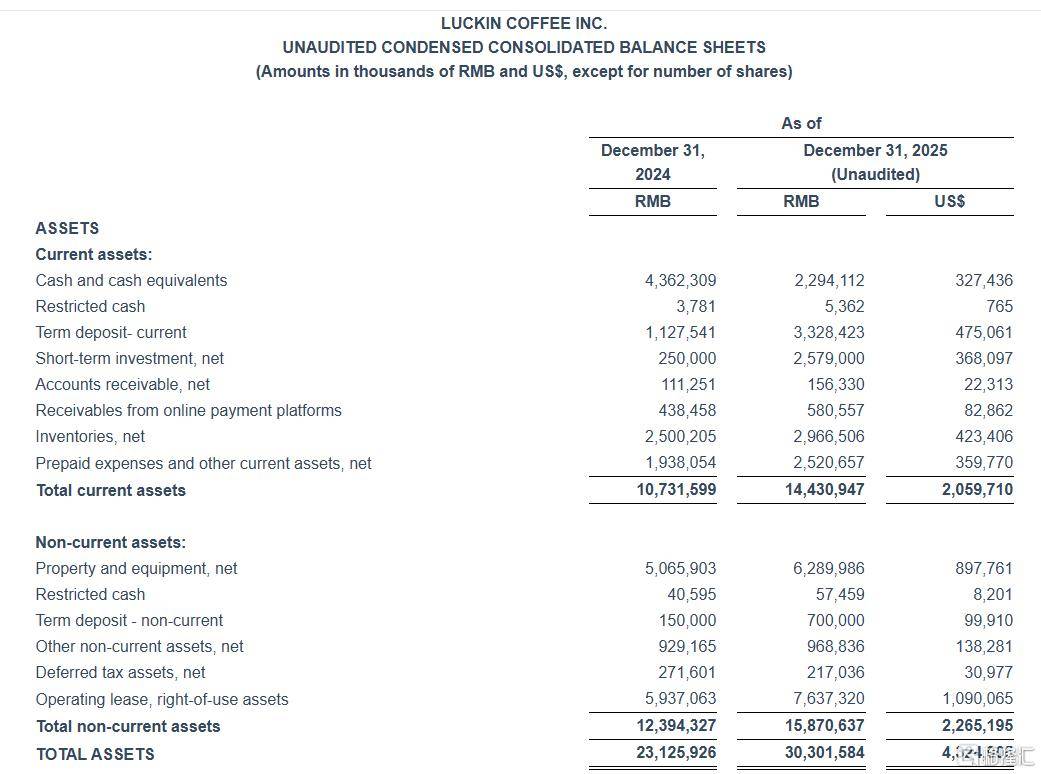
瑞幸咖啡公布2025年第四季度及全年财报 全年总净收入超492亿元人民币
Zhong Guo Jing Ji Wang· 2026-02-26 12:48
Core Insights - Luckin Coffee reported a total net revenue of 12.777 billion RMB for Q4 2025, representing a year-on-year growth of 32.9% [1] - For the entire year of 2025, total net revenue reached 49.288 billion RMB, marking a 43.0% increase compared to the previous year [1] - The company’s total number of stores reached 31,048 by the end of Q4 2025, with a cumulative transaction customer count exceeding 450 million [1] Financial Performance - In Q4 2025, self-operated store revenue was 9.547 billion RMB, up 32.0% year-on-year, while partner store revenue was 2.847 billion RMB, increasing by 39.2% [1] - The GAAP operating profit for Q4 2025 was 821 million RMB, with an operating margin of 6.4% [1] - For the full year 2025, self-operated store revenue was 36.243 billion RMB, a 41.6% increase, and partner store revenue was 11.594 billion RMB, growing by 49.7% [1] - The annual GAAP operating profit was 5.073 billion RMB, with an operating margin of 10.3% [1] Store Expansion and Customer Growth - In Q4 2025, Luckin Coffee added 1,834 new stores, including 1,792 in China (including Hong Kong), 13 in Singapore, 25 in Malaysia, and 4 in the United States [2] - The total number of stores increased by 8,708 in 2025, representing a year-on-year growth of 39.0% [2] - The average monthly transaction customer count for Q4 2025 grew by 26.5% year-on-year, reaching 98.35 million, while the annual average increased by 31.1% to 94.15 million [2] Sustainable Development Initiatives - Luckin Coffee is committed to sustainable development and has integrated these principles into daily operations [2] - The company opened its first barrier-free store in Hangzhou in December 2025, promoting inclusive employment solutions for people with disabilities [2] - Luckin Coffee received the "2025 Best ESG Employer in China" award from Aon Group in December 2025 for its diverse sustainable practices [2] Strategic Focus - The CEO emphasized the company's strong execution in focusing on scale growth, which has led to robust business performance despite changing market conditions [3] - The company aims to continue providing high-quality, cost-effective products that resonate emotionally with customers while expanding its business scale to create long-term value for shareholders [3]
瑞幸咖啡公布2025年第四季度及全年财报 全年总净收入超492亿元人民币
Zhong Guo Jing Ji Wang· 2026-02-26 12:40
Core Insights - Luckin Coffee's Q4 2025 total net revenue reached 12.777 billion RMB, a year-on-year increase of 32.9% [1] - For the full year 2025, total net revenue grew by 43.0% to 49.288 billion RMB [1] - The company ended Q4 2025 with a total of 31,048 stores and over 450 million cumulative transaction customers [1] Financial Performance - Q4 2025 self-operated store revenue was 9.547 billion RMB, up 32.0% year-on-year [1] - Q4 2025 joint-operated store revenue was 2.847 billion RMB, reflecting a 39.2% increase [1] - The GAAP operating profit for Q4 2025 was 821 million RMB, with an operating margin of 6.4% [1] - For the full year 2025, self-operated store revenue was 36.243 billion RMB, a 41.6% increase [1] - Joint-operated store revenue for the full year was 11.594 billion RMB, up 49.7% [1] - The full year GAAP operating profit was 5.073 billion RMB, with an operating margin of 10.3% [1] Store Expansion and Customer Growth - In Q4 2025, Luckin Coffee added 1,834 new stores, including 1,792 in China (including Hong Kong) [2] - The total number of stores increased by 8,708 in 2025, marking a 39.0% year-on-year growth [2] - The average monthly transaction customer count in Q4 2025 grew by 26.5% to 98.35 million [2] - For the full year 2025, the average monthly transaction customer count increased by 31.1% to 94.15 million [2] Strategic Initiatives - The company is committed to sustainable development and has integrated sustainability into daily operations [2] - Luckin Coffee opened its first barrier-free store in Hangzhou in December 2025, promoting inclusive employment solutions for people with disabilities [2] - The company received the "2025 Best ESG Employer in China" award from Aon Group in December 2025 [2] Leadership Perspective - The CEO emphasized the strong execution in focusing on scale growth and the ability to seize structural opportunities in the Chinese coffee market [3] - The company aims to continue providing high-quality, cost-effective products that resonate emotionally with customers while expanding its business scale [3]
瑞幸咖啡:第四季度净营收127.8亿元人民币,同比+33%。
Xin Lang Cai Jing· 2026-02-26 12:11
来源:滚动播报 瑞幸咖啡:第四季度净营收127.8亿元人民币,同比+33%。 ...
魔胴官宣昆凌出任魔胴西西里咖啡品牌推荐官 开启“凌”感时刻
Feng Huang Wang Cai Jing· 2026-02-26 08:23
Core Insights - The collaboration between the health management brand Magic Dong and actress Kun Ling aims to promote a lifestyle centered around health, inspiration, and beauty [1] Product Overview - Magic Dong's new product, the Sicilian Lemon Coffee, features a unique blend of refreshing lemon aroma and rich coffee flavor, designed to provide a moment of inspiration for busy individuals [1] - The coffee is inspired by Sorrento, Italy, and incorporates freeze-dried lemon and selected Robusta coffee beans, utilizing aerospace-grade freeze-drying technology to preserve the original flavor and aroma [1] Market Performance - Since its launch in March 2025, the Sicilian Lemon Coffee has gained widespread popularity, setting a record for single-day sales in the coffee category on Douyin [2] - The product has been featured as the exclusive sponsor of the reality show "Travel Diary" Season 3, achieving top ratings for twelve consecutive episodes, effectively conveying the brand's spirit of health, happiness, and exploration [2] Brand Recognition - Magic Dong has received the "Jiangsu Province High-Profile Trademark" certification and the "Quality Golden Shield · Innovation Sample" award in 2025, reflecting its high standards in global ingredient sourcing and production control [2] - According to a report by Zhi Shi Consulting, Magic Dong's flagship product has ranked first in China's bulletproof beverage market for five consecutive years, demonstrating its strong brand power and market leadership [2] Strategic Collaborations - The brand has engaged in cross-industry collaborations, such as sponsoring international superstar G-DRAGON's world tour concert in Taipei in 2025, enhancing its influence and recognition among young consumers [2]
从卖产品到做文化:京东、李宁、梅见青梅酒等六大品牌的艺术实践路径
Sou Hu Cai Jing· 2026-02-26 06:51
Core Insights - The article discusses the impact of AI on consumer behavior and brand differentiation, highlighting a promotional event by Alibaba's AI product Qianwen that generated millions of orders in a short time, showcasing the AI amplification effect [1] - It emphasizes the diminishing differentiation among brands as automation and content generation become standardized, leading companies to invest in unique capabilities like aesthetic judgment and cultural expression to maintain competitive advantages [1] Group 1: JD.com - **Artistic Philosophy**: JD.com views art as part of its public attribute development, aiming to strengthen connections with cities, communities, and the public through long-term cultural and artistic investments [3] - **Artistic Practice**: JD.com plans to build an independent contemporary art museum in Shenzhen Bay, covering over 10,000 square meters, offering free or low-cost access to exhibitions, performances, and community activities, linking art themes to its business background without commercial displays [4] - **Artistic Outcome**: JD.com transitions from an efficiency-driven enterprise to a participant in urban cultural arts, enhancing its public recognition and social image [5] Group 2: Li-Ning - **Artistic Philosophy**: Li-Ning focuses on art design and cultural expression as core competitive strengths, reshaping its brand image through visual language and local cultural elements [7] - **Artistic Practice**: The brand showcases new collections at fashion weeks in cities like New York and Paris, integrating traditional Chinese elements into its designs and collaborating with artists for limited series and artistic packaging [8] - **Artistic Outcome**: Li-Ning's products evolve from functional sportswear to art-driven apparel, increasing brand awareness and cultural recognition among younger consumers [9] Group 3: Meijian Qingmei Wine - **Artistic Philosophy**: Meijian Qingmei Wine positions art as a key direction for brand development, connecting aesthetics with lifestyle through experiential scenarios [9] - **Artistic Practice**: The brand has created China's first art space centered around wine, collaborating with numerous artists to integrate art into its products and hosting cultural events to enhance the brand's artistic identity [10] - **Artistic Outcome**: Meijian Qingmei Wine evolves from a beverage brand to a cultural consumption brand, establishing a clear artistic aesthetic in the market [11] Group 4: Muji - **Artistic Philosophy**: Muji emphasizes design as a core language, establishing daily aesthetics as a long-term brand standard [12] - **Artistic Practice**: The brand's stores utilize natural materials and modular display systems, hosting exhibitions and workshops to engage consumers in the aesthetic experience [15] - **Artistic Outcome**: Consumers develop stable memories of the brand's aesthetic, transforming simplicity and practicality into long-term brand assets [16] Group 5: IKEA - **Artistic Philosophy**: IKEA defines home design as "accessible daily art," focusing on providing aesthetically pleasing and functional products at reasonable prices [18] - **Artistic Practice**: The brand collaborates with independent designers to create limited series and encourages consumer participation through workshops and community events [18] - **Artistic Outcome**: Art and design become integral to home life, increasing consumer engagement and establishing IKEA as a "design popularizer" [18] Group 6: Starbucks - **Artistic Philosophy**: Starbucks views its store spaces as community cultural venues, enhancing the experience through localized content and design [20] - **Artistic Practice**: The brand develops unique store concepts that incorporate local art and hosts community events to foster customer interaction [21] - **Artistic Outcome**: Stores transform from mere consumption spaces to public gathering places, strengthening the brand's connection to urban lifestyles [22]


安徽乡村变革六记
Xin Lang Cai Jing· 2026-02-25 16:55
Group 1: Rural Transformation in Anhui - The article highlights the transformation of rural areas in Anhui, showcasing new developments and opportunities in the digital age [1] - A focus on the Dabeishan Ski Resort, which has attracted investment due to its geographical advantages, indicates a shift towards developing the "cold economy" in southern China [2] - The rise of "village coffee" along the "Wannan Canggu Line" illustrates how local businesses are revitalizing rural tourism and attracting visitors [3] Group 2: E-commerce and Agricultural Innovation - The success of live-streaming sales in rural areas, with one instance generating over 200,000 yuan, demonstrates the potential of e-commerce in enhancing farmers' income [4] - The use of drones in modern agriculture, as exemplified by a young farmer in Tianchang City, shows how technology is improving efficiency and productivity in farming [8] Group 3: Cultural and Community Engagement - The creation of a local theater group by elderly residents in rural areas reflects a cultural revival and community engagement, showcasing their creativity and storytelling [5][6] - The role of "industry village heads" in guiding rural development and integrating tourism with local culture has led to significant revenue growth in communities [7]
湖南三线小城春节消费火爆,商场就餐排队两小时,部分物价堪比一线城市| 新春走基层
Hua Xia Shi Bao· 2026-02-23 23:32
Core Insights - The article highlights the vibrant consumer activity in Changde during the Spring Festival, driven by returning residents and festive spending [2][3][4] Group 1: Consumer Behavior - Changde's retail and dining sectors experienced significant foot traffic, with some restaurants reporting wait times exceeding two hours [3][4] - The local population's return during the holiday season has led to increased demand for dining and shopping, as many street-side restaurants closed for the holiday [3][4] - Coffee shops in Changde opted to remain open during the holiday, responding to high consumer demand, with some owners canceling planned vacations due to overwhelming inquiries [4][5] Group 2: Economic Indicators - The total retail sales of consumer goods in Changde are projected to reach 179.78 billion yuan by 2025, reflecting a year-on-year growth of 4.9% [2] - By 2025, urban residents in Changde are expected to have an average consumption expenditure of 33,638 yuan, while rural residents will average 23,871 yuan, indicating steady growth in consumer spending [2] - The per capita disposable income for urban residents is projected to be 45,683 yuan, and for rural residents, 25,495 yuan by 2025, with both figures showing year-on-year increases of 4.2% and 5.8% respectively [6] Group 3: Price Trends - Prices for certain consumer goods in Changde have risen to levels comparable to first-tier cities like Beijing and Shanghai, particularly in fresh produce and dining [6] - For instance, the price of strawberries reached around 40 yuan per jin, and a typical meal for two at a hotpot restaurant cost approximately 220 yuan, similar to prices in major cities [6] - The overall consumer price trend reflects a growing cost of living, with local residents noting that prices for dining and fresh produce have not significantly decreased during the holiday season [6]

昆明:春城烟火漫江畔,茶咖飘香引客来
Xin Lang Zheng Quan· 2026-02-23 07:47
Group 1 - The core viewpoint of the article highlights the vibrant development of Kunming's cultural tourism economy, driven by unique local industries and government support [1][3] - Kunming's night economy has evolved from a single night market to a diverse ecosystem integrating culture, tourism, and commerce, with significant government management contributing to its success [3][4] - The city has established multiple night economy clusters, with notable areas like Nanqiang Street generating revenue of 1.17 billion yuan in the first half of 2025, reflecting a year-on-year growth of 9.28% and an average daily foot traffic exceeding 40,000 [3][4] Group 2 - The tourism sector in Kunming has seen a substantial increase, with overall tourism orders during the Spring Festival rising by 46% year-on-year and flight bookings increasing by 35% [4][6] - Kunming is recognized as the top destination for car rentals during the 2026 Spring Festival, showcasing its appeal as a family-friendly travel location [4] - The coffee and tea industries are pivotal to Kunming's economy, with the tea industry projected to reach a total output value of 9.871 billion yuan in 2024, marking a year-on-year growth of 14.92% [6][8] Group 3 - The service sector is a key pillar of Kunming's economy, with its contribution to GDP rising from 51% in 2014 to an expected 67% by 2025, indicating strong growth [8][10] - During the "14th Five-Year Plan" period, the annual growth rates for total tourist numbers and tourism spending in Kunming are projected to be 24.27% and 26.65%, respectively [8][12] - As of the end of 2025, Kunming has 29 listed companies, with a focus on industries such as non-ferrous metals and pharmaceuticals, although it still lags behind other southwestern cities like Chengdu and Chongqing in terms of the number of listed companies [13][14] Group 4 - The private equity landscape in Yunnan shows that there are 59 registered private fund managers, with Kunming accounting for 48 of them, managing a total of 93.088 billion yuan [14] - The article emphasizes the need for Kunming to enhance its capital market development and industry transformation to cultivate more nationally influential brands [14]
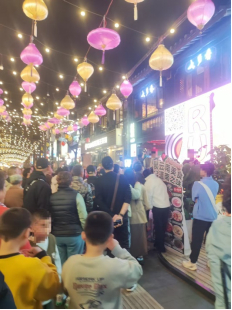
【申万宏源研究春节见闻】昆明:春城烟火漫江畔,茶咖飘香引客来
Xin Lang Zheng Quan· 2026-02-23 06:28
Group 1 - The article highlights the vibrant night economy in Kunming, showcasing a blend of cultural tourism and local specialties, with a focus on the bustling atmosphere of South Qiang Street [1][3] - Kunming's night economy has evolved into a diverse ecosystem, with the city establishing 4 national, 9 provincial, and 12 municipal night economy clusters, leading to significant revenue growth and job creation [3][4] - The tourism sector in Kunming has seen a remarkable increase, with a 46% year-on-year growth in overall tourism orders during the Spring Festival, and a 35% increase in flight bookings [4][6] Group 2 - The coffee and tea industries are pivotal to Kunming's economy, with the city serving as a major hub for coffee distribution and the largest tea market cluster in Southwest China, contributing to a projected tea industry output value of 9.871 billion yuan in 2024, a 14.92% increase [6][8] - The service sector is a core pillar of Kunming's economy, with its GDP share rising from 51% in 2014 to an expected 67% by 2025, driven by the integration of cultural tourism and specialty industries [8][10] - The number of listed companies in Yunnan province is 39, with 29 based in Kunming, indicating a need for further development in the capital market to support local industries and enhance economic growth [17][19]