科技股

Search documents
重大信号!49万亿巨头批量减持!
天天基金网· 2026-02-07 02:01
Core Viewpoint - UBS Group significantly reduced its holdings in major technology stocks during the fourth quarter of 2025, with only a slight increase in Meta among the "Magnificent 7" tech stocks [2][3]. Group 1: Holdings and Changes - UBS disclosed a reduction in its portfolio, with a total market value of $616.68 billion, a decrease of 5.65% quarter-over-quarter [2]. - The top five holdings as of the end of 2025 were Nvidia ($14.45 billion), Microsoft ($13.56 billion), Apple ($12.11 billion), Broadcom ($8.23 billion), and Amazon ($7.99 billion), collectively accounting for 14.52% of the investment portfolio [3]. - In Q4 2025, UBS reduced its stake in Nvidia by 10.47% (10.04 million shares), Apple by 10.57% (5.27 million shares), Microsoft by 7.64% (2.32 million shares), Google by 9.05% (2.21 million shares), Amazon by 4.57% (1.66 million shares), and Tesla by 15.09% (0.71 million shares) [3][4]. Group 2: Financial Performance - UBS reported Q4 2025 total revenue of $12.1 billion, exceeding analyst expectations and up from $11.6 billion year-over-year [5]. - Net profit attributable to shareholders increased by 56% year-over-year to $1.2 billion, surpassing the forecast of $919 million [5]. - Wealth management business saw a net inflow of $8.5 billion, significantly lower than the expected $27.4 billion, with a notable outflow of $14.1 billion from the U.S. wealth management sector [5][6]. Group 3: Future Outlook - UBS's CEO indicated that net new assets in the Americas wealth management division are expected to turn positive in 2026, although challenges are anticipated in the first half of the year [6]. - The investment banking division contributed significantly to the overall profit, with a 34% increase in operating profit driven by market volatility [6].







关键时点 外资巨头发声
Shang Hai Zheng Quan Bao· 2026-02-07 01:58
Core Viewpoint - Global markets are experiencing significant volatility, but several foreign investment institutions express cautious optimism about the Chinese market in 2026, driven by policy support, ongoing trends in the technology sector, and attractive valuations [1][7]. Group 1: Investment Outlook - BlackRock's Chief Investment Officer for China, Wang Xiaojing, highlights that the A-share market has shown positive performance over the past year, with significant gains in the CSI 300 index, small-cap stocks, and the technology sector [3]. - For the market to maintain its positive performance, four conditions must be met: liquidity must remain ample, the market needs to enter a phase of profit realization, policy expectations and incremental support must materialize, and geopolitical risks must ease [3][4]. - If these conditions are satisfied, the CSI 300 index is expected to perform well over the next 12 to 18 months [4]. Group 2: Sector Focus - The technology sector remains a key investment theme in the Chinese market, with expectations that it will continue to attract attention from both domestic and international investors [2][7]. - BlackRock's investment strategist, Lu Wenjie, identifies electricity supply as a critical factor for AI development, predicting that AI-related electricity consumption in the U.S. will double by 2030, which may lead to power shortages [5]. - Investment opportunities in power equipment and technology are highlighted as a high-certainty direction for AI development, especially as U.S. power shortages may necessitate the procurement of Chinese power equipment [5]. Group 3: Foreign Investment Sentiment - Fidelity International and other foreign institutions have noted that despite external uncertainties, Chinese assets are gaining attention due to policy support, industry trends, and valuation recovery [7]. - Fidelity's Asia-Pacific Investment Director, Stuart Rumble, mentions that the momentum for capital inflow into A-shares and offshore Chinese stocks is increasing, driven by consumer support policies and structural reforms [7]. - Swiss asset manager Guo Shaoyu emphasizes the importance of focusing on growth-oriented sectors in China, such as satellite and space industries, robotics supply chains, and practical applications of AI [8].
全线收涨!道指站上历史高点,中概股爆发
Huan Qiu Wang Zi Xun· 2026-02-07 01:04
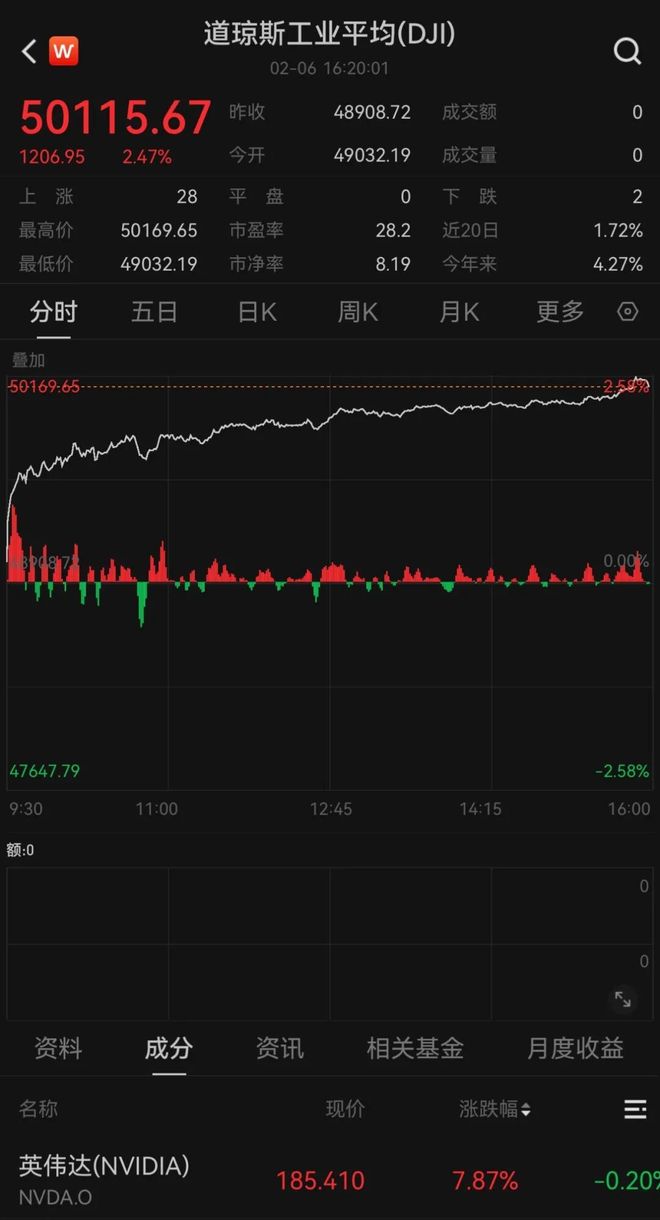
Group 1 - The US stock market saw all three major indices rise, with the Dow Jones Industrial Average surpassing the 50,000 mark for the first time, closing at 50,115.67 points, a historical high, with a gain of 2.47% [1] - The Nasdaq Composite Index rose by 2.18% to close at 23,031.21 points, while the S&P 500 Index increased by 1.97% to finish at 6,932.30 points [1] - Over the week, the Dow Jones gained 2.5%, while the Nasdaq and S&P 500 experienced declines of 1.84% and 0.1%, respectively [1] Group 2 - The US technology sector, represented by the Wind US Technology Seven Giants Index, increased by 1.02%, with Nvidia rising nearly 8% and Tesla over 3% [4] - Major bank stocks also saw significant gains, with Citigroup up nearly 6%, JPMorgan Chase up nearly 4%, and Goldman Sachs rising over 4% [4] - Chinese concept stocks performed well, with the Nasdaq China Golden Dragon Index rising by 3.71% and the Wind Chinese Technology Leaders Index increasing by 2.90% [4] Group 3 - Oil prices have been fluctuating upwards, with US crude oil closing above $63 per barrel, amid market focus on the progress of nuclear negotiations between the US and Iran [5] - Iranian Foreign Minister Araghchi stated that further actions depend on discussions in their respective capitals, indicating ongoing negotiations [5]
从恐慌到修复:亚太市场止跌背后,一场未完成的去杠杆
Sou Hu Cai Jing· 2026-02-06 10:10
Group 1 - The core point of the article highlights a significant market reaction in the Asia-Pacific financial markets following a sell-off in the US tech sector, indicating a re-pricing process rather than risk dissipation [1][2] - The initial trigger for the market volatility was the decline in tech stocks, driven by weak US employment data, leading to a reassessment of economic resilience and monetary policy [1][2] - The Asia-Pacific markets showed signs of stabilization after initial pressure, but the recovery was uneven, with South Korea experiencing a sharp decline before rebounding slightly [2][3] Group 2 - The cryptocurrency and precious metals markets exhibited heightened vulnerability due to high leverage, with Bitcoin experiencing significant volatility and forced liquidations impacting market structure [3][4] - Over the past 24 hours, billions of dollars in long positions were forcibly liquidated, contributing to downward pressure on prices [3][4] - The characteristics of these assets reveal that they rely on momentum and leverage during uptrends but lack buffers during downturns [4][5] Group 3 - A "V-shaped rebound" in assets does not equate to risk being resolved, as the market has not completed a clearing process [4][5] - The critical question for the market is whether the deleveraging process has concluded, with indications suggesting caution [5][6] - The market may continue to experience oscillations characterized by downward pressure, rebounds, and reassessments [6][10] Group 4 - In the current environment, operational difficulty has increased significantly for investors [7][8] - A more reliable strategy involves distinguishing between trading rebounds and trend opportunities, emphasizing the importance of clear discipline and risk boundaries [9][10] - The stabilization in the Asia-Pacific markets appears to be more of an emotional pause rather than a trend reversal, with high valuations and leverage still not fully digested [10][12]

V 型反弹惊魂一幕:亚太市场止跌背后的波动逻辑与风险启示
Sou Hu Cai Jing· 2026-02-06 07:22
Core Viewpoint - The recent market volatility, characterized by a rapid switch between panic and recovery, highlights the fragility of the current market environment, driven by high valuations, high leverage, and strong asset interconnectivity [2] Group 1: Causes of Volatility - The current market adjustment is not triggered by a single event but is a culmination of multiple risk factors, including weak U.S. employment data and the high valuations of technology stocks over the past six months, which have led to capital withdrawal [3] - The strong interconnectivity among core assets and high-leverage trading have amplified panic, with technology stocks acting as the "leading engine of decline," directly impacting related markets like cryptocurrencies, where the correlation coefficient between Bitcoin and tech stocks has remained above 0.8 [3] - Over $2.3 billion in long positions in the Bitcoin market were liquidated within 24 hours, exacerbated by rising margin requirements for silver, leading to a "liquidation-style sell-off" [3] Group 2: Stabilization Factors - The rapid recovery in the Asia-Pacific market is attributed to three main factors: the exhaustion of selling pressure in technology stocks, the triggering of technical buy orders at key support levels, and a marginal easing of regulatory policy expectations [4] - After the overnight sell-off, some technology giants saw their price-to-earnings ratios revert to near their one-year averages, attracting long-term capital for bargain hunting [4] - Bitcoin rebounded after breaking below the $60,000 mark, hitting a previous high transaction area, while gold also saw a rebound after dropping below the $4,700 support level [4] Group 3: Market Outlook - The market is likely to maintain a volatile pattern in the short term, as technology stock valuations still require time to adjust, and the high-leverage risks in cryptocurrencies and precious metals have not been fully released [7] - Long-term, the technological advancements in the tech industry and global demand for safe-haven assets will support the long-term value of core assets, but investors should remain cautious of "valuation corrections" and "policy adjustments" that may exert short-term pressure [7] - The recent V-shaped rebound serves as a typical manifestation of the rapid release of panic in capital markets, signaling the need for investors to adhere to principles of low leverage, diversification, and a focus on fundamentals in a high-volatility environment [7]

11月以来最差表现!外资狂抛34亿美元,韩国、印尼领跌新兴市场
Hua Er Jie Jian Wen· 2026-02-06 06:57
韩国、印尼市场遭遇重创 地缘政治担忧、美联储政策前景不确定性以及对科技股高估值的持续忧虑,令避险情绪主导市场。美元 反弹进一步加剧了新兴市场的压力。 新兴市场资产正遭遇两个多月来最严重的抛售潮,科技股暴跌和大宗商品价格下挫拖累整体表现,韩国 和印尼市场领跌。 韩国市场成为本轮抛售的重灾区。Kospi指数周五跟随美国科技股大跌,单日最大跌幅达5.1%。 MSCI新兴市场指数周五一度下跌1.5%后收窄跌幅,追踪新兴市场货币的同类指数基本持平。两项指标 均将录得11月以来最大单周跌幅。韩国Kospi指数周五一度暴跌5.1%,印尼股市基准指数一度下挫3%, 成为本周表现最差的市场之一。 海外资金流出规模创下历史新高。周四,国际投资者单日净卖出34亿美元韩国股票,刷新此前纪录,反 映出全球投资者对科技股风险敞口的快速收缩。美股科技板块的大幅回调直接波及韩国市场,该国股市 中科技类权重股占比较高。 国际资金正加速撤离。周四,海外投资者创纪录地抛售了34亿美元韩国股票,凸显风险资产面临的巨大 压力。 印尼资产同样面临多重压力。股市基准指数周五一度下跌3%,基准10年期国债收益率跳升至9月以来最 高水平。信用违约掉期(CDS ...
避险狂潮下的华尔街 “大撤退”:市场重启背后的三重逻辑
Sou Hu Cai Jing· 2026-02-06 05:45
Group 1 - The current mainstream sentiment on Wall Street is characterized by a "run for cover" mentality due to a combination of valuation bubbles, intensified AI competition, and policy uncertainties, leading to a broad retreat from previously favored assets like tech stocks and precious metals [1] - The core trigger for the recent risk-off retreat is the disconnection of popular asset valuations from fundamental support, with tech stocks experiencing inflated valuations driven by the AI boom, while their earnings growth has not kept pace [2] - Precious metals, particularly silver, have seen a significant decline of 17%, attributed to speculative trading that pushed prices to unreasonable highs without underlying economic demand [2] Group 2 - The market sentiment shift from "optimistic expectations" to "cautious defense" is driven by the accumulation of multiple risk factors, including heightened competition in the AI sector and uncertainties surrounding Federal Reserve policy changes [3][4] - Investors are increasingly moving funds from high-risk, overvalued assets into traditional safe-haven investments like U.S. Treasuries, indicating a notable decrease in risk appetite [3] - The essence of the recent risk-off wave is a recalibration of the asset pricing system, as previous bullish assumptions about the stock market are losing their validity due to emerging challenges in AI, economic stability, and unclear monetary policy directions [4] Group 3 - The market is expected to maintain a volatile adjustment phase in the short term, as the digestion of valuation bubbles will take time and key variables remain uncertain [5] - Despite the current risks, the retreat presents opportunities for long-term investors as some quality assets return to reasonable price levels, and ongoing AI advancements may drive industry upgrades and economic growth in the long run [5] - Investors are advised to avoid high-valuation, speculative assets and focus on stable, reasonably valued opportunities while maintaining a cautious defensive posture by allocating to safe-haven assets [5]
A股超3800股上涨,化工锂电爆发,港股科技股下挫,茶饮股走强
21世纪经济报道· 2026-02-06 04:10
Market Overview - On February 6, A-shares opened lower but rebounded, with the ChiNext index dropping nearly 2% at one point. Over 3,800 stocks in the market rose [1] - The total trading volume reached 1.39 trillion yuan, with a predicted volume of 2.14 trillion yuan, a decrease of 56.4 billion yuan [2] Sector Performance - The traditional Chinese medicine sector saw significant gains, with Hansoh Pharmaceutical hitting the daily limit, and Zhen Dong Pharmaceutical and Bioventure rising over 10%. This follows the Ministry of Industry and Information Technology's announcement of a five-year plan for high-quality development in the Chinese medicine industry [2] - The chemical sector also performed well, with stocks like Jangtian Chemical and Wanrun New Energy hitting the daily limit, and several others rising over 10% [3] Notable Stocks - Jiangtian Chemical: Current price 37.62 yuan, trading volume 24.08 million, up 14.52%, with a 60-day increase of 29.59% and a year-to-date increase of 61.39% [4] - Wanrun New Energy: Current price 87.80 yuan, trading volume 599,000, up 11.92%, with a year-to-date increase of 16.45% [4] - Shanshan Co.: Current price 14.37 yuan, trading volume 170 million, up 10.03%, with a year-to-date increase of 6.37% [4] Consumer Sector - The consumer sector faced declines, particularly in the liquor and tourism industries, with Huangtai Liquor hitting the daily limit down and Guizhou Moutai falling over 2.6% [5] Economic Outlook - Analysts predict that A-shares may reach new highs this year, with expectations of a "tight then loose" monetary policy from the Federal Reserve, a weaker dollar, and a balanced external and internal demand [6][7] Hong Kong Market - On the same day, Hong Kong's three major indices opened significantly lower, with the Hang Seng Index dropping over 1.2%. Major tech stocks like Alibaba and JD Health fell over 3% [8][9] Company Highlights - NIO saw a counter-trend increase of over 6%, with the company expecting an adjusted operating profit of approximately 700 million to 1.2 billion yuan for Q4, marking its first quarterly adjusted operating profit [10]

黄金、白银,暴跌!
中国能源报· 2026-02-06 04:05
科技股集体下跌。 | 了 筛选 | | 最新价 = | 涨跌幅 = □ | | --- | --- | --- | --- | | 高通 | N | 137.61 | -7.58% | | us QCOM | | | | | 甲骨文 | | 140.00 | -4.55% | | US ORCL | | | | | 谷歌-C | | 318.32 | -4.51% | | us GOOG | | | | | 亚马逊 | | 222.79 | -4.38% | | US AMZN | | | | | 赛富时 | | 191.47 | -4.00% | | us CRM | | | | | 美国超威公司 | | 192.70 | -3.74% | | us AMD | | | | | 特斯拉 | | 391.17 | -3.66% | | US TSLA | | | | | 微软 | | 400.13 | -3.41% | | us MSFT | | | | | Applovin Corporation | | 375.85 | -2.97% | | US APP | | | | | 英特尔 | | 47.63 ...

CA Markets:美联储政策转向或加速资产再定价
Sou Hu Cai Jing· 2026-02-06 03:00
Core Viewpoint - The global financial market is at a critical juncture, with the Federal Reserve's monetary policy changes being a core variable influencing market dynamics. The divergence between the Fed's hawkish stance and the market's dovish expectations is causing significant volatility across various asset classes [1][18]. Group 1: Federal Reserve Policy and Market Expectations - The Federal Reserve is currently in a "hawkish wait-and-see" position, which is the root cause of market volatility and asset repricing. The Fed's recent statements emphasize the need to maintain high interest rates until inflation stabilizes at the 2% target [2][4]. - In January 2026, the Fed decided to keep the federal funds rate unchanged at 3.50%-3.75%, signaling a pause in the rate-cutting cycle and removing language that suggested progress on inflation, which has led to a shift in market expectations [2][5]. - Market participants are betting on a rate cut in June 2026, with a probability of 68%, while the expectation for a March rate cut has dropped to 17.1%, indicating a significant shift in sentiment [6]. Group 2: Market Reactions and Asset Volatility - The divergence between Fed policy and market expectations has led to dramatic fluctuations in global asset markets, particularly in the U.S. Treasury market, where the 10-year Treasury yield fell from 4.3% to 3.8%, marking a significant drop [7]. - The tech sector has experienced a sell-off, with the Nasdaq 100 index declining over 4% in three consecutive trading days, reflecting concerns over tightening liquidity and high valuations in the tech space [8][9]. - The S&P 500 index is approaching a critical support level at 4800 points, and a breach of this level could trigger further panic selling, indicating a potential spiral downwards [10]. Group 3: Asset Repricing Trends - The tightening liquidity environment is expected to accelerate the repricing of global assets, with a fundamental shift in asset allocation logic anticipated. The Fed's uncertain policy direction will be a key driver of this process [11]. - The U.S. Treasury market is expected to experience continued volatility, with yields likely to trend lower as the market anticipates a rate cut in June, potentially stabilizing around 3.6%-3.8% [11]. - The stock market is expected to see increased differentiation, with high-valuation tech stocks facing ongoing pressure while value stocks and defensive sectors may attract more investment [12]. Group 4: Investment Opportunities and Strategies - The A-share and H-share markets are showing valuation advantages, potentially becoming a safe haven for international funds amid declining global risk appetite [13]. - Investors are advised to focus on structural opportunities in oil and industrial commodities, which are expected to benefit from global economic recovery and geopolitical tensions [12][13]. - A balanced approach to U.S. equities is recommended, with a shift away from high-valuation tech stocks towards value stocks and defensive sectors to mitigate risk [14].