支付

Search documents
累计入库项目数全市第一,多项政策全国首创 北京顺义交出“两区”建设五周年答卷
Bei Jing Shang Bao· 2025-09-13 07:36
Group 1 - Shunyi District has implemented over 200 key tasks related to the "Two Zones" initiative, achieving a high level of innovation density with 16 breakthrough policies, 8 of which are national firsts [1] - The district has established itself as a pilot area for rare disease drug security, upgraded "bonded + consumption" models, and initiated cross-border e-commerce sales of medical products, enhancing trade facilitation and public welfare [1] - In the aviation sector, Shunyi has pioneered the use of the comprehensive bonded zone for international aircraft engine repairs and opened the first fifth freedom route from Beijing, with the aviation engine maintenance project expected to operate by 2026 [1] Group 2 - The financial sector in Shunyi has attracted major foreign institutions, including Allianz Insurance Asset Management and PayPal, creating a multi-faceted financial cluster [2] - The Capital International Convention Center has commenced operations, promoting the "Shunyi Convention" brand, while cultural trade innovations have established Shunyi as a significant hub for international cultural exchanges [2] - The Tianzhu Comprehensive Bonded Zone has achieved an import and export value of 123.5 billion, with an average annual growth rate of 19% since 2020 [2] Group 3 - Shunyi District has seen a 50% increase in foreign enterprises, reaching a total of 2,181, due to enhanced foreign investment services and streamlined approval processes [3] - The district has established 16 national-level standardization pilot projects, significantly improving cross-border trade efficiency, with a new model for rare disease drug supply chain management [3] - The Capital Airport Economic Zone has developed 13 types of specialized port functions, supporting the growth of industries such as integrated circuits and biomedicine [3]

报告:全球支付体系呈现“区域化”与“基础设施化”并行趋势
Zhong Guo Xin Wen Wang· 2025-09-12 12:15
Core Insights - The report highlights a dual trend in the global payment industry characterized by "regionalization" and "infrastructuralization" as it undergoes significant transformation [1] - It emphasizes the role of card organizations in supporting the real economy through digital transformation and ecosystem collaboration, providing future development paths and policy recommendations [1] Industry Trends - The global payment industry is experiencing a shift towards real-time payment systems and regional interconnectivity, driven by advancements in technologies such as AI, big data, cloud computing, blockchain, and biometrics [1] - New payment models like Account-to-Account (A2A) payments, Buy Now Pay Later (BNPL), and cryptocurrency wallet payments are rapidly emerging, reflecting the market's demand for efficient and diverse payment tools [2] Achievements in China - China's payment industry has developed a leading global scale, deep technological penetration, and a diverse ecosystem, with a parallel issuance model of physical and digital cards becoming mainstream [2] - Various payment methods, including card swiping, QR codes, NFC, and biometric payments, are widely adopted in high-frequency, low-value transaction scenarios such as supermarkets and transportation [2] Collaborative Efforts - Card organizations are enhancing cooperation in product innovation, scenario co-construction, and risk management, with initiatives like the upgrade of dual-standard cards from magnetic to chip cards by 2025 [3] - The report underscores the indispensable core value of card organizations in advancing payment experiences and establishing a secure, globally compatible, and open interconnected industry mechanism [3]

PayPal全球收付平台发布,加码AI赋能跨境支付丨最前线
3 6 Ke· 2025-09-12 10:54
Core Insights - PayPal has launched an upgraded "PayPal Open" global payment platform, enhancing system stability and business scalability [1] - The new platform supports various features including subscription billing, in-app payments, multi-currency display and settlement, and intelligent risk control capabilities [1] - Key checkout experience optimizations include "Fastlane by PayPal" and "New Checkout," aimed at improving cross-border payment efficiency and security [1] Feature Enhancements - "Fastlane by PayPal" allows users to autofill shipping and payment information, increasing merchant checkout sales by an average of 7.5% [1] - "New Checkout" streamlines the payment process from multiple steps to three, reducing payment delays by 35% and improving completion speed by approximately 400 basis points [1] Venmo Expansion - By 2026, Venmo users will be able to use the app for purchases at millions of online and offline merchants globally, expanding its consumer scenarios [2] - This initiative provides new marketing channels for cross-border merchants targeting young, urban, high-spending digital-native consumers [2] AI Integration - PayPal is focusing on integrating AI technology into its services, with a recent developer hackathon aimed at creating smarter, automated cross-border payment solutions [2] - AI is expected to reshape existing search and social customer acquisition models, with 60%-70% of Chinese clients already utilizing AI technologies [2][3] Market Resilience - Despite challenges in the foreign trade environment, Chinese cross-border merchants have shown strong resilience and adaptability [3] - New cross-border business models are emerging, with digital services and content products like games and AI tools becoming new growth points [3] Commitment to China - PayPal plans to increase investment in the Chinese market, particularly in the integration of AI and payment services to help merchants maintain competitiveness in a complex international environment [4]

Airwallex空中云汇亮相2025外滩大会:以专业化合规能力打通欧洲市场 加速全球业务布局
Jing Ji Guan Cha Wang· 2025-09-12 10:33
Core Insights - The "2025 Inclusion·Bund Conference" held in Shanghai focused on "Reshaping Innovative Growth" and included discussions on global fintech innovation [1] - Liu Dinghua from Airwallex emphasized the importance of strict regulatory frameworks and fair competition in building the European fintech ecosystem [1] - Airwallex is expanding its presence in Europe by opening new offices in Paris and recruiting in London and Amsterdam to strengthen its localized team [1] Company Developments - Airwallex has established 26 offices globally and has over 1,800 local team members, with ongoing expansion efforts [2] - The company recently acquired OpenPay in San Francisco to enhance its billing capabilities, positioning itself against competitors like Stripe Billing [2] - Airwallex has successfully operated a payment institution license in Brazil and is preparing to launch acquiring products in Mexico to expand its footprint in Latin America [2] - The acquisition of CTIN Pay in Vietnam has allowed Airwallex to cover major markets in the Asia-Pacific region, enhancing its local market resources and operational experience [2] Financial Performance - As of mid-2025, Airwallex's annualized transaction volume surpassed $200 billion, representing a 92% increase year-over-year [2] - The company's annualized revenue reached $900 million, reflecting an 89% year-over-year growth [2] Future Strategy - Airwallex plans to continue focusing on fintech as a core support, optimizing cross-border payment products and services while enhancing its global service network [3] - The company aims to provide efficient and convenient cross-border financial solutions to support the innovative development and business expansion of global enterprises [3]
PayPal中国区CEO邱寒:年内有望解决海外来华游客支付难题
Jing Ji Guan Cha Bao· 2025-09-12 08:37
Group 1 - PayPal aims to resolve payment challenges for overseas tourists in China by allowing them to scan WeChat payment QR codes within this year [1] - The launch of PayPal World is intended to connect global local wallets, enabling users to make quick payments and receipts using their local wallets [1] - PayPal is collaborating with Tenpay Global as one of its first partners to achieve global payment interoperability [1] Group 2 - PayPal's business in China has primarily served cross-border e-commerce sellers, with a significant focus on the Chinese market [2] - The cross-border e-commerce export in China is projected to reach approximately 2.15 trillion yuan in 2024, reflecting a year-on-year growth of 16.9% [2] - PayPal's growth rate in China has exceeded the overall market growth, indicating strong performance [2] - The company recognizes the emerging trends in industries such as short dramas and gaming, and plans to support these sectors in their international expansion over the next five years [2]
银联与Visa联合报告发布揭示支付产业变革路径
Jing Ji Guan Cha Wang· 2025-09-12 05:48
Core Insights - The report highlights the focus on "regulatory consistency" and "penetrative regulation" globally, aiming for a dynamic balance between fair competition, risk prevention, and innovation incentives [1] - New payment methods such as Account-to-Account (A2A) payments, Buy Now Pay Later (BNPL), and cryptocurrency wallet payments are rapidly developing, reflecting the market's pursuit of efficient and diverse payment tools [1] Industry Achievements - The Chinese payment industry has achieved significant milestones, forming an ecosystem characterized by "global scale leadership, deep technological penetration, and diverse structural coexistence" [1] - The mainstream model of issuing both physical and digital cards has emerged, with digital wallets becoming the core payment tool due to their convenience [1] - Various payment methods, including card swiping, QR codes, NFC, HCE, palm scanning, and facial recognition, have achieved extensive coverage in high-frequency, low-value transaction scenarios such as supermarkets and transportation [1] Transformation Pathways - The report outlines the transformation path of card organizations in the global payment industry, noting that Visa is transitioning from a traditional four-party clearing network to an open ecosystem positioning [1] - Visa is extending its value boundary from transaction processing to capability output, strategically connecting multiple payment tracks and driving a comprehensive reconstruction of payment and fund flows [1] - Visa's card business continues to demonstrate vitality, evolving into a multi-engine structure of "consumer payments + commercial payments and fund flows + value-added services" [1]
全球收付平台深圳发布,贝宝邱寒:中国市场优先级不变
Nan Fang Du Shi Bao· 2025-09-12 02:50
Core Insights - PayPal has launched a global payment platform in Shenzhen to assist Chinese merchants in accelerating their globalization efforts through AI-enabled products and optimized consumer experiences [1][2] - The company emphasizes its commitment to the Chinese market, which is seen as a crucial part of its global strategy, and plans to focus on emerging industries such as short videos, live streaming, and AI over the next five years [2] Group 1: Market Position and Strategy - PayPal has established itself as a key player in the digital payment sector, having served nearly 200 markets and millions of consumers and merchants globally over 25 years [1] - The company has achieved significant growth in its Chinese operations, outpacing the 16.9% year-on-year increase in China's cross-border e-commerce exports [2] - PayPal aims to provide customized solutions for emerging industries, enhancing its local operations and services such as RMB withdrawals [2] Group 2: Addressing Pain Points in Cross-Border Payments - The company identifies three major pain points for cross-border e-commerce sellers: security risks, fragmented payment methods, and technical barriers for small and medium-sized merchants [3] - PayPal utilizes AI-driven risk management models to enhance transaction security, allowing merchants to mitigate potential fraud losses [3] - The platform has evolved from a single payment tool to a comprehensive global payment platform, integrating various payment methods and offering rapid fund transfer services [3] Group 3: Competitive Landscape - The cross-border payment sector is highly competitive, with both local and international players vying for market share [4] - PayPal's unique advantage lies in its extensive bilateral network of 400 million active users and millions of merchants, facilitating direct access to a large consumer base [4] - The company collaborates with other institutions, such as UnionPay International, to enhance its service offerings and promote industry growth [4]
金融科技融合 产品亮点纷呈
Jin Rong Shi Bao· 2025-09-12 01:59
Group 1 - The core viewpoint of the articles highlights the expansion of payment services in China, driven by the increasing number of international travelers and the launch of new initiatives by Mastercard to enhance payment convenience for foreign visitors [1] - Starting in 2024, Mastercard will upgrade its "Seamless China, Mastercard" payment facilitation project, introducing multiple measures to promote inclusive payment and card-based market development [1] - The annual service trade fair showcased various innovative technologies and services, including the introduction of "foreign card access" services in major cities like Beijing, Shanghai, and Chengdu, enhancing the travel experience for international visitors [1][2] Group 2 - The service trade fair attracted 97 domestic and foreign financial institutions, with 46 being foreign entities, indicating a significant international presence and showcasing China's commitment to financial openness [3] - HSBC's Asia and Middle East Co-CEO emphasized China's large market, comprehensive industrial support, and vibrant innovation ecosystem as key factors attracting multinational companies to invest in China [3] - The fair served as an important platform for demonstrating China's financial openness and the increasing integration of global markets, creating long-term development opportunities [3]

我国科研人员开发可用于癌症免疫治疗的“纳米标记机器人”;支付宝推出国内首个AI付
Mei Ri Jing Ji Xin Wen· 2025-09-12 00:36
Group 1 - Chinese researchers have developed a "nano-marking robot" for cancer immunotherapy, utilizing proximity labeling technology to create engineered nanoenzymes that can accurately identify cancer cells, showing promising results in mouse tumor models and clinical samples [1] - The research aims to pave the way for smarter and more efficient next-generation immunotherapies by addressing the challenge of cancer cells disguising themselves and providing insufficient natural signals for immune cells to attack [1] Group 2 - Yushutech's founder Wang Xingxing highlighted the current challenges in the robotics industry, particularly the difficulties in data collection and utilization, which hinder the effective deployment of AI models in robotics [2] - The robotics sector is facing a dual bottleneck of insufficient quality data and low utilization rates, alongside AI models that struggle with precise control, particularly in applications like dexterous hands [2] - Wang emphasized the need for the industry to focus on technological fundamentals, advocating for continued efforts in data accumulation and algorithm breakthroughs to bridge the gap between demonstration and practical application [2]

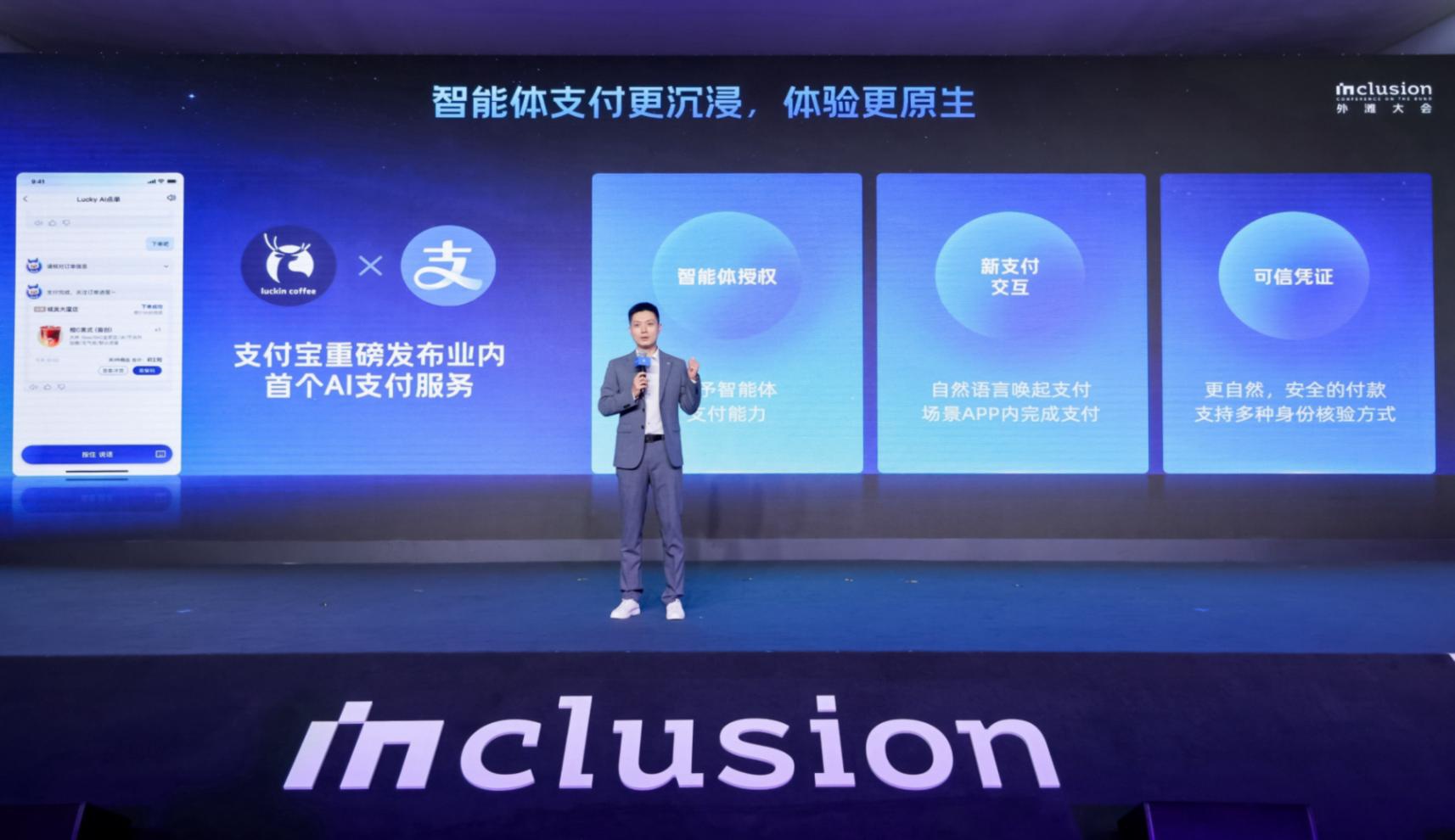
支付宝AI付登陆瑞幸支付宝小程序和App,说话可点单又能支付
Yang Guang Wang· 2025-09-11 08:56
Core Viewpoint - Alipay launched the first domestic "AI Payment" service at the 2025 Inclusion·Bund Conference, providing payment services for AI agents and integrating ordering and payment processes seamlessly for the first time in the industry [1][9]. Group 1: Service Launch and Features - The "AI Payment" service was first implemented in the "Lucky AI" ordering assistant at Luckin Coffee, allowing users to place orders and make payments through voice commands without leaving the AI chat interface [1][3]. - Users can now simply say "order" after receiving recommendations from "Lucky AI," completing the payment process after identity verification, making the experience as natural as conversing with a store clerk [3][6]. Group 2: Industry Impact and Future Prospects - Luckin Coffee's Product Director, Pu Yu, stated that the integration of "Lucky AI" with Alipay's AI Payment enhances the coffee consumption experience and lays the groundwork for expanding more service scenarios in the future [7]. - Ant Group's Chief Technology Officer, Zhu Lin, emphasized that the innovation aims to address safety and convenience in payments, predicting that new interactive payment methods could exceed 50% in the next five years, with a tenfold increase in diverse smart device payments [8]. - The launch of "AI Payment" is seen as a key step in activating the AI industry ecosystem, with the potential for the AI payment market to reach a trillion-level scale [8][9]. Group 3: Additional Innovations - Alipay has introduced several pioneering services, including the first "Payment MCP Server" for AI agents, "AI Tipping" for developers, "AI Subscription Payment" for service-based pricing, and the global first "Look-and-Pay" service for smart glasses [9]. - The introduction of "AI Payment" further completes the commercial loop from AI services to payments, promoting the prosperity of the AI ecosystem [9].