
物业管理

Search documents
中海物业20251210
2025-12-11 02:16
Summary of Zhonghai Property's Conference Call Company Overview - **Company**: Zhonghai Property - **Industry**: Property Management Key Financial Highlights - **Shareholder Profit**: Increased by 4.3% year-on-year to HKD 770 million, maintaining a net profit margin of 10.9% [2][3] - **Interim Dividend**: Declared at HKD 0.09 per share, up by HKD 0.005, with a payout ratio of 35.7% [2][3] - **Revenue Growth**: Total revenue for the first half of 2025 reached HKD 7.1 billion, a 3.7% increase year-on-year [3] - **Gross Profit**: Increased by 4.7% to HKD 1.2 billion, with a gross margin improvement of 0.2 percentage points to 17% [3] Revenue Structure - **Revenue Composition**: Property management accounts for 79% of revenue, while value-added services contribute 21% [2][4] - **Gross Profit Composition**: Property management represents 72% of gross profit, with value-added services at 28% [2][4] - **Managed Area**: Total managed area reached 436 million square meters, with property management revenue rising by 8.3% to HKD 5.6 billion [5] Expansion and Project Management - **Third-Party Projects**: New external contracts amounted to HKD 980 million, with an average project value increasing by 17% year-on-year [6] - **Urban Operations**: Annual contract value for urban operation projects rose by 9.6%, with core metropolitan area projects exceeding 60% of total contracts [6] - **Project Management Strategy**: The company employs a strategy of high contracts, high conversion, and high efficiency to enhance profitability [8] Value-Added Services Performance - **Residential Value-Added Income**: Reached HKD 610 million, with a gross margin of 35.2%, primarily driven by community asset management [7] - **Non-Residential Value-Added Services**: Revenue of HKD 860 million, with a gross margin of 13.4%, slightly down by 0.7 percentage points due to market conditions [7] - **Parking Space Sales**: Sold 365 parking spaces, generating revenue of HKD 27 million, with a stable gross margin above 20% [7] Shareholder Returns and Market Strategy - **Dividend Policy**: The company has consistently paid dividends since its IPO in 2015, with total dividends now equivalent to its market capitalization at listing [8] - **Future Dividend Plans**: There is potential for further increases in the dividend payout ratio, currently at around 35% [12] Future Outlook - **Performance Goals**: Focus on achieving targets for 2025, with strategic planning aligned with the "14th Five-Year Plan" [9] - **Project Optimization**: Continuous evaluation of projects for potential divestment based on cash flow, profit margins, and collection rates [10][11] Growth Areas in Value-Added Services - **Key Focus Areas**: 1. **Residential Services**: Significant growth in real estate brokerage, with potential for further expansion [13] 2. **Maintenance Services**: Increasing demand for maintenance as properties age, identified as a growth opportunity [13] 3. **Urban Operations**: Development of new value-added services based on foundational services [14] This summary encapsulates the key points from Zhonghai Property's conference call, highlighting financial performance, revenue structure, expansion strategies, and future growth areas.
最高法发布典型案例,回应物业领域群众关注的问题
Ren Min Ri Bao· 2025-12-11 02:03
Core Viewpoint - The Supreme People's Court has released five typical cases regarding property service contract disputes to address common issues such as property fee collection methods and difficulties in handover after contract termination, aiming to prevent and resolve conflicts in the property sector effectively [1] Group 1: Property Fee Collection - Property service providers cannot restrict access to essential services like elevators and entry systems as a means to collect overdue property fees, as this violates legal provisions and exceeds reasonable limits [2] - The Civil Code stipulates that property service providers must use lawful and reasonable methods for fee collection, and if owners fail to pay after notification, providers can resort to mediation, litigation, or arbitration without affecting the owners' normal living conditions [2] Group 2: Handover Obligations - Property service providers are not entitled to charge property fees after the termination of their service contract if they refuse to vacate the property and fulfill handover obligations to the new service provider [3][4] - The Civil Code mandates that upon contract termination, the original service provider must exit the property within an agreed or reasonable timeframe and assist in the handover process, failing which they cannot claim fees and may be liable for damages [4] Group 3: Authority of Owners' Decisions - Original property service providers lack the legal standing to challenge decisions made by the owners' assembly regarding the appointment of new service providers, as they are not considered owners and thus not bound by such decisions [5][6] - The Civil Code emphasizes that decisions regarding the appointment and dismissal of property service companies must be made collectively by the owners, and such decisions are legally binding on the owners but not on external parties like service providers [6]
三亚创新实施“先试后买”物业服务模式
Hai Nan Ri Bao· 2025-12-11 01:30
海南日报三亚12月10日电 (海南日报全媒体记者 李梦楠)12月10日,海南日报全媒体记者从三亚市 营商环境建设局获悉,该局在推出"先试后买"模式,为物业企业提供"展示期"和"缓冲期",降低准入门 槛与运营风险。 此外,该模式还通过建立多元协商机制,组织物业企业、居委会、物管会及业主代表开展专题座 谈,搭建沟通平台,协商历史遗留问题与服务标准,帮助企业明晰改进方向、化解矛盾,扫清工作障 碍。 三亚市营商环境建设局相关负责人表示,"先试后买"模式让企业平稳进入新项目,避免了仓促签约 或初期磨合不畅引发的服务纠纷与形象受损,实现低风险市场拓展。通过切实解决企业实际问题,展现 政府优化营商环境的主动作为,增强企业投资兴业的信心与安全感,激发市场主体活力。 据悉,该模式以社区居委会为临时委托方,与选定物业企业签订6个月临时服务协议,推动物业企 业聚焦服务提质,搭建企业与业主间的信任桥梁。同时,引导物业企业对目标小区实施连片管理,整合 人力资源、设备设施等资源,通过规模化运营降低各类成本,统一管理标准以提升服务品质。 ...
最高法发布典型案例,回应物业领域群众关注的问题
Ren Min Ri Bao· 2025-12-11 00:18
Core Viewpoint - The Supreme People's Court has released five typical cases regarding property service contract disputes, addressing common issues between property owners and service providers, aiming to guide lower courts and resolve civil disputes effectively [1][2]. Group 1: Property Fee Collection - Property service providers cannot restrict access to essential services like elevators and entry systems as a means to collect overdue property fees, as this violates legal rights of property owners [2][3]. - The court ruled that property service providers must use reasonable and lawful methods for fee collection, and if owners fail to pay after notification, providers can seek legal remedies without disrupting owners' daily lives [2][3]. Group 2: Termination of Property Service Contracts - Property service providers are not entitled to charge fees after the termination of their service contract if they fail to vacate the property and complete the handover to the new service provider [3][4]. - The court emphasized that original service providers must comply with handover obligations and cannot demand payment for services not rendered post-termination [3][4]. Group 3: Authority of Owners' Assembly - Property service providers lack the legal standing to challenge decisions made by the owners' assembly regarding the appointment of new service providers, as these decisions are binding only on property owners [4][5]. - The ruling reinforces the authority of owners' assemblies in managing property services and ensures that service providers cannot disrupt the decision-making process of property owners [5].
物业纠纷该注意哪些维权要点(法治聚焦)
Ren Min Ri Bao· 2025-12-10 22:30
Core Viewpoint - The Supreme People's Court has released five typical cases regarding property service contract disputes, aiming to address common issues such as property fee collection methods and difficulties in handover after contract termination, thereby promoting the resolution of civil disputes in the property sector and enhancing the protection of homeowners' rights [1][2]. Group 1: Property Fee Collection - Property service providers cannot restrict access to essential services like elevators and entry systems as a means to collect overdue property fees, as this violates homeowners' rights and lacks legal basis [2]. - The court ruled that property service providers must use reasonable and legal methods for fee collection, and if homeowners fail to pay after notification, providers can seek resolution through mediation, litigation, or arbitration, but not through actions that disrupt homeowners' daily lives [2]. Group 2: Handover Obligations - Property service providers are not entitled to demand payment for services after the termination of their contract if they refuse to vacate the property and fulfill handover obligations to the new service provider [3][4]. - The court emphasized that upon contract termination, the original service provider must exit the service area within a reasonable timeframe and cooperate with the new provider, failing which they cannot claim fees and may be liable for damages [4]. Group 3: Authority of Homeowners' Decisions - Original property service providers lack the standing to challenge decisions made by homeowners' assemblies regarding the appointment of new service providers, as they are not homeowners and thus not bound by such decisions [5][6]. - The court's ruling reinforces that decisions made by homeowners' assemblies regarding the hiring and firing of property service companies are legally binding on homeowners and do not extend to service providers, ensuring the integrity of homeowners' collective management rights [6].
2025中国物业管理行业市场总结&2026趋势展望
Xin Lang Cai Jing· 2025-12-10 13:57
Group 1 - The core viewpoint of the article emphasizes the transformation of the property management industry in China during the "14th Five-Year Plan" period, focusing on quality improvement and integration into national strategies for urban governance and public welfare [1][3][4] - The industry has shifted from being categorized as "other services" to "encouraged commercial services," indicating a deeper recognition and strategic positioning by the state [1][3] - By 2025, the property management sector is expected to play a significant role in urban renewal and grassroots governance, balancing economic and social attributes [1][3][4] Group 2 - The property management industry has seen a transition from a focus on scale expansion to a more rational and quality-driven approach, with companies exploring diversified services [3][12] - Customer satisfaction in property services has declined, with a national satisfaction score dropping to 72.9 points by 2025, alongside pressures on service fees and collection rates [8][11] - The average revenue growth rate for listed property companies has decreased significantly from around 40% in 2021 to below 4% in 2025, indicating a slowdown in industry growth [15][18] Group 3 - The capital market for property management has experienced a significant decline, with the total market value of listed property companies dropping from over 1 trillion HKD to approximately 246.47 billion HKD by 2025 [34][35] - The IPO market has seen a drastic reduction, with 2025 marking the first year without any new listings in the property sector, breaking a decade-long trend [42][45] - Mergers and acquisitions have shifted from a focus on scale to a more strategic approach, emphasizing complementary capabilities and internal resource integration [46][48] Group 4 - The property management industry is projected to continue expanding, with the total management area expected to reach 33 billion square meters by 2025, and revenue approaching 2 trillion RMB [57][60] - There is a growing emphasis on non-residential sectors, such as schools and hospitals, which present high potential for growth and diversification of services [60][63] - The exploration of diversified services, including community elderly care and housekeeping, is seen as a critical area for future growth, driven by high-frequency demand in the consumer market [63][64]


23.95亿主力资金净流入,物业管理概念涨1.26%
Xin Lang Cai Jing· 2025-12-10 12:58
Core Viewpoint - The property management sector has seen a rise of 1.26% as of the market close on December 10, ranking it 10th among concept sectors, with 117 stocks increasing in value [1][11]. Sector Performance - The top performers in the property management sector include Central Plaza, World Union, and Vanke A, which reached their daily limit up, with increases of 10.10%, 10.07%, and 10.06% respectively [1][12]. - Other notable gainers include TeFa Service, Hainan Airport, and China High-Tech, which rose by 7.82%, 7.52%, and 6.57% respectively [1][11]. - Conversely, the stocks with the largest declines include Mingdiao Co., Sanmu Group, and Yellow River Wind, which fell by 6.56%, 6.30%, and 5.28% respectively [1][11]. Capital Flow - The property management sector attracted a net inflow of 2.395 billion yuan, with 94 stocks receiving net inflows, and 6 stocks exceeding 100 million yuan in net inflow [2][11]. - Vanke A led the net inflow with 851 million yuan, followed by TeFa Information, Hainan Expressway, and Rongji Software, which saw net inflows of 453 million yuan, 262 million yuan, and 253 million yuan respectively [2][11]. Capital Inflow Ratios - The stocks with the highest capital inflow ratios include Annie Co., Dongbai Group, and Huijia Times, with net inflow ratios of 82.02%, 74.94%, and 69.32% respectively [3][12]. - The property management sector's capital inflow leaderboard features Vanke A, TeFa Information, and Hainan High-Speed, with respective inflow amounts of 850.62 million yuan, 452.85 million yuan, and 261.75 million yuan [3][12].

特发服务:12月10日召开董事会会议
Mei Ri Jing Ji Xin Wen· 2025-12-10 12:31
每经AI快讯,特发服务(SZ 300917,收盘价:44.54元)12月10日晚间发布公告称,公司第二届第三十 四次董事会会议于2025年12月10日在公司会议室以通讯方式召开。会议审议了《关于公司董事2024年考 核结果及奖金事宜的议案》等文件。 2024年1至12月份,特发服务的营业收入构成为:物业管理服务占比99.97%,其他业务占比0.03%。 每经头条(nbdtoutiao)——白金信用卡权益大缩水:贵宾厅限次、酒店减量⋯⋯银行吐槽没赚头,"羊 毛党"薅了个寂寞 (记者 张明双) 截至发稿,特发服务市值为75亿元。 ...

碧桂园服务(06098.HK)12月10日回购2921.95万港元,年内累计回购2.50亿港元
Zheng Quan Shi Bao Wang· 2025-12-10 12:29
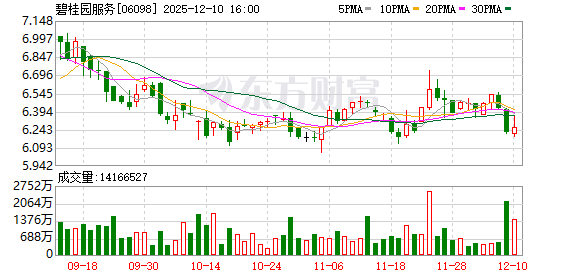
证券时报·数据宝统计,碧桂园服务在港交所公告显示,12月10日以每股6.190港元至6.260港元的价格回 购468.40万股,回购金额达2921.95万港元。该股当日收盘价6.260港元,上涨0.64%,全天成交额 8851.61万港元。 自11月18日以来公司已连续17日进行回购,合计回购2229.40万股,累计回购金额1.41亿港元。 其间该 股累计下跌1.73%。 今年以来该股累计进行58次回购,合计回购3936.00万股,累计回购金额2.50亿港元。(数据宝) 碧桂园服务回购明细 | 日期 | 回购股数(万股) | 回购最高价(港元) | 回购最低价(港元) | 回购金额(万港元) | | --- | --- | --- | --- | --- | | 2025.12.10 | 468.40 | 6.260 | 6.190 | 2921.95 | | 2025.12.09 | 494.70 | 6.360 | 6.220 | 3089.45 | | 2025.12.08 | 200.00 | 6.450 | 6.420 | 1286.73 | | 2025.12.05 | 30.90 | 6.450 ...

三木集团:12月10日召开董事会会议
Mei Ri Jing Ji Xin Wen· 2025-12-10 11:43
Group 1 - The core point of the article is that Sanmu Group (SZ 000632) held its 11th seventh board meeting on December 10, 2025, to discuss the proposal for the re-election of Mr. Zhang Zhonglin as an independent director [1] - For the first half of 2025, Sanmu Group's revenue composition was as follows: 94.27% from commodity trading, 2.77% from real estate, 1.36% from property management fees, 1.22% from leasing, and 0.24% from hotel services [1] - As of the report date, Sanmu Group's market capitalization was 3.4 billion yuan [1]
