
纺织服装

Search documents
纺织行业迎数智蝶变,SHEIN柔性按需创新助产业提质升级
Huan Qiu Wang· 2025-12-08 01:55
【环球网科技综合报道】"希音(SHEIN)打造的'SHEIN链'串联起品牌与供应商,在链主企业的带动下,产业链从开发、生产、仓储、物流等产业链各环节 实现数字化升级。"日前,在纺织行业的数智化转型中,作为时尚和生活方式零售商的"链主"企业,SHEIN对全产业链上下游供应商的"链式改造"赋能成为 行业数智化转型的标杆。 柔性按需创新驱动 "SHEIN 链 " 数智转型 纺织服装产业因上下游环节多、涉及面广、时间跨度长且中小企业占比高,属于典型的非标行业,其转型升级之路曾一度面临诸多现实挑战。SHEIN则通 过"小单快反"的柔性供应链模式创新,实现"以销定产",革新了传统服装生产的底层逻辑。这不仅带动一大批传统工厂破解了行业高库存顽疾,更成为推动 产业数智化转型升级的关键引擎。 除持续优化迭代线上数字化工具外,SHEIN还针对供应商实际生产中的需求与难点,持续研发推广行业先进的技术工具、设备及工艺。2023年,SHEIN成立 首个服装制造创新研究中心,近两年在该领域技术创新投入近2亿元。依托该中心,目前已累计开发170多项创新工具,向供应商交付近6000件,这些精益工 具平均提升相关工序效率达80%。 同时,在S ...


月销量增长200%!这种“新年战袍”正在赶制中
Zhong Guo Jing Ji Wang· 2025-12-07 05:19
Group 1 - The "doll clothing" market is gaining popularity among young consumers, with products like "New Year costumes" becoming the hottest items as 2026 approaches [1] - A traditional clothing factory in Tongxiang has launched a "doll clothing" product line, achieving a 200% increase in monthly sales since its introduction in March [1] - A fabric factory in Haining has transitioned to producing "doll clothing" using traditional materials, resulting in a fourfold increase in order volume and sales exceeding one million [1] Group 2 - The chairman of a textile technology company reported having nearly 10,000 orders for various styles, indicating strong demand from both domestic and international markets [2] - The global plush toy market is projected to exceed $10 billion in 2024, with an annual growth rate of 15%, creating a favorable environment for derivative products like doll clothing [2]
山东省及下辖各市经济财政实力与债务研究(2025)
新世纪评级· 2025-12-06 12:28
Economic Performance - Shandong Province achieved a GDP of 98,565.8 billion yuan in 2024, growing by 5.7% year-on-year, maintaining its position as the third-largest economy in China[2] - In the first three quarters of 2025, the GDP reached 77,115.0 billion yuan, with a year-on-year growth of 5.6%, surpassing the national average by 0.4 percentage points[2] - The province's industrial investment helped mitigate the negative impact of declining real estate investment, contributing to overall investment growth[2] Fiscal Strength - In 2024, Shandong's general public budget revenue was 7,711.74 billion yuan, a 3.3% increase from the previous year, ranking fifth nationally[4] - The tax ratio was 65.35%, down 4.7 percentage points from the previous year, placing it 13th among provinces[4] - Government fund budget revenue fell to 4,832.12 billion yuan in 2024, a decrease of 1.9% due to declining land transaction prices[4] Debt Situation - By the end of 2024, Shandong's government debt reached 28,428.81 billion yuan, an 18.9% increase from 2023, ranking second nationally[7] - The debt-to-budget revenue ratio was 4.46 times, indicating a moderate level of risk compared to other provinces[7] - The debt growth was concentrated in larger cities, with Qingdao and Jinan having the highest debt levels at 4,382.57 billion yuan and 3,770.56 billion yuan, respectively[8] City-Level Analysis - Qingdao, Jinan, and Yantai led the provincial economy with GDPs of 16,719.46 billion yuan, 13,527.60 billion yuan, and 10,782.83 billion yuan, respectively, accounting for 41.6% of the province's total GDP[3] - Most cities experienced a slowdown in economic growth, with the average growth rate around 5% to 7%[3] - In 2024, the general public budget revenue for Qingdao and Jinan was 1,339.26 billion yuan and 1,083.05 billion yuan, respectively, showing a clear leading advantage[5]
华泰香港市场研究11月精华:三大均衡育新机
Xin Lang Cai Jing· 2025-12-06 01:24
Group 1 - The Hong Kong stock market is entering a value investment phase, with current adjustments providing better cost-effectiveness compared to A-shares [2] - Short-term capital may continue to seek safety, with a focus on underperforming sectors such as consumer services, construction, textiles, and home appliances [2][3] - Certain industries like electronics, pharmaceuticals, automotive, and light manufacturing have experienced significant declines, presenting opportunities for recovery [2] Group 2 - The recent market volatility has highlighted the importance of balanced asset allocation, especially in the context of external disturbances affecting investor sentiment [4] - The Chinese AI industry is seen as a long-term theme supported by national planning, with technology stocks in Hong Kong still offering mid-term investment value [4] - The shift in market style from technology to defensive dividend sectors has been noted since mid-October, with various dividend-focused ETFs available in the Hong Kong market [6]
浙江新澳纺织股份有限公司第六届董事会第二十五次会议决议公告
Shang Hai Zheng Quan Bao· 2025-12-05 19:24
二、董事会会议审议情况 (一)审议并通过了《关于回购注销部分限制性股票的议案》 登录新浪财经APP 搜索【信披】查看更多考评等级 证券代码:603889 证券简称:新澳股份 公告编号:2025-051 浙江新澳纺织股份有限公司 第六届董事会第二十五次会议决议公告 本公司董事会及全体董事保证本公告内容不存在任何虚假记载、误导性陈述或者重大遗漏,并对其内容 的真实性、准确性和完整性承担个别及连带责任。 一、董事会会议召开情况 浙江新澳纺织股份有限公司(以下简称"公司")第六届董事会第二十五次会议于2025年12月5日在公司 会议室以现场方式召开,本次会议通知于2025年11月28日以书面、电话等方式通知全体董事、高级管理 人员。会议由董事长沈建华先生召集并主持,会议应出席董事9人,实际出席董事9人。本次会议的召集 和召开程序符合《公司法》和《公司章程》的规定,会议合法有效。 本议案事前已经薪酬与考核委员会审议通过,并同意提交至公司董事会审议。 具体内容详见公司在上海证券交易所网站(www.sse.com.cn)披露的《关于回购注销部分限制性股票的 公告》。 关联董事沈建华、华新忠、刘培意、张林锋、王玲华、王雨婷回 ...

聚焦 | 全球纺服四大巨头出口格局与国际竞争力剖析
Sou Hu Cai Jing· 2025-12-05 12:15
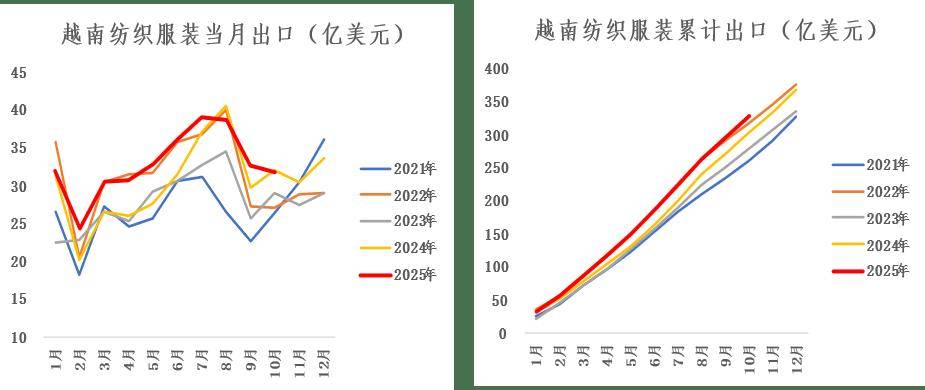
1、越南:增长迅速但供应链依赖度高 近年来,依托较低的生产成本与政策支持,东南亚与南亚地区逐步承接了部分由中国转移出的纺织产能,带动当地纺织品服装出口显著增长。其中,越 南、孟加拉、印度和巴基斯坦四国表现尤为突出,已经在全球纺织服装出口格局中占据重要地位,而中国正从"成品出口国"转型为"中间品供应国",2025 年1–9月对东盟与南亚三国纱线出口合计增长超20%,成为四国出口的"隐形引擎"。本文将从上述四国的纺织服装贸易视角出发,分析其今年的出口现 状、产业优势与劣势,来评估当前纺织品国家的出口格局以及国际竞争力。 越南纺织服装出口 来源:越南海关 近年来,越南纺织服装出口规模呈现持续扩张态势。从越南海关数据来看,2016-2021年间越南纺服年出口额都维持在350亿美元以下,而自2022年开始实 现显著突破,连续三年保持在350亿美元上方,其中2022年更是依靠低廉的劳动力和原材料创下378亿美元的历史新高。 根据最新越南海关数据,2025年1-10月越南纺服出口累计值为329亿美元,同比增加8.4%,已经超过了2021年的全年出口量,力争实现2025年480亿美元的 出口目标。今年如此优越的贸易量主要得益 ...
中国人的羽绒服,如何走向世界?
虎嗅APP· 2025-12-05 11:32
Core Viewpoint - The article discusses the participation of Bosideng Group in the 2025 Boao Forum for Entrepreneurs, highlighting its strategic thinking and achievements in the context of high-quality development in the new era [5]. Group 1: Company Overview - Bosideng Group has been a representative brand in China's down jacket industry, maintaining its commitment to the core business of down jackets for 49 years, and has become a globally recognized brand [5]. - The company has led the Chinese market in sales for 30 consecutive years, with a brand value of 118.058 billion yuan, and has been consistently included in the World Brand 500 [5]. Group 2: Global Expansion - Bosideng entered European markets such as Switzerland in the 1990s, becoming one of the early Chinese brands to go global [5]. - The brand has showcased its products at international fashion weeks in New York, Milan, London, and Paris, continuously expanding its overseas market and production capacity [5]. Group 3: Innovation and Technology - Innovation is viewed as the core of Bosideng's competitive advantage, supported by high-end platforms like the national industrial design center and CNAS-certified laboratories [5]. - The company has developed a collaborative system across the entire supply chain, reducing product delivery cycles to 7-10 days, and has implemented a digital closed-loop from design to virtual garments through its "BSD.AI Aesthetic Brain" [5]. Group 4: Sustainability and Social Responsibility - Bosideng integrates sustainable development into its strategic operations, establishing a clear "1+3+X" ESG strategic framework and carbon goals, becoming the first Asian textile and apparel company to receive MSCI ESG AAA rating [6]. - The company has contributed 1.55 billion yuan to social causes over the years, promoting rural revitalization and common prosperity through long-term partnerships with communities [6]. Group 5: Future Direction - As it enters a new decade, Bosideng aims to align with national development strategies and the spirit of the 20th National Congress, striving to transition from being the first in China to becoming a global leader [6].

棒杰股份:债权人申请对公司进行预重整
Xin Lang Cai Jing· 2025-12-05 10:01
棒杰股份公告,2025年12月5日,公司收到债权人苏州环秀湖逐光企业管理合伙企业(有限合伙)的 《告知函》,环秀湖逐光以公司不能清偿到期债务且资产不足以清偿全部债务,但具备重整价值为由, 向浙江省金华市中级人民法院提交申请对公司进行预重整的材料。截至本公告披露日,公司尚未收到法 院受理预重整申请的文件,申请人的预重整申请能否被法院裁定受理,公司后续是否进入预重整或重整 程序均存在重大不确定性。 ...

际华集团(601718.SH):智能穿戴未涉及AI眼镜
Ge Long Hui· 2025-12-05 07:52
(原标题:际华集团(601718.SH):智能穿戴未涉及AI眼镜) 格隆汇12月5日丨际华集团(601718.SH)在投资者互动平台表示,公司的智能穿戴未涉及AI眼镜。 ...

国新证券每日晨报-20251205
Guoxin Securities Co., Ltd· 2025-12-05 03:03
Domestic Market Overview - The domestic market showed a mixed performance on December 4, with the Shanghai Composite Index closing at 3875.79 points, down 0.06%, while the Shenzhen Component Index rose 0.4% to 13006.72 points. The STAR 50 Index increased by 1.36%, and the ChiNext Index rose by 1.01%. The total trading volume of the A-share market was 156.17 billion yuan, a decrease from the previous day [1][4][9] - Among the 30 sectors tracked by CITIC, 9 sectors saw gains, with electronics, defense, and machinery leading the increases. Conversely, sectors such as retail, consumer services, and textiles experienced significant declines. Notably, indices related to concepts like Moore Threads, satellite internet, and semiconductor equipment performed actively [1][4][9] Overseas Market Overview - On December 4, the U.S. stock market exhibited mixed results, with the Dow Jones Industrial Average falling by 0.07%, the S&P 500 Index rising by 0.11%, and the Nasdaq increasing by 0.22%. Notable declines were seen in 3M Company and UnitedHealth Group, both dropping over 2%. The index tracking seven major U.S. tech companies rose by 0.4%, with Facebook gaining over 3% and NVIDIA increasing by more than 2% [2][4] News Highlights - President Xi Jinping held talks with French President Emmanuel Macron, emphasizing the importance of mutual understanding and support between China and France, regardless of external changes. The two leaders discussed various cooperation agreements in fields such as nuclear energy, agriculture, education, and environmental protection [3][12][15] - The Ministry of Commerce announced that the Chinese government is conducting export controls on rare earth-related items in accordance with the law, ensuring compliance for civilian use applications [17][18] - The State Administration for Market Regulation indicated that new national standards for electric bicycles will be included in the 2026 supervision and inspection plan, focusing on safety inspection items [19] - The National Bio-Manufacturing Industry Innovation Center officially began trial operations, focusing on green low-carbon, bio-agriculture, and healthcare sectors [21]