基金

Search documents
近半主动权益基金净值新高 200多只“毛基”上岸 谁带来了开年“钱途”?
Di Yi Cai Jing· 2026-02-25 12:17
Core Viewpoint - The A-share market has experienced a significant surge, with public equity funds seeing a strong start to the year, as nearly half of these products have reached historical net asset value highs, and over 90% have achieved positive returns [1][2]. Group 1: Market Performance - The A-share market has shown a strong upward trend, with over 3,700 stocks rising and more than 100 hitting the daily limit in the last two days [6]. - The trading volume has increased significantly, surpassing 2 trillion yuan, reaching 2.48 trillion yuan [6]. - The performance of the non-ferrous metal sector has been particularly strong, with a year-to-date increase of 21.94%, and 18 constituent stocks within this sector have seen gains exceeding 50% [3]. Group 2: Fund Performance - Among 4,780 comparable active equity funds, 2,347 have achieved historical net asset value highs this year, representing 49.1% of the total [2]. - Over 90% of active equity funds have recorded positive returns since the beginning of the year, with 149 funds showing gains of over 20% [2]. - The top-performing funds, managed by the same fund manager, have achieved returns of 52.64%, 51.95%, and 46.61% respectively [2]. Group 3: Investment Strategies - Investment strategies are shifting from liquidity-driven to profit-driven, with a recommendation for investors to maintain a contrarian mindset as market leadership may rotate quickly [1]. - The focus on resource-related sectors has provided significant advantages in the current market environment, with many top-performing funds heavily invested in non-ferrous metals and technology stocks [3][4]. - Analysts suggest that the market may stabilize and recover post-Spring Festival, with emerging technologies and value stocks expected to perform well [7].





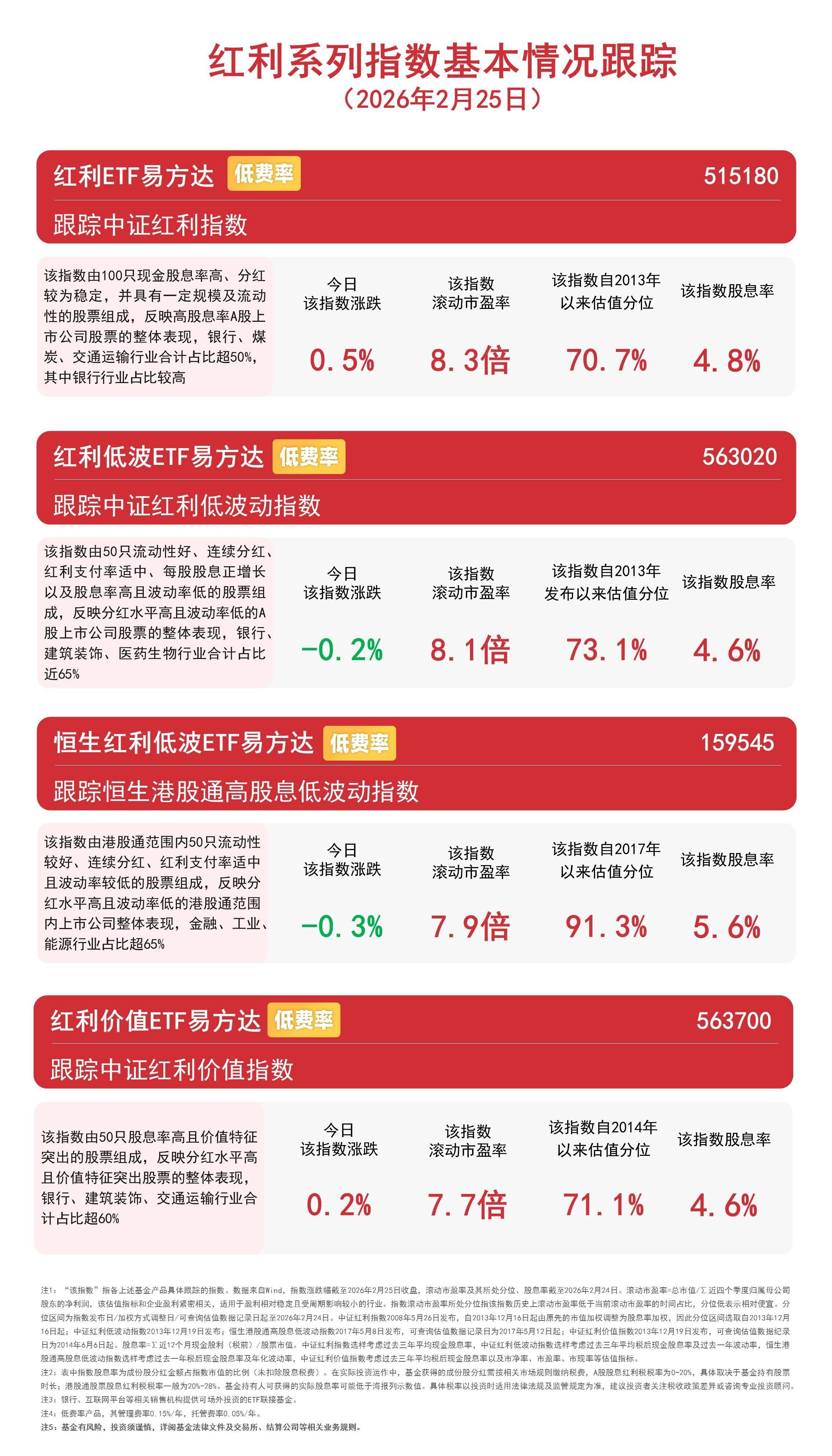
红利板块震荡分化,关注红利低波ETF易方达(563020)、恒生红利低波ETF易方达(159545)等产品布局机会
Sou Hu Cai Jing· 2026-02-25 11:53
Group 1 - The core index performance shows that the CSI Dividend Index increased by 0.5%, while the CSI Dividend Value Index rose by 0.2%. Conversely, the CSI Dividend Low Volatility Index decreased by 0.2%, and the Hang Seng Hong Kong Stock Connect High Dividend Low Volatility Index fell by 0.3% [1][4][8] - The E Fund's dividend low volatility ETFs, including the E Fund Dividend Low Volatility ETF (563020) and the E Fund Hang Seng Dividend Low Volatility ETF (159545), have seen a net inflow of funds totaling 120 million yuan and 190 million yuan respectively over the past two trading days [1] - E Fund is currently the only fund company that implements low fee rates for all its dividend ETFs, with a management fee rate of 0.15% per year for products such as the E Fund Hang Seng Dividend Low Volatility ETF (159545), E Fund Dividend ETF (515180), and others [1] Group 2 - The CSI Dividend Low Volatility Index is composed of 50 stocks that have good liquidity, continuous dividends, moderate dividend payout ratios, positive growth in earnings per share, and low volatility, reflecting the overall performance of A-share listed companies with high dividend levels and low volatility. The banking, construction decoration, and pharmaceutical industries account for a total of 65% [3] - The Hang Seng Dividend Low Volatility Index consists of 50 stocks within the Hong Kong Stock Connect that have good liquidity, continuous dividends, moderate dividend payout ratios, and low volatility, reflecting the overall performance of listed companies in the Hong Kong Stock Connect with high dividend levels and low volatility. The financial, industrial, and energy sectors account for over 65% [7]

中小盘领跑,中证500ETF易方达(510580)、中证1000ETF易方达(159633)年内相对大盘蓝筹跑出明显超额,近20日获得资金净流入
Ge Long Hui· 2026-02-25 11:21
Group 1 - The A-share market has shown a clear style in 2026, with mid-cap stocks outperforming and growth stocks leading, as evidenced by the year-to-date gains of 14.63% for the CSI 500 ETF and 11.48% for the CSI 1000 ETF, significantly outperforming large-cap blue chips [1] - There has been a continuous net inflow of funds, with both institutional and trading capital resonating, leading to substantial net subscriptions for the CSI 500 ETF and CSI 1000 ETF, which are among the top in net inflows for broad-based indices [1] - The CSI 500 ETF has seen a net inflow of 529 million yuan over the past 20 days, while the CSI 1000 ETF has experienced a net inflow of 125 million yuan [1] Group 2 - The market has recognized the "capital absorption effect" of mid and small-cap stocks, reflecting a high acknowledgment of the performance elasticity and valuation recovery of mid-cap stocks [2] - The combination of CSI 500 (mid-cap core) and CSI 1000 (small-cap growth) has formed a "golden combination," excelling in momentum, capital, industry, prosperity, and liquidity, making it the preferred broad-based investment in the current market [2] - The CSI 500 ETF and CSI 1000 ETF are well-suited for diversified allocation, with high liquidity and smooth trading, featuring specialized and innovative companies supported by industrial policies, enhancing performance realization [2]
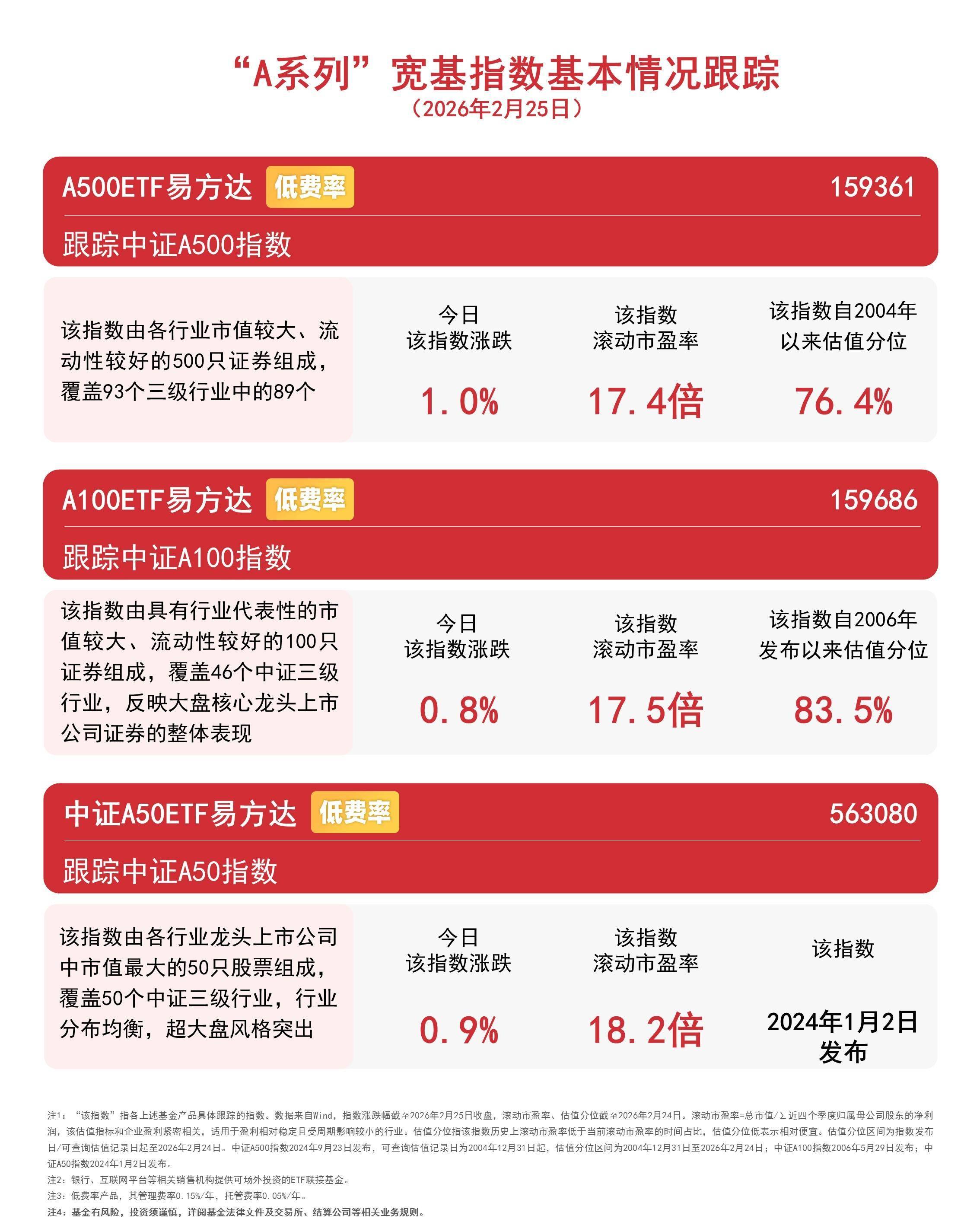
机构称A股当下处在牛市逻辑当中,A500ETF易方达(159361)助力一键布局核心资产
Sou Hu Cai Jing· 2026-02-25 10:51
Group 1 - The core viewpoint is that the A-share market is currently in a bull market logic, and short-term fluctuations should not shake confidence in the positive trend [1] - The CSI A500 index rose by 1.0%, the CSI A50 index increased by 0.9%, and the CSI A100 index went up by 0.8% [1] - Open Source Securities maintains a bullish outlook as the core driving forces of the current bull market have not significantly tightened or shifted [1]
华安基金:险资加力权益配置,持续增配港股红利
Xin Lang Cai Jing· 2026-02-25 10:45
Market Overview and Key Insights - The Hang Seng China Enterprises Dividend Index increased by 0.56%, while the Hang Seng Index rose by 0.03% and the Hang Seng Technology Index by 0.27% last week. In the A-share market, the CSI State-Owned Enterprises Dividend Index fell by 0.48%, while the CSI 300 Index increased by 0.39% [1][6] - By the end of Q4 2025, insurance capital significantly increased its allocation to equity assets, with the proportion of equity investments rising to 15.3%, approaching historical highs. This reflects the policy requirement for "long money, long investment" and an optimized assessment mechanism for insurance capital [1][7] Insurance Capital Allocation - The characteristics of insurance capital align well with the low volatility and high dividend nature of dividend stocks, making dividend stocks a primary allocation direction for insurance capital. Insurance funds are expected to become significant incremental capital in the stock market, emphasizing the importance of understanding their allocation direction for investment [1][7] - With long-term bond yields at historical lows, incremental insurance capital is likely to flow more into dividend stocks, indicating a favorable long-term funding environment for dividend strategies [1][7] Dividend Strategy and ETF Insights - The Hang Seng China Enterprises Dividend Index has a dividend yield of 5.72%, compared to 4.86% for the CSI Dividend Index, with a price-to-book (PB) ratio of 0.64 and a price-to-earnings (PE) ratio of 7.26. Over the past five years, it has achieved a cumulative return of 155%, outperforming the Hang Seng Total Return Index by 150% [2][7] - The CSI State-Owned Enterprises Dividend Index has a dividend yield of 4.83%, a PB of 0.85, and a PE of 8.48, with a five-year cumulative return of 69%, outperforming the CSI 300 Total Return Index by 78% [2][7] - The low interest rate environment and weak economic recovery in China are favorable for dividend strategies, with strong dividend willingness and capability among central state-owned enterprises [2][7] ETF Product Overview - The Hang Seng China Enterprises Dividend ETF (513920) is the first ETF in the market with triple attributes of Hong Kong stocks, central enterprises, and dividends, tracking the Hang Seng China Enterprises Dividend Index (HSSCSOY) [3][8] - The National Enterprises Dividend ETF (561060) tracks the CSI National Enterprises Dividend Index, selecting 100 stocks from state-owned enterprises with high cash dividend yields and stable dividends, reflecting the overall performance of high-dividend state-owned enterprises in the A-share market [4][9]

洞察价值,知行合一:对话平安基金莫艽,解码“深度研究+动态仓位”的投资哲学
Sou Hu Cai Jing· 2026-02-25 10:30
Core Viewpoint - The article highlights the investment philosophy of Mo Qiao, a fund manager at Ping An Fund, who emphasizes deep research and dynamic positioning over macro predictions and market trends [1][2]. Investment Philosophy - Mo Qiao's core investment philosophy revolves around the dynamic matching of value and price, rejecting the traditional view of never selling good companies [2][3]. - He integrates the Kelly formula into his investment practice, adjusting positions based on the proximity of stock prices to their value ranges [2][3]. - The focus is on long-term value space rather than short-term growth rates, with a preference for assessing companies based on their dividend yield for safety margins [2][3]. Investment Framework - Mo Qiao's investment framework is summarized as "Dao and Qi Distinction," where "Dao" refers to the DCF principle and "Qi" encompasses four differentiated strategies [3][6]. - The strategies include extreme depth of research to determine value ranges, dynamic position adjustments following the Kelly formula, focusing on price-value comparisons rather than low PE/PB, and investing in quality companies [3][6]. Research Methodology - The depth of research involves creating extensive notes for each holding, covering business models and industry dynamics, which enhances stock-picking capabilities and decision-making [7][10]. - The approach emphasizes understanding the underlying logic of industries and companies, allowing for targeted research and investment decisions [10]. Market Approach - Mo Qiao avoids pure thematic investments and market timing, focusing instead on individual stock selection based on current value assessments [3][4]. - The strategy includes dynamic position adjustments based on market conditions, with a focus on absolute returns and controlling drawdowns [5][6]. Industry Focus - The investment strategy prioritizes low-cycle industries, as they often present better pricing opportunities during downturns [10][11]. - Mo Qiao's approach includes analyzing industries through global benchmarks and focusing on companies with strong governance and growth potential [9][10]. Response to Market Trends - In the context of popular sectors like AI and robotics, Mo Qiao remains cautious, emphasizing the importance of intrinsic value over speculative price movements [11][12]. - The strategy involves reducing positions in overvalued stocks driven by market hype while increasing stakes in undervalued quality companies [11][12].
黄金股票ETF(517400)收涨超1%,全球货币体系重构下,黄金表现机会仍存
Mei Ri Jing Ji Xin Wen· 2026-02-25 09:52
Group 1 - The core viewpoint is that under the restructuring of the global monetary system, there are still opportunities for gold performance, supported by rising geopolitical tensions and the ongoing risks associated with U.S. government debt [1] - The market is expected to face more legal and policy fluctuations regarding future tariffs, which may continue to create uncertainty in trading [1] - The demand for gold as a safe asset is expected to increase due to frequent global geopolitical turmoil and the trend of "de-dollarization," positioning gold as a potential new pricing anchor [1] Group 2 - The long-term trend for gold remains solid, driven by monetary overexpansion and the monetization of fiscal deficits, which challenge the credibility of the U.S. dollar [1] - The logic supporting gold prices includes the Federal Reserve's interest rate cut cycle, increasing overseas uncertainties, and the global trend of de-dollarization [1] - Investors are encouraged to pay attention to investment opportunities in gold ETFs, specifically the Cathay Gold ETF (518800) and the Gold Stock ETF (517400) [1]
56亿,加仓
3 6 Ke· 2026-02-25 09:42
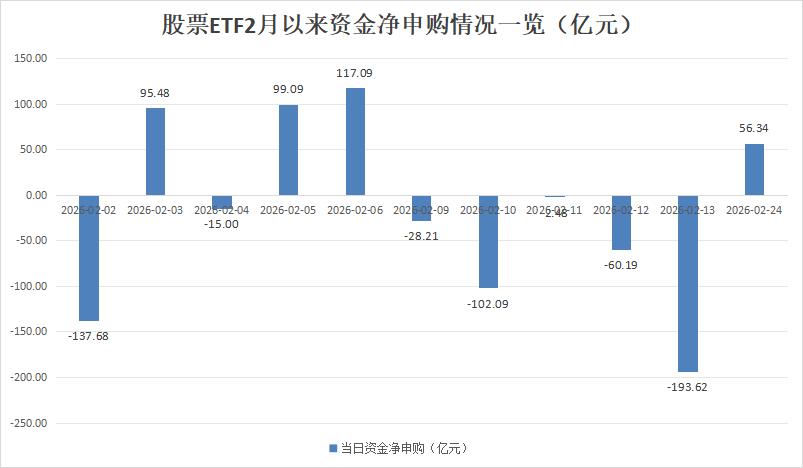
Group 1 - The stock ETF market experienced a significant net inflow of 56.34 billion yuan on February 24, reversing the trend of net outflows observed in the first five trading days of the year [1][2] - The A-share market opened higher and closed with the Shanghai Composite Index up by 0.87%, while the ChiNext Index saw a peak increase of over 2% [2] - The total scale of all stock ETFs reached 3.92 trillion yuan, with 1,339 stock ETFs in the market [2] Group 2 - The Hong Kong stock market ETFs led the net inflow, with 84.72 billion yuan, while broad-based ETFs saw a net outflow of 50.11 billion yuan [4] - ETFs tracking the Hang Seng Technology Index had the highest single-day net inflow of 46.59 billion yuan, while those tracking the CSI A500 Index faced a net outflow of 17.18 billion yuan [4] - Major fund companies like E Fund and Huaxia Fund reported significant net inflows in their ETFs, with E Fund's total ETF scale reaching 659.7 billion yuan [4][5] Group 3 - Specific ETFs such as the Hang Seng Technology Index ETF and the China Internet ETF saw net inflows of 16.53 billion yuan and 13.41 billion yuan, respectively [5][6] - The performance of the robotics and power grid equipment ETFs also attracted over 4 billion yuan in net inflows, indicating growing interest in these sectors [8] Group 4 - The market saw notable net outflows from broad-based ETFs, including the CSI 500 ETF and the media ETF, with the latter experiencing a net outflow of 4.46 billion yuan [9] - The short-term bond ETF faced the largest single-day net outflow of 11.54 billion yuan, reflecting a shift in investor sentiment towards riskier assets [9]
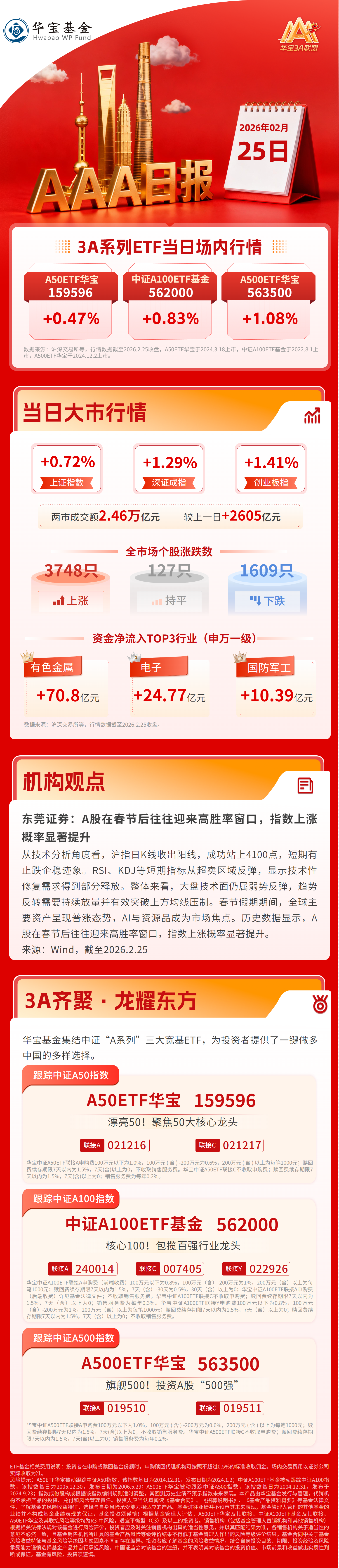
两市再度放量,A股高开高走,机构:A股在春节后往往迎来高胜率窗口 | 华宝3A日报(2026.2.25)
Xin Lang Cai Jing· 2026-02-25 09:19
Core Viewpoint - The A-share market is experiencing a positive trend post-Spring Festival, with a significant probability of index increases, supported by technical indicators showing signs of recovery [4][15]. Market Performance - The Shanghai Composite Index rose by 0.72%, while the Shenzhen Component Index increased by 1.29% on the same day [3][13]. - The total trading volume across both markets reached 2.46 trillion yuan, an increase of 261 billion yuan compared to the previous day [3][13]. - A total of 3,748 stocks rose, while 1,275 stocks declined [3][14]. Fund Performance - The Hwabao A50 ETF and Hwabao A100 ETF saw increases of 0.83% and 0.47%, respectively, on the same trading day [11][16]. - The Hwabao A50 ETF focuses on 50 leading companies, while the Hwabao A100 ETF encompasses the top 100 industry leaders [6][17]. Institutional Insights - Dongguan Securities noted that A-shares typically enter a high-probability window for gains after the Spring Festival, with a significant increase in the likelihood of index rises [4][15]. - Technical analysis indicates that the Shanghai Composite Index has formed a bullish candlestick pattern, suggesting a potential reversal if trading volume continues to increase [4][15]. Fund Details - The Hwabao A50 ETF has a subscription fee structure where amounts below 1 million yuan incur a fee of 1.0%, while amounts between 1 million and 2 million yuan incur a fee of 0.6% [5][16]. - The Hwabao A100 ETF has a similar fee structure, with a subscription fee of 0.8% for amounts below 1 million yuan [7][18]. - The Hwabao A500 ETF also follows a comparable fee structure, with a subscription fee of 1.0% for amounts below 1 million yuan [8].
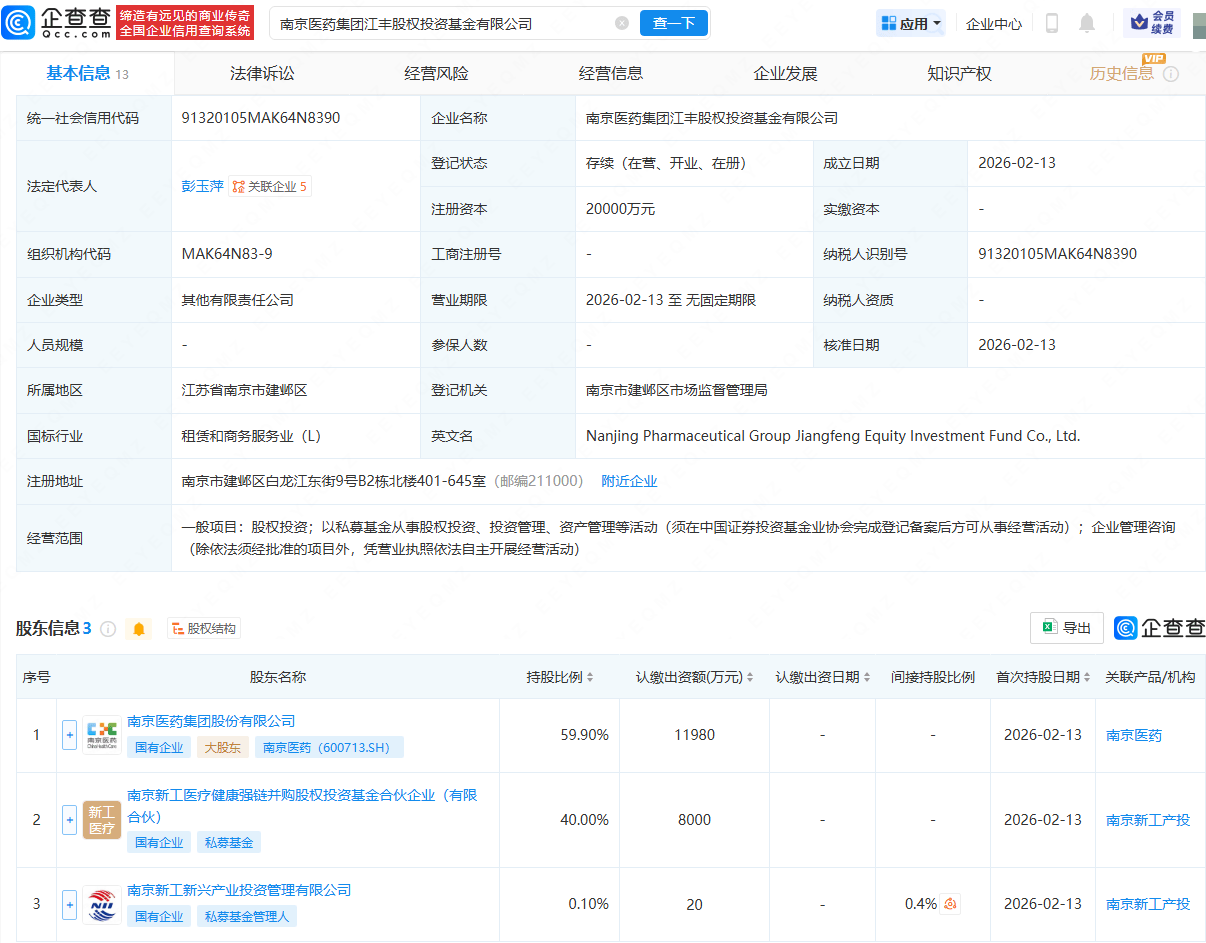
南京医药等投资成立股权投资基金公司
Sou Hu Cai Jing· 2026-02-25 09:15
| 工 章 台 缔造有远见的商业传奇 | 南京医药集团江丰股权投资基金有限公司 | | 8 查一下 | ー 応用 ▼ | 企业中心 | | --- | --- | --- | --- | --- | --- | | 基本信息 13 | 法律诉讼 | 经营风险 | 经营信息 企业发展 | | 知识产权 F | | 统一社会信用代码 | 91320105MAK64N8390 | 企业各称 | 南京医药集团江丰股权投资基金有限公司 | | | | 法定代表人 | 彭玉萍 凉关联企业 5 | 登记状态 | 存续(在营、开业、在册) | 成立日期 | 2026-02-13 | | | | 注册资本 | 20000万元 | 实缴资本 | | | 组织机构代码 | MAK64N83-9 | 工商注册号 | | 纳税人识别号 | 91320105MAK64I | | 企业集团 | 其他有限责任公司 | 营业期限 | 2026-02-13 至 无固定期限 | 纳税人资质 | | | 人员规模 | - | 参保人数 | | 核准日期 | 2026-02-13 | | 所属地区 | 江苏省南京市建邺区 | 登记机关 | 南京市建邺 ...