机器人

Search documents
春晚广告位争夺战:四十年国民记忆与商业暗流
凤凰网财经· 2026-02-19 10:54
Core Viewpoint - The evolution of the Spring Festival Gala sponsorship reflects the transformation of China's economy and consumer behavior over the past 40 years, showcasing the shift from material scarcity to technological innovation and brand storytelling [4][5]. Group 1: 1980s to Early 1990s - The Era of Material Scarcity - The transition from a planned economy to a market economy in the 1980s led to a scarcity of goods, making items like watches and bicycles symbols of wealth and status [6][7]. - The first brand to sponsor the Spring Festival Gala was Kambas watches in 1984, which used 3,000 quartz watches as payment, marking the beginning of brand sponsorship in the event [7][9]. - Kambas became a household name, with production reaching 1.26 million units by 1987 and over 2 million by 1991, highlighting the impact of the Gala on brand visibility and market demand [9][10]. Group 2: Mid-1990s to Early 2000s - The Rise of Consumerism - The late 1990s saw a surge in consumer spending, with households moving from basic necessities to larger purchases like televisions and refrigerators [12][14]. - In 1995, Shandong Kongfu Banquet Wine became the first "advertising king" of the Spring Festival Gala, paying 30.79 million yuan, initiating a trend among liquor companies [12][14]. - The sales of Qin Pool Wine skyrocketed from 180 million yuan in 1995 to 950 million yuan in 1996 after winning the sponsorship, demonstrating the immediate impact of Gala advertising [17]. Group 3: 2000s to 2010s - The Era of Brand Awareness - The early 2000s marked a shift towards household appliances as the main consumer focus, with Midea becoming a prominent sponsor, securing 16 sponsorships from 2003 to 2019 [18][20]. - The cost of advertising during the Gala increased significantly, with Midea's sponsorship rising from 6.8 million yuan in 2005 to 57.2 million yuan in 2011, reflecting the growing value of the event [20]. - Brands began to focus on storytelling and emotional connections with consumers, as seen with Haier and Gree, indicating a maturation of brand marketing strategies [21]. Group 4: Mid-2010s to Present - The Digital Economy and Technological Innovation - The rise of internet companies has transformed the Spring Festival Gala into a platform for digital engagement, with WeChat's "red envelope war" in 2015 significantly increasing viewer interaction [24][26]. - The Gala has become a battleground for tech giants, with platforms like Douyin and Kuaishou participating in interactive sponsorships, showcasing the shift towards a two-way communication model [29]. - The introduction of robots and AI technologies in recent Galas reflects China's transition from manufacturing to intelligent manufacturing, highlighting the importance of innovation in the economy [31].



未来10年,这18个赛道将带来48万亿美元收入
创业家· 2026-02-19 09:33
Core Insights - McKinsey's report identifies 18 industry sectors likely to reshape the global business landscape, predicting revenues of $29 trillion to $48 trillion by 2040, contributing 18-34% to global GDP growth [2] E-commerce - By 2040, e-commerce's share of global retail revenue is expected to rise to 27%-38%, up from approximately 20% currently [3] - Growth drivers include market expansion in developing countries and new product categories in developed nations, such as healthcare and emotionally valuable products [4] - Significant investments are anticipated in customer acquisition and last-mile delivery across e-commerce platforms [5] Electric Vehicles - Electric vehicles (EVs) are projected to exceed 50% of global passenger car sales by 2040 [6] - Breakthroughs in battery technology and smart algorithms will significantly influence this sector, prompting increased R&D investments from both EV manufacturers and traditional automakers [7] Cloud Services - The demand for higher storage and computing capabilities is driven by a more interconnected world and the need for AI products requiring substantial computational power [9] - The cloud services industry experienced a 17% compound annual growth rate (CAGR) from 2005 to 2020, with similar growth expected in the coming decades [10] Semiconductors - The semiconductor industry is essential for the digital world, with demand from computing, data storage, automotive, communication, and industrial electronics driving growth [11] - A sustained CAGR of 6%-8% is forecasted for the semiconductor sector over the next decade [11] AI Software Services - The rapid development of AI has led to its classification as a distinct sector, with increasing usage of AI assistants [12] - Companies in the AI space are engaged in a competitive race to develop advanced foundational models and applications [13] Digital Advertising - Digital advertising, through search, social media, and media services, is expanding in value as internet usage among the middle class increases [14] - Continuous algorithm improvements enhance platforms' abilities to target customers and track advertising costs, although competition for user attention necessitates increased investment in engaging content [15] Streaming Video - Investment in customer acquisition and content production is rising, prompting streaming platforms to seek new revenue models [17] - Developing countries may provide incremental growth in subscription and advertising revenue for streaming services, with projections indicating over 1 billion households subscribing to long-form video services by 2040 [18] Shared Autonomous Vehicles - The advent of autonomous driving technology may reduce the necessity for personal vehicle ownership [19] - By 2040, shared autonomous vehicles could account for 25%-51% of shared mobility revenue [20] Space Economy - The world is on the brink of entering a space economy era, with advancements in reusable rocket technology transforming the aerospace industry [21][22] Cybersecurity - Cybercrime caused approximately $950 billion in direct economic losses in 2020, with indirect losses potentially reaching $4-6 trillion [24] - Increasing awareness of cybersecurity has led companies to enhance their investments in this area [25] Batteries - Significant advancements in battery technology have tripled energy density over the past few decades [26] - The global energy transition is driving demand for batteries, particularly in electric vehicles, energy storage, and consumer electronics, with EVs expected to represent over 80% of the battery market by 2040 [28] Video Games - By 2030, an estimated 40% of the global population may become video game players [30] - New gaming models, such as mobile and cloud gaming, are accelerating market growth, with free-to-play games generating substantial revenue [32] Robotics - The integration of AI with robotics is creating significant expectations for humanoid robots, which are seen as potential "ultimate intelligent agents" [33] Industrial and Consumer Biotechnology - Breakthroughs in gene editing and other technologies are accelerating the application of biotechnology in agriculture, alternative proteins, consumer products, and bio-materials [37] Modular Construction - Modular construction methods, which involve prefabricating building components for on-site assembly, can significantly enhance construction efficiency [38] Nuclear Fission Power - The development of safer, smaller modular reactors presents opportunities to supplement renewable energy sources [39] Air Traffic - Electric vertical takeoff and landing vehicles and delivery drones are expected to drive significant technological changes in air traffic [41] Obesity Treatment Drugs - The prevalence of obesity is projected to rise from 15% in 2020 to 24% by 2035, indicating a potential market for effective weight loss products [43]

What's the next major catalyst for Japanese stocks? Goldman Sachs discusses
Youtube· 2026-02-19 09:04
Group 1: Japanese Market Dynamics - The upcoming meeting between Prime Minister Takahichi and President Trump on March 19 is expected to be a significant catalyst for the Japanese equities market [1] - Japanese stocks have shown strong performance, with the TOPIX up 15% and the NIKKEI up 16% year-to-date in dollar terms, while the S&P 500 is flat and NASDAQ is down 2% [6] - Japanese retail investors net sold approximately 400 billion yen worth of equity recently, raising questions about their return to the market [3] Group 2: Foreign Investment Trends - There is an expectation of increased foreign participation in the Japanese market, particularly from US dollar-denominated investors, as Japan has outperformed the US on a dollar-adjusted basis [6][7] - Historically, periods of increased foreign flows into the Japanese market have led to multiple expansions at the index level, driving market growth [7] - The duration of foreign investors' participation in Japan may depend on market volatility, with a more stable market potentially encouraging longer-term investments [12][13] Group 3: Sectoral Opportunities - Japan's industrial sectors, such as shipbuilding, factory automation, and defense, are expected to benefit from increased cooperation with the US, particularly in the context of re-industrialization [2][15] - The Japanese market is considered less exposed to AI-related disruptions compared to the US, making it a safer investment option for certain sectors [14][15] - The focus on industrials and critical resources aligns with Japan's strengths, suggesting potential for growth in these areas [15]

在科创之路上“马不停蹄”·新世说
Xin Lang Cai Jing· 2026-02-19 08:42
马年新春,"马不停蹄"是个高频词,寄托着人们奋进的期望。过去,古人常以此形容长途跋涉中不停赶 路的状态,今天,新一轮科技革命和产业变革突飞猛进,全球技术迭代呈指数级加速趋势,这个词汇精 准地描摹出了科技创新快速迭代的发展态势。 转自:文汇报 今年春节,机器人彻底火了。 除夕夜的春晚舞台上,一群群身姿矫健的机器人,凭借令人惊叹的运动控制能力,完成了一系列高难度 表演动作,瞬时"刷屏",相关产品也在网上火热开售。从舞台到生活,有不少智能机器人产品已走进千 家万户,并代替人力,成为不可或缺的家庭成员。 建设国际科技创新中心,是上海承担的重要使命。十多年来,上海国际科创中心建设实现从"打基 础"到"建框架"再到"强功能"的跨越式发展。过去一年,上海全社会研发经费支出占GDP比例达到4.5% 左右,集成电路、生物医药、人工智能三大先导产业规模突破2万亿元。数字背后,是上海在前沿赛道 上"动得早"更"动得快"的生动体现。 面向未来,深化上海国际科创中心建设,是上海从高速增长转向高质量发展的核心路径。科创的"马不 停蹄",也越来越体现在科技成果转化速度的不断加快上。 过去,从论文到产品往往需要多年漫长跋涉,今天,基础研究突 ...
印度大学中国机器狗冒充自研遭现场揭穿
Xin Lang Cai Jing· 2026-02-19 08:36
特别声明:以上文章内容仅代表作者本人观点,不代表新浪网观点或立场。如有关于作品内容、版权或其它问 题请于作品发表后的30日内与新浪网联系。 印度大学中国机器狗冒充自研遭现场揭穿 印度大学中国机器狗冒充自研遭现场揭穿 大型尴尬现场!印度大学用中国机器狗冒充自研!印度AI峰会上,加尔戈蒂亚斯大学将中国宇树Go2机 器狗改名"Orion",公然宣称自研,现场被观众戳穿。涉事教授紧急改口,称相关表述"非本人本意", 试图甩锅。校方随后承认设备为采购,辩称仅作教学工具,却被平台标注"误导公众"。这款市售机器狗 价格透明、特征明显,换标即充自研,沦为国际笑柄。闹剧折射出急功近利的科研心态,真正的自主创 新靠不了贴牌与谎言。中国硬科技实力藏不住,靠蹭与装,只会越遮越尴尬。#印度一大学拿中国机器 狗冒充自研##三分钟视频助燃计划##热点解读# ...

秀我中国|机器人过大年:机器人在我面前露了一“手”
Xin Hua She· 2026-02-19 08:04
记者:刘洋、鲍赫 新华社音视频部 0:00 人形机器人在跑得快、跳得高的同时,手上的绣花功夫也在不断提升。来自灵心巧手的机器人乐队有着 先进的灵巧手,春节期间,它们给记者露了一"手"。 新华社北京分社 47号智媒实验室 制作 新华社技术局 联合出品 ...

外国网友从中国春晚发现一个信号
Zhong Guo Xin Wen Wang· 2026-02-19 07:29
外国网友从中国春晚发现一个信号 中新网北京2月19日电 (贺劭清 李嘉茵)打醉拳、耍双节棍、前空翻、后空翻……在2026年总台春晚的舞台上,来自四家中国科技公司的人形机器人轮番登 场,引发海外热议。 "这无疑是迄今为止最令人印象深刻的机器人表演。""这是我见过最震撼的机器人动作!"春晚播出已两天,可相关视频与讨论仍不断在海外社交平台"刷 屏"。除了称赞中国人形机器人的快速发展,几乎每个视频下都有网友提问——"谁来告诉我,这是不是真的"。 "这不仅仅是一场表演,更是一个信号。当人形机器人登上14亿观众的舞台时,未来就不再是理论上的了。" "我想不出世界上还有哪个国家能将传统与科幻融合得这么好。中国人总是让我们惊叹不已!" "这确实是一个令人印象深刻的时刻。看到人形机器人在春晚这样的大型舞台上表演,充分说明了中国对机器人和人工智能的重视程度。" "这类事件具有象征意义,它们展现了人们对技术的信心,也预示着投资和国家关注的焦点所在。" 外国网友为中国硬核科技实力点赞的同时,也有人难以置信——"不是真的,是像皮影戏那样,每个机器人都是由一个人类在幕后远程操控的!" 对此有网友反驳:"哈哈,真是没脑子的想法。如果你仔细 ...
春晚广告位争夺战:四十年国民记忆与商业洪流
Xin Lang Cai Jing· 2026-02-19 07:21
Core Insights - The evolution of the CCTV Spring Festival Gala sponsorship reflects the transformation of Chinese society and economy over the past 40 years, showcasing the changing consumer demands and emerging industries [20][21]. Group 1: 1980s to Early 1990s - The Era of Scarcity - In the 1980s, as China transitioned from a planned economy to a market economy, consumer goods were scarce, leading to a high demand for basic commodities [22]. - The first brand to sponsor the Spring Festival Gala was Kambas watches in 1984, which used 3,000 quartz watches as payment, marking the beginning of brand sponsorship in the gala [22][23]. - Kambas became a household name, with production reaching 1.26 million units in 1987 and over 2 million by 1991, despite the high price of its watches relative to average incomes [23][24]. Group 2: Mid-1990s to Early 2000s - The Rise of Consumerism - The mid-1990s saw a shift in consumer spending from basic goods to electronics, with Shandong Kongfu Banquet Wine becoming the first "advertising king" by paying 30.79 million yuan for sponsorship in 1995 [26]. - The competition among liquor brands for sponsorship reflected the rise of "social consumption," where premium liquor became a status symbol for social gatherings [28]. - After winning the Spring Festival sponsorship, Qin Pool Wine's sales skyrocketed from 180 million yuan in 1995 to 950 million yuan in 1996, demonstrating the immediate impact of gala sponsorship [29]. Group 3: 2000s to Early 2010s - The Home Appliance Boom - The early 2000s marked a shift towards home appliances as the primary consumer focus, with Midea becoming the most frequent sponsor, securing 16 sponsorships from 2003 to 2019 [30]. - The cost of advertising during the gala increased significantly, with Midea's sponsorship fee rising from 6.8 million yuan in 2005 to 57.2 million yuan in 2011, an increase of 840% [30]. - Midea's revenue grew from 17.5 billion yuan in 2003 to over 140 billion yuan in 2014, reflecting the effectiveness of its gala sponsorship strategy [12][30]. Group 4: Mid-2010s to Present - The Digital Economy and Technological Innovation - The rise of internet companies has transformed the Spring Festival Gala into a platform for digital engagement, with WeChat's "red envelope war" in 2015 significantly boosting viewer interaction [15][35]. - The gala's advertising has evolved from one-way promotion to interactive engagement, with platforms like Douyin and Kuaishou participating in sponsorships [16][35]. - The presence of technology companies has increased, with innovations such as AI and robotics showcased during the gala, indicating a shift from traditional advertising to technology-driven marketing [19][37].


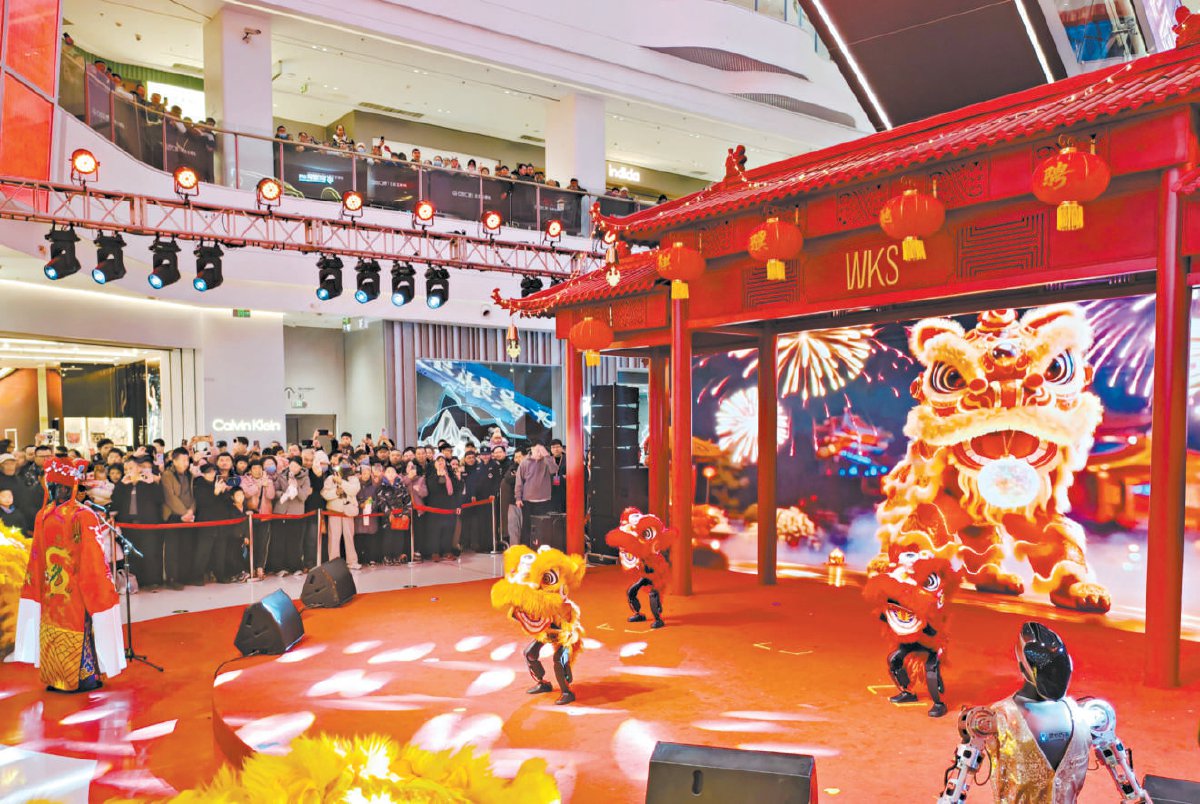
“机器人天团”陪您过大年
Xin Lang Cai Jing· 2026-02-19 06:34
今天上午,海淀新春科技庙会在五棵松万达正式开启,包括春晚同款在内的43款具身机器人组成的"机器人天团",从初三到初七,让您一趟看个够、玩个 够! 本报记者 王海欣 摄 ...
新春走基层丨这个春节,满眼都是机器人
Zhong Guo Xin Wen Wang· 2026-02-19 05:53
新春走基层丨这个春节,满眼都是机器人 中新网北京2月19日电(记者 吴家驹)这个春节,机器人几乎无处不在。 它们不仅在春晚舞台上"拉满"存在感,更悄然走进人类的生活,在各个领域大显身手。 一年前,宇树机器人在春晚舞台上转手绢,让所有人眼前一亮,但动作中仍带着一丝笨拙与滑稽。到了马年春晚,宇树机器人再次亮相,展现出的技术进步 令人惊叹。 在4分多钟的武术表演中,它们完成了连续花式翻桌跑酷、弹射空翻、单脚连续空翻等高难度动作,并实现集群快速跑位,多个动作是"全球首创"。宇树科 技创始人王兴兴表示,希望能在春晚舞台上让机器人挑战极限。 与此同时,机器人的身影已活跃在我们身边:北京一家新开业的智能餐厅里,机器人往来穿梭,有的忙着送餐,有的忙着送祝福;上海一家便利店前,机器 人用欢快流畅的街舞表演为开业聚拢人气;浙江金华市科技馆的新春主题活动上,机器人登台演绎传统婺剧;武侯祠成都大庙会上,机器人化身"赛博喜 神"精彩展演;广州白云迎春花市上,机器人穿着大花袄,踩着鼓点扭起秧歌。大年初一登上北京春晚的机器人摇滚乐队"灵宝乐队",在舞台上实现多机协 同、真实演奏,正月也将参加线下演出。 松延动力机器人搭档蔡明表演小品。截图 ...