医药生物

Search documents
A 股 TTM&全动态估值全景扫描(20251220):A 股估值收缩,商贸零售行业领涨
Western Securities· 2025-12-20 14:30
Core Conclusions - The overall valuation of A-shares has contracted this week, with the retail trade sector leading the gains. The Ministry of Commerce recently held a meeting to promote the "Three New" (new consumption formats, new models, new scenarios) pilot work, providing policy support for industry recovery. The concept of "reward economy" has emerged, further boosting sentiment in the consumption sector. Currently, the overall PB (LF) of the retail trade sector is at the historical 37.0 percentile, indicating significant room for valuation improvement [1][8]. Valuation Overview - This week, the overall PE (TTM) of A-shares decreased from 21.74 times last week to 21.73 times this week, while the PB (LF) remained stable at 1.77 times [10]. - The main board's PE (TTM) increased from 17.46 times last week to 17.54 times this week, and the PB (LF) rose from 1.48 times to 1.49 times [17]. - The ChiNext's PE (TTM) fell from 72.27 times to 71.32 times, and the PB (LF) decreased from 4.27 times to 4.21 times [19]. - The Sci-Tech Innovation Board's PE (TTM) dropped from 210.87 times to 205.59 times, and the PB (LF) fell from 5.17 times to 5.04 times [25]. Relative Valuation Analysis - The relative PE (TTM) of computing power infrastructure, excluding operators/resource categories, decreased from 4.47 times last week to 4.28 times this week, while the relative PB (LF) fell from 4.66 times to 4.46 times [28]. - In terms of static PE (TTM), major industries such as discretionary consumption, consumer staples, midstream manufacturing, cyclical, and midstream materials have absolute and relative valuations above the historical median, with discretionary consumption and consumer staples exceeding the historical 90th percentile [32]. - From the perspective of PB (LF), industries like resources, TMT, cyclical, and midstream manufacturing have absolute and relative valuations above the historical median, while discretionary consumption, midstream materials, financial services, services, and consumer staples are below the historical median [34]. Dynamic Valuation Insights - Analyzing the full dynamic PE, industries such as discretionary consumption, midstream manufacturing, cyclical, and midstream materials have absolute and relative valuations above the historical median, with discretionary consumption exceeding the historical 90th percentile [41]. - The current comparison of odds (PB historical percentiles) and win rates (ROE historical percentiles) indicates that industries like agriculture, public utilities, and oil and petrochemicals exhibit characteristics of low valuation and high profitability [59]. - The comparison of odds (full dynamic PE) and win rates (25-26 consensus expected net profit compound growth rate) shows that industries such as building materials, power equipment, media, and defense industry possess both low valuations and high performance growth [62]. ERP and Yield Spread - The non-financial ERP of A-shares increased from 0.87% last week to 0.89% this week, while the equity-debt yield spread improved from -0.12% to -0.05% [63]. - The full dynamic ERP of key non-financial companies in A-shares rose from 2.77% to 2.80% this week [70].
贵州百灵再遭ST;2连板华体科技:不涉及商业航天相关业务丨公告精选
2 1 Shi Ji Jing Ji Bao Dao· 2025-12-19 13:47
中原内配公告称,公司控股子公司中原内配(上海)电子科技有限公司与宁波普智未来机器人有限公司 签署了《战略合作框架协议》,双方就人形机器人相关业务达成战略合作意向。上海子公司将审核成为 宁波普智公司人形机器人关节模组的核心供应商,按约定向宁波普智公司供应合格产品,并在其相关业 务场景中优先部署应用宁波普智公司生产的人形机器人本体。合作协议为框架性协议,具体合作内容以 签订的具体项目合同为准,预计对公司2025年度财务状况和经营成果不构成重大影响。 公告显示,宁波普智公司是由均胜集团旗下宁波均普人工智能与人形机器人研究院有限公司与智元机器 人关联企业上海智元新创技术有限公司联合成立,公司致力于推动通用型机器人在智能制造场景的落地 应用,主营业务涵盖机器人本体研发、工业场景定制化解决方案及创新中心运营。目前宁波普智公司年 产能达3,000台人形及轮式机器人,是宁波首家实现该领域规模化量产的企业。 今日焦点 中原内配:控股子公司与宁波普智公司就人形机器人相关业务签署战略合作框架协议 贵州百灵:因2019年至2021年及2023年年报存在虚假记载被实施其他风险警示,股票简称将变更为"ST 百灵" 贵州百灵公告称,公司及 ...

胜通能源本周涨幅最大,累计上涨61.06%
Xin Lang Cai Jing· 2025-12-19 13:25
本周超2900股上涨,24股涨幅超30%。其中,涨幅最大的是胜通能源,本周累计上涨61.06%;华人健 康、百大集团、西测测试本周累计涨幅均超50%。本周涨超30%的个股中,按所属行业统计,商贸零 售、医药生物行业均有3股上榜。本周累计下跌的个股中,14股跌幅在20%以上,广道退累计跌超 40%,中源家居、*ST立方跌幅均在25%以上。(证券时报) ...
北交所市场点评:缩量微跌,关注商业航天及消费主线
Western Securities· 2025-12-19 11:59
Investment Rating - The report suggests a focus on sectors driven by policies and demand, particularly in commercial aerospace, healthcare, and energy storage [3][29]. Core Insights - The market experienced a slight decline with the North Exchange A-share trading volume reaching 21.53 billion yuan, down by 1.836 billion yuan from the previous trading day, and the North Exchange 50 Index closing at 1431.71, down 0.51% [1][8]. - The report highlights a significant divergence in stock performance, with sectors exhibiting new productive capabilities showing relative resilience [3]. - Commercial aerospace and satellite internet concepts emerged as market focal points, driven by recent developments such as the establishment of the "Commercial Aerospace Measurement and Control and Satellite Application Alliance" and Google's announcement of a space data center plan [3][21]. - The healthcare sector saw increased activity, particularly in pharmaceutical companies like Lude Medical, boosted by rising demand during the flu season and news regarding Ant Group's AI health application [3][21]. Summary by Sections Market Review - On December 18, the North Exchange A-share trading volume was 21.53 billion yuan, a decrease of 1.836 billion yuan from the previous day, with the North Exchange 50 Index closing at 1431.71, down 0.51% [1][8]. - Among 286 companies listed, 97 saw an increase, 5 remained flat, and 184 experienced a decline [1][18]. Important News - The State Administration for Market Regulation emphasized the need to address "involutionary" competition and promote a market order characterized by quality and fair pricing [2]. - The introduction of humanoid robots in CATL's battery production line has reportedly tripled daily output compared to manual labor [2][21]. Key Company Announcements - Ruixing Co. announced plans to participate in a public auction for a 10% stake in Weifang China Resources Gas Co., with a starting price of 14.125 million yuan [22]. - Chicheng Co. plans to use up to 30 million yuan of idle raised funds for cash management [24].
汽车、机械设备行业主力资金净流入均超20亿元
Zheng Quan Shi Bao Wang· 2025-12-19 11:45
人民财讯12月19日电,据证券时报·数据宝统计,今日沪深两市主力资金净流出44.44亿元。从行业来 看,申万一级行业中有12个行业主力资金净流入,其中汽车、机械设备行业主力资金净流入均超20亿 元,居前;有色金属、传媒、商贸零售、基础化工等行业主力资金净流入金额均超3亿元。 19个主力资金净流出的行业中,电子、医药生物、交通运输行业主力资金净流出金额居前,分别为 29.79亿元、25.45亿元、10.31亿元;食品饮料、国防军工、轻工制造、非银金融、通信行业主力资金净 流出金额均超5亿元。 (原标题:汽车、机械设备行业主力资金净流入均超20亿元) ...
【19日资金路线图】两市主力资金净流出超40亿元 有色金属等行业实现净流入
Zheng Quan Shi Bao· 2025-12-19 11:29
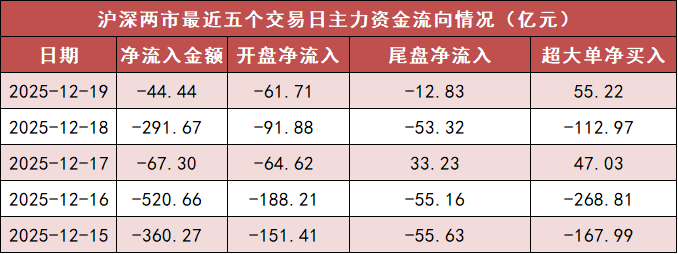
12月19日,A股市场整体上涨。 1.两市主力资金净流出超40亿元 4.主力资金净流入居前20股 今日沪深两市主力资金开盘净流出61.71亿元,尾盘净流出12.83亿元,两市全天主力资金净流出44.44亿元。 | | | 沪深两市最近五个交易日主力资金流向情况(亿元) | | | | --- | --- | --- | --- | --- | | 日期 | | 净流入金额 开盘净流入 | 尾盘净流入 | 超大单净买入 | | 2025-12-19 | -44.44 | -61. 71 | -12. 83 | 55. 22 | | 2025-12-18 | -291. 67 | -91. 88 | -53. 32 | -112. 97 | | 2025-12-17 | -67. 30 | -64. 62 | 33. 23 | 47. 03 | | 2025-12-16 | -520. 66 | -188. 21 | -55.16 | -268. 81 | | 2025-12-15 | -360. 27 | -151.41 | -55. 63 | -167.99 | 2.沪深300今日主力资金净流入近10亿元 沪 ...

【19日资金路线图】两市主力资金净流出超40亿元 有色金属等行业实现净流入
证券时报· 2025-12-19 11:28
12月19日,A股市场整体上涨。 截至收盘,上证指数收报3890.45点,上涨0.36%;深证成指收报13140.21点,上涨0.66%;创业板指收报3122.24点,上涨0.49%。两市合计成交 17259.15亿元,较上一交易日增加704.32亿元。 1. 两市主力资金净流出超40亿元 今日沪深两市主力资金开盘净流出61.71亿元,尾盘净流出12.83亿元,两市全天主力资金净流出44.44亿元。 | | | 沪深两市最近五个交易日主力资金流向情况(亿元) | | | | --- | --- | --- | --- | --- | | 日期 | | 净流入金额 开盘净流入 | 尾盘净流入 | 超大单净买入 | | 2025-12-19 | -44 44 | -61.71 | -12. 83 | 55. 22 | | 2025-12-18 | -291. 67 | -91.88 | -53. 32 | -112. 97 | | 2025-12-17 | -67. 30 | -64. 62 | 33. 23 | 47.03 | | 2025-12-16 | -520. 66 | -188. 21 | -55.1 ...

主力资金丨尾盘主力资金抢筹6股
Zheng Quan Shi Bao Wang· 2025-12-19 11:12
(原标题:主力资金丨尾盘主力资金抢筹6股) 汽车、机械设备行业主力资金净流入均超20亿元。 A股三大指数今日(12月19日)集体上涨,行业板块呈现普涨态势,房地产服务、商业百货、包装材 料、食品饮料、纺织服装、家用轻工、汽车服务、房地产开发板块涨幅居前,贵金属、半导体板块跌幅 居前。 据证券时报·数据宝统计,今日沪深两市主力资金净流出44.44亿元。从行业来看,申万一级行业中有12 个行业主力资金净流入,其中汽车、机械设备行业主力资金净流入均超20亿元,居前;有色金属、传 媒、商贸零售、基础化工等行业主力资金净流入金额均超3亿元。 19个主力资金净流出的行业中,电子、医药生物、交通运输行业主力资金净流出金额居前,分别为 29.79亿元、25.45亿元、10.31亿元;食品饮料、国防军工、轻工制造、非银金融、通信行业主力资金净 流出金额均超5亿元。 据数据宝统计,中际旭创、胜宏科技、新易盛、美年健康、德明利等个股尾盘主力资金净流出居前。 山子高科主力资金净流入10.59亿元,该股今日也涨停,龙虎榜数据显示,上榜营业部席位全天成交7.25 亿元,合计净买入2.08亿元。具体来看,机构合计净买入5811.53万元; ...

数据复盘丨免税、海南自贸等概念走强 83股获主力资金净流入超1亿元
Zheng Quan Shi Bao Wang· 2025-12-19 11:10
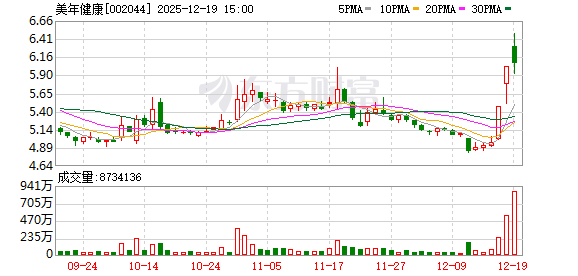
Market Overview - On December 19, the Shanghai Composite Index closed at 3890.45 points, up 0.36%, with a trading volume of 738.1 billion yuan. The Shenzhen Component Index closed at 13140.21 points, up 0.66%, with a trading volume of 987.849 billion yuan. The ChiNext Index closed at 3122.24 points, up 0.49%, with a trading volume of 444.704 billion yuan. The total trading volume of both markets was 1.725949 trillion yuan, an increase of 70.462 billion yuan compared to the previous trading day [1]. Sector Performance - Various sectors showed positive performance, with retail, real estate, light industry manufacturing, environmental protection, education, steel, textile and apparel, and automotive sectors leading the gains. Concepts such as duty-free, Hainan Free Trade Zone, rental and sale rights, dairy, beer, community group buying, superconductors, and controllable nuclear fusion were notably active. Conversely, banking, precious metals, and electronics sectors experienced declines [2]. Fund Flow Analysis - The main funds in the Shanghai and Shenzhen markets experienced a net outflow of 4.444 billion yuan, with the ChiNext seeing a net outflow of 3.881 billion yuan. However, the CSI 300 index saw a net inflow of 0.988 billion yuan, and the Sci-Tech Innovation Board had a net inflow of 0.925 billion yuan. Among the 31 primary industries, 12 sectors had net inflows, with the automotive sector leading at 2.348 billion yuan [3]. Individual Stock Performance - A total of 2077 stocks saw net inflows, with 83 stocks receiving over 1 billion yuan in net inflows. The stock with the highest net inflow was Xue Ren Group, with 1.379 billion yuan, followed by Shan Zi Gao Ke, Aerospace Development, N You Xun, Gan Feng Lithium, and Salt Lake Co., with net inflows of 1.059 billion yuan, 0.928 billion yuan, 0.748 billion yuan, 0.641 billion yuan, and 0.473 billion yuan respectively [5]. Major Sell-offs - There were 3085 stocks that experienced net sell-offs, with 72 stocks seeing over 1 billion yuan in net outflows. The stock with the highest net outflow was Meinian Health, with 0.942 billion yuan, followed by Saiwei Electronics, Shunhao Co., Shenghong Technology, and Xiangnan Chip, with net outflows of 0.719 billion yuan, 0.545 billion yuan, 0.500 billion yuan, and 0.481 billion yuan respectively [7]. Institutional Activity - According to the post-market data, institutional investors had a net sell of approximately 27.7851 million yuan, with 11 stocks seeing net purchases and 12 stocks experiencing net sales. The stock with the highest net purchase was Aerospace Intelligence, with 90.6183 million yuan, followed by Shan Zi Gao Ke, West Materials, and Hua Ren Health [9][10].





医药生物行业资金流出榜:美年健康等6股净流出资金超5000万元
Zheng Quan Shi Bao Wang· 2025-12-19 09:43
沪指12月19日上涨0.36%,申万所属行业中,今日上涨的有28个,涨幅居前的行业为商贸零售、综合, 涨幅分别为3.66%、2.22%。医药生物行业今日上涨1.27%。跌幅居前的行业为银行、电子、煤炭,跌幅 分别为0.44%、0.29%、0.29%。 资金面上看,两市主力资金全天净流入70.25亿元,今日有18个行业主力资金净流入,机械设备行业主 力资金净流入规模居首,该行业今日上涨1.18%,全天净流入资金38.84亿元,其次是汽车行业,日涨幅 为1.47%,净流入资金为35.17亿元。 主力资金净流出的行业有13个,电子行业主力资金净流出规模居首,全天净流出资金46.40亿元,其次 是医药生物行业,净流出资金为15.79亿元,净流出资金较多的还有银行、国防军工、交通运输等行 业。 | 代码 | 简称 | 今日涨跌幅(%) | 今日换手率(%) | 主力资金流量(万元) | | --- | --- | --- | --- | --- | | 603259 | 药明康德 | 2.08 | 1.88 | 40193.37 | | 000566 | 海南海药 | 10.03 | 11.37 | 16469.77 ...