
电力

Search documents
帮主郑重收评:沪指红盘收官,稀有金属掀涨停潮,下周策略一次说透
Sou Hu Cai Jing· 2026-02-27 09:42
Market Overview - The A-share market is experiencing a structural divergence, with the Shanghai Composite Index rising by 0.41%, while the Shenzhen Component fell by 0.06% and the ChiNext Index dropped by 1.04% [1] - The total trading volume was over 2.5 trillion yuan, a decrease of more than 500 billion yuan compared to the previous trading day, indicating a focus on individual stock performance rather than index gains [1] Key Sectors - The rare metals sector, including companies like Zhangyuan Tungsten, Yunnan Zhenyi, and Northern Rare Earth, has seen significant gains, driven by supply-demand imbalances and rising product prices [3][4] - Power stocks also performed well, with companies like Jiawei New Energy hitting the daily limit, supported by economic recovery expectations and low valuations [4] - The computing power leasing sector, including companies like Yuntian Lifei and Tuo Wei Information, surged due to a historic increase in AI model usage in China, surpassing North America [4] Declining Sectors - Sectors such as paper, PCB, CPO, and storage chips faced declines, particularly in companies reliant on overseas orders, which were affected by Nvidia's stock price drop following its earnings report [5][7] Investment Strategy - Investors are advised not to chase high prices, especially in the rare metals sector that has recently hit historical highs, and to wait for pullbacks to identify strong fundamentals [6][8] - For traditional energy sectors like electricity and coal, the recommendation is to continue buying on dips due to their defensive attributes and high dividend yields [6] - Caution is advised in the computing hardware sector, with a focus on domestic, self-sufficient computing power applications rather than those dependent on foreign orders [7] - Emphasis on maintaining a balanced portfolio with a recommended position size of 50-70% to manage risks effectively in a structurally divergent market [7][8]


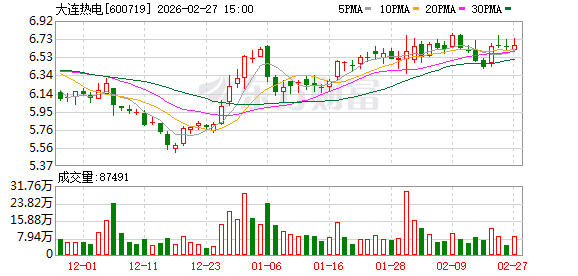
大连热电:公司始终会围绕发展战略,审慎研究各类有利于提升公司长期价值的事项
Zheng Quan Ri Bao· 2026-02-27 09:38
Group 1 - The company, Dalian Thermal Power, stated that it will continue to focus on its development strategy and carefully study various matters that could enhance its long-term value [2] - The company emphasized that any related updates will be communicated through official announcements [2]

HALO交易爆发,抢占“AI电荒”风口!电力ETF华宝(159146),一键布局AI能源机遇
Xin Lang Cai Jing· 2026-02-27 09:37
Group 1: Market Trends - The "HALO" trading strategy, which stands for "Heavy Assets, Low Obsolescence," is gaining traction as funds flow into tangible assets in the AI era, with Goldman Sachs and Morgan Stanley highlighting these high-barrier assets as the best hedge against AI disruption [1][2] - The energy and electricity sectors are expected to see new opportunities under the "HALO" trading strategy, as physical assets become indispensable and AI development continues to increase electricity demand, making them a defensive investment [1] Group 2: ETF and Index Composition - The ETF tracking the electricity sector includes various power generation methods, with weights of 40.81% for thermal power, 24.81% for hydro power, 14.25% for wind power, 11.83% for nuclear power, and 6.87% for solar power, combining both dividend and growth attributes [5][12] - The top ten weighted stocks in the index include leading companies such as Changjiang Electric Power, China Nuclear Power, and Three Gorges Energy, collectively accounting for 52.07% of the index [6][13] Group 3: Valuation Insights - The current valuation of the electricity index is at a historical low, with a price-to-earnings ratio (PE-TTM) of approximately 17 times as of December 31, 2025, which is below most of the valuation levels over the past decade, indicating a certain safety margin [8][16]



马年4连阳!“HALO交易逻辑”火爆,电力ETF华宝(159146)连创上市新高
Mei Ri Jing Ji Xin Wen· 2026-02-27 09:35
Group 1 - The electric power sector continues to experience strong growth, with stocks like Yunnan Energy Holdings, Jiangxi Energy, and Huayin Power hitting the daily limit up [1] - The electric power ETF managed by Huabao (159146) saw a significant increase of over 1.8%, reaching a new high since its listing, marking four consecutive days of gains [1] - The fund manager of the electric power ETF attributes the sector's performance to "HALO trading," where physical assets like energy and electricity are seen as essential amid the rise of AI, which is expected to increase electricity demand [1] Group 2 - The electric power ETF focuses on public utility sectors, including thermal, hydro, wind, nuclear, and photovoltaic power, combining both dividend and growth attributes [1] - The concentration of leading stocks in the electric power sector is high, and the sector is expected to benefit from the growth in AI computing power and favorable electricity reform policies [1] - The electric power industry presents investment opportunities that can be easily accessed through the ETF, allowing investors to capitalize on the sector's development [1]
套现1100亿!李嘉诚连夜跑路!
商业洞察· 2026-02-27 09:22
Core Viewpoint - The article discusses the recent rapid divestment of UK Power Networks by Li Ka-shing, following the forced takeover of his port operations in Panama, highlighting the increasing political risks that can undermine business stability and the importance of national backing for capital investments [2][5][19]. Group 1: Recent Transactions - On February 26, 2026, Li Ka-shing's companies announced the sale of UK Power Networks for HKD 110 billion [2]. - This sale comes after a significant drop in asset value, as the same asset was valued at GBP 15 billion just four years prior [4]. - The sale reflects a clear intention to liquidate assets amid rising political risks [4][19]. Group 2: Political Risks and Asset Control - On February 23, 2026, the Panamanian government forcibly took control of two ports operated by Li Ka-shing's company, marking a significant political intervention [5][8]. - The ports are strategically located at both ends of the Panama Canal, which Li Ka-shing had managed since 1997 [8]. - This incident illustrates the vulnerability of even high-quality assets to political decisions, undermining the belief in stable commercial rules [19][21]. Group 3: Historical Context and Business Philosophy - Li Ka-shing was once the largest foreign investor in the UK, controlling significant portions of the energy and telecommunications sectors [10][11]. - His investment strategy was based on the belief that adhering to commercial rules would ensure safety and respect in any market [26]. - However, recent geopolitical shifts, including Brexit and tightening foreign investment regulations, have eroded this belief [18][27]. Group 4: Implications of Recent Events - The forced takeover in Panama and the subsequent asset sale in the UK signify a dramatic shift in Li Ka-shing's business landscape, suggesting that capital is no longer free from national influences [22][39]. - The article posits that without a strong national backing, even substantial contracts and assets can become vulnerable in the face of political power [35][41]. - The narrative concludes that the era of Li Ka-shing's business philosophy, which thrived on global capital mobility, is coming to an end [39][40].

套现1100亿!李嘉诚怕了,亚洲战略的冲锋号已吹响
Sou Hu Cai Jing· 2026-02-27 09:21
Core Viewpoint - Li Ka-shing's family is selling its UK Power Networks Holdings Limited for a total cash amount of HKD 110.75 billion, marking a significant shift from global expansion to risk reduction [1][3]. Group 1: Sale Details - The sale involves a 100% stake in UK Power Networks, with Cheung Kong Infrastructure and Power Assets each receiving HKD 44.3 billion, while CK Hutchison will receive HKD 22.15 billion [1]. - The estimated total value of the transaction is GBP 16.838 billion, which shows a significant increase from the previous negotiation valuation of GBP 15 billion in early 2022 [3]. Group 2: Historical Context - Li Ka-shing's investments in the UK have been extensive, totaling over RMB 255.5 billion, covering various sectors including electricity, water, gas, telecommunications, and ports [4]. - The UK Power Networks is described as a "cash cow" and a "crown jewel," controlling a power distribution network of approximately 192,000 kilometers, serving over 8.5 million households and businesses [3]. Group 3: Strategic Shift - The sale of UK Power Networks is part of a broader trend of divestments by Li Ka-shing, which includes selling telecom infrastructure in Europe for EUR 10 billion and other significant assets in London and Hong Kong [7][8]. - The total cash generated from these divestments over the past five years exceeds HKD 350 billion, indicating a strategic retreat from European markets [10]. Group 4: Future Focus - Li Ka-shing is shifting focus from Europe to Southeast Asia, with investments in port infrastructure and technology startups, indicating a strategic pivot rather than a complete withdrawal from overseas markets [10][11]. - The Southeast Asian market presents potential challenges, including market fragmentation, regulatory uncertainties, and increased competition, which will test the precision and risk management of Li Ka-shing's future investments [13].
信义能源(03868)发布年度业绩,股东应占溢利10.11亿元 同比增加27.79%
智通财经网· 2026-02-27 09:13
Core Viewpoint - Xinyi Energy (03868) reported its annual results for the year ending December 31, 2025, showing a slight increase in revenue and a significant rise in profit attributable to equity holders [1] Financial Performance - The company achieved revenue of RMB 2.453 billion, an increase of 0.53% year-on-year [1] - Profit attributable to equity holders was RMB 1.011 billion, reflecting a year-on-year increase of 27.79% [1] - Basic earnings per share were RMB 0.12, with a proposed final dividend of HKD 0.036 per share [1] Revenue Breakdown - Compared to the fiscal year 2024, revenue from electricity sales and net contributions from electricity price adjustments increased by 4.4% to RMB 1.528 billion, while another segment decreased by 5.1% to RMB 0.916 billion [1] - The overall revenue increase was primarily due to contributions from the 2024 and 2025 portfolios, although it was offset by grid consumption restrictions and an increase in the frequency and volume of market-based electricity transactions during the year [1]
广州入选国家首批新型电力系统建设试点城市 将探索超大城市绿色低碳转型新路径
Zhong Guo Fa Zhan Wang· 2026-02-27 09:13
Group 1 - The National Energy Administration of China has officially announced the first batch of cities and projects for the new power system construction capability enhancement pilot, with Guangzhou being selected as a pilot city [1] - Guangzhou is the only super-large city among the ten pilot cities and is the only city in Guangdong Province to be selected, highlighting its significant role in energy transition and power system upgrades [1][2] - The city has a solid foundation for energy transformation, with distributed renewable energy installed capacity exceeding 3.9 million kilowatts and a strong local power grid that maintains world-leading reliability [2] Group 2 - Guangzhou has established the first city-level virtual power plant platform in China in 2021 and is recognized for its rich scenarios in virtual power plants, also being a pilot city for vehicle-grid interaction [2] - The city is home to the only national manufacturing innovation center for new energy storage, providing a strong innovation engine for industry development [2] - The active electricity market in Guangzhou, with the largest scale of electricity users, trading volume, and number of electricity sales companies in the southern region, supports the construction of the new power system [2] Group 3 - The Southern Power Grid Guangdong Guangzhou Power Supply Bureau is actively promoting the construction of the new power system and aims to use the pilot project as an opportunity to demonstrate new technologies and products [3] - The bureau is committed to serving the "Electricity Bay Area" construction and providing a "Guangzhou demonstration" for the green and low-carbon transition of similar super-large cities nationwide [3]
涪陵电力今日涨停,中信证券上海徐汇区漕溪北路证券营业部净卖出1.64亿元
Xin Lang Cai Jing· 2026-02-27 09:03
Group 1 - Fuling Power experienced a trading limit increase today, with a transaction amount of 1.693 billion yuan and a turnover rate of 8.49% [1] - The post-market dragon and tiger list indicates that the Shanghai-Hong Kong Stock Connect special seat bought 134 million yuan and sold 61.816 million yuan [1] - Two institutional special seats net bought 153 million yuan, while CITIC Securities' Shanghai Xuhui District Caoxi North Road Securities Office net sold 164 million yuan [1]


中观洞察系列之一:碳排放双控制度落地,影响几何?
CMS· 2026-02-27 09:02
Group 1: Policy Transition - The transition from energy consumption dual control to carbon emission dual control is driven by the need for more precise governance and alignment with carbon neutrality goals[9] - The new carbon emission control system aims to replace the broad energy consumption metrics that previously included non-fossil energy sources, which hindered renewable energy development[10] - By 2026, local government reports will largely phase out references to energy consumption reduction per GDP, focusing instead on carbon intensity[7] Group 2: Implementation and Targets - To meet the 2030 target of reducing carbon emissions by over 65% from 2005 levels, an average annual reduction of approximately 5% is required from 2025 to 2030, exceeding the original plan of 3.7%[12] - During the 12th Five-Year Plan, carbon intensity decreased by 20%, surpassing the planned 17% reduction, demonstrating the effectiveness of stringent assessment mechanisms[26] - The carbon emission dual control system will focus on key industries such as electricity, steel, chemicals, and construction materials, which are identified as high carbon emitters[31] Group 3: Economic Impact and Industry Opportunities - The implementation of carbon emission controls is expected to create structural adjustment pressures on production, potentially leading to a rise in the Producer Price Index (PPI)[33] - Historical data indicates that approximately 70% of industries reduced carbon emissions during the previous assessment period from 2014 to 2017, coinciding with a recovery in PPI[33] - Industries with high carbon emissions, such as steel and non-metallic minerals, show a significant negative price elasticity, suggesting that supply reductions will support price increases[34]