
医美

Search documents
新氧(SY):动态点评报告:2025Q2美容治疗收入超指引上限,超70%新客来自私域及老带新
Guohai Securities· 2025-09-01 05:39
Investment Rating - The report assigns an "Accumulate" rating for the company, marking its first coverage [2]. Core Insights - In Q2 2025, the company's beauty treatment revenue exceeded guidance, with over 70% of new customers acquired through private channels and referrals [5]. - The company reported total revenue of 378.7 million yuan, a year-on-year decrease of 7.0%, and a net loss of 36 million yuan compared to a net profit of 18.9 million yuan in the same period last year [5]. - The beauty treatment service revenue reached 144.4 million yuan, surpassing the previous guidance of 120-140 million yuan, with a year-on-year growth of 426.1% driven by the expansion of beauty centers [5]. - The company anticipates Q3 2025 beauty treatment service revenue to be between 150-170 million yuan, representing a year-on-year growth of 230.5% to 274.6% [5]. - The company plans to expand its beauty center network to 50 locations by the end of the year, with over 70% of new customers coming from private channels and referrals, resulting in a low customer acquisition cost [5]. Financial Summary - The company forecasts revenues of 1.567 billion yuan, 2.751 billion yuan, and 4.366 billion yuan for 2025, 2026, and 2027 respectively, with year-on-year growth rates of 7%, 76%, and 59% [7]. - The projected net profit for 2025 is a loss of 148 million yuan, followed by profits of 36 million yuan and 134 million yuan in 2026 and 2027, reflecting year-on-year growth rates of 75% and 124% [7]. - The report indicates a significant improvement in gross margin for the beauty treatment business, reaching 24.25% in Q2 2025, an increase of 5.5 percentage points quarter-on-quarter [5].

四环医药与深原质药联合成立AI研发公司 探索开发AI驱动的新型医美产品
Zheng Quan Shi Bao Wang· 2025-09-01 04:23
Group 1 - The core viewpoint of the article is that Four Seasons Pharmaceutical has signed a framework agreement with Deep Origin Pharmaceutical Biotechnology (Beijing) Co., Ltd. to promote the application of artificial intelligence (AI) in the research and development of medical beauty products [1] - The collaboration aims to establish an AI research and development company led by Four Seasons Pharmaceutical, focusing on the exploration of AI-driven new medical beauty product development [1] - This initiative marks a significant step in the strategic layout of the "AI + Medical Beauty" innovation track for the company [1]
四环医药(0460.HK):创新药医美齐爆发,从扭亏到价值兑现的跨越之路
Ge Long Hui· 2025-09-01 00:13
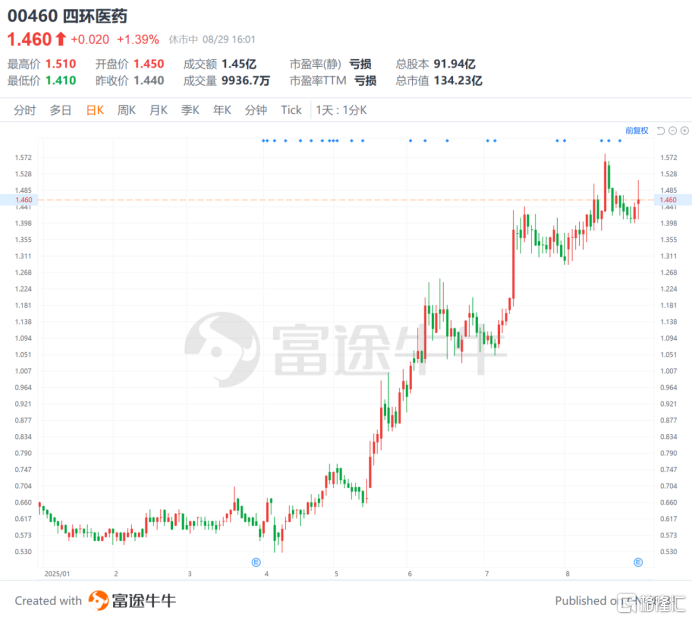
Core Insights - The company has reported a significant growth in both its medical aesthetics and innovative pharmaceutical businesses, with multiple key products receiving approval for commercialization [1][4][10] - The total revenue for the first half of the year reached approximately 1.146 billion RMB, representing a year-on-year increase of about 20.7%, while the profit attributable to shareholders was approximately 103 million RMB, marking a successful turnaround from losses [2][4] - The company declared an interim cash dividend of 0.99 RMB per share, highlighting its strong return capability since its IPO in 2010, with a total of 33 dividends amounting to approximately 7.5 billion RMB by the end of 2024 [2] Innovative Pharmaceutical Business - The innovative pharmaceutical segment has seen explosive growth, with revenues from innovative drugs and other pharmaceuticals reaching 58.2 million RMB, a year-on-year increase of 96.6%, driven primarily by a surge in sales of diabetes medications [4][6] - The company has optimized its business structure, allowing for efficient conversion of research and development results into commercial success, with R&D expenses decreasing by 21.9% to 153 million RMB [6][4] - Key products such as the anti-tumor drug Pyrocilin and the proton pump inhibitor Annelaz sodium have been approved and are expected to contribute significantly to revenue growth [6][7] Medical Aesthetics Business - The medical aesthetics segment achieved revenues of approximately 580 million RMB, reflecting a year-on-year growth of 81.3%, supported by strategic partnerships and an upgraded marketing strategy [10][11] - The company has launched several self-developed products, making it the first in the industry to offer a comprehensive range of aesthetic solutions, which is expected to drive further revenue growth [10][11] - A robust marketing network has been established, covering over 6,800 medical aesthetic institutions, ensuring rapid product distribution and market penetration [11] Strategic Outlook - The company has demonstrated strong execution capabilities and strategic foresight in both the innovative pharmaceutical and medical aesthetics sectors, with a focus on long-term growth [13] - With a cash reserve of nearly 3.9 billion RMB, the company is well-positioned for continued innovation and market expansion [13] - The market is beginning to recognize the company's intrinsic value, as evidenced by a stock price increase of over 150% within the year, indicating a potential for valuation re-rating [13]

朗姿股份(002612):主营业务承压 预计轻医美新模式助力业绩增长
Xin Lang Cai Jing· 2025-08-30 01:03
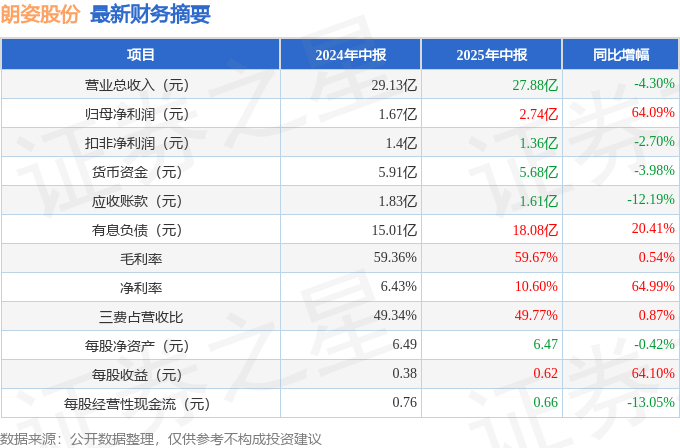
Group 1 - The company reported its H1 2025 results, with revenue of 2.788 billion yuan, a decrease of 4.3% year-on-year, and a net profit attributable to shareholders of 274 million yuan, an increase of 64.1% year-on-year [1] - In Q2 2025, revenue was 1.389 billion yuan, a slight decrease of 0.5% year-on-year, while net profit attributable to shareholders surged by 134% to 179 million yuan [1] - The gross margin for H1 2025 remained stable at 59.67%, while the net profit margin decreased to 10.6%, down 4.4 percentage points year-on-year [1] Group 2 - The medical beauty segment generated revenue of 1.333 billion yuan in H1 2025, a decline of 6.1%, accounting for 47.8% of total revenue, with a gross margin of 54.54% [2] - The fashion women's wear business reported revenue of 988 million yuan, a decrease of 2.42%, with a gross margin of 65.15%, and online sales accounted for 46.3% of total revenue [2] - The green baby and child segment generated revenue of 435 million yuan, a decline of 3.43%, with a gross margin of 62.4% [2] Group 3 - The company is driven by three main segments: fashion women's wear, green baby and child, and medical beauty, with plans for continuous expansion through self-built and acquisition strategies [3] - The competitive landscape in the medical beauty sector is fragmented, with expectations for consolidation towards leading players, supported by the company's 1+N strategy [3] - The company has adjusted its profit forecast for 2025 to 370 million yuan, up from the previous estimate of 270 million yuan, with projected net profits for 2026 and 2027 at 290 million yuan and 310 million yuan, respectively [3]

朗姿股份2025年中报简析:净利润同比增长64.09%
Zheng Quan Zhi Xing· 2025-08-29 22:59
Financial Performance - The company reported a net profit of 274 million yuan for the first half of 2025, representing a year-on-year increase of 64.09% [1] - Total operating revenue for the same period was 2.788 billion yuan, a decrease of 4.3% compared to the previous year [1] - The gross profit margin was 59.67%, up by 0.54% year-on-year, while the net profit margin increased to 10.6%, a rise of 64.99% [1] Quarterly Analysis - In Q2 2025, the company achieved an operating revenue of 1.389 billion yuan, down 0.53% year-on-year, but the net profit surged by 134.03% to 179 million yuan [1] - The company's earnings per share for the first half of 2025 was 0.62 yuan, reflecting a 64.1% increase year-on-year [1] Cost and Expenses - Total expenses (selling, administrative, and financial) amounted to 1.388 billion yuan, accounting for 49.77% of revenue, which is an increase of 0.87% year-on-year [1] - The company’s cash flow per share was 0.66 yuan, down 13.05% compared to the previous year [1] Debt and Financial Ratios - The company’s interest-bearing debt increased by 20.41% to 1.808 billion yuan [1] - The return on invested capital (ROIC) for the previous year was 6.34%, indicating a generally weak capital return [3] Brand Performance - The Milan Baiyu brand reported a revenue of 302.62 million yuan in Q1 2025, a decrease of 8.74% year-on-year, with a net profit decline of 50.19% [4] - The Jingfu Medical brand saw a revenue increase of 1.13% to 125.20 million yuan, with a significant net profit growth of 633.07% [4] - Other brands like Hancheng and Wuhan Wuzhou experienced revenue declines, with net profits also decreasing significantly [5]
巨子生物(2367.HK):可复美品牌保持较快增长 医美审批进程加快
Ge Long Hui· 2025-08-29 18:44
Core Viewpoint - The company reported strong revenue and profit growth in the first half of 2025, driven by the performance of its brands and online sales channels [1][4]. Financial Performance - In 1H2025, the company achieved revenue of 3.11 billion yuan, a year-on-year increase of 22.5% [1] - The net profit attributable to shareholders was 1.18 billion yuan, up 20.2% year-on-year [1] - Adjusted net profit reached 1.21 billion yuan, reflecting a 17.4% increase compared to the previous year [1] Product Performance - The company's professional skincare products generated revenue of 3.10 billion yuan, with a growth rate of 22.5% [1] - Efficacy skincare products accounted for 2.41 billion yuan in revenue, growing by 24.2% and representing 77.4% of total revenue [1] - The medical dressings segment generated 690 million yuan, with a year-on-year growth of 17.1% [1] - The company's brands, 可复美 and 可丽金, reported revenues of 2.54 billion yuan and 500 million yuan, respectively, with growth rates of 22.7% and 26.9% [1][2] Sales Channels - Direct-to-consumer (DTC) online sales reached 1.82 billion yuan, up 13.3% year-on-year [2] - E-commerce platform sales surged to 390 million yuan, a significant increase of 133.6% [2] - Offline direct sales grew to 120 million yuan, reflecting a 74.3% increase [2] - The company has expanded its offline presence with 24 brand stores across various cities by the end of 1H2025 [3] Market Expansion - 可复美 has entered the Southeast Asian market by partnering with Watsons in Malaysia [3] - The company continues to enhance its online multi-platform strategy and refine operations, benefiting from the rapid expansion of beauty categories on platforms like JD.com [3] Profitability and Cost Management - The company's gross margin slightly decreased by 0.7 percentage points to 81.7%, attributed to changes in product mix and a decline in the proportion of high-margin medical dressing revenue [3] - Sales, management, and R&D expense ratios were 34.0%, 2.7%, and 1.3%, respectively, with a decrease in sales expense ratio due to a higher proportion of low-cost channels [3] Future Outlook - The company anticipates accelerated growth in the second half of the year, driven by increased brand marketing efforts and the potential approval of new medical aesthetic products [4] - The adjusted net profit forecasts for 2025-2027 are 2.59 billion, 3.45 billion, and 4.48 billion yuan, respectively [4]
巨子生物(02367):25H1业绩快速成长,龙头优势与韧性彰显
HTSC· 2025-08-29 11:10
Investment Rating - The investment rating for the company is maintained as "Buy" with a target price of HKD 82.50 [1]. Core Insights - The company demonstrated rapid growth in H1 2025, achieving revenue of RMB 3.113 billion, a year-on-year increase of 22.5%, and a net profit of RMB 1.18 billion, up 20.6% year-on-year, with a net profit margin of 37.98% [5]. - The company is focusing on long-term strategies, maintaining stable business operations, and ensuring both revenue and profit growth while keeping profitability relatively stable [5]. - The company is expanding the application boundaries of recombinant collagen through research and development, enhancing brand value, and iterating quality products to create a long-term growth matrix [5][6]. Financial Performance - For H1 2025, the company's revenue from its main brand, Kefu Mei, was RMB 2.542 billion, a year-on-year increase of 22.7% [6]. - The company reported a gross margin of 81.68%, with a sales and distribution expense ratio of 34.01%, reflecting optimization in sales expenses [8]. - The company expects to maintain its profit forecast, projecting net profits of RMB 2.6 billion, RMB 3.203 billion, and RMB 3.812 billion for 2025, 2026, and 2027 respectively, with corresponding EPS of RMB 2.53, RMB 3.11, and RMB 3.71 [9]. Market Position and Growth Potential - The company has successfully expanded its offline channels, entering approximately 1,700 public/private hospitals and clinics, and over 13,000 chain pharmacies [7]. - The direct sales through e-commerce platforms showed significant growth, achieving revenue of RMB 391 million, a year-on-year increase of 133.6% [7]. - The company is also exploring international markets, having entered Watsons in Malaysia, which is expected to provide new growth opportunities [7]. Valuation Metrics - The company is valued at a market capitalization of HKD 55.955 billion, with a closing price of HKD 52.25 as of August 28 [1]. - The projected PE ratios for the upcoming years are 24.23 for 2025, 19.22 for 2026, and 15.60 for 2027, indicating a favorable valuation compared to peers [4][11].
朗姿股份上半年实现营业收入27.88亿元 净利润同比增长64.09%
Zheng Quan Ri Bao· 2025-08-29 09:13
Group 1 - The core viewpoint of the report indicates that Langzi Co., Ltd. experienced a decline in revenue but a significant increase in net profit for the first half of 2025, with total revenue of 2.788 billion yuan, down 4.30% year-on-year, and net profit attributable to shareholders of 274 million yuan, up 64.09% year-on-year [2] - The fashion women's clothing segment enhanced brand strength through new product launches and digital transformation initiatives, achieving a total online payment amount of 1.65 billion yuan, a year-on-year increase of 30% [2] - In the medical aesthetics sector, the company focused on safety and quality, with 8 medical institutions receiving TUV-SQS certification and 5 obtaining 5A hospital qualifications, while also establishing 7 medical aesthetics acquisition funds with a total scale of 2.837 billion yuan [3][4] Group 2 - The company optimized its supply chain management, achieving a procurement rate of 91.5% in the medical aesthetics business, with a significant increase in the procurement rates of main materials and auxiliary materials [4] - Langzi Co., Ltd. reduced costs effectively, with a procurement price reduction rate of 9.1% [4] - The company expanded its medical aesthetics business nationwide, operating 42 medical beauty institutions by the end of the first half of the year, with a focus on community-based services [4]
四环医药(00460.HK)中期扭亏为盈至1.03亿元 拟派中期股息每股0.99分
Ge Long Hui· 2025-08-29 04:38
收益的变化,来自医美业务的收益约为人民币5.85亿元,同比上升约81.3%,主要由于期内本集团旗下 医美平台渼颜空间加大与多家医美机构的战略合作以及大力推广营销战略3.0版本升级取得显著成功, 产品获得市场的高度认可,从而推动医美销售收入大幅增长。 格隆汇8月29日丨四环医药(00460.HK)公告,截至2025年6月30日止6个月中期业绩,集团取得总收益约 为人民币11.46亿元,同比上升约20.7%。期内公司拥有人应占溢利约为人民币1.03亿元(截至2024年6月 30日止6个月:亏损人民币3340万元),集团实现扭亏为盈,主要由于期内集团医美业务收益增加所致。 期内的每股基本盈利为人民币1.11分。由于公司成功完成了集团整体扭亏的阶段性战略目标,为感谢股 东及投资者的支持,董事会议决宣派期内中期现金股息每股人民币0.99分(相等于每股1.09港仙)。 ...
四环医药发布中期业绩 股东应占溢利1.03亿元 同比扭亏为盈
Zhi Tong Cai Jing· 2025-08-29 04:36
Core Insights - Four Seasons Pharmaceutical (00460) reported a mid-year performance for 2025, with revenue of 1.146 billion RMB, a year-on-year increase of 20.69% [1] - The company achieved a profit attributable to shareholders of 103 million RMB, recovering from a loss of 33.424 million RMB in the same period last year [1] - Basic earnings per share were 1.11 cents, and the company proposed an interim cash dividend of 0.99 cents per share [1] Revenue Growth - The increase in revenue was primarily driven by the medical aesthetics business, which generated approximately 585 million RMB, up about 81.3% from 323 million RMB in the same period of 2024 [1] - The significant growth in medical aesthetics sales was attributed to strategic partnerships and an upgraded marketing strategy for the company's medical aesthetics platform, Meiyan Space [1] R&D and Product Development - Innovation and product matrix enhancement are core competitive engines for Meiyan Space [2] - Meiyan Space has established five R&D platforms focusing on international innovative materials, regenerative materials, HA products, biopolymers, and composite innovative materials [2] - The company has a professional R&D team of over 80 members, advancing the development and registration of over 60 medical aesthetic products, covering categories such as injections, photonic devices, weight loss drugs, and skincare products [2] - Recent breakthroughs include the approval of two self-developed regenerative injection products: polycaprolactone microsphere facial filler (Youth Needle) and polylactic acid facial filler (Childlike Needle) [2]