
机床

Search documents
津上机床中国1月12日回购11.40万股,耗资401.63万港元
Zheng Quan Shi Bao Wang· 2026-01-12 15:06
证券时报 数据宝统计,津上机床中国在港交所公告显示,1月12日以每股34.760港元至35.300港元的价 格回购11.40万股,回购金额达401.63万港元。该股当日收盘价35.480港元,上涨4.35%,全天成交额 6448.05万港元。 津上机床中国回购明细 | 日期 | 回购股数(万股) | 回购最高价(港元) | 回购最低价(港元) | 回购金额(万港元) | | --- | --- | --- | --- | --- | | 2026.01.12 | 11.40 | 35.300 | 34.760 | 401.63 | | 2026.01.09 | 14.50 | 34.000 | 33.280 | 489.68 | | 2026.01.08 | 12.90 | 33.960 | 33.160 | 434.96 | | 2026.01.07 | 14.90 | 34.200 | 33.600 | 506.93 | | 2026.01.06 | 15.00 | 34.200 | 33.820 | 511.53 | | 2026.01.05 | 13.90 | 34.240 | 33.360 | 47 ...
增动能、调结构、优监管
Xin Lang Cai Jing· 2026-01-09 17:39
Core Insights - The latest round of state-owned enterprise (SOE) reforms has shown significant progress, with core functions and competitiveness of SOEs being enhanced [1] - The focus on innovation and R&D has led to a continuous increase in funding, with central enterprises' R&D expenditure averaging a growth of 6.5% annually since the 14th Five-Year Plan, and basic research investment growing by 19% annually [2] - The restructuring of state-owned assets is a key focus, with strategic mergers and the establishment of new central enterprises aimed at enhancing the role of state-owned economy in modern industrial systems [4] Group 1: Innovation and R&D - Central enterprises have seen R&D funding exceed 1 trillion yuan for three consecutive years from 2022 to 2024, indicating a strong commitment to innovation [2] - The establishment of 134 pilot platforms for external testing and verification across 16 key industries demonstrates a proactive approach to bridging technology and product development [2] - The continuous improvement of R&D expenditure accounting and evaluation systems reflects a commitment to optimizing R&D investment efficiency [2] Group 2: Corporate Governance and Management - The integration of party leadership into corporate governance has been enhanced, leading to more scientific and efficient board operations [3] - The implementation of performance-based management practices has become common, with 6% of central enterprise management personnel being adjusted or removed due to performance issues [3] - The market-oriented operational mechanisms have been strengthened, improving resource utilization and management efficiency within SOEs [3] Group 3: Structural Adjustment - The restructuring of state-owned assets is crucial for accelerating the transformation of growth drivers and supporting the development of a modern industrial system [4] - New central enterprises, such as China Chang'an Automobile Group, have been established, and 116 strategic mergers have been initiated to bolster key industries [4] - By 2025, central enterprises are expected to generate over 1.1 trillion yuan in revenue from strategic emerging industries, highlighting a shift towards new productive forces [4] Group 4: Regulatory Enhancements - The effectiveness of state asset supervision has been improved through the establishment of a matrix-style regulatory model that balances object and behavior supervision [6] - The implementation of smart regulatory platforms in regions like Zhejiang has enhanced oversight capabilities, integrating AI for risk identification and management [7] - The ongoing reforms aim to deepen and solidify the achievements made, with a focus on continuous improvement in regulatory practices [7]
增动能、调结构、优监管——从深化提升行动“成绩单”看国企改革攻坚新成效
Xin Hua Wang· 2026-01-09 13:42
Group 1: Core Achievements of State-Owned Enterprise Reform - The main tasks of the state-owned enterprise reform deepening and enhancement action have been largely completed, with core functions and competitiveness of state-owned enterprises increasingly strengthened [1] - The overall landscape of state-owned assets and enterprises has undergone fundamental changes, addressing critical issues that hinder high-quality development [1] Group 2: Enhancing Development Potential - Since the 14th Five-Year Plan, central enterprises' R&D expenditure has grown by an average of 6.5% annually, with continuous annual investments exceeding 1 trillion yuan from 2022 to 2024, and basic research investment increasing by 19% annually [2] - The establishment of 134 pilot verification platforms in key industries and the implementation of 100 pilot reforms for empowering scientific and technological achievements have been initiated [2] Group 3: Structural Adjustment - Optimizing the layout and structure of state-owned assets is a key focus of the reform, essential for accelerating the transformation of momentum and supporting the construction of a modern industrial system [4] - New central enterprises have been established, and 116 strategic reorganizations have been conducted to develop pillar industries, with central enterprises' revenue in strategic emerging industries expected to exceed 11 trillion yuan by November 2025 [4] Group 4: Regulatory Enhancements - The effectiveness of state-owned asset supervision has been improved through the continuous advancement of regulatory functions and the establishment of a matrix-style regulatory model that balances object and behavior supervision [6] - The integration of artificial intelligence into the regulatory process has been emphasized, with platforms developed to enhance risk identification and management [7]
高端制造受市场追捧!机床ETF(159663)涨3.49%,国机精工等涨停
Mei Ri Jing Ji Xin Wen· 2026-01-09 02:56
Group 1 - The A-share market saw a collective rise in the three major indices, with the Shanghai Composite Index increasing by 0.94%, driven by strong performances in sectors such as aerospace, internet, and power generation equipment [1] - The machine tool sector showed significant strength, with the machine tool ETF (159663) rising by 3.49%, and key component stocks like Haozhi Electromechanical up by 12.94%, Guoji Precision up by 10.01%, and Xiamen Tungsten up by 10.00% [1] Group 2 - According to the China Machine Tool Industry Association, the machine tool industry in China achieved a cumulative operating income of 942.1 billion yuan from January to November 2025, reflecting a year-on-year growth of 1.3%. The metal cutting machine segment saw a more robust growth of 10.5% year-on-year [3] - The "Made in China 2025" initiative identifies high-end CNC machine tools as a key development area for the manufacturing sector over the next decade, emphasizing the importance of machine tools in processing materials to achieve desired shapes, precision, and surface quality for various industries [3] - The machine tool ETF (159663) closely tracks the China Securities Machine Tool Index, which encompasses critical segments of the high-end equipment manufacturing sector, including laser equipment, machine tools, robotics, and industrial control equipment, aligning with the new productivity concept that emphasizes innovation and industrial upgrading [3]


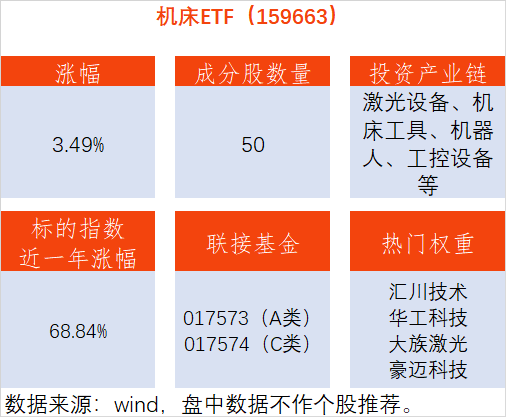
工业母机ETF(159667)近20日净流入超2.8亿元,国家创业引导投资基金启动,精准锚定科技创新前沿
Mei Ri Jing Ji Xin Wen· 2026-01-08 08:18
Group 1 - The core viewpoint of the news is the launch of the National Venture Capital Guidance Fund, which aims to attract a total capital scale of 1 trillion yuan by leveraging a central government investment of 100 billion yuan to support emerging and future industries, promoting the integration of technological and industrial innovation [1] - The fund has a 20-year duration and encourages companies to engage in original and disruptive technology breakthroughs, supporting the transformation of key common technologies, which is expected to inject long-term capital into the machinery equipment industry and drive industrial upgrades and technological breakthroughs [1] - The Industrial Mother Machine ETF (159667) tracks the China Securities Machine Tool Index (931866), which selects 50 listed companies involved in machine tool manufacturing and key component services, reflecting the overall performance of the machine tool industry and covering components and production equipment related to humanoid robots [1]

日本企业担忧中国禁运稀土
日经中文网· 2026-01-08 02:59
Core Viewpoint - China's decision to strengthen export controls on dual-use items to Japan may include rare earth products, potentially impacting various Japanese industries such as automotive, electronic components, and machine tools [2][4]. Group 1: Export Controls and Implications - The Chinese government announced a ban on all dual-use items to military users in Japan, which may include rare earth elements, although it is currently unclear if rare earths are specifically included [4][7]. - Rare earths are considered essential in high-tech products, from electric vehicles (EVs) to weaponry, and their restriction could severely affect Japanese manufacturers [4][7]. - Japanese officials have expressed concerns over the potential impact on industries, particularly in the context of EVs and hybrid vehicles that rely on neodymium magnets, with key rare earth elements like dysprosium and terbium sourced primarily from China [7]. Group 2: Industry Responses and Adaptations - Japanese companies are actively seeking to diversify their supply chains and have been collaborating with countries like Australia in mining development to mitigate risks associated with rare earth supply disruptions [7][8]. - The Japanese Ministry of Economy, Trade and Industry is supporting private sector mining and smelting projects, expanding its focus beyond just copper to include critical minerals, with budget allocations for 2025 aimed at enhancing mineral resource reserves [8].

津上机床中国(01651.HK)1月7日耗资506.93万港元回购14.9万股
Ge Long Hui· 2026-01-07 10:05
Group 1 - The core point of the article is that Tsunashima Machine Tool China (01651.HK) announced a share buyback on January 7, 2026, spending HKD 5.0693 million to repurchase 149,000 shares at a price range of HKD 33.6 to 34.2 per share [1][1][1] - On January 6, 2026, the company also conducted a buyback, spending HKD 5.1153 million to repurchase 150,000 shares [1][1][1]
工业母机ETF(159667)盘中净流入1800万份,近20日净流入超2.5亿元,人形机器人催化持续
Mei Ri Jing Ji Xin Wen· 2026-01-06 07:32
Group 1 - The core viewpoint of the article highlights the significant inflow of funds into the Industrial Mother Machine ETF (159667), with a net inflow of 18 million units during the trading session and over 250 million yuan in the past 20 days, driven by the ongoing interest in humanoid robots [1] - The article mentions that robots are seen as the ultimate carrier of AI and are expected to become a major battleground in the competition between China and the United States [1] - It is noted that Tesla's V3 version is expected to evolve towards lightweight, compact, high integration, and high stability, with a potential release in Q1 2026, followed by mass production [1] Group 2 - The Industrial Mother Machine ETF (159667) tracks the CSI Machine Tool Index (931866), which selects 50 listed companies involved in the manufacturing and servicing of machine tools and key components from the Shanghai and Shenzhen markets [1] - The index aims to reflect the overall performance of listed companies related to the machine tool industry and includes components and production equipment necessary for humanoid robots [1] - Domestic companies such as Yushu, Zhiyuan, Leju, Yundongchu, and Galaxy General are accelerating capital operations, with upcoming listings expected to catalyze the sector [1]

机床行业报告 | 项目案例
QYResearch· 2026-01-05 09:51
Core Viewpoint - The machine tool industry is experiencing significant growth, driven by advancements in technology and increasing demand across various sectors such as automotive, aerospace, and consumer electronics. The global market is projected to reach $73.2 billion in 2024 and $93.7 billion by 2031, with China and the US being the largest consumers [9][11][15]. Upstream Components - The upstream segment of the machine tool industry includes essential components such as tool magazines, spindles, and rotary tables. These components are crucial for enhancing the efficiency and automation of machining processes [3][4][5]. - The global market for tool magazines is expected to reach $1.203 billion in 2024, spindles at $1.608 billion, and rotary tables at $1.720 billion [5]. Global Competition Landscape - Major manufacturing countries are focusing on the machine tool sector as a strategic area for development, emphasizing self-sufficiency in core technologies and supply chain resilience [7]. - Various countries have implemented policies to support the machine tool industry, including China's emphasis on key technologies, Germany's Industry 4.0 initiative, and Japan's support for small and medium enterprises [8]. Market Size and Growth - The global machine tool market is projected to grow from $73.2 billion in 2024 to $93.7 billion by 2031, indicating a robust growth trajectory [9]. - In China, the machine tool market is expected to reach $26.5 billion in 2024, with projections of $37.2 billion by 2030 [11]. Regional Production and Consumption - China, Japan, Germany, Italy, and the US are the top five machine tool production regions, with China showing significant trends in import substitution, particularly in metal forming and CNC machine tools [17]. - By 2031, the demand for various types of machine tools is expected to continue growing, with China and the US accounting for over 50% of global consumption [15]. Export and Import Trends - In 2024, China's machine tool exports are projected to exceed $8.21 billion, surpassing Germany for the first time, with major export destinations including Southeast Asia, Russia, and Brazil [26][28]. - The import value for machine tools in China is expected to be $5.49 billion in 2024, reflecting a clear trend towards import substitution over the past five years [28]. Company Rankings - The global machine tool market in 2024 will see several Chinese companies ranked among the top 25, indicating a growing presence in the international market [24]. - The leading companies by market share include Yamazaki Mazak (Japan) at 5.86%, Trumpf (Germany) at 4.21%, and DMG Mori Seiki (Japan) at 3.63% [25].
津上机床中国(01651)1月5日斥资470.85万港元回购13.9万股
智通财经网· 2026-01-05 09:38
Core Viewpoint - The company,津上机床中国, announced a share buyback plan, indicating confidence in its stock value and future prospects [1] Group 1: Share Buyback Details - The company will repurchase 139,000 shares at a total cost of HKD 4.7085 million [1] - The buyback price per share ranges from HKD 33.36 to HKD 34.24 [1]