
Mobile Phones

Search documents
realme回归OPPO,将成为旗下子品牌
2 1 Shi Ji Jing Ji Bao Dao· 2026-01-07 09:18
Group 1 - The core point of the article is that realme, previously an independent brand from OPPO, will return to OPPO as a sub-brand to enhance resource integration and collaboration among OPPO, realme, and OnePlus [1][3] - Realme's CEO, Li Bingzhong, will lead the overall sub-brand business, while OnePlus China President Li Jie will maintain his responsibilities, indicating a strategic alignment between the brands [1] - The integration aims to provide more innovative and differentiated products and improved customer service for global users [1] Group 2 - Realme and OnePlus have overlapping product focuses, particularly in gaming performance and imaging, highlighting the intense competition in the domestic smartphone market [3] - Realme has faced challenges in establishing offline service points, which has limited its market penetration despite its focus on cost-performance [3] - The integration is expected to create a more comprehensive synergy across products, markets, channels, and resources among OPPO, realme, and OnePlus [3] Group 3 - OPPO is actively expanding its overseas market presence, leveraging realme's established global sales network, particularly in India, where realme has performed well [4] - The smartphone market is facing unprecedented supply chain challenges, particularly with rising storage costs, which are expected to impact mid-range product sales in 2026 [4] - Resource integration and synergy are becoming key competitive factors among smartphone brands in the current market landscape [4]

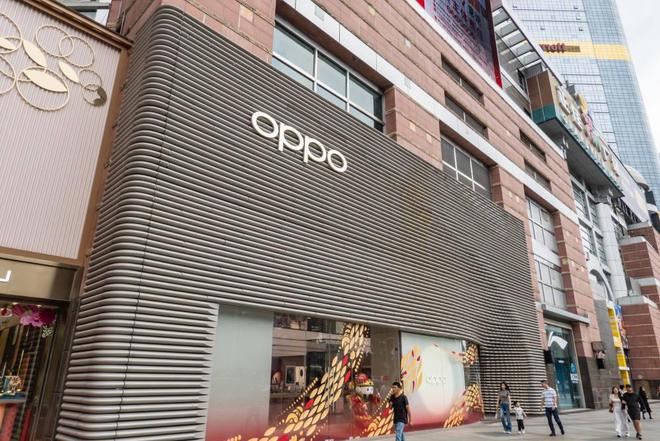
realme回归OPPO 将成为旗下子品牌
2 1 Shi Ji Jing Ji Bao Dao· 2026-01-07 09:13
Core Viewpoint - The brand realme, which was previously spun off from OPPO, will return to OPPO as a sub-brand, aiming for better resource integration and collaboration among OPPO, realme, and OnePlus to enhance product innovation and service efficiency [1] Group 1: Company Strategy - Realme will be led by CEO Li Bingzhong and will fully integrate into OPPO's after-sales service system [1] - The collaboration aims to provide more innovative and differentiated products to global users [1] Group 2: Market Positioning - OnePlus and realme are preparing for a new product launch, with both brands continuing to focus on gaming performance and imaging capabilities [2] - The competition in the smartphone market is intense, particularly in the gaming and imaging segments, with similar positioning seen in vivo's iQOO brand [2] Group 3: Operational Challenges - Realme has faced challenges in establishing offline service points, which has limited its market penetration despite its focus on cost-performance [2] - The integration of realme, OnePlus, and OPPO is expected to create a more comprehensive synergy across products, markets, and resources [2] Group 4: Sales Performance - OnePlus has reported a 42.3% sales growth, leading the industry, with the OnePlus 15 surpassing the sales of the OnePlus 13 [3] - Realme, which originated in India, has shown better sales performance in overseas markets compared to domestic sales, which will benefit OPPO's overseas strategy post-integration [3] Group 5: Industry Challenges - The smartphone market is facing unprecedented supply chain challenges, particularly with rising storage costs impacting mid-range product sales forecasts for 2026 [3] - The high storage prices are expected to lead to further brand consolidation within the smartphone industry [3][4]
努比亚红魔11 Pro+ 5G手机直降到手4849元
Xin Lang Cai Jing· 2026-01-07 01:40
Core Insights - Nubia Red Magic 11 Pro+ 5G stands out in the competitive smartphone market, featuring the fifth-generation Snapdragon 8 Supreme version, which provides strong performance for handling large games and complex tasks [2][3] - The smartphone is equipped with 12GB of RAM and 256GB of storage, making it suitable for multitasking and storing large amounts of files, photos, and videos [2][3] - Currently, the promotional price on Tmall is 5,099 yuan, with an additional discount of 100 yuan and a national subsidy of 149.97 yuan, allowing customers to purchase it for as low as 4,849.03 yuan, offering a cost-effective option for high-performance smartphones [2][3]
国产手机电池容量突破10000mAh,内存涨价挑战仍存
Guan Cha Zhe Wang· 2026-01-06 02:35
Core Viewpoint - The launch of the Honor Power2 smartphone features a significant battery capacity of 10080mAh, which is the largest in the industry, and it is designed for specific user scenarios such as outdoor and delivery services [1][2]. Group 1: Product Features - The Honor Power2 has a battery capacity increase of 2080mAh compared to its predecessor, making it comparable to the battery capacity of the iPhone Air [1]. - The device maintains a slim profile with a thickness of 7.98mm and a weight of approximately 216 grams, achieved through advancements in battery materials, including a 15% silicon content that results in an energy density of 926Wh/L [1]. - The smartphone is equipped with features tailored for outdoor use, such as signal optimization for weak signal areas, enhanced positioning accuracy, and an IP68/IP69K rating for dust and water resistance [2]. Group 2: Processor and Performance - The Honor Power2 is powered by the MediaTek Dimensity 8500 Elite processor, which is expected to outperform the previous Snapdragon 7 Gen3 in multi-core performance, with benchmark scores indicating it may exceed the Snapdragon 8 Gen3 [3]. - The camera specifications include a 50MP main camera and a 5MP wide-angle camera, which are considered average compared to competitors [3]. Group 3: Pricing and Market Position - The pricing for the Honor Power2 starts at 2699 yuan for the 12GB + 256GB version and 2999 yuan for the 12GB + 512GB version, reflecting a 500 yuan increase from the previous generation [3]. - The smartphone market is experiencing upward price pressure due to rising component costs, affecting various brands including Honor, Vivo, and Xiaomi, with expectations of continued price increases in 2026 [12]. - The competitive landscape is intensifying with upcoming mid-range and performance smartphones featuring high-capacity batteries and advanced specifications, indicating a shift towards higher performance in the mid-range segment [13].

手机市场再无“小而美”?华硕暂停手机业务,小众品牌集体逼近「斩杀线」
3 6 Ke· 2026-01-05 00:05
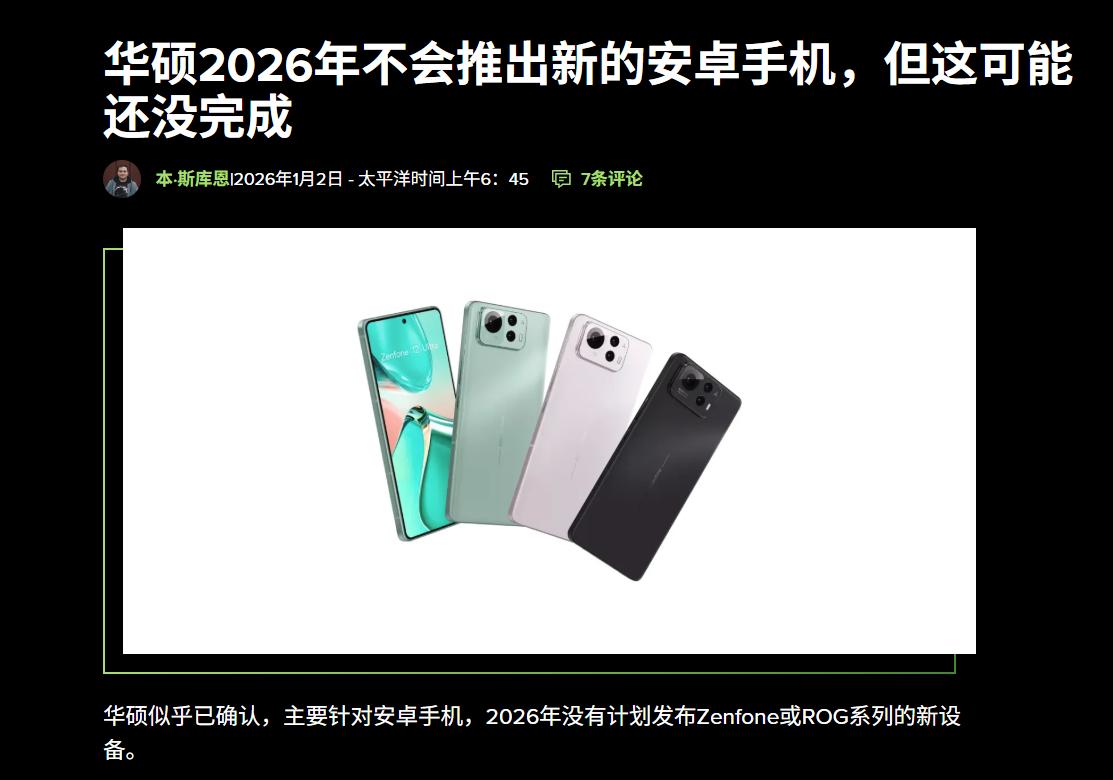
Core Viewpoint - ASUS has announced that it will suspend the launch of new smartphones, including the Zenfone and ROG Phone series, in 2026, marking a significant shift in the smartphone market and signaling the end of an era for small-sized flagship devices [1][3][15]. Company Overview - ASUS has historically focused on unique innovations rather than following mainstream trends, exemplified by products like the Padfone and ZenFone Zoom, which showcased its commitment to creativity [5][8]. - The Zenfone series targeted small-sized smartphone enthusiasts, with models like ZenFone 8, 9, and 10 receiving positive reviews for their compact design and flagship specifications [10][14]. - The ROG Phone series was designed specifically for gamers, featuring unique functionalities such as side charging ports and AirTriggers, catering to a niche market [11][13]. Market Challenges - The smartphone industry is facing rising costs, with a projected 25% increase in material costs by 2026 due to supply chain dependencies, which disproportionately affects smaller brands like ASUS [16][18]. - The competitive landscape is dominated by giants like Apple and Samsung at the high end, and Chinese brands like Xiaomi and OPPO at the mid to low end, leaving ASUS in a challenging position [19][22]. - ASUS's smartphone business has been a financial burden, with significant losses reported in previous years, and its market share in Taiwan dwindling to approximately 1.2% by 2025 [23][25]. Industry Implications - The exit of ASUS from the smartphone market reflects a broader trend where unique, niche products struggle to survive in an increasingly saturated and mature market [26][28]. - The success in the smartphone industry now hinges on supply chain management, cost control, and extensive distribution channels, rather than solely on product uniqueness [28].
2025年以旧换新销售额超2.6万亿元
Xin Lang Cai Jing· 2026-01-02 19:32
Group 1 - In 2025, the sales volume of products related to the trade-in program is expected to exceed 2.6 trillion yuan, benefiting over 360 million people [1] - The trade-in program will include over 11.5 million cars, 129 million home appliances, 9.1 million digital products, 120 million home renovation items, and 12.5 million electric bicycles [1] - From January to November, the total retail sales of consumer goods grew by 4.0% year-on-year, with the trade-in program contributing over 1 percentage point to this growth [1] Group 2 - Since the full implementation of the policy in September 2024, over 480 million direct subsidies have been issued to consumers, leading to the introduction of many green, low-carbon, and smart products into daily life [2] - For every two new household cars sold in 2025, one will benefit from the trade-in subsidy, and the number of old electric bicycles replaced will exceed nine times that of 2024 [2] - The concentration of trade-in home appliance stores in certain commercial areas has led to a more than 30% increase in consumer spending within a 1-kilometer radius [2]
Trump Mobile Gold Phone Didn't Launch In 2025: Company Blames Government Shutdown
Benzinga· 2026-01-01 12:05
Core Insights - Trump Mobile has revised its promises regarding the production of its phones, initially claiming they would be made in America, which has now been walked back [2][3] - The launch of the gold-colored T1 smartphone has been delayed until 2026, with the company citing a government shutdown as a reason for the delays [2][5] - The T1 phone is available for reservation with a $100 deposit, but its launch timeline has been extended multiple times, originally set for August and then pushed to the end of 2025 [3][4] Company Overview - Trump Mobile was launched by Donald Trump Jr. and Eric Trump in June 2025, with no official involvement from Donald Trump himself [4] - The company was established in response to criticisms of major smartphone manufacturers like Apple and Samsung for not producing devices in the United States [4] - Trump Mobile offers phone plans at $47.45 per month, which is a nod to Donald Trump's presidency [3][4] Product Offerings - In addition to the T1 phone, Trump Mobile provides options for customers to bring their existing phones to the service [5] - The company also lists second-hand phones on its website, although it has not disclosed the number of customers or second-hand devices sold [5][7]

“非洲之王”传音的自我进化:文化融入、实用AI、长期主义
Huan Qiu Wang· 2025-12-31 04:40
Core Viewpoint - The article highlights the strategic approach of Transsion Holdings, particularly its brand TECNO, in leveraging cultural connections through sports sponsorship, specifically the Africa Cup of Nations, to enhance brand visibility and align with local values in Africa [2][4][6]. Group 1: Sponsorship and Cultural Integration - Transsion's sponsorship of the Africa Cup is not merely a commercial decision but a deep cultural integration, recognizing football as a unifying symbol in Africa [4][6]. - The company aims to transition from being a mere observer of African culture to an active participant, fostering a connection with consumers through familiar cultural touchpoints [6][19]. - Transsion is also involved in community initiatives, such as the "Dream Stadium" project, committing to improve or build 100 community football fields across Africa [6]. Group 2: AI Strategy and Market Position - Transsion adopts a pragmatic approach to AI, focusing on practical applications that enhance user convenience rather than following industry hype [7][9]. - The company’s AI features, such as offline translation supporting around 100 languages, cater specifically to the needs of users in remote areas of Africa, demonstrating a commitment to addressing local challenges [7][9]. - Despite the competitive landscape, Transsion maintains a dominant market share of 51% in Africa's smartphone market, with a focus on self-competition and continuous adaptation to consumer insights [10][12]. Group 3: Long-term Vision and Local Engagement - Transsion emphasizes a "Glocal" strategy, combining global technology with local solutions to address specific needs in the African market [15][19]. - The company views itself as a contributor to the digital transformation of Africa, aiming to be a key player in building a digital ecosystem rather than just a smartphone seller [16][18]. - The focus on understanding and solving local problems has positioned Transsion as a trusted partner in users' lives, fostering a deeper relationship beyond mere transactions [19].


手机「贾维斯」元年将至 AI Agent能否接管一切?
Zheng Quan Shi Bao· 2025-12-31 01:42
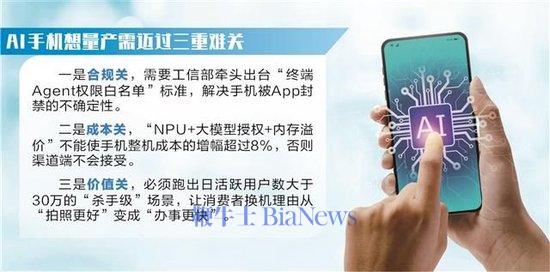
Core Viewpoint - The emergence of AI Agent smartphones is set to revolutionize the mobile industry by 2026, with significant advancements in technology and collaboration among major players [2][3]. Group 1: Industry Trends - The collaboration between Doubao and ZTE has led to the launch of the Doubao AI smartphone (Nubia M153), prompting other manufacturers to accelerate their AI Agent smartphone development [2][3]. - Major companies like ByteDance are reportedly pursuing partnerships with leading hardware manufacturers such as Vivo, Lenovo, and Transsion to develop AI smartphones [3]. - The "Big Model Six Little Tigers," including Zhiyu, have announced the open-sourcing of their core AI Agent model AutoGLM, which is expected to boost the development of AI Agent smartphones [3]. Group 2: Development Paths - The industry is divided into two distinct paths: the "radical faction" represented by Doubao AI smartphones, which utilize high-permission integration, and the "conservative faction" represented by companies like Huawei, which adopt a more cautious approach through API interfaces [4]. - Leading smartphone manufacturers like Vivo and Huawei, which shipped over 40 million units last year, are more likely to treat AI as a feature rather than a foundational element due to the high costs associated with system-level changes [4]. Group 3: Challenges and Concerns - The development of AI Agent smartphones raises concerns regarding user privacy and security, as the ability to control applications without direct user interaction could threaten the interests of existing app platforms [5][6]. - Major applications, including WeChat and Taobao, have begun to block the Doubao AI assistant due to security concerns, highlighting the risks associated with granting extensive permissions to AI applications [5][6]. - The relationship between intelligence and permissions is described as a "seesaw," where increased permissions can enhance AI capabilities but also pose significant privacy risks [6]. Group 4: Future Outlook - Experts predict that 2026 could mark the "mass production year" for AI Agent smartphones, contingent upon meeting specific technological and cost criteria [8]. - Key conditions for achieving this milestone include the performance of system-on-chip (SoC) NPU exceeding 40 TOPS, the production of 12nm RF amplifiers, and the availability of cost-effective memory modules [8]. - The successful transition from "demo" to "cash flow" for AI smartphones will require overcoming regulatory, cost, and value challenges, including establishing a clear permissions framework and demonstrating compelling use cases for consumers [8][9].

深度|“AI手机”元年!AI Agent能否接管一切?激进派PK稳健派
Zheng Quan Shi Bao· 2025-12-31 00:55
Core Viewpoint - The emergence of AI Agent smartphones is anticipated to revolutionize the mobile industry by 2026, with significant developments from various manufacturers and AI model companies, although challenges remain in compliance, cost, and value [1][10]. Group 1: Industry Developments - The collaboration between Doubao and ZTE has led to the introduction of the Doubao AI smartphone, marking a significant step in AI Agent smartphone development [1]. - Major companies like ByteDance are reportedly pursuing partnerships with leading hardware manufacturers such as Vivo and Lenovo to advance AI smartphone initiatives [3]. - The "Big Model Six Little Tigers," including Zhipu, are contributing to the AI Agent smartphone landscape, with Zhipu's AutoGLM model being a notable development [3]. Group 2: Diverging Paths - The industry is witnessing two distinct approaches: the "radical faction," represented by Doubao AI smartphones, which integrates high-level permissions, and the "conservative faction," represented by companies like Huawei, which opts for a more cautious approach through API interfaces [4]. - Major smartphone manufacturers like Vivo and Huawei, which had over 40 million units shipped last year, face significant compliance costs for system-level changes, influencing their strategy to treat AI as a feature rather than a foundational element [4]. Group 3: Challenges and Concerns - The development of AI Agent smartphones raises concerns regarding user privacy and security, particularly as applications like WeChat and Taobao have begun to block access to Doubao's AI assistant due to potential risks [6][7]. - The relationship between permissions and intelligence is described as a "seesaw," where increased permissions for AI can enhance functionality but also pose privacy threats, leading to cautious authorization from app and phone manufacturers [7][8]. - To address these challenges, industry experts suggest the need for advancements in privacy computing and regulatory frameworks to establish clear guidelines for AI usage [8]. Group 4: Future Outlook - The year 2026 is projected to be a pivotal moment for AI Agent smartphones, contingent on achieving specific technological benchmarks, including processing power and cost reductions [10]. - The successful mass production of AI smartphones will depend on overcoming three key hurdles: compliance with regulatory standards, managing production costs, and demonstrating compelling user value [10].