
信息技术

Search documents
河南联合信息科技股份有限公司(H0202) - 整体协调人公告-委任
2025-11-16 16:00
(於 中 華 人 民 共 和 國 註 冊 成 立 的 股 份 有 限 公 司) Henan Union Information Technology Co., Ltd. 河南联合信息科技股份有限公司 警 告 本 公 告 乃 根 據 香 港 聯 合 交 易 所 有 限 公 司(「聯交所」)及 證 券 及 期 貨 事 務 監 察 委 員 會(「證監會」)的 要 求 而 刊 發,僅 用 作 向 香 港 公 眾 人 士 提 供 資 料。 香 港 聯 合 交 易 所 有 限 公 司 及 證 券 及 期 貨 事 務 監 察 委 員 會 對 本 公 告 的 內 容 概 不 負 責,對 其 準 確 性 或 完 整 性 亦 不 發 表 任 何 聲 明,並 明 確 表 示,概 不 對 因 本 公 告 全 部 或 任 何 部 份 內 容 而 產 生 或 因 依 賴 該 等 內 容 而 引 致 的 任 何 損 失 承 擔 任 何 責 任。 (e) 本 公 告(及 其 所 載 資 料)僅 供 參 考,並 不 構 成 或 組 成 於 美 國(包 括 其 領 土 及 屬 地、美 國 任 何 州 及 哥 倫 比 亞 特 區)或 進 行 有 ...
2024年度A股上市公司环境、社会和公司治理(ESG)实践深度研究白皮书-东方财富证券
Sou Hu Cai Jing· 2025-11-16 02:46
Core Insights - ESG has become a core issue for high-quality development of A-share listed companies amid deepening global sustainable development agendas and strengthening domestic and international regulatory policies [1][16] - A-share ESG practices in 2024 show strong policy-driven momentum, gradual deepening of practices, but still have shortcomings [1][2] Policy Landscape - The domestic regulatory framework for ESG is continuously improving, with ESG being incorporated into national strategic frameworks and mandatory disclosures set to begin in 2026 for certain companies [1][18] - International standards such as ISSB and CSRD are promoting standardized disclosures, while major overseas markets are tightening compliance requirements for cross-border operations [1][23] Practice Performance - There is a positive correlation between ESG practices and corporate value, with significant relationships observed between ESG ratings and return on assets (ROA) and return on equity (ROE) [1][38] - The disclosure rate of sustainability reports reached 45.85%, a significant increase from the previous year, with larger market capitalization and state-owned enterprises showing a stronger willingness to disclose [1][2] Strategic and Governance Aspects - Only 9.31% of listed companies fully articulate their ESG strategies, with 82% lacking any related strategy, indicating a predominance of basic-level practices and a scarcity of excellence [2][18] - Governance structure establishment rate is at 34.84%, with board-led governance becoming mainstream, but linking ESG to executive compensation remains concentrated in specific industries [2][18] Risk and Opportunity Management - 71.84% of companies conduct ESG risk identification, with industrial and information technology sectors being high-risk areas, yet only 32% identify climate-related risks and opportunities [2][18] - The application rate of scenario analysis is below 14%, indicating weak capability in opportunity identification [2][18] Sector-Specific Developments - Sustainable supply chain management is gradually advancing, with over 20% of suppliers in most industries establishing ESG assessment mechanisms [2][18] - Human resource management focuses on diversity, inclusion, and health safety, with an average female employee ratio of 33.2% [2][18] - The sustainable finance market is steadily developing, with green bonds as a core pillar and the scale of ESG public funds and bank wealth management gradually recovering [2][18] Overall Assessment - The development of ESG in A-shares has transitioned from conceptual advocacy to institutional implementation, yet challenges remain in strategic system completeness, uneven disclosure quality, and insufficient depth in specific practices [2][18] - Future efforts should focus on strengthening policy coordination, improving governance mechanisms, and enhancing data credibility to transform ESG from compliance costs into long-term competitive advantages [2][18]



仁东控股股份有限公司 关于拍卖处置低效资产的进展公告
Zhong Guo Zheng Quan Bao - Zhong Zheng Wang· 2025-11-15 23:08
Core Viewpoint - The company is undergoing a restructuring plan approved by the Guangzhou Intermediate People's Court, focusing on the disposal of inefficient assets to improve its asset structure and financial performance [1][3]. Group 1: Auction Progress - The company successfully auctioned its 3.0236% stake in Beijing Haidian Technology Financial Capital Holding Group Co., Ltd. for 3,053,110.05 yuan, with the buyer being Huang Jianfang [2]. - The buyer is required to pay the remaining auction price to the company's designated bank account within the publicized payment deadline, and failure to do so will result in a breach of contract [2]. Group 2: Related Explanation - The asset auction is conducted in accordance with the relevant provisions of the Enterprise Bankruptcy Law and the restructuring plan, which is expected to enhance the company's asset quality and profitability [3]. - The company will continue to monitor the progress of this matter and fulfill its information disclosure obligations as per legal requirements [3].

基金研究周报:偏弱整理,微盘与红利板块显韧性(11.10-11.14)
Wind万得· 2025-11-15 22:23
Market Overview - The A-share market experienced a downward trend from November 10 to November 14, with the Shanghai Composite Index closing at 3990.49 points, a slight decline of 0.18% for the week [2] - Growth sectors faced significant pullbacks, with the ChiNext and STAR Market indices dropping over 5%, indicating pressure on high-valuation sectors [2] - Structural differentiation continued, with the CSI Dividend Index rising 0.25%, showcasing the resilience of value styles, while the Wind Micro-Cap Index surged 4.11%, becoming one of the few market highlights [2] Industry Performance - The average performance of Wind's primary industry indices increased by 0.48%, with over half of the sectors achieving positive returns [9] - The healthcare sector rose by 3.27%, consumer staples by 2.72%, and real estate by 2.62%, marking the strongest performances [9] - Conversely, the information technology sector fell by 4.27%, industrials by 1.28%, and telecommunications services by 1.09%, indicating significant pressure on technology and manufacturing sectors [9] Fund Issuance - A total of 24 funds were issued last week, including 14 equity funds, 4 mixed funds, 2 bond funds, and 4 fund of funds (FOFs), with a total issuance of 14.173 billion units [13] Fund Performance - The Wind All-Fund Index decreased by 0.37% last week, with the ordinary equity fund index down by 0.40% and the mixed equity fund index down by 0.71% [3] - The bond fund index saw a slight increase of 0.06%, indicating a mixed performance across different fund types [3] Global Market Context - Global equity markets showed a mixed performance, with the US market stable and the Dow Jones rising by 0.34%, while European markets performed strongly, with France's CAC40 up by 2.77% and Germany's DAX up by 1.30% [4] - In the commodity market, natural gas rose by 4.47%, silver by 4.69%, and gold by 1.86%, while coking coal plummeted by 6.77% [4] - The US dollar index weakened amid strong expectations for a Federal Reserve rate cut in December, which diminished the dollar's attractiveness [4]

美股重挫叠加政府停摆余波:美国经济陷 “政策迷雾” 与市场动荡双重考验
Sou Hu Cai Jing· 2025-11-14 13:44
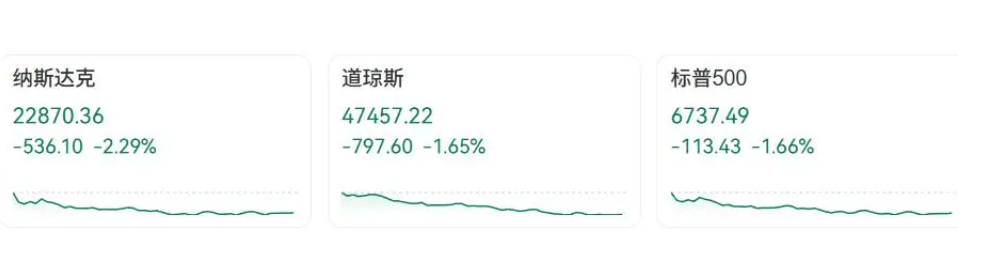
Market Overview - On November 13, U.S. stock markets experienced their largest single-day decline in over a month, with the Dow Jones Industrial Average dropping nearly 800 points, reflecting a 1.65% decrease [2] - The S&P 500 index fell by 1.66%, while the Nasdaq Composite index, heavily impacted by technology stocks, plummeted by 2.29% [2] - The decline was attributed to persistent inflation concerns, fluctuating Federal Reserve policies, and the aftermath of a government shutdown [2] Sector Performance - The technology sector, particularly the "Big Seven" tech companies, led the market downturn, with notable declines including Tesla down 6.64%, Nvidia down 3.58%, and Amazon down 2.71% [2] - In contrast, defensive value stocks saw an uptick, with the value stock index rising approximately 1% this week, while growth stocks fell by 0.6% [2] Individual Stock Movements - Cisco saw a 4.6% increase due to an upward revision of its revenue and profit forecasts, benefiting from increased demand for networking equipment [3] - Disney, however, faced a significant drop of 7.8% as concerns grew over a prolonged distribution dispute with YouTube TV, raising uncertainties about its traditional television business [3] Economic Impact of Government Shutdown - The recent government shutdown, lasting 43 days, resulted in an estimated economic loss of $1.5 trillion, significantly exceeding previous estimates [4] - Key social programs, such as the Supplemental Nutrition Assistance Program, were affected, leading to disruptions for 42 million Americans [4] - The aviation sector was particularly hard hit, with a 10% reduction in flight volumes at 40 major airports due to increased absenteeism among air traffic controllers [4] Policy and Data Concerns - The shutdown has created a "data vacuum," with critical economic reports like the Consumer Price Index and employment data potentially never being released, complicating Federal Reserve policy decisions [5] - Market expectations for a 25 basis point rate cut in December have decreased from 70% to approximately 47% due to the uncertainty surrounding inflation and labor market resilience [5] Global and Domestic Implications - The turmoil in U.S. markets has had global repercussions, with concerns about slowing U.S. economic growth impacting oil prices and causing disruptions in transatlantic flight schedules [6] - The temporary resolution of the government shutdown does not address underlying governance issues, with significant budgetary disagreements remaining unresolved [7] - The potential for another government shutdown looms as only three of the twelve annual appropriations bills have been passed, indicating ongoing political instability [7]
资金逆势积极加仓,创业板ETF(159915)全天获超1.7亿份净申购
Sou Hu Cai Jing· 2025-11-14 11:49
Market Overview - The market experienced a correction today, with growth-style indices such as the ChiNext Index declining, while funds showed a contrary attitude by increasing their positions, with the ChiNext ETF (159915) seeing a net subscription of over 170 million units throughout the day [1] - For the week, the ChiNext Mid-Cap 200 Index fell by 0.9%, the ChiNext Index decreased by 3.0%, and the ChiNext Growth Index dropped by 4.6% [1][2] Index Performance - Weekly performance for the indices is as follows: - ChiNext Index: -3.0% - ChiNext Mid-Cap 200 Index: -0.9% - ChiNext Growth Index: -4.6% [2] - The rolling price-to-earnings (P/E) ratios are: - ChiNext Index: 41.4 times - ChiNext Mid-Cap 200 Index: 111.1 times - ChiNext Growth Index: 40.6 times [2] Sector Composition - The ChiNext Mid-Cap 200 Index consists of 200 stocks with medium market capitalization and good liquidity, reflecting the overall performance of representative companies in the ChiNext market, with the information technology sector accounting for over 40% [4] - The ChiNext Growth Index is composed of 50 stocks with prominent growth styles and high earnings growth, with the power equipment, pharmaceutical, and communication sectors collectively accounting for about 60% [4] ETF Tracking - Currently, there are 16 ETFs tracking the ChiNext Index, 5 ETFs tracking the ChiNext Mid-Cap 200 Index, and 1 ETF tracking the ChiNext Growth Index, with variations in fee rates, tracking errors, and sizes among different ETFs [4] Historical Performance - Year-to-date performance for the indices is as follows: - ChiNext Index: +45.3% - ChiNext Mid-Cap 200 Index: +25.6% - ChiNext Growth Index: +57.7% [7] - The cumulative performance over the past year is: - ChiNext Index: +38.7% - ChiNext Mid-Cap 200 Index: +18.6% - ChiNext Growth Index: +50.2% [7]


港股或率先受益于美元流动性转松趋势,恒生科技ETF易方达(513010)助力布局港股科技龙头
Mei Ri Jing Ji Xin Wen· 2025-11-14 11:13
Core Insights - The Hong Kong stock market showed mixed performance this week, with significant rebounds in the pharmaceutical sector and active performance in the new consumption sector, while popular technology stocks experienced varied movements [1] - The CSI Hong Kong Stock Connect Pharmaceutical and Health Index rose by 6.9%, and the CSI Hong Kong Stock Connect Consumption Theme Index increased by 2.3%, while the Hang Seng Technology Index fell by 0.4% [1][3] Index Performance - The Hang Seng New Economy Index increased by 0.7%, while the Hang Seng Technology Index decreased by 0.4% [3] - The rolling price-to-earnings (P/E) ratios for the indices are as follows: Hang Seng New Economy Index at 24.7x, Hang Seng Technology Index at 23.1x, CSI Hong Kong Stock Connect Pharmaceutical and Health Index at 29.2x, CSI Hong Kong Stock Connect Internet Index at 24.2x, and CSI Hong Kong Stock Connect Consumption Theme Index at 21.6x [3] - The rolling P/E ratio percentiles indicate that the Hang Seng New Economy Index is at 54.1%, the Hang Seng Technology Index at 30.8%, the CSI Hong Kong Stock Connect Pharmaceutical and Health Index at 46.0%, the CSI Hong Kong Stock Connect Internet Index at 23.0%, and the CSI Hong Kong Stock Connect Consumption Theme Index at 21.4% [3] Market Outlook - Western Securities noted that the reopening of the U.S. government and the resumption of spending by the Treasury could lead to a loosening of dollar liquidity, potentially driving a rebound in the Hong Kong stock market, with the Hang Seng Technology Index expected to benefit from a new round of strong rebound [1]

民营经济在成都拔节生长 五季连扬背后藏着哪些成长密码
Sou Hu Cai Jing· 2025-11-14 09:11
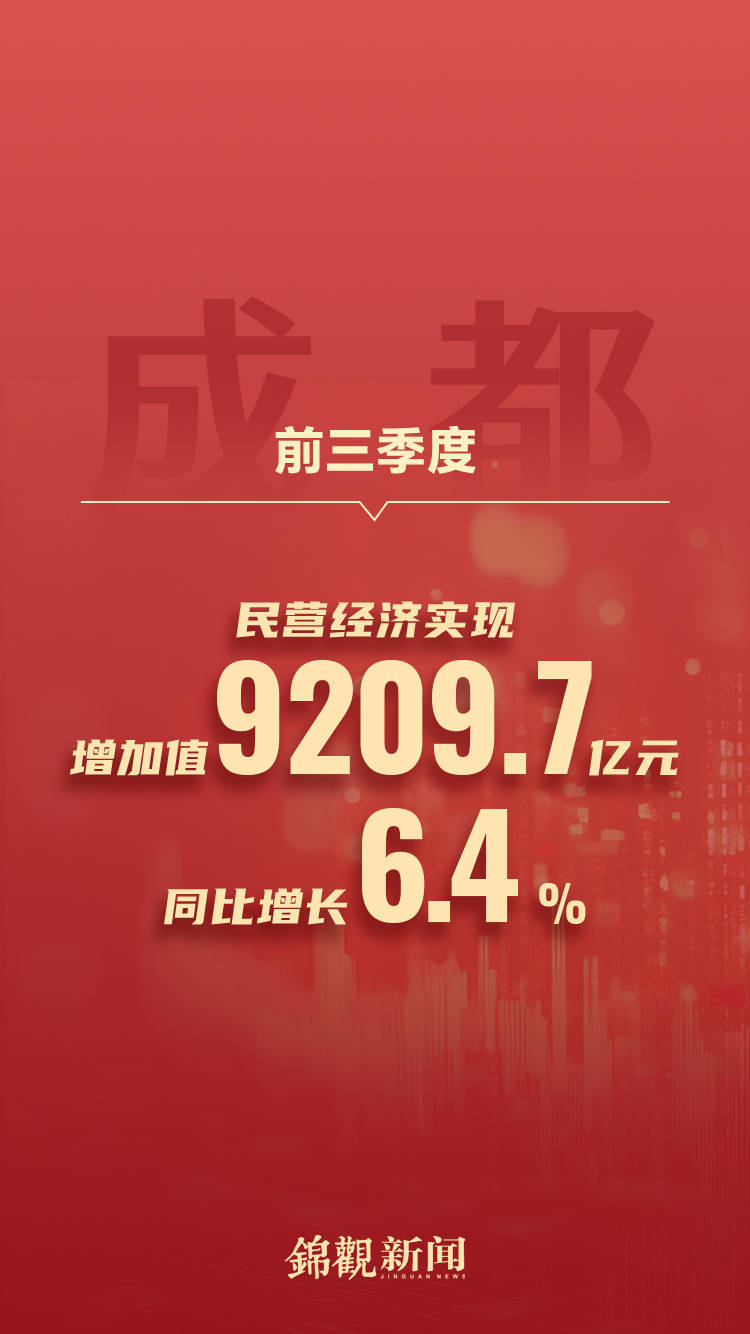
Core Insights - Chengdu's private economy has shown continuous growth for five consecutive quarters, achieving a value-added of 920.97 billion yuan with a growth rate of 6.4%, ranking among the top in the country [1][12][9] - The city has been recognized as an "Annual Innovative City" in the "2024-2025 Urban Business Environment Innovation Report," highlighting its favorable business environment [4][5] - The establishment of the Chengdu Private Economy Development Promotion Center aims to enhance support for private enterprises, embodying the principle of "responding to needs and not disturbing without reason" [5][8] Economic Performance - In the first three quarters of 2025, Chengdu's GDP reached 1,822.69 billion yuan, with a year-on-year growth of 5.8% [12] - Private investment in Chengdu increased by 6% year-on-year, outpacing the overall investment growth in the city [9][12] - The private economy has become a crucial force in advancing China's modernization, with the city’s private sector contributing significantly to its economic stability [5][12] Business Environment - The Chengdu Private Economy Development Promotion Center has organized 233 resource matching events, benefiting over 6,200 enterprises, and has facilitated 91 financing-related events, connecting 1,513 enterprises with financial institutions [8][12] - The city has seen a net increase of 518 industrial enterprises and 122 service enterprises in the first nine months of 2025, along with the addition of four new listed companies and 1,741 innovative small and medium-sized enterprises [15] Industry Growth - Chengdu's private enterprises are experiencing accelerated growth, with significant achievements in various rankings, reflecting their enhanced competitiveness and resilience [15] - The city is fostering a robust aerospace industry, with the Chengdu Rocket Production Base expected to produce 20 rockets annually after completion, injecting strong momentum into the sector [18] - The capital market has also seen success, with four Chengdu private enterprises recently listed, showcasing the city's supportive ecosystem for business growth [18] Digital Transformation - The Chengdu Public Transport Group's app has surpassed 10 million users, marking a new phase in digital service for public transportation, facilitated by local enterprises [23] - The collaboration between enterprises and the city is emphasized as a key factor in mutual growth and service enhancement [23] Future Outlook - With ongoing optimization of the business environment and effective implementation of support policies, more private enterprises are expected to thrive in Chengdu, contributing to the city's modernization efforts [23]
北交所开市四周年:上市公司增逾200家 下阶段改革任务明确
Di Yi Cai Jing· 2025-11-14 08:36
Core Insights - The Beijing Stock Exchange (BSE) has achieved significant growth in its four years of operation, with the number of listed companies increasing from 81 to 282, representing a growth of approximately 248% [2][3] - The BSE has successfully attracted a large number of innovative small and medium-sized enterprises (SMEs), with over 80% of listed companies being SMEs and nearly 90% being privately owned [1][2] - The BSE's market performance has improved, with a notable increase in IPOs and new stock listings, leading to enhanced market liquidity [1][4] Market Performance - As of November 14, the BSE has 282 listed companies, with over 200 new listings in four years, significantly outpacing other A-share segments [2][3] - The average revenue of BSE companies reached 520 million yuan, with over 80% of companies reporting profitability [2][3] - The North Star 50 Index has shown strong performance, with a cumulative increase of over 40% since September 24, 2023 [4][5] Liquidity and Market Structure - The BSE has focused on improving liquidity, which has been a challenge due to the smaller size of listed companies [3][6] - Recent policy measures, including the accelerated launch of the North Star 50 ETF and optimization of market-making systems, are expected to enhance liquidity [6][7] - The introduction of new trading mechanisms and the encouragement of long-term institutional investment are key strategies for improving market liquidity [7][8] Future Development Plans - The BSE aims to enhance its market functions by refining listing standards, improving merger and acquisition regulations, and expanding its bond market product offerings [8][9] - The exchange plans to promote the establishment of more public funds focused on small and medium-sized stocks to facilitate investment [8][10] - The BSE is also looking to deepen international cooperation and increase its market's internationalization [10][11]
加速科技成果转化|既要“孵得出”,更要“转得好”
Ke Ji Ri Bao· 2025-11-14 07:31
Core Insights - Ningxia Kuangsu Technology Co., Ltd. achieved significant recognition by winning an award at the 14th China Innovation and Entrepreneurship Competition, marking a historic breakthrough for the region's tech startups [1][2] - The success of the company highlights the effectiveness of Ningxia's technology incubators in facilitating the transformation of innovative ideas into market-ready products [2][4] Group 1: Company Achievements - Ningxia Kuangsu Technology specializes in the industrialization of electromagnetic measurement technology and has developed a rapid measurement device for antenna electromagnetic characteristics, which has been successfully delivered to a leading domestic smartphone manufacturer [2][3] - The project received an "excellent" rating during the acceptance evaluation, showcasing the company's technical capabilities and innovation [2] Group 2: Incubator Impact - Ningxia's technology incubators have played a crucial role in overcoming barriers faced by startups, such as lack of funding, market access, and operational resources, enabling them to transition from laboratory concepts to industry applications [2][4] - The region has seen a growth in the number of technology incubators and innovation spaces, with 40 national and regional incubators and 85 maker spaces established during the 14th Five-Year Plan, representing increases of 29% and 21.4% respectively [4] Group 3: Future Plans - The Ningxia Technology Department plans to implement a "three-full" professional incubation service model, which will integrate policies, technology, funding, and talent to support startups throughout their development cycle [5] - A new management approach categorizes incubators into a pyramid structure to enhance their specialization and effectiveness, with performance evaluations conducted every two years to ensure continuous improvement [4][5]