
养老服务

Search documents
(第八届进博会)从进博会看中国消费市场新趋势:多元消费图景涌现
Zhong Guo Xin Wen Wang· 2025-11-10 11:38
Group 1: Core Trends in Consumption - The 8th China International Import Expo reflects new consumption trends in the Chinese market, showcasing innovation and vitality [1] - The shift from passive disease response to proactive health management is driving the rapid development of the active health consumption market [2] - The "silver economy" is expanding, with a projected 310 million people aged 60 and above in China by the end of 2024, expected to exceed 400 million by around 2035 [3] Group 2: Active Health Consumption - The expo features new products and solutions catering to diverse health needs, including health supplements that combine ancient remedies with modern nutrition technology [2] - AI and IoT technologies are being integrated into home fitness solutions, providing personalized exercise plans and smart fitness equipment for home use [2] Group 3: Silver Economy Innovations - The expo introduces new themes around elderly care, including medical care, home modifications for aging, and smart devices to enhance the silver consumer market [3] - Companies like Boston Scientific and BD Medical are presenting innovative products aimed at addressing the specific needs of elderly patients [3] - IKEA and Panasonic are focusing on creating safer living environments for the elderly through home design and flooring solutions [3] Group 4: Emotional Consumption Trends - The "self-indulgent consumption" market in China is projected to exceed 2 trillion yuan in 2024, with individuals aged 26 to 45 making up over 82% of this demographic [4] - Companies are tapping into emotional needs by creating products that resonate with consumers' feelings, such as the CRYBABY IP from Pop Mart [4] - AI and sensory technology are being utilized to capture and respond to user emotions, enhancing the consumer experience through personalized recommendations [4]
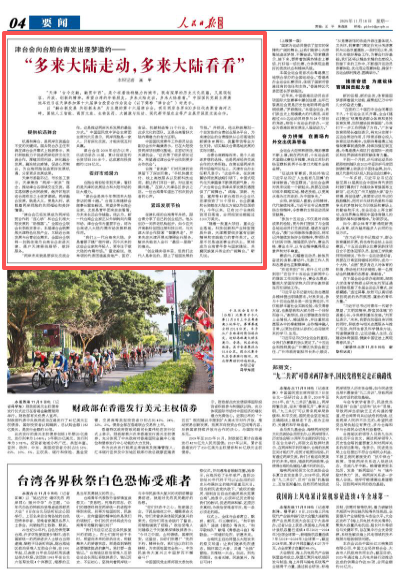
“多来大陆走动,多来大陆看看”
Ren Min Ri Bao Hai Wai Ban· 2025-11-09 22:56
Group 1: Event Overview - The 16th Cross-Strait Investment Cooperation Fair (津台会) was held in Tianjin, attracting over 800 representatives from both sides to discuss industries such as artificial intelligence, trade, tourism, biomedicine, health, and modern urban agriculture [1][2] - The theme of the event was "Integrating New Development, Creating a New Future," emphasizing the importance of cross-strait economic and cultural exchanges [2] Group 2: Economic Opportunities - The event serves as a "bridge" for cross-strait economic cooperation and a "booster" for Taiwanese enterprises to establish themselves in mainland China, with over 350 signed projects and an intended investment amount of approximately 123.8 billion yuan since its inception in 2008 [2] - Taiwanese entrepreneurs are increasingly focusing on the mainland's domestic market, with a shift from export-oriented strategies to catering to local demand [3] Group 3: Youth Engagement - Young Taiwanese are encouraged to explore opportunities in Tianjin, with initiatives aimed at fostering entrepreneurship and collaboration among Taiwanese youth [4][5] - The presence of Taiwanese youth at the event highlights their interest in Tianjin's development and the potential for future cooperation [3][4] Group 4: Investment Landscape - Major Taiwanese companies, including Hon Hai, Ting Hsin, and Fubon, have invested in 70 projects in Tianjin, making it a significant hub for Taiwanese investment in northern China [5] - In 2023, 32 Taiwanese investment projects were established in Tianjin, with a total contract investment exceeding 31 million USD [5]

对话松下控股全球副总裁本间哲朗:两端赋能驶向中国AI星辰大海
2 1 Shi Ji Jing Ji Bao Dao· 2025-11-09 10:00
Core Insights - The eighth China International Import Expo (CIIE) is a significant platform for global companies to showcase advanced technologies and observe market trends in China [1] - Panasonic's participation highlights its strategic focus on AI and its transformation in the Chinese market over 47 years, with a shift from home appliances to a diverse portfolio including electronic components and new energy [2][3] Company Strategy - Panasonic's AI strategy, termed "two-end empowerment," focuses on integrating AI into consumer products and supporting the AI industry with essential components [4][5] - The company has seen a 3% sales growth and a 24% profit increase in the first half of the 2025 fiscal year in China, driven by strong performance in high-performance capacitors and electronic components [5][6] Market Trends - The Chinese market is increasingly adopting new technologies, with a notable acceptance of innovative products, such as the AI-enabled smart toilet developed specifically for China [3][4] - The AI computing market in China is projected to grow significantly, with estimates suggesting a market size of $33.7 billion by 2026, driven by demand for AI computing capabilities [5][6] Investment and Expansion - Panasonic is investing heavily in new factories in China, with a total investment of 1.51 billion yuan across three new facilities focused on 5G electronic materials and semiconductor needs [6][7] - The company is optimistic about the future of AI in China, noting the widespread visibility of AI technology in everyday life [7]
进博会观察|欧葆庭中国区CEO柯烨明:中国养老机构竞争愈加激烈,国资正在大量进入
Jing Ji Guan Cha Bao· 2025-11-09 08:56
Core Viewpoint - The competition among elderly care institutions in China is intensifying, with significant state-owned capital entering the market, presenting both opportunities and challenges for foreign investment in the sector [1][2][9]. Industry Overview - The Chinese elderly care market is experiencing rapid growth due to an aging population, with over 300 million people aged 60 and above, accounting for 21.1% of the total population [1]. - The market is attracting more foreign investment, with many international companies showcasing products tailored for the elderly during the China International Import Expo [1]. Competitive Landscape - The competition among elderly care institutions is becoming more fierce, with some institutions improving service quality to attract consumers, while others resort to price wars, sacrificing service quality for lower prices [2][9]. - The trend of "state-owned enterprises advancing while private enterprises retreat" is becoming more pronounced, as many new service providers are emerging from sectors like insurance and real estate [2][9]. Market Dynamics - The average occupancy rate of elderly care institutions in China is low, not due to a lack of demand, but rather a mismatch between resources and needs [6]. - Factors affecting occupancy include poor project location, inadequate service offerings, and the financial capability and willingness of elderly individuals to pay for services [6][7]. Regulatory Environment - The Chinese government is continuously optimizing the elderly care service system, and the management of care institutions is becoming more mature [5][9]. - There is an increasing emphasis on regulatory oversight, with the government implementing a unified care service system to ensure quality across both private and public institutions [5]. Company Strategy - The company plans to expand its service offerings and management models across China, leveraging its established expertise and successful operational framework developed over the past decade [10]. - The company has been actively engaging with local experts and institutions to enhance its service quality and adapt to the unique needs of the Chinese market [8][10].
浦东构建“大城养老”样板,加速释放万亿元级市场空间
Di Yi Cai Jing Zi Xun· 2025-11-08 11:49
Core Viewpoint - Pudong aims to attract more investment in the elderly care sector, establishing itself as a new highland for the silver economy in China [1] Group 1: Policy and Planning - Pudong will incorporate "promoting the development of the silver economy" into its 14th Five-Year Plan and elderly care service support policies [2] - The district has the largest elderly population in Shanghai, with 1.13 million registered elderly residents and an aging rate of 33.47% by 2024 [2] - A significant market potential of over one trillion yuan is being released as the elderly population becomes the primary demand group [2] Group 2: Infrastructure and Services - Pudong has established a comprehensive elderly care service network with 182 care institutions, over 36,000 beds, and more than 2,000 community care facilities [2] - The district has implemented innovative medical and elderly care integration practices, with 60 institutions having internal medical facilities [2] - Smart healthcare platforms have benefited over 3,600 elderly individuals, showcasing a leading model of integrated medical and elderly care [2] Group 3: Industry and Innovation - Pudong has formed a robust industrial foundation and innovative ecosystem for elderly care, supported by key industries like integrated circuits, biomedicine, and artificial intelligence [3] - Local chip companies are addressing challenges in smart elderly care products, enhancing the technological capabilities of the sector [3] - The district is home to pioneering health management products and companies that cater to chronic diseases and rehabilitation needs of the elderly [3] Group 4: Economic Development and Collaboration - Pudong has established the Zhangjiang Smart Elderly Care Industrial Park, gathering nearly 80 innovative companies to create a full-chain ecosystem [4] - The district has launched a recommended directory for age-friendly products, enhancing market recognition and accessibility [4] - Financial cooperation is being deepened to empower the entire elderly care industry chain, with strategic partnerships aimed at providing financial support and innovative insurance solutions [5]
银色进博:“银发经济”增进老年人福祉
Ren Min Wang· 2025-11-08 10:09
Group 1 - The eighth China International Import Expo (CIIE) showcases innovative products catering to the aging population, highlighting the intersection of technology and the silver economy [1][3] - Products such as electric toothbrushes designed for sensitive gums and AI massage chairs demonstrate how technology enhances the quality of life for the elderly [1][3] - The "silver economy" is identified as a significant growth area, with projections indicating that by 2030, the elderly population in China will reach 369 million, accounting for 26.4% of the total population [2] Group 2 - The forum on "Accelerating the Development of the Silver Economy" emphasizes the need for collaboration between health insurance and elderly care services to create a high-quality care ecosystem [2] - Companies like Bayer are focusing on innovative solutions to meet the rising health demands of consumers, particularly in the context of aging and climate change [2] - The importance of corporate social responsibility is highlighted through donations to elderly care facilities, reflecting a commitment to improving the well-being of the elderly [3]
海安市首批优抚定点养老机构挂牌亮相
Xin Hua Ri Bao· 2025-11-07 21:42
Core Points - The meeting on October 28 focused on the establishment of designated elderly care institutions for preferential treatment objects in Hai'an City [1] - The initiative aims to ensure the basic elderly care needs of preferential treatment objects and explore new models combining social elderly care with preferential services [1] Summary by Categories Institutional Development - A total of 30 institutions, including Hai'an Hengyuan Rehabilitation Nursing Co., Ltd., were selected as the first batch of designated elderly care institutions after a comprehensive evaluation process [1] - The selection involved voluntary applications, on-site inspections, and comprehensive assessments [1] Target Beneficiaries - The designated institutions will primarily serve preferential treatment objects with household registration in Hai'an City, including retired soldiers, martyrs' families, and other recognized beneficiaries [1] - Beneficiaries must present identification and relevant certificates to access preferential services [1] Future Plans - The Hai'an Veterans Affairs Bureau plans to continue aligning services with the needs of preferential treatment objects and integrate social elderly care resources [1] - The goal is to enhance the quality of life for veterans and improve the retirement service guarantee system [1]
山东建成医养结合养老机构1125家
Qi Lu Wan Bao· 2025-11-07 16:33
Core Insights - Shandong Province is advancing high-quality development in civil affairs during the 14th Five-Year Plan period, with significant investments and innovative policies aimed at improving social welfare and support systems [1][2][3] Group 1: Policy and System Development - Shandong has established a comprehensive social assistance system, providing regular support to 1.325 million individuals on minimum living allowances and 348,000 individuals in extreme difficulty [1] - The province has introduced innovative policy documents addressing urban-rural minimum living allowances, identification of individuals in extreme difficulty, and dynamic monitoring of low-income populations [1] Group 2: Financial Investment and Support Mechanisms - A dynamic adjustment mechanism for nine categories of vulnerable groups has been established, with a total investment of CNY 97.05 billion, representing an 88.2% increase compared to the previous Five-Year Plan [2] - The province has created a "three proactive" work mechanism for assistance policies, actively monitoring 1.86 million low-income individuals and 8.4 million key focus groups [2] Group 3: Public Service Optimization - Shandong has developed 24,000 community elderly care service facilities and has prioritized services for disabled elderly individuals, with 1,125 integrated medical and nursing care institutions, the highest in the country [2] - The province has implemented a free marriage registration policy, saving approximately CNY 10 million annually for the public, and has issued 347,000 cross-regional marriage registrations since the start of the 14th Five-Year Plan [2] Group 4: Reform and Innovation - Shandong has taken the lead in the national civil affairs system by implementing reform initiatives and has secured CNY 930 million in trial funding for 24 national reform pilot projects [3] - The province is among the first three to provide consumption subsidies for elderly care services to individuals with moderate to severe disabilities, leading the nation in both funding and the number of issued vouchers [3]
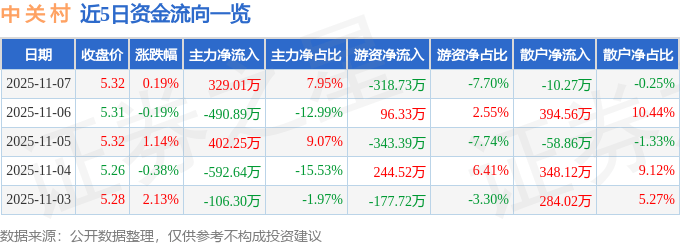
股票行情快报:中关村(000931)11月7日主力资金净买入329.01万元
Sou Hu Cai Jing· 2025-11-07 13:16
Core Viewpoint - The stock of Zhongguancun (000931) showed a slight increase on November 7, 2025, closing at 5.32 yuan, with a trading volume of 77,800 hands and a total transaction amount of 41.37 million yuan [1] Group 1: Stock Performance - On November 7, 2025, the stock price increased by 0.19% with a turnover rate of 1.04% [1] - The net inflow of main funds was 3.29 million yuan, accounting for 7.95% of the total transaction amount, while retail investors experienced a net outflow of 0.1 million yuan, representing 0.25% of the total [1][2] Group 2: Recent Fund Flow Overview - The recent five-day fund flow data indicates fluctuations in net inflows and outflows among different investor categories, with notable changes on November 6, where main funds saw a net outflow of 4.91 million yuan [2] - The stock's performance over the past five days shows a mix of gains and losses, with the highest closing price recorded at 5.32 yuan on November 5, 2025 [2] Group 3: Company Financials and Industry Comparison - As of the latest report, Zhongguancun's total market value is 4.007 billion yuan, with a net asset of 1.866 billion yuan and a net profit of 49.49 million yuan [3] - The company reported a decline in main operating income by 2.46% year-on-year for the first three quarters of 2025, with a net profit decrease of 4.14% [3] - The gross profit margin stands at 59.64%, which is higher than the industry average of 48.95%, indicating a competitive edge in profitability [3]

10万港人北上养老,“银发经济”开辟新蓝海
2 1 Shi Ji Jing Ji Bao Dao· 2025-11-07 08:40
Core Insights - The trend of Hong Kong seniors moving to mainland China for retirement is increasing, with nearly 100,000 elderly residents choosing to settle in Guangdong Province, marking a 40.5% increase over the past decade [1][3][5] - The "Guangdong Elderly Care Service Plan" has been established to facilitate cross-border elderly care, providing financial support for Hong Kong seniors in mainland institutions [5][6] - The aging population in Hong Kong, coupled with high living costs and a shortage of local elderly care facilities, drives the demand for cross-border retirement options [3][4][6] Industry Overview - Hong Kong has the highest life expectancy globally, with an average of 85.3 years, yet faces challenges in meeting the retirement needs of its aging population due to limited space and high costs [3][4] - The average waiting time for a bed in local elderly care facilities in Hong Kong is approximately 24 months, with some facilities requiring up to 6 years [4][5] - The "silver economy" in China is projected to grow significantly, with estimates suggesting it could reach 30 trillion yuan by 2035, representing about 10% of GDP [8][9] Market Dynamics - Financial institutions and state-owned enterprises are increasingly entering the cross-border elderly care market, with various companies offering services tailored to the needs of Hong Kong seniors [6][10] - The operational model for elderly care is evolving, with a focus on service quality, personalized care, and community integration to attract and retain clients [6][10] - The introduction of REITs for elderly care facilities is expected to enhance investment opportunities in the sector, although successful issuance has yet to occur in China [11]