健康消费品

Search documents
圣贝拉集团(02508) - 自愿公告有关本集团与L Catterton达成战略合作
2026-03-18 08:46
香港交易及結算所有限公司及香港聯合交易所有限公司對本公告之內容概不負責,對其準確 性或完整性亦不發表任何聲明,並明確表示概不就因本公告全部或任何部分內容而產生或因 倚賴該等內容而引致之任何損失承擔任何責任。 SAINT BELLA GROUP LIMITED ( 於 開 曼 群 島 註 冊 成 立 的 有 限 公 司 ) (股份代號:2508) 自願公告 有關本集團與L Catterton達成戰略合作 本公告乃由聖貝拉集團有限公司(「本公司」,連同其附屬公司統稱「本集團」) 自願作出,旨在向本公司股東及潛在投資者提供有關本集團最新業務發展的 資料。 本公司董事(「董事」)會(「董事會」)欣然宣佈,本集團與全球頂尖消費私募基 金L Catterton達成戰略合作。董事會認為,此次合作將充分整合雙方在高端消 費及全球化網絡方面的優勢資源,為本集團的長遠發展注入動力。 雙方將重點開展以下協作: 一、技術創新支持與體驗升級 L Catterton將為本集團提供全球領先的技術創新支持與消費者洞察,助力 本集團優化服務品質與創新客戶體驗。 二、雙向資源聯動,助力國際化佈局 聖貝拉集團有限公司 本次合作核心戰略目標,為通過 ...
百亿产业园落地,炒大消费的题材又多了一个
Sou Hu Cai Jing· 2026-02-22 07:40
Group 1 - The leading company in the traditional health supplement sector announced an investment of 1.485 billion yuan to build a health consumer goods industrial park, which is interpreted as a significant transformation in response to the trend of younger and food-oriented consumption [1] - This move is seen as a key action to position itself in the health sector, reflecting a strategic shift towards the growing health market [1] Group 2 - The concept of "speculative capital" is introduced, indicating that quality stocks often attract capital competition before showing significant price movements, which reflects the market's attitude towards future trends [2] - The phenomenon of "speculative capital" is characterized by the simultaneous appearance of "institutional inventory" data and "speculative capital movement" data, suggesting a competitive dynamic among different types of capital [2][3] Group 3 - The analysis highlights that prior to price movements, there are often two rounds of noticeable "speculative capital" activity, followed by a period of adjustment, indicating a battle among different capital participants [5] - The identification of "washing" behavior through quantitative data can help recognize quality stocks that are undergoing adjustments, as institutions may be collecting more shares rather than abandoning the stock [5][8] Group 4 - The analysis emphasizes the importance of a multi-dimensional quantitative approach to market analysis, which helps avoid falling into information traps and allows for a comprehensive understanding of stock value from various perspectives, including capital, behavior, price, and probability [11][13] - Stocks that exhibit repeated "washing" behavior indicate a longer-term investment strategy by participating capital, rather than short-term speculation, making them worthy of continued observation [11][13] Group 5 - The core advantage of quantitative trading is to replace subjective judgment with objective data, allowing for the construction of a probabilistic investment framework [14] - The analysis suggests that instead of making impulsive decisions based on news, it is crucial to observe capital behavior related to news events to assess the true market sentiment and make more rational investment decisions [14]

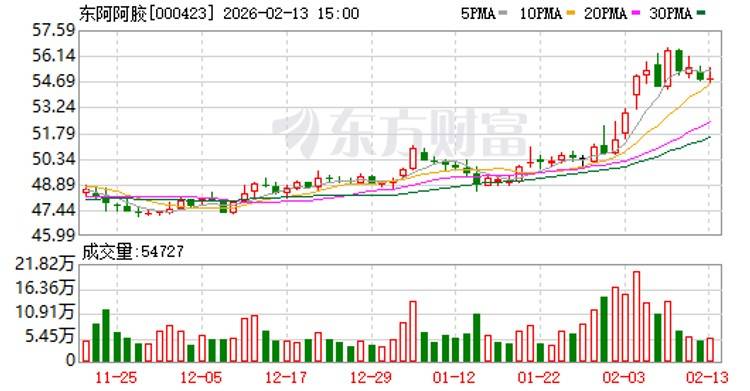
东阿阿胶瞄准年轻养生市场
Bei Jing Ri Bao Ke Hu Duan· 2026-02-11 23:25
Core Viewpoint - Dong'e Ejiao is focusing on cultivating a "second growth curve" by investing 1.485 billion yuan in a health consumer goods industrial park to meet the consumption demands of younger consumers for health products [1][3]. Group 1: Investment Details - On February 11, Dong'e Ejiao announced plans to invest 1.485 billion yuan, with 1.421 billion yuan allocated for fixed assets and 64 million yuan for working capital, to build a health consumer goods industrial park [3]. - The project will focus on the production of food and health products, including medicinal food, health supplements, and functional foods, along with supporting logistics, quality inspection centers, and e-commerce sorting [3]. Group 2: Market Trends and Strategic Importance - The investment aligns with the rapid development of the health industry and the trend of "health preservation becoming younger," aiming to match the evolving consumption needs of younger demographics [3]. - Dong'e Ejiao's revenue from its main product, Ejiao and related products, was 2.845 billion yuan in the first half of 2025, accounting for over 90% of total revenue, highlighting the importance of this investment for future growth [3]. Group 3: Challenges and Industry Context - The health consumer goods sector is characterized by diverse demand and rapid product iteration, necessitating higher standards for R&D, quality, and agile supply chains [4]. - Dong'e Ejiao faces challenges such as limited expansion capacity in existing facilities and supply constraints for raw materials, particularly donkey hides, due to a declining domestic donkey population [4][5]. - The rising prices of donkey meat and the overall pressure on raw material supply are significant concerns for the company, which is attempting to build a more sustainable supply chain [5].


东阿阿胶重金寻找“第二增长曲线”
Bei Jing Shang Bao· 2026-02-11 16:35
Core Viewpoint - Dong'e Ejiao is prioritizing the cultivation of a "second growth curve" by investing in a health consumer goods industrial park to meet the consumption demands of younger consumers for health products [1][3]. Investment and Project Details - The company plans to invest 1.485 billion yuan (including 1.421 billion yuan for fixed assets and 64 million yuan for working capital) in the industrial park project, which will focus on the production and logistics of health consumer goods, including food and health supplements [1][3]. - The project aims to align with the rapid development of the health industry and the emerging trend of "health management for the young," providing a core driving force for future performance growth [3]. Business Strategy and Market Position - Dong'e Ejiao is expanding its health consumer goods business alongside its pharmaceutical operations, aiming to create a dual-driven growth model [5]. - The construction of the new facility is seen as a proactive attempt to address the challenges posed by tight raw material supplies, particularly the scarcity of donkey hides, which are essential for their main product, Ejiao [5]. Raw Material Supply Challenges - The company is facing a tightening supply of raw materials, particularly due to a decline in the domestic donkey population, which has led to rising prices for donkey meat and hides [4]. - The chairman of Aoyou International emphasized the need for Dong'e Ejiao to transition from passive reliance on raw materials to actively building a complete industry chain ecosystem to ensure sustainable growth [4].

瞄准年轻养生市场!砸重金培育“第二增长曲线”,东阿阿胶斥资近15亿元投建健康消费品产业园
Bei Jing Shang Bao· 2026-02-11 11:27
Core Viewpoint - Dong'e Ejiao is focusing on cultivating a "second growth curve" by investing 1.485 billion yuan in a health consumer goods industrial park to meet the consumption demands of younger consumers for health products [1][5]. Group 1: Investment and Project Details - The company announced on February 11 that it plans to invest 1.485 billion yuan, with 1.421 billion yuan allocated for fixed assets and 0.64 billion yuan for working capital, to build a health consumer goods industrial park [1]. - The project will focus on the production of food and health products, including medicinal food, health supplements, and functional foods, along with supporting logistics, quality inspection centers, new product incubation centers, and e-commerce sorting and storage [1]. Group 2: Business Strategy and Market Trends - Dong'e Ejiao's investment aligns with the rapid development of the health industry and the emerging trend of "healthcare for the young," aiming to capture the evolving consumer demands for health products [5]. - The project is designed to address the urgent needs of the company's health consumer goods business, which requires higher standards for research and development, quality, and agile supply chains due to diverse consumer demands and rapid product iterations [5]. Group 3: Raw Material Supply Challenges - The company has been facing tight raw material supply issues, particularly due to a decline in the domestic donkey population, which has led to increased prices for donkey skin, a key raw material for its products [6]. - The rising prices of donkey meat have put pressure on the entire supply chain, and the company has acknowledged the challenges in securing raw materials due to the decreasing number of donkeys and the time required for research and breeding technologies [6]. Group 4: Future Growth Potential - Dong'e Ejiao is working to establish a dual-driven growth model by expanding its health consumer goods business alongside its pharmaceutical operations, which is seen as a proactive attempt to navigate the challenges posed by raw material supply constraints [7]. - The success of this investment in the industrial park and its ability to create new growth avenues under raw material pressure remains to be seen [7].
东阿阿胶:拟投资14.85亿元建设健康消费品产业园,建设周期约22个月
Cai Jing Wang· 2026-02-11 06:22
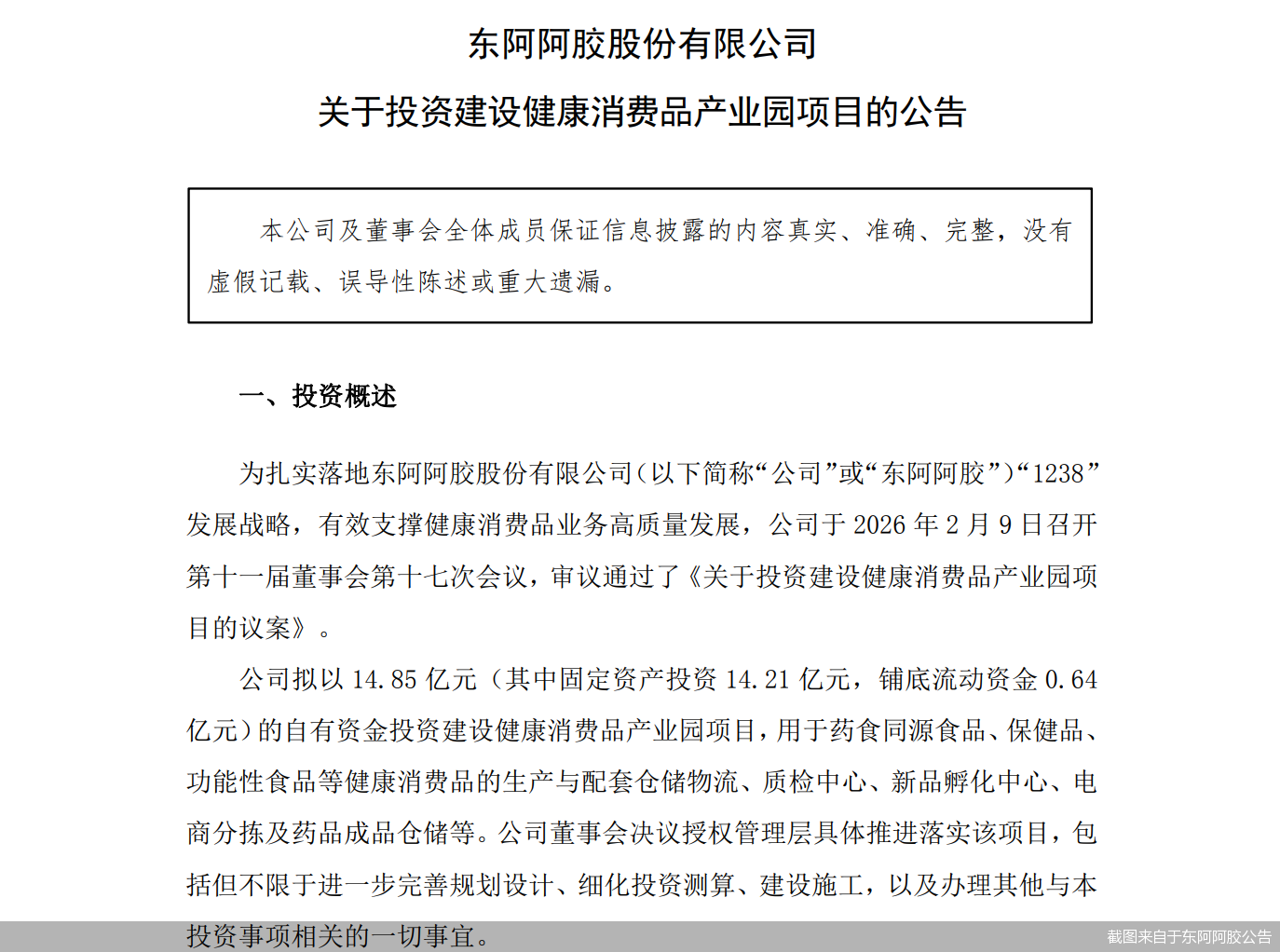
Core Viewpoint - Dong'e Ejiao (000423) announced an investment of 1.485 billion yuan to establish a health consumer goods industrial park, aimed at supporting the high-quality development of its health consumer goods business [1] Investment Details - The total investment amounts to 1.485 billion yuan, with 1.421 billion yuan allocated for fixed asset investment and 64 million yuan for working capital [1] - The project will be located in the Economic Development Zone of Dong'e County, Liaocheng City, Shandong Province, with an estimated construction period of approximately 22 months [1] Strategic Alignment - This investment is seen as a necessary step in implementing the company's "1238" development strategy, aligning with the urgent needs of the health consumer goods business [1] - The project aims to effectively ensure the supply capacity of health consumer goods, promoting the company's sustainable high-quality development [1]
东阿阿胶(000423.SZ)拟14.85亿元投资建设健康消费品产业园项目
智通财经网· 2026-02-10 12:16
Core Viewpoint - Dong'e Ejiao (000423.SZ) plans to invest 1.485 billion yuan in a health consumer goods industrial park project, focusing on the production and logistics of health-related products [1] Investment Details - The total investment includes 1.421 billion yuan for fixed assets and 64 million yuan for working capital [1] - The project aims to produce health food, health supplements, and functional foods, along with supporting facilities such as warehouses, quality inspection centers, and e-commerce sorting [1] Management Authorization - The company's board has authorized the management to advance the project, which includes refining planning designs, detailing investment calculations, and overseeing construction [1] - Management is also responsible for handling all matters related to this investment initiative [1]
东阿阿胶:拟以14.85亿元投资建设健康消费品产业园项目
Xin Lang Cai Jing· 2026-02-10 10:04
Core Viewpoint - The company plans to invest 1.485 billion yuan in a health consumer goods industrial park project, focusing on the production of health-related products and logistics facilities [1] Group 1: Investment Details - The total investment amounts to 1.485 billion yuan, which includes 1.421 billion yuan for fixed asset investment and 64 million yuan for working capital [1] - The project will cover a total land area of 406,800 square meters and is expected to take approximately 22 months to complete [1] Group 2: Project Purpose - The industrial park will be used for the production of food and medicine integration products, health supplements, and functional foods [1] - Facilities will include storage and logistics, quality inspection center, new product incubation center, e-commerce sorting, and finished drug warehousing [1]
健康消费“去中心化”,Swisse的Mega Brand踩中了这一变化
Ge Long Hui· 2025-12-27 08:47
Group 1 - The current trend in China's health consumption market can be summarized as "decentralization," indicating a shift in consumer demographics, scenarios, and decision-making processes, which raises the requirements for brand organization and product structure [1] - The traditional growth model driven by a single brand or product is becoming increasingly unsustainable, with long-term competitiveness now relying on a brand system that addresses various consumer life stages and health needs [1] - Swisse's "Mega Brand" strategy is a proactive response to this trend, focusing on building a clear brand hierarchy around the main brand to achieve systematic coverage of different consumer groups and consumption depths [1] Group 2 - From an investment perspective, the value of the Mega Brand lies not in short-term growth speed but in sustainable growth and cyclical resilience, with brands that possess matrix capabilities showing higher visibility and more controllable fluctuations in performance [2] - For the health group, Swisse represents not just a standout single brand but a growth paradigm that aligns with the current health consumption phase, emphasizing a structure-driven growth model rather than a single-point-driven approach [2]
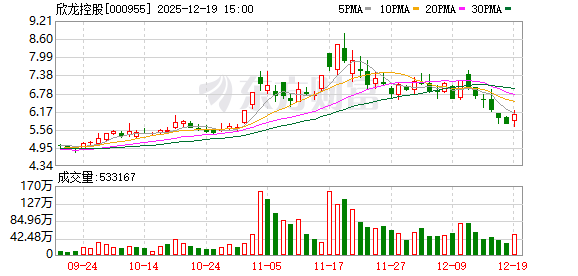
欣龙控股:目前业务主要涉及非织造新材料、健康消费品以及医药等领域
Zheng Quan Ri Bao· 2025-12-19 09:12
Group 1 - The core viewpoint of the article highlights that Xinlong Holdings is focused on its development positioning of "rooted in Hainan Free Trade Port, serving a healthy and beautiful life" [2] - The company's current business primarily involves non-woven new materials, health consumer products, and pharmaceuticals [2]