生猪养殖

Search documents
东方证券农林牧渔行业周报:10月生猪供给压力落地,产能去化加速-20251129
Orient Securities· 2025-11-29 13:51
Investment Rating - The report maintains a "Positive" investment rating for the agriculture industry [5] Core Insights - The report highlights the acceleration of production capacity reduction in the pig farming sector, driven by recent policies and market conditions, which is expected to enhance long-term performance in the sector [3][9] - The report identifies several investment opportunities across different segments of the agriculture industry, including pig farming, feed, planting, and pet food sectors [3][32] Summary by Relevant Sections Pig Farming - The report notes a significant reduction in breeding sows, with the number decreasing to 39.9 million heads by the end of October 2025, a month-on-month decline of 1.1% and a year-on-year decline of 2.1% [9] - October saw a substantial increase in pig slaughtering, with 38.34 million pigs processed, representing a month-on-month increase of 7% and a year-on-year increase of 26.2% [9] - The average price for market pigs dropped to 12.27 yuan/kg in October, down 11% month-on-month and 32.4% year-on-year, indicating a challenging profitability environment for the industry [9][40] Feed Sector - The report indicates that raw material prices for feed are stabilizing at the bottom, with corn prices averaging 2329.8 yuan/ton, up 2.17% week-on-week, and soybean meal prices at 3107.43 yuan/ton, up 1.04% week-on-week [21][40] Planting Chain - The report emphasizes a positive outlook for the planting and seed industry, with grain prices on an upward trend, highlighting significant investment opportunities in large-scale planting [3][32] Pet Food Sector - The pet food industry is experiencing growth, with increasing recognition of domestic brands and continuous market expansion, presenting investment opportunities in leading companies [3][32]
辉煌“十四五” 壮美新答卷 | 与乡亲们想在一起干在一起
Guang Xi Ri Bao· 2025-11-29 02:21
原标题: 2021年以来,我区共分三批次选派5.8万余名驻村干部 与乡亲们想在一起干在一起 初冬,玉林市陆川县"陆川猪"产业园里,一头头生猪膘肥体壮已达出栏标准,工人们正有条不紊地 将这些"二师兄"赶上专用转运车,它们将陆续发往定点屠宰场。 玉林市应急管理局派驻陆川县横山镇陆洪村工作队员包快,在这里扎根两年,为"陆川猪"产业发展 作出了贡献。 "抓好产业发展,才能带领群众走上致富路子。"在今年全区2023—2024年度驻村工作队先进集体和 优秀个人总结表彰会议上,包快分享心得。两年来,他立足当地种养资源禀赋,积极争取200万元财政 资金建设"陆川猪"产业园,并主动引进"金融活水",全村396户获得授信1640万元,有效破解村民产业 发展资金难题。 持续选派驻村第一书记和工作队员,是巩固拓展脱贫攻坚成果同乡村振兴有效衔接的重要制度安 排。近年来,广西不断完善政策、健全机制,通过健全驻村干部选、育、管、励全链条体系,着力锻造 政治过硬、本领过硬、作风过硬的"驻村铁军",为推进乡村全面振兴提供坚强有力保障。2021年以来, 共分三批次选派5.8万余名驻村干部下沉一线,与乡亲们想在一起、干在一起,在实干中让乡村焕发出 ...
新股消息 | 牧原股份港股IPO获中国证监会备案
Zhi Tong Cai Jing· 2025-11-28 13:02
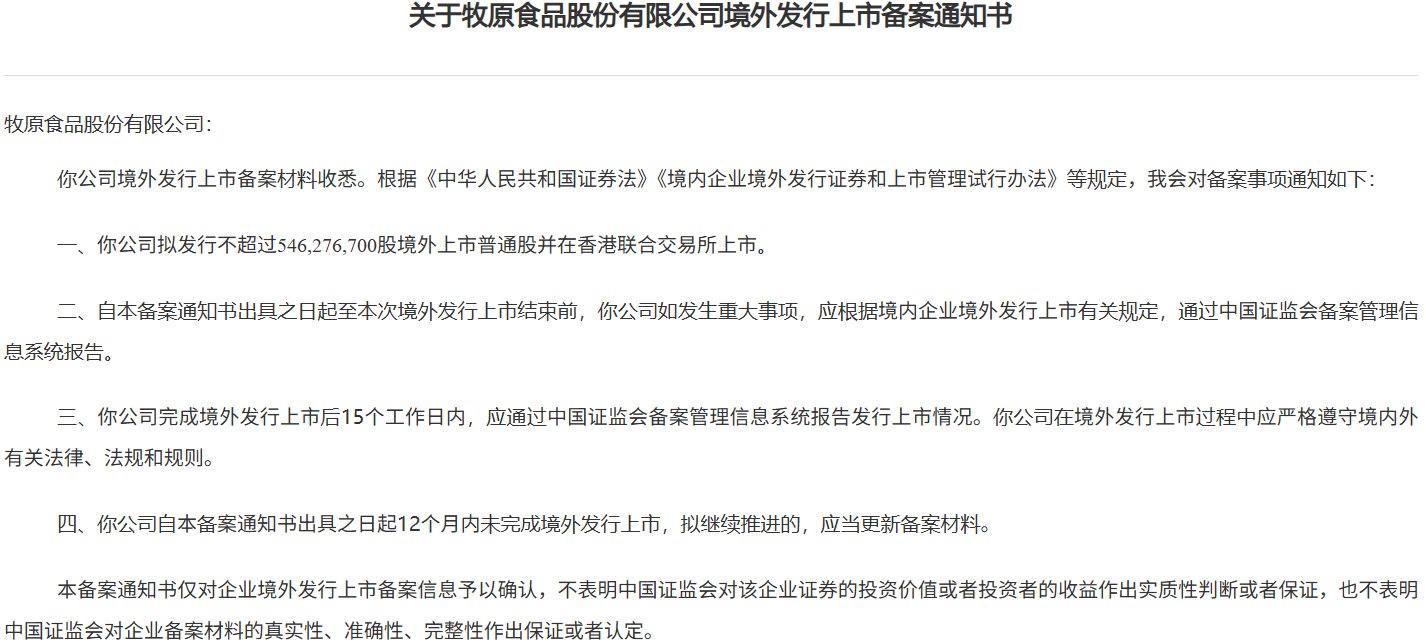
Core Viewpoint - The China Securities Regulatory Commission has issued a notice regarding Muyuan Foods Co., Ltd.'s plan to issue up to 546,276,700 overseas listed ordinary shares and list them on the Hong Kong Stock Exchange [1] Group 1: Company Overview - Muyuan Foods is a technology-driven leader in the pork industry and a pioneer in smart pig farming [3] - The company employs a vertically integrated business model that covers the entire pork industry chain, including pig breeding, pig farming, feed production, and meat processing [3]


牧原股份港股IPO获中国证监会备案
Zhi Tong Cai Jing· 2025-11-28 12:56
Group 1 - The core viewpoint of the article is that Muyuan Foods Co., Ltd. plans to issue up to 546,276,700 overseas listed ordinary shares and list them on the Hong Kong Stock Exchange [1] - Muyuan Foods is recognized as a technology-driven leader in the pork industry and a pioneer in smart pig farming [3] - The company employs a vertically integrated business model that encompasses the entire pork industry chain, including pig breeding, pig farming, feed production, and meat processing [3]
牧原股份递表港交所 为全球第一大生猪养殖企业
Zhi Tong Cai Jing· 2025-11-28 12:21
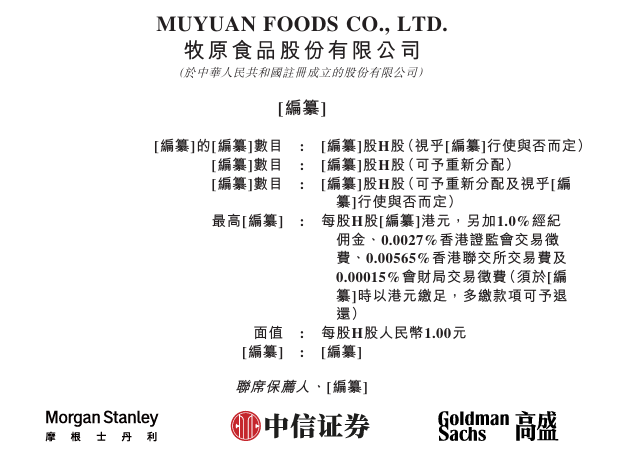
Core Viewpoint - Muyuan Foods Co., Ltd. (牧原股份) has submitted an application to list on the Hong Kong Stock Exchange, with Morgan Stanley, CITIC Securities, and Goldman Sachs as joint sponsors [1][27]. Company Overview - Muyuan Foods is a technology-driven leader in the pork industry, operating a vertically integrated business model that covers the entire pork production chain, including breeding, farming, feed production, and slaughtering [3]. - The company operates through two main business segments: pig farming (selling market pigs, piglets, and breeding pigs) and slaughtering (including the sale of carcasses, cuts, and by-products) [3]. - Major products include live pigs and fresh or frozen meat products, ensuring transparency, quality control, and traceability throughout the production process [3]. Financial Performance - Revenue for the years 2022, 2023, 2024, and the six months ending June 30, 2025, was recorded at RMB 124.83 billion, RMB 110.86 billion, RMB 137.95 billion, and RMB 76.46 billion, respectively [5]. - Net profit for the same periods was RMB 14.93 billion, a loss of RMB 4.17 billion, RMB 18.93 billion, and RMB 10.79 billion [6]. - Gross profit margins were 17.5%, 3.1%, 19.1%, and 19% for the respective years [8]. Market Position - According to Frost & Sullivan, Muyuan Foods is the largest pig farming enterprise globally by production capacity and output, with a market share increasing from 2.6% in 2021 to 5.6% in 2024 [4]. - The company entered the slaughtering business in 2019, and by 2024, it ranked fifth globally and first in China in terms of slaughter volume [4]. Industry Overview - Global pork consumption has been on the rise, with a compound annual growth rate (CAGR) of 4.9% from 2020 to 2024, reaching 115.3 million tons in 2024 [10]. - China's pork consumption is stabilizing, with an expected volume of 58.2 million tons in 2024, and is projected to fluctuate around 59 million tons from 2025 to 2029 [10]. - The number of breeding sows in China decreased from 41.6 million in 2020 to 40.8 million in 2024, while the output of pigs is expected to reach approximately 707.3 million by 2029 [13]. Pricing Trends - The average market price of pigs in China has shown significant fluctuations due to supply and demand dynamics, with prices peaking at RMB 33.9 per kilogram in 2020 and dropping to RMB 15.1 per kilogram in 2023 [19].
新股消息 | 牧原股份递表港交所 为全球第一大生猪养殖企业
Zhi Tong Cai Jing· 2025-11-28 11:50
Company Overview - Muyuan Foods Co., Ltd. is a technology-driven leading pork enterprise and a pioneer in smart pig farming, operating a vertically integrated business model covering the entire pork industry chain from breeding to slaughter [3][4] - The company operates through two main business segments: pig farming and meat processing, with its primary products being live pigs and fresh or frozen meat products [3][4] - As of June 30, 2025, the company has established over 1,000 pig farms across 23 provinces in China [3] Financial Performance - The company reported revenues of RMB 124.83 billion, RMB 110.86 billion, RMB 137.95 billion, and RMB 76.46 billion for the years 2022, 2023, 2024, and the six months ending June 30, 2025, respectively [5] - Net profits for the same periods were RMB 14.93 billion, a loss of RMB 4.17 billion, RMB 18.93 billion, and RMB 10.79 billion [6] - The gross profit margins were 17.5%, 3.1%, 19.1%, and 19% for the respective years [8] Market Position - According to Frost & Sullivan, Muyuan Foods is the largest pig farming enterprise globally by production capacity and output, with a market share increase from 2.6% in 2021 to 5.6% in 2024 [4] - The company entered the meat processing business in 2019, and by 2024, it ranked fifth globally and first in China in terms of slaughter volume [4] Industry Overview - Global pork consumption is on the rise, with a compound annual growth rate (CAGR) of 4.9% from 2020 to 2024, reaching 115.3 million tons in 2024 [10] - China is the largest pork producer and consumer, with pork consumption stabilizing around 58.2 million tons in 2024 [10] - The number of breeding sows in China decreased from 41.6 million in 2020 to 40.8 million in 2024, while the pig output is expected to grow at a CAGR of 7.5% from 2020 to 2024 [13] Shareholding Structure - As of November 20, 2025, the controlling shareholders, including Qin Yinglin and Qian Ying, collectively hold approximately 54.91% of the total share capital and control 55.62% of the voting rights [24]
新股消息 | 牧原股份(002714.SZ)递表港交所 为全球第一大生猪养殖企业
智通财经网· 2025-11-28 11:47
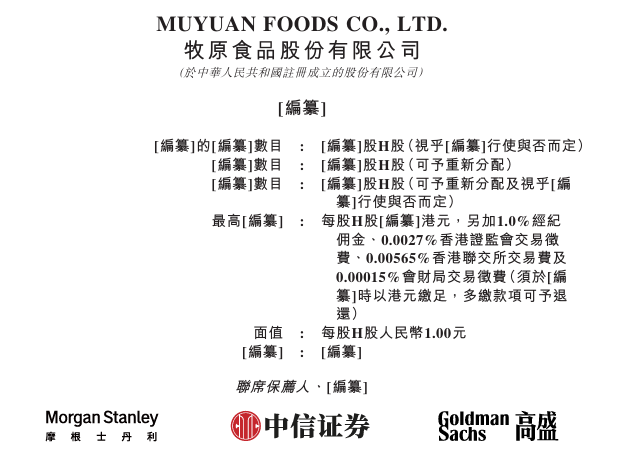
Company Overview - Muyuan Foods Co., Ltd. (referred to as "the Company") has submitted an application to list on the Hong Kong Stock Exchange, with Morgan Stanley, CITIC Securities, and Goldman Sachs as joint sponsors [1] - The Company is a technology-driven leader in the pork industry, operating a vertically integrated business model that covers the entire pork production chain, including breeding, farming, feed production, and slaughtering [3][4] - The Company's main products include live pigs (commercial pigs, piglets, and breeding pigs) and fresh and frozen meat products, ensuring food safety and quality control through a fully transparent production process [3] Financial Performance - The Company recorded revenues of RMB 124.83 billion, RMB 110.86 billion, RMB 137.95 billion, and RMB 76.46 billion for the years 2022, 2023, 2024, and the six months ending June 30, 2025, respectively [5] - Net profits for the same periods were RMB 14.93 billion, a loss of RMB 4.17 billion, RMB 18.93 billion, and RMB 10.79 billion [6] - The gross profit margins were 17.5%, 3.1%, 19.1%, and 19% for the years 2022, 2023, 2024, and the six months ending June 30, 2025, respectively [8] Market Position - According to Frost & Sullivan, the Company is the largest pig farming enterprise globally by production capacity and output, with a market share increase from 2.6% in 2021 to 5.6% in 2024 [4] - The Company's slaughtering and meat business ranked fifth globally and first in China by the number of pigs slaughtered in 2024, with the highest compound annual growth rate in revenue among large Chinese competitors from 2021 to 2024 [4] Industry Overview - Global pork consumption has been on the rise, with a compound annual growth rate of 4.9% from 2020 to 2024, reaching 115.3 million tons in 2024 [10] - China is the largest pork producer and consumer, with pork consumption stabilizing around 58.2 million tons in 2024 and expected to fluctuate around 59 million tons from 2025 to 2029 [10] - The number of breeding sows in China decreased from 41.6 million in 2020 to 40.8 million in 2024, while the output of pigs is projected to grow at a compound annual growth rate of 7.5% from 2020 to 2024 [13] Shareholding Structure - As of November 20, 2025, the controlling shareholders, including Mr. Qin Yinglin, Ms. Qian Ying, and Muyuan Group, collectively hold approximately 54.91% of the total share capital and control 55.62% of the voting rights [25]
新股消息 | 牧原股份(002714.SZ)递表港交所
智通财经网· 2025-11-28 10:33
Core Insights - Muyuan Foods Co., Ltd. has submitted an application to list on the Hong Kong Stock Exchange, with Morgan Stanley, CITIC Securities, and Goldman Sachs as joint sponsors [1] - The company is a technology-driven leader in the pork industry, recognized as a pioneer in smart pig farming, and operates a vertically integrated business model covering the entire pork supply chain [1] Industry Position - According to Frost & Sullivan, since 2021, Muyuan Foods has been the largest pig farming enterprise globally in terms of production capacity and slaughter volume, maintaining the highest slaughter volume for four consecutive years [1] - The company expanded into the pork slaughtering and meat processing business in 2019 to enhance its operational advantages across the entire supply chain [1] Financial Performance - By 2024, Muyuan Foods is projected to rank fifth globally and first in China in terms of slaughter numbers, according to Frost & Sullivan [1] - The revenue compound annual growth rate (CAGR) of the company's slaughtering and meat processing business from 2021 to 2024 is expected to be the highest among large peers in the Chinese industry [1]
新股消息 | 牧原股份递表港交所
智通财经网· 2025-11-28 10:31
Core Viewpoint - Muyuan Foods Co., Ltd. has submitted an application to list on the Hong Kong Stock Exchange, with Morgan Stanley, CITIC Securities, and Goldman Sachs as joint sponsors. The company is recognized as a technology-driven leader in the pork industry, employing a vertically integrated business model that covers the entire pork production chain from breeding to slaughtering and meat processing [1]. Group 1: Company Overview - Muyuan Foods is the largest pig farming enterprise globally in terms of production capacity and output since 2021, maintaining the highest pig output for four consecutive years [1]. - The company expanded into the pork slaughtering and meat processing business in 2019 to enhance its operational advantages across the entire industry chain [1]. Group 2: Market Position and Growth - According to Frost & Sullivan, Muyuan Foods is projected to rank fifth globally and first in China in terms of slaughtering numbers by 2024 [1]. - The revenue compound annual growth rate (CAGR) of the company's slaughtering and meat processing business from 2021 to 2024 is the highest among large peers in the Chinese industry [1].
忘掉今年吧,明年的消费应该怎么布局?
格隆汇APP· 2025-11-28 09:26
Core Viewpoint - The article discusses the current state of the consumer market, highlighting that consumer sectors have underperformed for four consecutive years, suggesting a potential rebound in the upcoming year if certain conditions are met [2][3]. Group 1: Current Market Conditions - The overall consumer performance this year has been poor due to a general economic slowdown, with retail sales growth at only 2.9% in October [5]. - Real estate prices have been declining, with predictions of continued downward pressure, impacting household wealth and consumer spending [7][13]. - The largest segment in consumer stocks is liquor, particularly Maotai, which has seen its wholesale price drop below 1600, down from over 3800 four years ago, indicating a significant decline in consumer sentiment [10]. Group 2: Future Consumer Outlook - If there is a recovery in the overall economy, low-priced consumer stocks with reasonable valuations could see significant growth [12]. - However, the likelihood of an economic recovery next year is low, with continued declines in real estate prices and a slowdown in exports [14]. - The article suggests that consumer spending will remain constrained due to shrinking household wealth, with a potential recovery not expected until 2027 [13]. Group 3: Specific Consumer Opportunities - Despite the overall economic challenges, there are specific consumer segments that may present opportunities, such as tourism-related spending from foreign visitors and affluent domestic consumers [16][18]. - The article emphasizes the importance of focusing on sectors with significant scale advantages, which can outperform competitors even in a sluggish economy [18]. - New consumption trends, such as trendy toys, gold jewelry, and pet products, may still show growth potential despite the overall market conditions [18]. Group 4: Monitoring and Strategy - Investors are advised to keep an eye on policy changes that could impact the overall economy and consumer spending, while focusing on specific segments that are less affected by the broader economic downturn [20]. - The article suggests that the consumer sector should prioritize niche markets and segments that cater to affluent consumers or benefit from international tourism [18][20].