存储

Search documents
中信证券:26H1存储合约价仍有望保持快速上涨,看好景气至少持续至2026年底
Mei Ri Jing Ji Xin Wen· 2025-12-04 00:44
Core Viewpoint - The report from CITIC Securities indicates that since Q2 2025, the mainstream storage prices have experienced significant absolute increases due to "supply optimization and AI-driven demand" [1] Group 1: Market Conditions - The market has fully transitioned into a "seller's market" by Q4 2025, with steep price increases observed [1] - Despite the current seller's market, the industry is still in the early stages of a super cycle, suggesting continued growth potential [1] Group 2: Future Outlook - High visibility of shortages is expected over the next six months, supporting a positive outlook for mainstream storage DRAM/NAND and niche storage prices in the first half of 2026 [1] - Contract prices are anticipated to rise rapidly, aiming to catch up with the increases in spot prices, indicating sustained demand exceeding supply at least until the end of 2026 [1]

中信证券:预计存储行业供不应求至少持续至2026年底
Zheng Quan Shi Bao Wang· 2025-12-04 00:37
人民财讯12月4日电,中信证券表示,存储仍处于超级景气周期初期,目前未来半年缺货可见度高,合 约价涨价幅度在2026年一季度末之前有望扩大或维持,累计涨幅追赶现货价涨幅。预计行业供不应求至 少持续至2026年底,乐观看待本轮结构性周期景气的持续性。更贴近存储原厂的公司在上行周期受益程 度更大、盈利持续性更强,核心推荐1)利基型存储开启涨价;2)企业级存储进展快、涨价受益逻辑强的 公司;3)企业级SSD/内存配套芯片设计公司有望间接受益。 ...
中信证券:存储行业景气至少持续至2026年底
Xin Lang Cai Jing· 2025-12-04 00:37
Core Viewpoint - The report from CITIC Securities indicates that despite entering a "seller's market" in Q4 2025, the industry is still in the early stages of a super cycle, with high visibility of shortages in the next six months [1] Group 1: Market Conditions - The main storage segments, including DRAM and NAND, are expected to see price increases in the first half of 2026 [1] - Contract prices are anticipated to rise rapidly, catching up with the increases in spot prices [1] - The industry is expected to experience a supply-demand imbalance that will last at least until the end of 2026 [1] Group 2: Industry Outlook - The current cycle's prosperity is viewed optimistically, suggesting a sustained period of growth in the storage market [1]
中概股普跌,阿特斯太阳能跌超9%,蔚来跌近5%,铜、锡狂飙创新高
2 1 Shi Ji Jing Ji Bao Dao· 2025-12-03 23:33
Market Overview - Major U.S. stock indices showed mixed performance, with the Dow Jones up by 408.44 points (+0.86%), the S&P 500 rising by 20.35 points (+0.30%), while the Nasdaq saw a decline of 107.49 points (-1.38%) [1] - Large tech stocks exhibited varied movements; Tesla increased over 4%, Google rose more than 1%, while Microsoft, Meta, and Nvidia fell over 1% [1] Chinese Stocks - The Nasdaq Golden Dragon China Index fell by 1.38%, with notable declines in several Chinese companies: - Aiko Solar down over 9% - NIO and Xpeng down approximately 4% - Li Auto and New Oriental down over 3% [2] Commodity Market - Base metals experienced a general increase, with LME tin rising nearly 4.4% and LME copper up by 2.7%, reaching historical highs [4] - The price of copper is expected to rise significantly due to supply disruptions and global inventory mismatches, potentially reaching $12,500 per ton by mid-2026 [4] Cryptocurrency Market - Cryptocurrencies saw a collective rise, with Bitcoin surpassing $93,000, marking a 1.8% increase [6] - Over the past 24 hours, more than 106,000 traders faced liquidation, totaling approximately $360 million [6] Federal Reserve Insights - Speculation around the next Federal Reserve Chair is intensifying, with Kevin Hassett emerging as a leading candidate, potentially influencing market expectations for interest rate adjustments [7] - The probability of a 25 basis point rate cut by the Federal Reserve in December has surged to 89% [7]


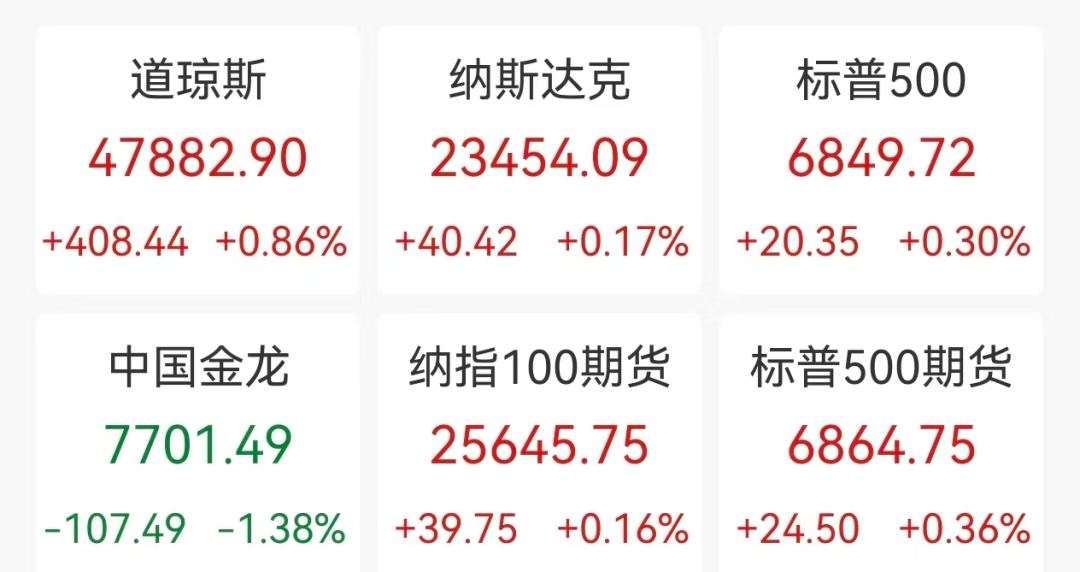
美股三大指数集体收涨,有色金属、加密储备概念股涨幅居前
Feng Huang Wang Cai Jing· 2025-12-03 22:34
Market Performance - The three major U.S. stock indices closed higher, with the Dow Jones up 0.86%, Nasdaq up 0.17%, and S&P 500 up 0.3% [1] - The Nasdaq China Golden Dragon Index fell by 1.38%, with most popular Chinese concept stocks declining, including NIO and Xpeng down over 4%, and Li Auto and New Oriental down over 3% [1] Technology Sector - Large tech stocks showed mixed performance, with Tesla rising over 4% and Google up over 1%, while Microsoft fell over 2% and Meta and Nvidia dropped over 1% [2] - The performance of storage and lithium stocks declined, with SanDisk down over 5% and other companies like Micron Technology and Western Digital down over 2% [2] Employment Data - The U.S. ADP employment numbers for November showed a decrease of 32,000 jobs, the lowest level since March 2023, falling short of market expectations [3] Federal Reserve Insights - Deutsche Bank indicated that Jerome Powell may remain on the Federal Reserve Board after his term as Chairman ends, potentially to maintain the independence of monetary policy [4] - The Federal Reserve's deferred asset size has begun to shrink, indicating a potential end to its ongoing losses, which were primarily due to high interest rates [5] Cryptocurrency Market - Following a significant drop at the beginning of December, the cryptocurrency market stabilized, with a survey showing only 7.5% of traders expecting a "crypto winter," down from 30% previously [6] Currency Exchange Rates - The Chinese yuan appreciated against the U.S. dollar, with the central parity rate adjusted up by 40 basis points to 7.0754, marking the highest level since October 14, 2024 [7]
美股异动丨Pure Storage绩后重挫超26%,拖累其他存储概念股走低
Ge Long Hui· 2025-12-03 15:25
Pure Storage绩后重挫超26%,闪迪跌超7%,西部数据跌4.3%,美光科技跌3.2%。消息面上,Pure Storage发布2026财年第三季度业绩,营收为9.645亿美元,略超过市场预期的9.55亿美元;调整后每股 收益为0.58美元,符合预期;非通用会计准则下营业利润率为20.3%,略高于去年同期的20.1%。尽管公 司营收超预期并上调全年指引,投资者似乎仍对业绩感到失望。(格隆汇) ...

抢抓AI存储上行机遇 上市公司募资扩产忙
Zheng Quan Ri Bao Zhi Sheng· 2025-12-03 13:40
Core Viewpoint - The AI storage market is experiencing significant growth, prompting companies to accelerate their investment and development efforts in high-end storage solutions to meet increasing demand driven by AI technologies [1][2]. Group 1: Company Developments - Jiangbolong plans to raise up to 3.7 billion yuan for R&D and industrialization of high-end storage solutions targeting the AI sector, semiconductor storage control chips, and high-end packaging and testing [1]. - Demingli aims to raise up to 3.2 billion yuan for expanding SSD and DRAM production, as well as establishing a smart storage management and R&D headquarters [2]. - Zhaoyi Innovation reported rapid market share gains for its DDR4 8Gb products and plans to mass-produce self-developed LPDDR4 series products next year [3]. Group 2: Market Trends - The demand for storage is being driven by the exponential growth of generative AI and large model technologies, leading to a significant increase in data processing needs [1]. - DRAM spot prices surged, with DDR5 chips increasing by 30% in one week due to tight supply and limited shipments from major module manufacturers [2]. - The storage industry is expected to enter a prolonged "super cycle" due to AI-driven supply shortages, with market demand continuing to rise [1][2]. Group 3: Industry Standards and Collaboration - The establishment of the Future Storage working group aims to develop AI storage standards and promote a technical framework for storage architecture and performance evaluation [3][4]. - The working group will focus on key technologies such as KV Cache optimization and storage acceleration for AI inference [3].

华为周跃峰:中国存储产业内外承压,但依然有望全球争先
第一财经· 2025-12-03 07:16
Core Viewpoint - The article discusses the current state and future prospects of the Chinese storage industry, emphasizing the challenges posed by international competition and internal price wars, while also highlighting the opportunities presented by the rise of AI and data storage needs [3][4][6]. Industry Challenges - The global storage market has reached a scale of nearly $100 billion, but many domestic storage manufacturers in China are still caught in price wars, while international giants have their HBM production capacity booked until 2027 [3][6]. - The mechanical hard disk (HDD) market in China consumes nearly 60 billion yuan annually, but the lack of core technology and insufficient production capacity puts the industry in a passive position amid global supply fluctuations [3][8]. Opportunities in the Storage Industry - Despite challenges, there is optimism about the future of the Chinese storage industry, with significant advancements in domestic technology and production capabilities [4][6]. - The annual data generation in China has increased dramatically, and the country has achieved a high level of domestic production in storage components and systems [4][6]. AI's Impact on Storage - The rise of AI is driving demand for storage solutions, with major global players like Samsung, SK Hynix, and Micron shifting their production towards HBM-related chips, leading to a tightening supply of standard storage products [6][8]. - The development of AI is reshaping the storage industry, necessitating a shift from traditional IT systems to data-centric architectures that can handle massive data processing and transmission [9][10]. Future Directions - Huawei plans to launch an AI data platform that integrates AI capabilities into storage solutions, indicating a shift towards intelligent data platforms rather than mere data storage [10][12]. - The traditional data tiering system is being simplified in the AI era, with all data potentially needing to be accessed at any time, which requires new storage media that can handle large volumes economically [11][12]. Call for Innovation - There is a strong call for domestic storage companies to move beyond low-level price competition and focus on technological innovation to enhance their competitiveness in the global market [12]. - The storage market is projected to grow significantly as digitalization transitions to intelligence, highlighting the importance of accelerating technological advancements in the storage industry [12].

手机、电脑大概率要涨价了
第一财经· 2025-12-03 04:17
Core Viewpoint - The storage industry is experiencing unprecedented price increases, with expectations of further significant hikes in the near future due to supply shortages and increased demand from AI applications [3][10]. Industry Preparedness - The storage supply chain is unprepared for the sudden price increases, with many manufacturers caught off guard by the scale of the shortages [8][10]. - NAND flash manufacturers have already booked production capacity for the next three years, leaving no room for additional orders in the near term [5][10]. Price Trends - Prices for NAND flash memory have surged dramatically, with 1Tb QLC NAND flash prices increasing by 78% and DDR4 16Gb prices rising by 50% in late November [6][10]. - SSD prices have also seen significant increases, with some manufacturers reporting a 30%-40% rise in October compared to September [6][10]. Supply Chain Dynamics - The demand for storage from cloud service providers, particularly in North America, is absorbing a large portion of the available capacity, leaving consumer electronics with limited supply [12]. - Current inventory levels for smartphone manufacturers are critically low, averaging below four weeks, which is insufficient to meet future demand [12][13]. Future Outlook - The ongoing price increases are expected to persist for several years, with some industry experts predicting a supply-demand gap of at least 6% for DRAM in the coming year [10][12]. - The consumer electronics market, particularly low-end smartphones, may face severe impacts from rising storage costs, potentially shifting demand towards second-hand devices [13][14]. Technological Shifts - There is a trend towards phasing out older memory technologies in favor of more advanced options like DDR5 and LPDDR5, driven by the increasing demands of AI applications [14][15]. - Companies are investing in new product lines and expanding production capacities to meet the evolving needs of the market, although significant new capacity is not expected until at least 2027 [10][15].

手机、电脑大概率要涨价了
Di Yi Cai Jing· 2025-12-03 03:53
Core Viewpoint - The storage industry is experiencing unprecedented price increases, with expectations of further significant hikes in the near future due to supply shortages and increased demand from AI applications [2][6][11]. Group 1: Price Increases and Market Dynamics - Recent smartphone models have seen price increases of 100 to 300 yuan, with expectations of even larger price hikes ahead [2]. - The NAND flash memory supply chain is currently facing severe shortages, with manufacturers unable to meet demand, leading to a halt in price quotations from several SSD module manufacturers [3][4]. - Prices for NAND flash memory have surged significantly, with 1Tb QLC NAND flash prices rising by 78% and DDR4 16Gb 3200 prices increasing by 50% compared to early November [4]. Group 2: Supply Chain Challenges - The NAND flash manufacturers have their production capacity booked for the next three years, leading to a critical shortage of available supply for downstream manufacturers [3]. - The supply chain is experiencing unexpected volatility due to a lack of preparedness for the sudden price increases and shortages [6]. - The production capacity for NAND flash is not expected to increase significantly until at least 2027, as new facilities are still in planning stages [7]. Group 3: Impact on Consumer Electronics - Consumer electronics, particularly smartphones, are expected to bear the brunt of the storage price increases, with many manufacturers currently holding low inventory levels that can only cover about four weeks of demand [9]. - The anticipated price hikes in consumer electronics are likely to lead to a decline in sales, with projections indicating a decrease in shipment volumes for smartphones and laptops in the coming year [11]. - Manufacturers are considering adjusting product specifications, such as reducing storage capacities in lower-end models, to cope with rising costs [10]. Group 4: Future Outlook and Strategic Adjustments - The storage industry is shifting focus towards more advanced products suitable for AI applications, with a trend towards phasing out older memory types [11][12]. - Companies are investing in new technologies, such as DDR5 and LPDDR5, to meet the growing demand for higher memory bandwidth driven by AI applications [12]. - Collaboration between companies, such as the partnership between Zhaoyi Innovation and Changxin Memory, is aimed at enhancing domestic DRAM production capabilities to reduce reliance on foreign suppliers [12].