房地产开发

Search documents
为什么开发商没钱了可以烂尾,老百姓拿不到房却不能断供?
Sou Hu Cai Jing· 2026-02-15 17:39
Core Viewpoint - The increasing prevalence of "unfinished buildings" in the real estate development sector is alarming, affecting both small and large developers, leading to significant distress for homebuyers who face financial burdens without receiving their purchased properties [1] Group 1: Causes of Unfinished Buildings - High debt levels severely restrict developers' financing capabilities, resulting in a dwindling cash flow and halted construction projects due to poor sales performance and inventory accumulation [3] - The lack of regulation on homebuyer prepayments allows developers to misallocate funds, leading to financial losses in other ventures and ultimately resulting in unfinished projects [4] Group 2: Reactions and Responsibilities - Many netizens express strong dissatisfaction, questioning why developers can abandon projects while homebuyers must continue to repay loans despite not receiving their homes. Banks assert that the responsibility lies with developers, as homebuyers have signed contracts that obligate them to repay loans [6] - Critics argue that banks should take responsibility for rigorously assessing borrowers' qualifications and repayment capabilities, as some banks have relaxed their scrutiny in pursuit of short-term profits, exacerbating the financial pressure on homebuyers [8] Group 3: Proposed Solutions - A comprehensive cancellation of the pre-sale system for residential properties is suggested, allowing sales only after the main structure is completed to prevent developers from misusing funds [9] - If the pre-sale model is retained, strict "designated use" management of homebuyer prepayments is necessary, ensuring that funds are not diverted by developers and are effectively regulated by relevant authorities [9]



楼市将迎来大变局?41.5%的城镇家庭,或将面临3个情况
Sou Hu Cai Jing· 2026-02-15 17:27
中国房地产市场正经历一场深刻的变革,持续了二十余载的房价上涨势头,自2021年下半年起已显露疲态,并呈现出明显的调整迹象。尤其进入2023年春 季,无论是新建商品房还是二手房交易量都出现了显著下滑,同时,越来越多的城市房价也步入了下跌通道。 具体数据显示,8月份,全国百城新建商品房价格环比下跌的城市数量达到了42个,房价已连续四个月呈现月度下跌;而二手房市场更为严峻,环比下跌城 市数量高达96个,占比超过九成半,且房价已连续16个月出现月度下跌。 其次,持有房产的成本将显著增加。 尽管银行已下调了房贷利率,但这主要惠及首套房贷,而拥有两套及以上房产家庭的房贷利率并未有大幅下调。更重 要的是,这部分家庭可能同样面临收入下降的困境,因此其偿还多笔房贷的压力将远超仅拥有一套房产的家庭。此外,物业费、供暖费等生活成本的上涨, 也会让多套房产的持有者倍感压力。 值得一提的是,当前各地房地产市场普遍不景气,地方政府的土地财政收入锐减。在此背景下,"开征房产税"的呼声日益高涨。一旦经济形势有所好转,房 产税试点城市范围很可能进一步扩大。届时,拥有多套房产家庭的持有成本将呈几何级数增长。 此轮房地产市场的大幅调整,其根源可归 ...
建发股份回复监管函:2025年由盈利转大额亏损
Feng Huang Wang· 2026-02-15 16:24
Core Viewpoint - The company, Jianfa Co., Ltd. (建发股份), has revised its 2025 financial outlook, projecting significant losses due to underperformance in its real estate and home furnishing segments, with a shift from profit to substantial losses [1] Group 1: Financial Projections - Jianfa Co., Ltd. expects 2025 revenue to be between 673.6 billion to 693.6 billion yuan, with a projected net loss attributable to shareholders ranging from 10 billion to 5.2 billion yuan [1] - The supply chain business is anticipated to generate revenue of 510 billion to 530 billion yuan, while real estate development is expected to contribute approximately 157 billion yuan, and home furnishing operations around 6.6 billion yuan [1] - The net profit margin for the supply chain business is projected to be between 0.63% to 0.67%, with real estate and home furnishing segments expected to incur significant losses [1] Group 2: Real Estate Business Performance - Jianfa Co., Ltd.'s real estate operations are managed by subsidiaries Jianfa Real Estate and Lianfa Group, which have shown contrasting performance [2] - Jianfa Real Estate is projected to achieve a net profit of approximately 6 billion yuan in 2025, while Lianfa Group is expected to incur a net loss between 10.8 billion to 9.3 billion yuan [3] - Lianfa Group's losses are attributed to market downturns and adjustments in sales strategies, leading to significant inventory write-downs estimated between 6 billion to 8 billion yuan [3] Group 3: Home Furnishing Operations - The home furnishing segment, primarily operated by subsidiary Meikailong, is expected to generate revenue of about 6.6 billion yuan but face a net loss between 22.5 billion to 15 billion yuan [4] - The decline in demand in the home retail market and reduced rental income have led to a significant drop in the fair value of investment properties, estimated to decrease by 12.6 billion to 21.5 billion yuan [4][5] - Meikailong has also made provisions for asset impairments ranging from 4.5 billion to 5.7 billion yuan, affecting various asset categories [5]

有人预测:2026年,购房者会面对4个“风险”,大众买房需要谨慎
Sou Hu Cai Jing· 2026-02-15 14:23
前几年,很多人买房的逻辑很简单: 风险一:期房烂尾 只要敢上杠杆,房子总能涨,至少能保值。 但现在再看看身边: 高位站岗的、房子卖不掉的、甚至楼盘烂尾、钱房两空的例子越来越多。 到了2026年,普通大众买房,真的要换一种思路: 不是"还能不能涨",而是"会不会踩坑"。 很多人对期房的信任,已经被这两年的烂尾楼打醒了。 有研究报告测算,全国楼盘烂尾率大约在3.85%左右,对应烂尾面积约2.31亿平方米,按每套100㎡算, 大约是231万套烂尾楼。 而仅恒大一家暴雷,就留下了上百万套烂尾项目,直接影响数百万家庭。 到了2026年,这个问题并没有完全消失: 房企整体还在"缩量过冬",开发投资、新开工面积继续下行,高杠杆房企的资金链压力依旧不小; 虽然保交楼、纾困基金在推进,但中小房企项目、三四线项目,风险依然偏高。 对普通人来说,一旦买到烂尾楼:首付打水漂,还得继续还贷,一边租房一边还月供,压力全部压在家 庭身上。 所以,2026年买房,第一条铁律就是:能选现房、次新房,就别轻易碰期房。 非要买期房,一定要看:开发商是不是在监管"白名单"里;项目有没有列入保交楼名单; 预售资金监管是否严格,有没有"明股实债"、挪用 ...
2026第一波大招落地,多地官方下场收二手房。重庆……
Sou Hu Cai Jing· 2026-02-15 12:47
Core Viewpoint - The article discusses a significant shift in the housing market, where government-led initiatives to purchase second-hand homes are emerging as a crucial trend for 2026, indicating a deep restructuring of the housing system rather than a temporary market rescue [2][25]. Group 1: Government Initiatives - Multiple cities, including Shanghai, Nanjing, Hangzhou, and Haikou, are initiating a "stock housing acquisition wave" led by the government [2]. - In Shanghai, pilot programs are being launched in key districts such as Pudong, Jing'an, and Xuhui, with specific requirements for the properties being acquired [3][5]. - The acquisition conditions include properties built before 2000, with a maximum area of 70 square meters and a total price cap of 4 million yuan, with financial support from China Construction Bank [5]. Group 2: Housing Supply and Demand Dynamics - The acquired properties will be converted into affordable rental housing to support new citizens and young people [5][10]. - The acquisition model aims to address liquidity issues in the stock housing market while simultaneously creating affordable housing options [10][11]. - The policy is designed to stimulate the new housing market by releasing funds and housing vouchers, thereby facilitating a smoother transition for homeowners [9][15]. Group 3: Broader Implications - The current initiatives are seen as a way to build confidence in the housing market and provide a predictable exit mechanism during times of slow market liquidity [13][14]. - The approach benefits multiple stakeholders, including homeowners looking to upgrade and renters seeking affordable housing, ultimately improving overall market liquidity [16]. - The article highlights that while the scope may be limited initially, the signal sent by these policies is clear: the government is actively working to revitalize the housing market [15][26]. Group 4: Case Study - Chongqing - Chongqing has not officially announced the purchase of individual second-hand homes but is exploring beneficial strategies within the broader framework of stock revitalization [18]. - In early 2024, state-owned enterprises in Chongqing acquired seven stock housing projects, totaling 4,207 units, demonstrating a proactive approach to housing supply [20]. - The city has implemented various measures to stabilize the real estate market, including a recent announcement of 22 policies aimed at revitalizing stock housing [23][24].
2026房地产,已开始悄悄救市了!
Sou Hu Cai Jing· 2026-02-15 12:47
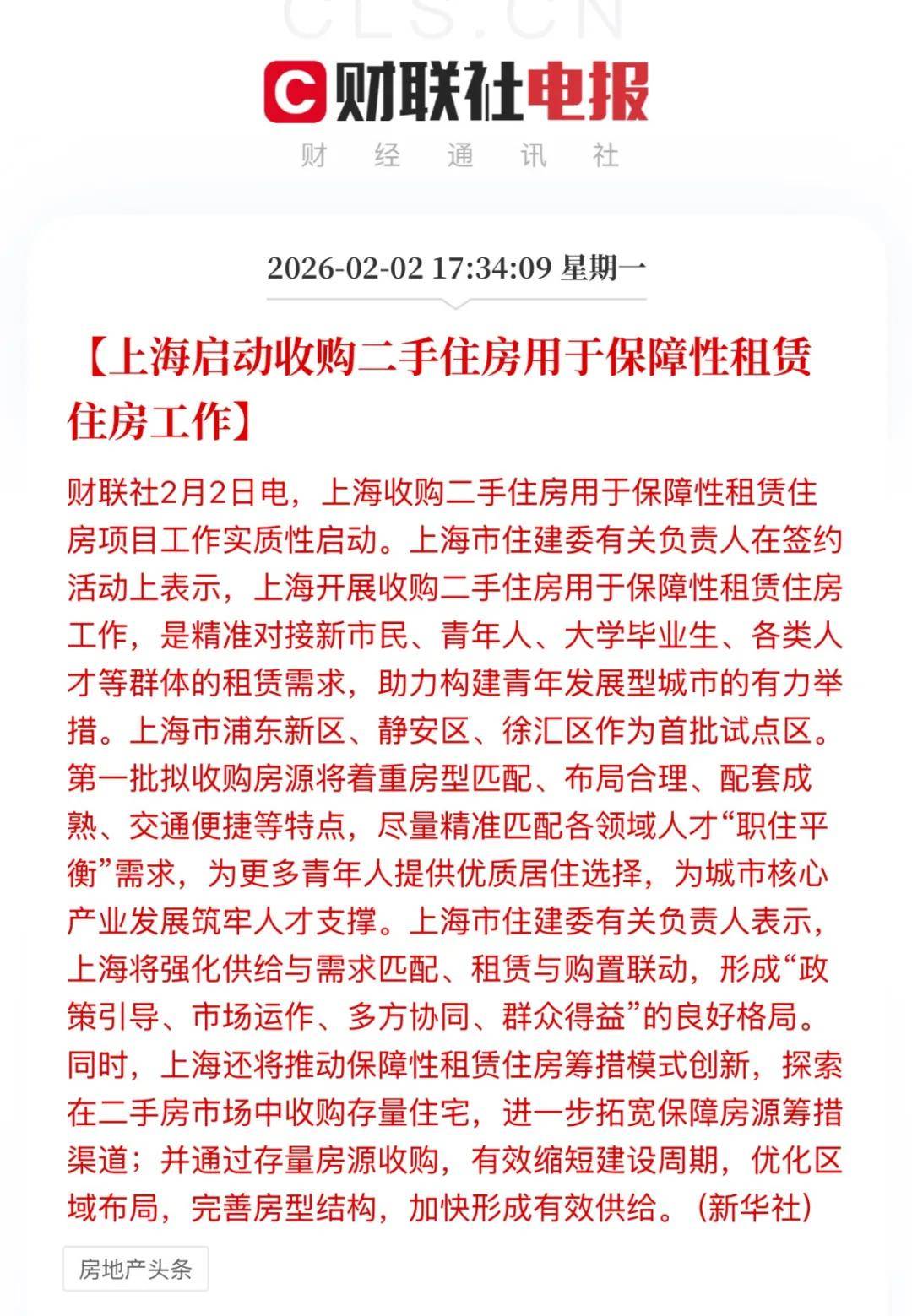
作为一名长期关注中国楼市的观察者,尤其关注农村人口进城定居的趋势,我深耕地产研究已有十八载。我希望能成为您了解楼市动态、把握置业先机的 可靠朋友。 近日,在房产交流群里,我听到一个颇具代表性的案例,令人深思。 在地方层面,已经开始落地不少大招。以上海为例,其行动最为迅速和有力。 2月初,上海联合建设银行,在浦东、静安、徐汇三个核心区域,正式启动收购二手住房用作保障性租赁住房的计划。 这一举措有两方面的意义。一方面,国家队真金白银入场,直接消化市场上最难出售的"老破小",为积压的库存打开了一个突破口。另一方面,也等于为 二手房市场划定了一条"官方底价线",向市场传递信号:不必恐慌,房价跌到一定程度,有国家托底。 这并非上海的独有行动。北京早在去年底就已放宽了非京籍购房门槛,直接刺激了学区房市场。西城、朝阳等热门区域的部分小区,成交量甚至翻倍,价 格也上涨了数十万元。郑州、南京、青岛等地,也早已开始了类似的"收购存量房"的探索。 与以往不同,这轮救市不再是普惠式的大水漫灌,而是聚焦核心城市,瞄准刚需和改善型需求的"定向爆破"。 故事发生在上海市静安区。上周,一套二手房的买卖双方原本已就价格达成共识,眼看就要签订合 ...

别再自欺欺人了!2025年楼市真相:降价都卖不动,硬着陆已经在路上
Sou Hu Cai Jing· 2026-02-15 12:47
最近身边聊房子的人,语气全变了。以前是抢房、涨价、连夜排队,现在是砍价、观望、开发商愁得睡不着。你以为楼市只是暂时降温?错了,一组组冰冷 数据砸下来,谁都没法装看不见。过去那种闭眼买房就能赚的时代,彻底翻篇了。现在的楼市,不是调整,是真真切切在往下走,硬着陆不是预测,是正在 发生的现实。 一、销量跌回十几年前,新房市场直接冻住 2025 年全国新房卖了 8.8 亿平米,比上一年再缩 8.7%,这个体量直接退回到 2009 年的水平。住宅卖得更差,7.4 亿平米,连 2007 年的规模都没保住。 简单说,现在的新房成交量,比很多人刚上班、刚用智能手机那会儿还要低。 销售额也跟着跳水,全年只有 8.39 万亿,比 2024 年再少一成多。以前开发商开盘就日光,现在售楼处一天见不到几个客户,就算降价几十万,愿意接盘的 人也寥寥无几。很多城市的楼盘,降价、送车位、送装修全用上,还是没人买单。 新房卖不动,直接导致整个行业停摆。开发投资跌到 8.27 万亿,同比大降 17.2%,新开工面积少了两成,竣工量也少了近两成。以前到处是塔吊、推土 机,现在大片工地安安静静,有的干脆停工,连复工的消息都等不到。 二、房企钱袋子彻 ...

粤港湾控股获纳入MSCI中国小型股指数成份股
Zhi Tong Cai Jing· 2026-02-15 10:53
Core Viewpoint - The company, Yue Gang Wan Holdings (01396), has been included in the MSCI China Small Cap Index, effective after the market close on February 27, 2026, which reflects positive recognition of its business performance and investment potential [1] Group 1: MSCI Inclusion - The inclusion in the MSCI China Small Cap Index is expected to enhance the company's public visibility and increase the liquidity of its shares, thereby improving its investment value [1] - MSCI is a globally recognized independent index provider, and its indices are widely used as investment benchmarks by global investment managers [1] Group 2: Business Development - The board expresses gratitude to shareholders and investors for their continued support and emphasizes the company's commitment to deepening its development in the AI business sector [1] - The company plans to focus on AI hardware infrastructure, integration of AI computing resources, and collaborative ecological services to support the intelligent upgrade of various industries [1]
香港华人有限公司(00655)预期年度所占合营企业的亏损约8亿港元至约10亿港元
智通财经网· 2026-02-15 10:25
此外,于2025年上半年购入按权益法入账的投资对象的额外股本权益所确认的暂时负商誉9490万坡元于 2025年下半年拨回。诚如OUE公布所述,来自所占按权益法入账的投资对象业绩的亏损、预期OUE集 团于上述按权益法入账的投资对象的投资减值以及暂时负商誉的拨回主要为非现金性质及并无对OUE 集团的营运现金流及企业融资要求有重大影响。 智通财经APP讯,香港华人有限公司(00655)发布公告,本公司一间主要合营企业的附属公司OUE Limited(一间于新加坡证券交易所有限公司主板上市的公司,连同其附属公司,合称"OUE集团")于本公 布日期发出其截至2025年12月31日止年度(本年度)未经审核财务业绩的溢利指引的公布(OUE布)。根据 OUE公布,OUE集团预期于本年度取得股东应占亏损,亏损主要由于所占来自其按权益法入账的投资 对象约2.2亿坡元至2.4亿坡元的亏损,包括一间其于中国内地业务受中国内地普遍放缓的物业市场及现 时经济环境下的不利影响的投资对象;及OUE集团预期对按权益法入账之投资对象的投资所确认的减值 亏损(须待减值评估之最终确定)。 根据本公司现有的资料,预期本集团于本年度可能取得所占合营企业 ...
新城市建设发展(00456.HK):畅流工业园的投资物业被政府纳入统一的公益性征地范围 相关租赁协议被迫终止
Ge Long Hui· 2026-02-15 10:13
因政府要求纳入公益性徵地范围的企业不仅要尽快配合政府完成拆迁等工作,而且要保持社会稳定;所 以,广东畅纳及其合作方和广州畅流形成了和解协议:集团的广州畅流须向广东畅纳及其合作方支付赔 偿款人民币1.8亿元(「该赔偿款」)。 就该赔偿款而言,集团正评估该赔偿款对于集团的影响并与广东畅纳及其合作方协商付款方式及安排; 为了保护集团的广州畅流利益,等候相关政府部门的最终徵地拆迁补偿条款解决和解协议应尽的赔偿责 任,集团董事会决定对广东畅纳及其合作方或其指定人士给予人民币票据、一年期限、年化4%利息。 同时,集团董事会指示按照香港及内地的有关法律、法规依法合规安排票据的完成,达成共识,帮助集 团的广州畅流继续向政府力争尽早和政府完成徵地补偿安排解决问题。 格隆汇2月15日丨新城市建设发展(00456.HK)公布,2026年2月13日,董事会获告知,集团下属的广州畅 流位于中华人民共和国广东省广州市海珠区赤岗西路20-22号,通称畅流工业园的投资物业,于2025年 初被政府纳入统一的公益性徵地范围,造成了广州畅流与广东畅纳投资开发有限公司(「广东畅纳」)就 集团投资物业所订立的租赁协议被迫终止,广东畅纳提出,其在租赁协 ...