制造业

Search documents
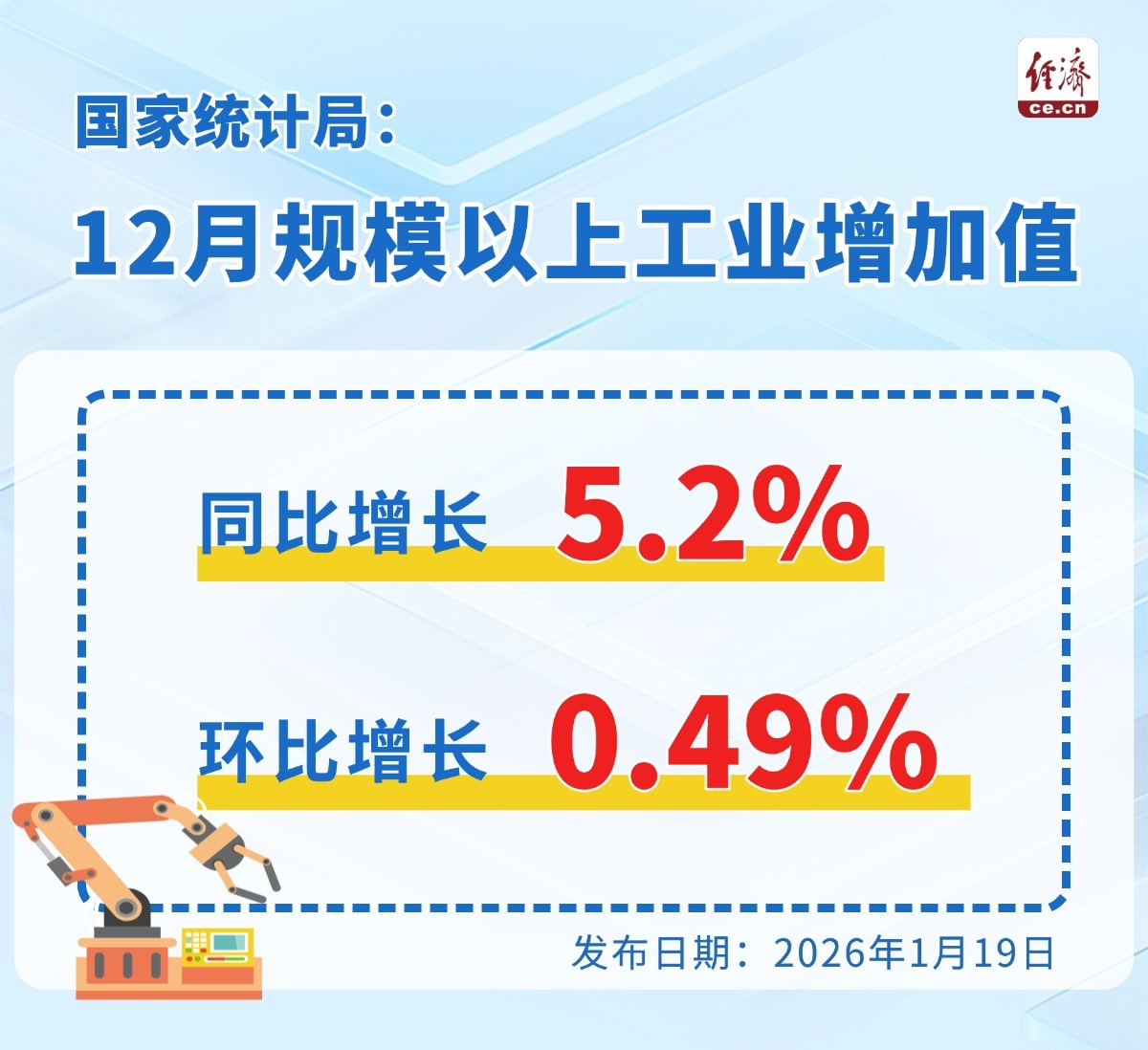
统计局:2025年12月份规模以上工业增加值增长5.2%
Zhong Guo Jing Ji Wang· 2026-01-19 03:41
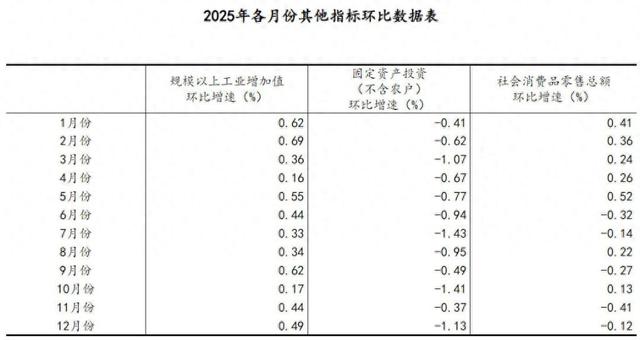
Core Insights - In December 2025, the industrial added value of large-scale industries in China experienced a year-on-year real growth of 5.2% and a month-on-month growth of 0.49% [1] Group 1: Industrial Performance - The mining industry saw a year-on-year growth of 5.4%, while the manufacturing sector grew by 5.7%, and the production and supply of electricity, heat, gas, and water increased by 0.8% in December [3] - Among different economic types, state-controlled enterprises had a year-on-year growth of 3.9%, joint-stock enterprises grew by 5.8%, foreign and Hong Kong, Macao, and Taiwan-invested enterprises increased by 2.7%, and private enterprises saw a growth of 4.2% [3] - Out of 41 major industries, 33 reported year-on-year growth in added value, with notable increases in coal mining and washing (6.4%), oil and gas extraction (3.7%), and food processing (3.2%) [3] Group 2: Product Output - In December, among 623 industrial products, 325 reported a year-on-year increase in output, including a 4.9% increase in ten non-ferrous metals and a 3.0% increase in ethylene [4] - The production of automobiles reached 3.412 million units, a decrease of 2.8%, while new energy vehicles grew by 8.7% to 1.791 million units [4] - The sales rate of products from large-scale industrial enterprises was 98.2%, reflecting a year-on-year decline of 0.7 percentage points, and the export delivery value reached 1.4932 trillion yuan, showing a nominal year-on-year growth of 3.2% [4]

郑学工:我国经济顶压前行 经济总量实现新跨越
Guo Jia Tong Ji Ju· 2026-01-19 03:35
2025年是"十四五"规划收官之年,在以习近平同志为核心的党中央坚强领导下,各地区各部门深入贯彻 落实党中央、国务院决策部署,坚持稳中求进工作总基调,完整、准确、全面贯彻新发展理念,加快构 建新发展格局,实施更加积极有为的宏观政策,纵深推进全国统一大市场建设,国民经济运行总体平 稳,经济发展向新向优。 一、经济总量再上新台阶,全年增长目标圆满实现 三、国内需求不断释放,外贸韧性持续彰显 消费需求平稳增长。消费品以旧换新等提振消费政策协同发力,消费需求持续释放,消费市场保持平稳 增长。2025年,最终消费支出对经济增长贡献率为52.0%。其中,四季度最终消费支出对经济增长贡献 率为52.9%。 投资结构持续优化。"两重"建设加快推进,重点领域投资增长较快,积极发挥投资在扩内需、优供给、 惠民生方面的关键作用。2025年,资本形成总额对经济增长贡献率为15.3%。其中,四季度资本形成总 额对经济增长贡献率为16.0%。 净出口彰显较强韧性。面对复杂的外部环境,我国外贸结构持续优化,进出口实现平稳增长,对经济增 长的支撑作用较强。2025年,货物和服务净出口对经济增长贡献率为32.7%。其中,四季度货物和服务 净出 ...
国家统计局:2025工业生产较快增长,高技术制造业增势较好,固定资产投资同比下降
Sou Hu Cai Jing· 2026-01-19 03:21
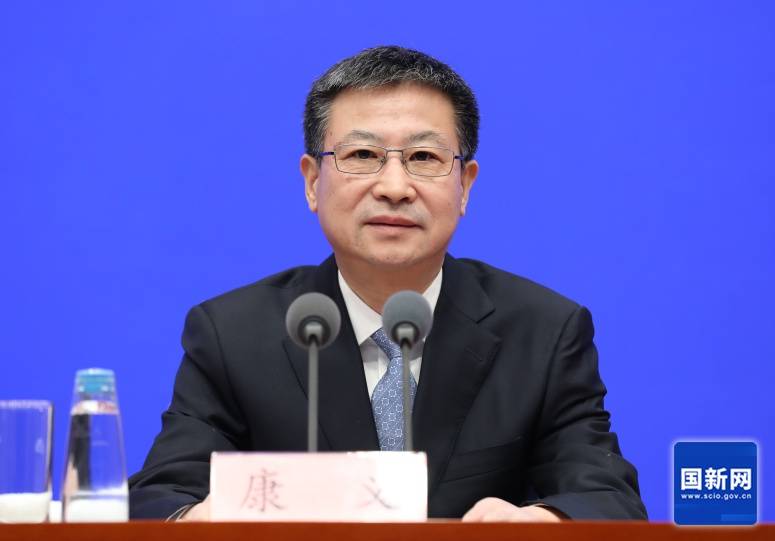
资,民间投资下降1.9%。高技术产业中,信息服务业,航空、航天器及设备制造业投资分别增长28.4%、 16.9%。12月份,固定资产投资(不含农户)环比下降1.13%。 康义强调,总的来看,2025年国民经济顶住多重压力保持稳中有进发展态势,高质量发展取得新成效。但也 要看到,外部环境变化影响加深,国内供强需弱矛盾突出,经济发展中老问题、新挑战仍然不少。下阶段, 要坚持稳中求进、提质增效,实施更加积极有为的宏观政策,持续扩大内需、优化供给,做优增量、盘活存 量,因地制宜发展新质生产力,纵深推进全国统一大市场建设,推动经济实现质的有效提升和量的合理增 长,确保"十五五"开好局、起好步。 九派新闻特派记者 代梦颖 武菲菲 北京报道 编辑 王佳箐 吴迪 【来源:九派新闻】 1月19日上午10时,国务院新闻办公室举行新闻发布会,介绍2025年国民经济运行情况。会上,国家统计局局 长康义表示,2025年经济发展向新向优,预期目标圆满实现。国民经济运行顶压前行、向新向优,高质量发 展取得新成效,经济社会发展主要目标任务圆满实现,"十四五"胜利收官。 国家统计局局长康义。图/国新网 康义介绍,初步核算,全年国内生产总值14 ...
国家统计局公布2025年全国固定资产投资基本情况
Zhong Guo Xin Wen Wang· 2026-01-19 03:01
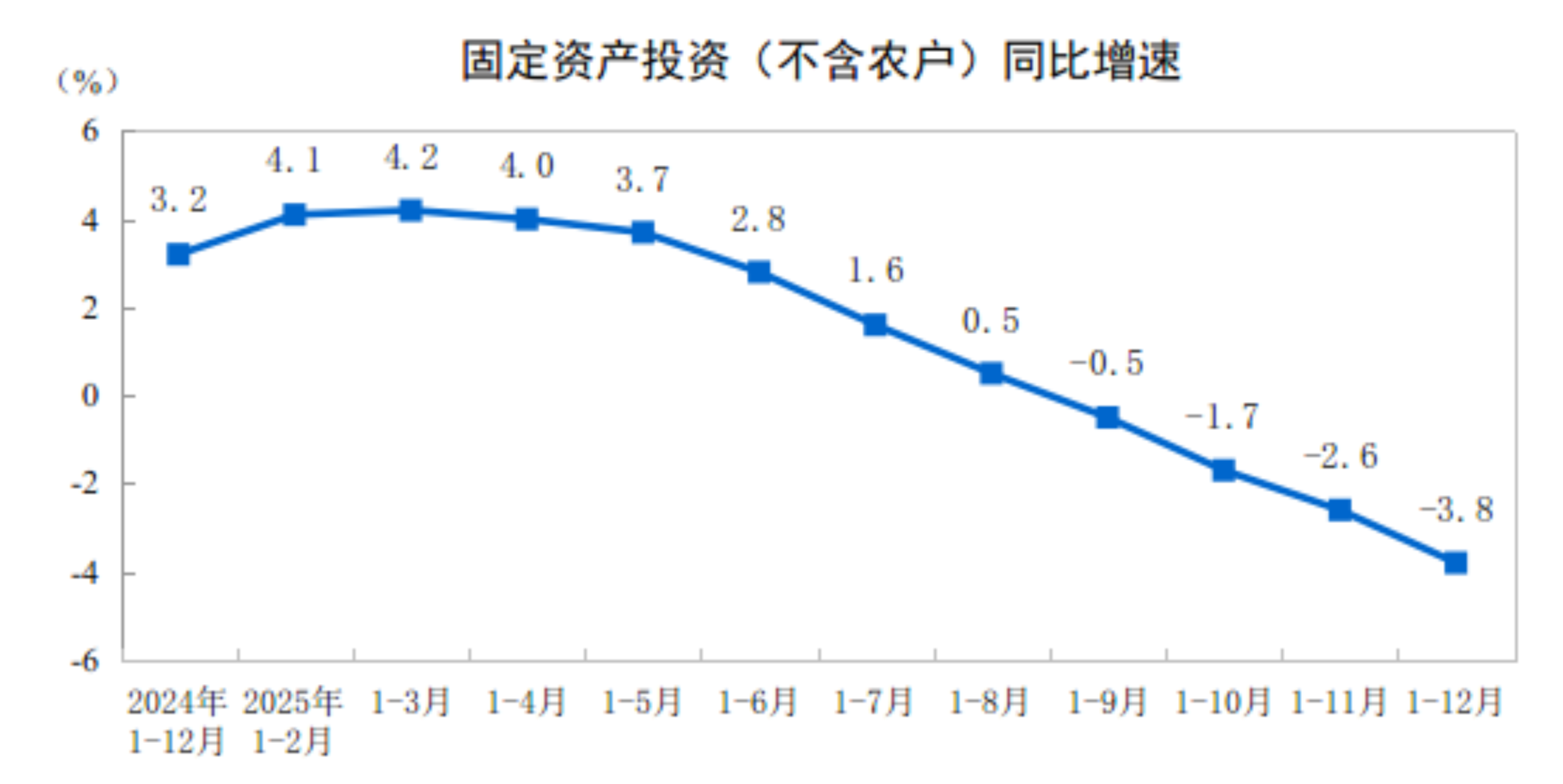
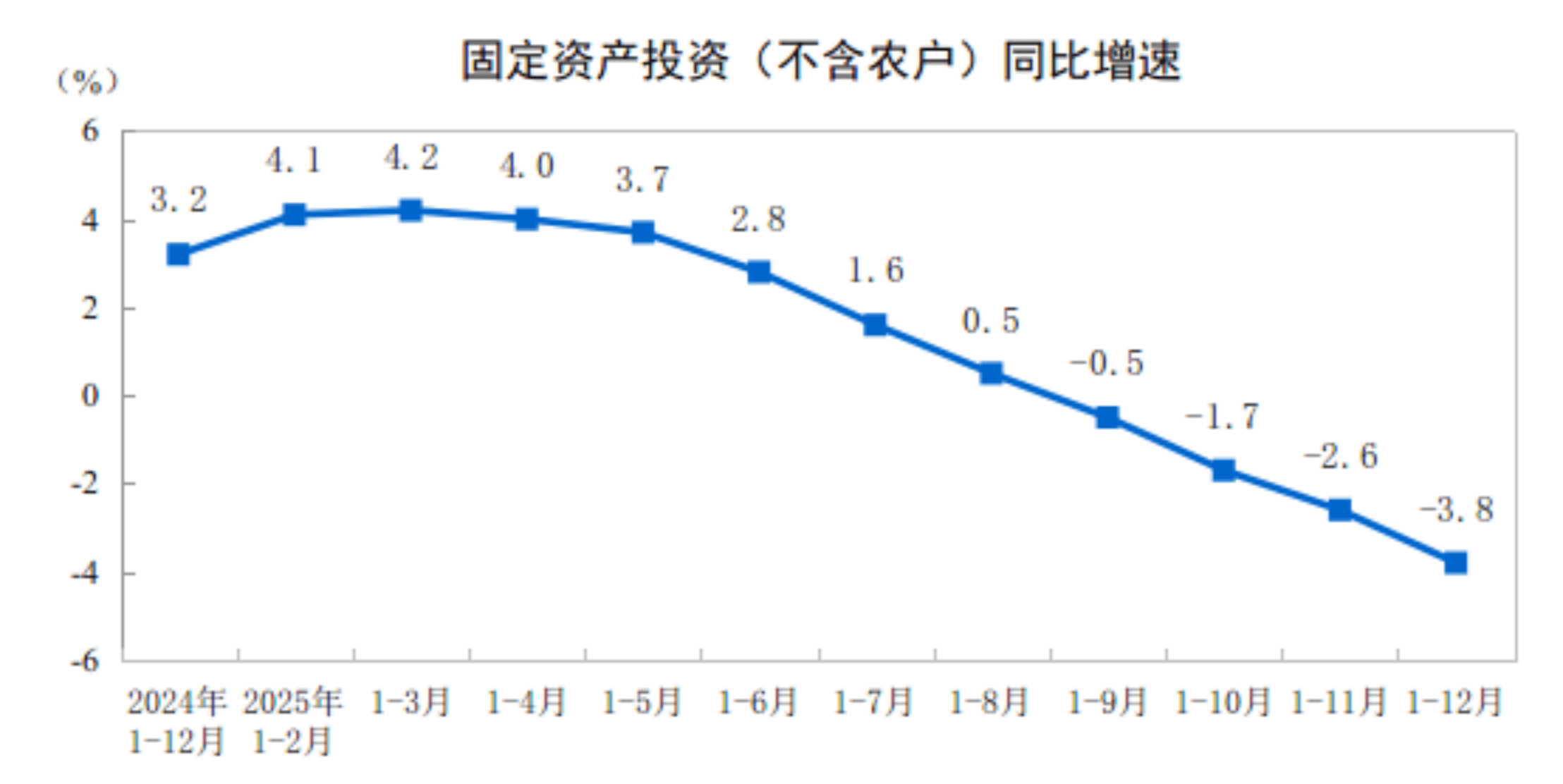
Core Insights - In 2025, China's total fixed asset investment (excluding rural households) is projected to be 48,518.6 billion yuan, representing a decline of 3.8% compared to the previous year [1] - Private fixed asset investment is expected to decrease by 6.4% year-on-year [1] - Month-on-month, fixed asset investment (excluding rural households) fell by 1.13% in December [1] Investment by Industry - Investment in the primary industry reached 957 billion yuan, showing a growth of 2.3% year-on-year [3] - Investment in the secondary industry totaled 177,368 billion yuan, with a growth of 2.5% [3] - The tertiary industry saw a decline in investment of 7.4%, totaling 298,248 billion yuan [3] - Within the secondary industry, industrial investment grew by 2.6%, with mining investment increasing by 2.5%, manufacturing investment rising by 0.6%, and investment in electricity, heat, gas, and water production and supply increasing by 9.1% [3] - In the tertiary industry, infrastructure investment (excluding electricity, heat, gas, and water production and supply) decreased by 2.2% [3] - Notable growth in infrastructure investment includes a 36% increase in pipeline transportation and a 22.9% increase in multimodal transport and transportation agency services [3] Investment by Region - Investment in the eastern region declined by 8.4% year-on-year [3] - The central region experienced a decrease of 2.7% in investment [3] - The western region saw a decline of 1.3% in investment [3] - The northeastern region faced the most significant drop, with a decrease of 15.5% [3] Investment by Registration Type - Domestic enterprises' fixed asset investment fell by 3.8% year-on-year [3] - Investment from Hong Kong, Macau, and Taiwan enterprises decreased by 2.2% [3] - Foreign enterprises experienced a significant decline in fixed asset investment, dropping by 13.8% [3]
更“耗材”的全球投资周期意味着什么?
HTSC· 2026-01-19 02:52
Group 1: Global Investment Trends - The global capital expenditure is expected to accelerate by 2026, with "consumables" growth significantly surpassing the initial phase of AI investments[1] - AI investment in 2025 is projected to reach $460 billion, accounting for approximately 1.5% of GDP, exceeding the peak of the internet bubble period[13] - The demand for commodities related to AI is anticipated to increase exponentially, with a low price sensitivity due to supply-side constraints[2] Group 2: Fiscal Policies and Defense Spending - Major economies like the US, Europe, and Japan are implementing expansionary fiscal policies, focusing on defense and supply chain security, which will increase "consumable" demand[2] - NATO countries' defense spending is expected to rise from 2.1% of GDP in 2024 to 3.5% by 2035, with annual increases of 0.13 percentage points required for EU countries[49] - Germany and France are projected to reach defense spending targets of 3-3.5% of GDP by 2030, necessitating annual increases of 0.2 percentage points[52] Group 3: Manufacturing and Economic Recovery - The global manufacturing sector is likely to experience an upturn, driven by AI-related investments and infrastructure demands, positively impacting exports, especially from Asia[59] - The uncertainty surrounding tariffs is expected to decrease, which may alleviate the drag on manufacturing investments[61] - The US corporate investment growth forecast for 2026 has been revised upward to 4.8%[62]
国家统计局:2025年全国固定资产投资(不含农户)485186亿元
Sou Hu Cai Jing· 2026-01-19 02:47
Group 1 - The core viewpoint of the article indicates that in 2025, the total fixed asset investment (excluding rural households) in China is projected to be 48,518.6 billion yuan, representing a decline of 3.8% compared to the previous year [1][3] - Private fixed asset investment is expected to decrease by 6.4% year-on-year [1][3] - In December, the month-on-month fixed asset investment (excluding rural households) fell by 1.13% [1][3] Group 2 - By industry, first industry investment reached 957 billion yuan, showing a growth of 2.3% year-on-year; second industry investment was 177,368 billion yuan, with a growth of 2.5%; while third industry investment declined by 7.4% [3] - Within the second industry, industrial investment increased by 2.6%, with mining investment growing by 2.5%, manufacturing investment rising by 0.6%, and investment in electricity, heat, gas, and water production and supply increasing by 9.1% [3] - In the third industry, infrastructure investment (excluding electricity, heat, gas, and water production and supply) decreased by 2.2%, with pipeline transportation investment growing by 36.0%, multimodal transport and transportation agency investment increasing by 22.9%, and water transportation investment rising by 7.7% [3] Group 3 - By region, investment in the eastern region fell by 8.4% year-on-year, the central region saw a decline of 2.7%, the western region decreased by 1.3%, and the northeastern region experienced a significant drop of 15.5% [3] - By registration type, domestic enterprise fixed asset investment decreased by 3.8%, investment from Hong Kong, Macau, and Taiwan enterprises fell by 2.2%, and foreign enterprise fixed asset investment declined by 13.8% [3]
国家统计局:2025年经济发展向新向优,预期目标圆满实现
Xin Lang Cai Jing· 2026-01-19 02:44
2025年,面对国内外经济环境的复杂变化,在以习近平同志为核心的党中央坚强领导下,各地区各部门 深入贯彻落实党中央、国务院决策部署,坚定不移贯彻新发展理念、推动高质量发展,统筹国内国际两 个大局,统筹发展和安全,实施更加积极有为的宏观政策,纵深推进全国统一大市场建设,国民经济运 行顶压前行、向新向优,高质量发展取得新成效,经济社会发展主要目标任务圆满实现,"十四五"胜利 收官。 初步核算,全年国内生产总值1401879亿元,按不变价格计算,比上年增长5.0%。分产业看,第一产业 增加值93347亿元,比上年增长3.9%;第二产业增加值499653亿元,增长4.5%;第三产业增加值808879 亿元,增长5.4%。分季度看,一季度国内生产总值同比增长5.4%,二季度增长5.2%,三季度增长 4.8%,四季度增长4.5%。从环比看,四季度国内生产总值增长1.2%。 一、粮食增产丰收,畜牧业稳定增长 全年全国粮食总产量71488万吨,比上年增加838万吨,增长1.2%。其中,夏粮产量14975万吨,下降 0.1%;早稻产量2851万吨,增长1.2%;秋粮产量53662万吨,增长1.5%。分品种看,小麦产量14007 ...
5.0%!突破140万亿元!2025年GDP出炉
Zheng Quan Shi Bao· 2026-01-19 02:38
Economic Overview - In 2025, China's GDP reached 1401879 billion yuan, growing by 5.0% year-on-year at constant prices [1][5] - The first industry added value was 93347 billion yuan, increasing by 3.9%; the second industry added value was 499653 billion yuan, growing by 4.5%; and the third industry added value was 808879 billion yuan, rising by 5.4% [1][5] Quarterly Performance - GDP growth rates by quarter were 5.4% in Q1, 5.2% in Q2, 4.8% in Q3, and 4.5% in Q4 [1][5] - The Q4 GDP growth rate was 1.2% on a quarter-on-quarter basis [1] Agricultural Production - National grain production totaled 71488 million tons, an increase of 838 million tons or 1.2% year-on-year [6] - Meat production reached 10072 million tons, a growth of 4.2%, with pork production at 5938 million tons, up 4.1% [6] Industrial Growth - The industrial added value for large-scale enterprises grew by 5.9% year-on-year [7] - High-tech manufacturing saw a growth of 9.4%, outpacing overall industrial growth [7] Service Sector Performance - The service sector's added value increased by 5.4% year-on-year [8] - Key sectors such as information technology services and rental services grew by 11.1% and 10.3%, respectively [8] Retail and Consumption - Total retail sales of consumer goods reached 501202 billion yuan, growing by 3.7% year-on-year [9] - Online retail sales amounted to 159722 billion yuan, an increase of 8.6% [9] Investment Trends - Fixed asset investment (excluding rural households) was 485186 billion yuan, a decrease of 3.8% [10][11] - Manufacturing investment grew by 0.6%, while real estate investment fell by 17.2% [10] Trade Performance - Total goods import and export reached 454687 billion yuan, growing by 3.8% year-on-year [12] - Exports increased by 6.1%, while imports rose by 0.5% [12] Price Stability - The Consumer Price Index (CPI) remained stable year-on-year, with a core CPI increase of 0.7% [13] - Producer prices decreased by 2.6% year-on-year [13] Employment and Income - The urban unemployment rate averaged 5.2% for the year [14] - Per capita disposable income reached 43377 yuan, with a nominal growth of 5.0% [15] Population Trends - The total population decreased by 3.39 million to 140489 million [16] - The urbanization rate increased to 67.89%, up by 0.89 percentage points [16] Future Outlook - The economy is expected to face challenges from external changes and domestic supply-demand imbalances [17] - Emphasis will be placed on expanding domestic demand and optimizing supply to ensure quality growth [17]

2025年全年全国固定资产投资(不含农户)485186亿元 同比下降3.8%
Bei Jing Shang Bao· 2026-01-19 02:37
Core Insights - The National Bureau of Statistics reported a 3.8% year-on-year decline in national fixed asset investment (excluding rural households) for 2025, totaling 48,518.6 billion yuan [1] - Excluding real estate development investment, national fixed asset investment decreased by 0.5% [1] Investment Breakdown - Infrastructure investment fell by 2.2% [1] - Manufacturing investment saw a slight increase of 0.6% [1] - Real estate development investment experienced a significant decline of 17.2% [1] Real Estate Market - The sales area of newly built commercial housing reached 88,101 million square meters, down 8.7% [1] - The sales revenue from newly built commercial housing was 83,937 billion yuan, a decrease of 12.6% [1] Sector Performance - Investment in the primary industry grew by 2.3% [1] - Investment in the secondary industry increased by 2.5% [1] - Investment in the tertiary industry declined by 7.4% [1] Private Investment Trends - Private investment decreased by 6.4% [1] - Excluding real estate development investment, private investment fell by 1.9% [1] High-Tech Industry - In high-tech industries, investment in information services grew by 28.4% [1] - Investment in aerospace and equipment manufacturing increased by 16.9% [1] Monthly Trends - In December, fixed asset investment (excluding rural households) experienced a month-on-month decline of 1.13% [1]
国家统计局:2025年电力、热力、燃气及水生产和供应业投资增长9.1%
Guo Jia Tong Ji Ju· 2026-01-19 02:33
Core Viewpoint - In 2025, China's fixed asset investment (excluding rural households) reached 48,518.6 billion yuan, representing a decline of 3.8% compared to the previous year, with private investment decreasing by 6.4% [1][4]. Investment by Industry - Investment in the primary industry was 957 billion yuan, an increase of 2.3% year-on-year [3]. - Investment in the secondary industry totaled 177,368 billion yuan, growing by 2.5% [3]. - Investment in the tertiary industry was 298,248 billion yuan, showing a decline of 7.4% [3]. - Within the secondary industry, industrial investment increased by 2.6%, with mining investment up by 2.5%, manufacturing investment up by 0.6%, and investment in electricity, heat, gas, and water production and supply rising by 9.1% [3]. Infrastructure and Regional Investment - Infrastructure investment (excluding electricity, heat, gas, and water production and supply) in the tertiary industry decreased by 2.2% [3]. - Investment in pipeline transportation grew by 36.0%, while multimodal transport and transportation agency investment rose by 22.9%, and water transportation investment increased by 7.7% [3]. - Investment in the eastern region fell by 8.4%, the central region by 2.7%, the western region by 1.3%, and the northeastern region by 15.5% [3]. Investment by Registration Type - Domestic enterprises' fixed asset investment decreased by 3.8%, while investment from Hong Kong, Macau, and Taiwan enterprises fell by 2.2%, and foreign enterprises' investment dropped by 13.8% [3][5].