商用车

Search documents
崔东树:2025年8月商用车新能源渗透率30%
Di Yi Cai Jing· 2025-09-18 07:16
Core Insights - The penetration rate of new energy in commercial vehicles is projected to reach 30% by August 2025, with significant increases in specific vehicle categories [1] Summary by Category New Energy Penetration Rates - The new energy penetration rate for trucks is expected to be 23% by 2025 [1] - The new energy penetration rate for buses is anticipated to be 63% by 2025 [1] - All categories are expected to see substantial growth compared to the same period [1]
崔东树:1-8月商用车国内销量同比增长8% 政策推动下表现相对较强
Zhi Tong Cai Jing· 2025-09-18 07:00
Core Insights - The domestic commercial vehicle market is experiencing a strong growth trend, particularly in the new energy vehicle (NEV) segment, driven by policy support and increasing demand for vehicle upgrades [1][2][10] - In August, domestic commercial vehicle sales reached 246,000 units, a year-on-year increase of 14%, while the cumulative sales from January to August 2025 reached 2.01 million units, up 8% compared to the previous year [7][10] - The penetration rate of new energy commercial vehicles is expected to reach 30% by August 2025, significantly higher than the 23% recorded in the same month of the previous year [13][15] Commercial Vehicle Market Analysis - The commercial vehicle market is showing a recovery after a period of decline, with 2025 projected to see a total of 2.85 million units sold, nearly flat compared to 2024 [6][10] - The sales of new energy commercial vehicles are projected to reach 579,000 units in 2024, representing an 84% year-on-year increase [11][12] - The market is characterized by a strong performance in the truck segment, particularly in heavy and light trucks, while the bus segment is also seeing growth due to electrification [15][19] New Energy Vehicle Insights - The penetration rate of new energy commercial vehicles has increased from approximately 3% in 2019-2021 to 25% in the first eight months of 2025 [2][13] - The sales of new energy commercial vehicles from January to August 2025 reached 500,000 units, marking a 55% year-on-year increase [11][12] - The demand for new energy vehicles is particularly strong in the truck and bus segments, with truck penetration at 23% and bus penetration at 63% as of August 2025 [15][19] Competitive Landscape - Major players in the commercial vehicle market include Beiqi Foton, SAIC-GM-Wuling, and Dongfeng Motor, with Beiqi Foton leading in light truck sales [16][19] - The market is witnessing a shift towards new energy vehicles, with companies like Geely and Chery making significant strides in the light truck segment [22][24] - The competitive structure is evolving, with traditional fuel vehicles requiring effective policy support to maintain market share amidst the growing dominance of new energy vehicles [2][15]





崔东树:国内商用车交强险数据的2025年商用车强势增长
Ge Long Hui· 2025-09-18 06:49
Core Insights - The article highlights a strong growth forecast for commercial vehicle sales in China, driven by the rise of new energy vehicles and supportive policies for vehicle upgrades [1] Group 1: Commercial Vehicle Sales Data - In August, domestic sales of commercial vehicles reached 246,000 units, representing a year-on-year increase of 14% but a month-on-month decrease of 1% [1] - From January to August 2025, domestic sales of commercial vehicles totaled 2.01 million units, showing an 8% year-on-year growth, marking a new high compared to the stable period since 2022 [1] Group 2: New Energy Commercial Vehicles - Sales of new energy commercial vehicles are projected to reach 579,000 units in 2024, reflecting an 84% year-on-year increase [1] - By August 2025, sales are expected to hit 73,600 units, which is a 46% year-on-year increase and a 3% month-on-month growth [1] - After the policy tailwind at the end of 2024, new energy vehicle performance is anticipated to be relatively weak in January 2025, followed by a significant year-on-year surge from February to August, with cumulative sales reaching 500,000 units and a 55% year-on-year growth [1]
新能源重卡现616辆大单!
第一商用车网· 2025-09-18 06:48
Core Viewpoint - The launch of the Shandeka new energy product series by China National Heavy Duty Truck Corporation (CNHTC) represents a significant step towards green logistics and showcases the integration of German quality and green technology in the heavy-duty truck industry [1][3][13]. Industry Trends - CNHTC is committed to leading industry development and creating customer value, having made early investments in the new energy heavy truck sector [3]. - The new energy product series is a result of extensive technological research and development, responding to market demands [3]. Product Features - The Shandeka series has been recognized for its reliability, efficiency, and full attendance, serving over one million customers and winning multiple awards [5]. - The launch signifies the completion of a full product matrix that includes both traditional and new energy vehicles, marking a key advancement into the green logistics sector [5]. Technological Innovations - The new energy products feature long-range capabilities with high-performance battery systems, addressing concerns about range anxiety for logistics applications [9]. - Energy-saving measures include lightweight vehicle design and optimized electric drive systems, providing tailored total cost of ownership (TCO) solutions [9]. - Safety and comfort are enhanced through patented safety technologies, ergonomic seating, and intelligent voice interaction systems [9]. Service Commitment - CNHTC has established a comprehensive lifecycle service system for the new energy series, ensuring customers can buy, use, and maintain their vehicles with confidence [11]. - The successful signing of cooperation agreements with several well-known enterprises at the launch event reflects strong market recognition and CNHTC's determination to capture the new energy heavy truck market [11]. Future Outlook - As the new energy products are gradually introduced to the market, CNHTC aims to inject new momentum into the green transformation of the logistics industry, contributing to a new chapter in intelligent manufacturing for heavy trucks in China [15].

8月新能源轻卡销近1.8万辆史上最高!TOP4超2000辆,奇瑞暴涨104倍排第几?| 头条
第一商用车网· 2025-09-18 06:48
Core Viewpoint - The domestic new energy light truck market has shown remarkable growth, achieving a record monthly sales of 17,700 units in August 2025, marking a 91% year-on-year increase and extending a continuous growth streak to 20 months [4][6][33]. Sales Performance - From March 2025, new energy light truck sales have consistently exceeded 10,000 units monthly, with June recording the highest single-month sales of 16,600 units [1][2]. - In August 2025, the total sales of new energy light trucks reached 17,700 units, representing a 21% month-on-month increase and a 91% year-on-year increase [4][6]. - The overall light truck market sold 56,600 units in August, with new energy light trucks accounting for 31.27% of the total, up from 27.00% the previous month [9]. Market Trends - The new energy light truck market has seen a cumulative sales figure of 105,300 units from January to August 2025, reflecting a 94% year-on-year growth [26][31]. - The penetration rate of new energy light trucks in the overall light truck market reached 23.11% in the first eight months of 2025, significantly higher than the 17.73% recorded for the entire year of 2024 [9]. Regional Insights - All 31 provincial-level administrative regions in China have seen new energy light truck registrations, with Guangdong leading with over 35,300 units, accounting for 33.48% of the national total [12][14]. - The top cities for new energy light truck registrations include Shenzhen, Guangzhou, Zhengzhou, and Chengdu, among others [14]. Company Performance - The leading companies in the new energy light truck market for August 2025 include: - Yuan Cheng with 3,252 units sold (18.36% market share) - Foton with 2,908 units (16.41% market share) - SAIC Yuejin with 2,779 units (15.69% market share) - Jianghuai with 2,177 units (12.29% market share) [3][23]. - Notably, Chery Commercial Vehicles achieved a staggering 10,400% year-on-year growth in sales [3]. Fuel Type Analysis - Pure electric vehicles remain the dominant technology in the new energy light truck market, accounting for 92.31% of sales from January to August 2025, an increase from the previous year [17]. - In contrast, fuel cell light trucks have seen a decline in sales, with only 664 units sold, a 46% decrease year-on-year [20]. Conclusion - The new energy light truck market has demonstrated strong growth, with significant increases in both sales and market penetration. The trend is expected to continue, raising questions about the sustainability of this growth and the potential for future sales targets [33].




加速商用车电动化变革,比亚迪推出电动客车首个千伏高压平台
Hua Xia Shi Bao· 2025-09-18 02:42
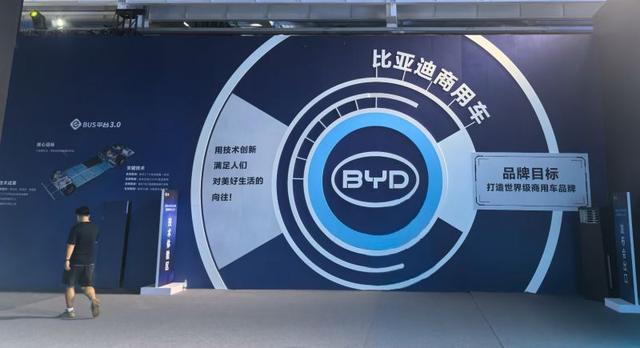
Core Insights - The Chinese commercial vehicle market is undergoing a significant transformation driven by both policy and market demand, with a notable increase in the penetration rate of new energy commercial vehicles to 27.6% in August 2025, reflecting a 0.8 percentage point increase from the previous month [1] - BYD's strategy of "technology as a spear" is becoming increasingly clear, as evidenced by the launch of the e-Bus platform 3.0 and the new electric bus C11, which features a groundbreaking 1000V high-voltage platform and improvements in energy consumption and low-temperature range [1][5] - The release of the e-Bus platform 3.0 is seen as a pivotal moment in the transition of the commercial vehicle industry from being policy-driven to technology-driven [1][5] Market Dynamics - The commercial vehicle market in 2025 shows a clear structural differentiation, with heavy truck sales increasing by 46.7% year-on-year in August, while medium and light trucks experienced declines of 9.3% and 14.8%, respectively [2] - The overall bus market grew by 11.6%, but the growth rate for medium and large buses (9.2%) lagged behind that of light buses (12.4%), indicating a strong demand for efficient and environmentally friendly commercial vehicles [2] - The domestic market for new energy commercial vehicles saw a significant increase in sales, with a 58.6% growth rate, while export growth was only 9.5%, highlighting the stringent requirements of international markets for technological reliability [2] Technological Advancements - BYD has invested over 14 billion yuan in new energy commercial vehicle research and development since 2008, employing more than 7,000 R&D personnel, establishing itself as a leader in the field [3] - The e-Bus platform 3.0 represents a technological breakthrough that sets new industry standards, particularly with its 1000V high-voltage architecture, which addresses current concerns regarding range anxiety and energy consumption [5] - Innovations in safety technology and intelligent systems are redefining bus safety standards and enhancing operational efficiency, thereby improving user experience and market confidence in electric buses [5][6] Future Outlook - The launch of the new platform aligns with the accelerating trend towards new energy commercial vehicles, with expectations of a sales peak during the "golden September and silver October" period [6] - BYD's position as a leader in new energy bus exports, with a presence in over 70 countries and regions, is expected to strengthen its international competitiveness and contribute to the global standing of Chinese manufacturing [6][7] - The e-Bus platform 3.0 is viewed as a milestone that injects strong momentum into the global electric bus market, promoting a shift towards greener and smarter commercial vehicles [7]

一汽解放:将持续深化质量建设 质量贯穿产品全生命周期
Zhong Zheng Wang· 2025-09-17 13:11
Core Viewpoint - The recognition of FAW Jiefang's "12347-E2E Excellent Operation Quality Management Model" at the 5th China Quality Award signifies a new phase in quality management for the commercial vehicle industry in China, emphasizing the company's commitment to enhancing customer satisfaction and achieving commercial value [1] Group 1: Quality Management Model - The "12347-E2E Excellent Operation Quality Management Model" is a culmination of years of exploration and practice in quality management by FAW Jiefang [1] - The model consists of a customer-centric approach, focusing on market reliability and production quality, and includes three closed loops for customer satisfaction, strategic value creation, and continuous improvement [2] - It incorporates four major projects aimed at enhancing product strength, reliability, manufacturing precision, and quality management systems [2] Group 2: Quality Improvement Initiatives - FAW Jiefang has established a three-year quality improvement goal that encompasses 12 specific indicators across product development, manufacturing, supply chain management, and after-sales service [2] - The company has created a "quality attack network" through end-to-end responsibility mechanisms, process optimization, and systematic governance of quality issues [3] - Continuous quality improvement is supported by leadership involvement, mechanisms, and employee engagement, ensuring that product quality remains a core focus [3] Group 3: Brand Value and Market Position - FAW Jiefang has maintained its position as the leading brand in the commercial vehicle sector, ranking 58th in the 2025 "China's 500 Most Valuable Brands" list with a brand value of 145.029 billion [3] - The company has consistently ranked first in brand value within the commercial vehicle industry for 14 consecutive years, reflecting its commitment to quality management and brand growth [3] Group 4: Strategic Direction - In response to new market conditions, FAW Jiefang is committed to long-term strategies that prioritize quality as a lifeline for survival and development [4] - The company has outlined four strategic directions for quality improvement, including product strength enhancement, manufacturing precision upgrades, market reliability upgrades, and quality management system capability building [4] - The overarching goal is to support brand enhancement, sales growth, and increased customer satisfaction through a comprehensive quality management system [4]
商用车板块9月17日涨0.49%,江淮汽车领涨,主力资金净流出6427.39万元
Zheng Xing Xing Ye Ri Bao· 2025-09-17 08:42
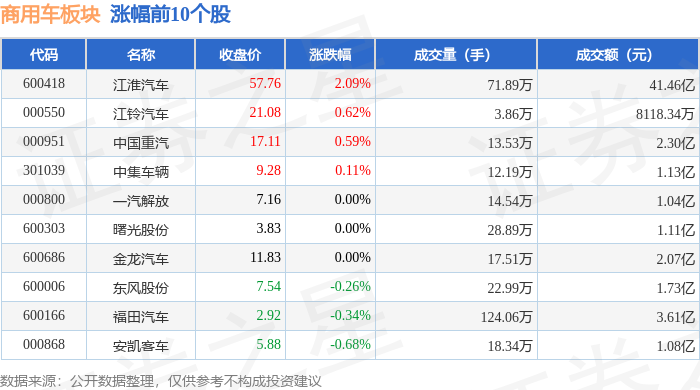
Market Overview - The commercial vehicle sector increased by 0.49% on September 17, with Jianghuai Automobile leading the gains [1] - The Shanghai Composite Index closed at 3876.34, up 0.37%, while the Shenzhen Component Index closed at 13215.46, up 1.16% [1] Stock Performance - Jianghuai Automobile (600418) closed at 57.76, with a rise of 2.09% and a trading volume of 718,900 shares, amounting to a transaction value of 4.146 billion yuan [1] - Other notable stocks include: - Jiangling Motors (000550) at 21.08, up 0.62% [1] - China National Heavy Duty Truck Group (000951) at 17.11, up 0.59% [1] - Zhongshun Vehicle (301039) at 9.28, up 0.11% [1] - FAW Jiefang (000800) at 7.16, unchanged [1] - Shuguang Co. (600303) at 3.83, unchanged [1] - King Long Motor (600686) at 11.83, unchanged [1] - Dongfeng Motor (600006) at 7.54, down 0.26% [1] - Foton Motor (600166) at 2.92, down 0.34% [1] - Ankai Bus (000868) at 5.88, down 0.68% [1] Capital Flow - The commercial vehicle sector experienced a net outflow of 64.274 million yuan from institutional investors, while retail investors saw a net inflow of 63.9394 million yuan [2] - The capital flow for individual stocks shows: - China National Heavy Duty Truck Group had a net outflow of 27.7444 million yuan from institutional investors [3] - Jianghuai Automobile saw a net inflow of 14.5642 million yuan from institutional investors [3] - Other stocks like Foton Motor and Dongfeng Motor also experienced net outflows from institutional investors [3]

电动客车千伏平台强势来袭!比亚迪要在商用车行业掀起新浪潮
第一商用车网· 2025-09-17 07:45
Core Viewpoint - The article highlights BYD's launch of the e-Bus platform 3.0, marking a significant technological advancement in the electric bus sector, which is expected to drive the transformation of the commercial vehicle industry towards electrification [1][3][21]. Group 1: Technological Innovations - BYD's e-Bus platform 3.0 is the first 1000V platform for electric buses, showcasing a leap in technology and innovation in the new energy commercial vehicle sector [1][12]. - The platform focuses on three core areas: safety, efficiency, and intelligence, featuring the world's first mass-produced 1000V high-voltage architecture and a 1500V silicon carbide power chip [12][13]. - The new platform integrates battery and chassis, enhancing safety with a battery pack that can withstand significant pressure and impacts [13]. Group 2: Market Position and Strategy - BYD is positioned as a leading brand in the new energy commercial vehicle industry, with over 89,000 electric buses deployed globally, maintaining its status as the top exporter of new energy buses for two consecutive years [6][21]. - The company is addressing the urgent need for electrification in the commercial vehicle sector, where commercial vehicles account for only 12% of total vehicle ownership but contribute 55% of carbon emissions [4][6]. - BYD is expanding its market reach by adopting innovative financing models and enhancing its service network, which covers over 70 countries [8][21]. Group 3: Product Features and Benefits - The new C11 electric bus, based on the e-Bus platform 3.0, is designed for various operational scenarios, including commuting and tourism, and features advanced comfort and efficiency specifications [14][19]. - The C11 offers a spacious interior, high luggage capacity, and improved energy efficiency, with a maximum range of over 400 kilometers under full load with air conditioning [19][21]. - The vehicle's design includes features that enhance stability and comfort, making it suitable for diverse road conditions [16][19].

【周观点】9月第1周乘用车环比-30.0%,继续看好汽车板块
东吴汽车黄细里团队· 2025-09-17 05:15
Key Points - The core viewpoint of the article emphasizes the current state and future outlook of the automotive industry, highlighting the need for strategic adjustments in investment focus towards electric and intelligent vehicles as the market evolves [5][7]. Group 1: Weekly Review - In the first week of September, the compulsory insurance for vehicles reached 360,000 units, showing a decrease of 30.0% week-on-week and 3.9% month-on-month [11][51]. - The performance of sub-sectors this week ranked as follows: SW commercial trucks (+4.2%), SW automotive parts (+3.4%), SW motorcycles and others (+0.8%), SW passenger cars (-1.8%), and SW commercial passenger vehicles (-2.1%) [11][12]. - The top five stocks covered this week included Luxshare Precision, Joyson Electronics, New Spring Co., Hengshuai Co., and Chuanfeng Power, all showing significant gains [11][12]. Group 2: Industry Changes - Key developments in the industry include the announcement of the Xpeng G7 extended range version, Great Wall's Ora Cat, and Leapmotor's Lafa5 in the Ministry of Industry and Information Technology [4][11]. - Horizon Robotics has formed a strategic partnership with Hello to accelerate the commercialization of Robotaxi [4]. - Baolong Technology's automotive sensors have been selected for projects by leading domestic joint venture car manufacturers [4]. - WeRide's autonomous minibus, Robobus, has launched in Leuven, Belgium, marking its entry into the eleventh global market [4]. Group 3: Market Focus - The automotive A-H shares performed generally poorly this week, with commercial trucks being the best-performing sub-sector [6][12]. - The eight ministries jointly issued the "Automotive Industry Stabilization and Growth Work Plan for 2025-2026," emphasizing a stable and improving trend by 2026, focusing on both scale and quality [6][12]. - New vehicle announcements include the Xpeng G7 extended range version, Great Wall's Ora Cat, and Leapmotor's Lafa5 [6][12]. Group 4: Investment Strategy - The automotive industry is perceived to be at a crossroads, with the electric vehicle boom nearing its end and intelligent vehicle development entering a critical phase [7][12]. - The recommendation is to increase the allocation towards "dividend style" investments in the automotive sector for the second half of 2025 [7][12]. - Key investment themes include passenger vehicles (Yutong Bus), heavy trucks (China National Heavy Duty Truck Group A-H, Weichai Power), two-wheelers (Chuanfeng Power, Longxin General), and automotive parts (Fuyao Glass, Xingyu Co., New Spring Co., Jifeng Co.) [7][12].