私募基金

Search documents
一图看懂新晋百亿量化私募蒙玺投资:行稳致远,国内低延迟赛道先行者
私募排排网· 2025-07-10 02:59
Core Viewpoint - The article highlights the growth and performance of Mengxi Investment, a leading quantitative asset management firm in China, emphasizing its innovative strategies and strong market positioning [3][24]. Company Overview - Mengxi Investment, established in 2016, is recognized as a pioneer in the domestic quantitative industry, leveraging data mining, statistical analysis, and software development to create a comprehensive quantitative asset management platform [3]. - As of June 30, the average return for Mengxi Investment's products over the past year reached ***%, ranking in the top 10 among quantitative private equity funds [3]. - The company has achieved a significant asset management scale of over 110 billion yuan and employs more than 90 staff members [3][7]. Development History - The company was registered in Shanghai in 2016 and began developing asset management strategies in 2017 [6]. - By 2020, Mengxi Investment managed assets worth 10 billion yuan and had 40 employees, entering the whitelist of several institutions [6]. - The asset management scale grew to 40 billion yuan by 2022, with 60 employees, and reached over 110 billion yuan by 2025 [7]. Core Strategies - Mengxi Investment employs a multi-factor stock selection model, utilizing over 200 global data sources to build a diversified factor library [9]. - The current strategies focus on index enhancement and market-neutral stock strategies, with significant positions in major domestic indices [9]. - The company has developed a short-cycle strategy that has shown low historical excess drawdown and low correlation with peers, providing differentiated returns for investors [9]. Research and Development Team - The research team consists of over 60 members with strong educational backgrounds in mathematics, physics, and chemistry from globally recognized institutions [10]. - The team operates under a "large group" research model and a "small group" incentive model to enhance efficiency and achieve optimal results [10]. Core Advantages - Mengxi Investment maintains a leading position in the low-latency trading sector, with deep integration of AI technologies [12]. - The company emphasizes building a robust talent pipeline, ensuring that talent development precedes strategy and management scale [13]. - The firm has invested significantly in IT upgrades and new equipment, maintaining a competitive edge in technology [15]. Product Line - The company offers various quantitative products, including the Mengxi National Index 2000 Quantitative Fund and the Mengxi Wind Small Cap Index Fund, which focus on short-term trading strategies [16][17]. - The performance of these products has been strong, with returns and annualized returns reaching impressive levels since their inception [17]. Awards and Recognition - Mengxi Investment has received multiple awards, including recognition as a top private equity manager and for its innovative quantitative strategies [21][22][23]. Social Responsibility - The company actively engages in social responsibility initiatives, encouraging employees to participate in charitable activities and offering incentives for blood donation [24]. - Mengxi Investment aims to balance economic benefits with social value, striving to create sustainable long-term returns for investors [24].

7.10犀牛财经早报:6月超2000只私募基金净值创新高 年内84家村镇银行获批解散
Xi Niu Cai Jing· 2025-07-10 01:40
Group 1 - Over 2000 private equity funds reached historical net value highs in June, with over 90% of hundred billion-level private equity funds achieving positive returns in the first half of the year [1] - The quantitative private equity funds reported a 100% positive return rate, indicating strong performance in the market [1] - The private equity issuance market has significantly rebounded, with some leading private equity firms raising over 3 billion yuan through single-channel fundraising [1] Group 2 - Nearly 10 billion USD has flowed into AI pharmaceutical development, driven by frequent project collaborations and financing events [2] - Major pharmaceutical companies have signed significant agreements with AI drug development firms, including an 8.12 billion USD collaboration between Novo Nordisk and Deep Apple Therapeutics [2] - The AI pharmaceutical sector is experiencing a surge in large orders, indicating a growing interest and investment in this area [2] Group 3 - China's express delivery business volume has exceeded 1 trillion pieces this year, achieving this milestone 35 days earlier than in 2024 [3] - The express delivery industry has seen continuous growth, with volumes surpassing 1 trillion pieces for five consecutive years [3] Group 4 - The Shanghai Rural Commercial Bank has clarified its stance on refusing to exchange severely damaged coins, suggesting customers visit authorized banks for such transactions [5] - The bank aims to improve efficiency and accuracy in handling damaged currency exchanges [5] Group 5 - Zhiyuan Robotics has responded to speculation about a "backdoor listing," stating there are no significant plans for major business changes or asset restructuring in the next 12 months [6] - The company has acquired a 63.62% stake in a listed company, raising market interest [6] Group 6 - Apple plans to upgrade its Vision Pro headset, which is priced at 3,499 USD, to enhance performance and comfort [7] - The upgrade will include a faster processor and improved AI capabilities, addressing previous sales challenges due to the device's weight and price [7] Group 7 - Weishi Electronics has responded to inquiries regarding potential overcapacity, emphasizing the targeted nature of its new investment projects in Mini-LED and large-screen backlight products [8] - The company has received notifications for projects awaiting mass production, indicating ongoing development efforts [8] Group 8 - Tianye Innovation Co., a supplier for popular beverage brands, has faced disciplinary action for financial reporting violations, impacting its credibility in the market [10] - The company had to revise its financial data after discrepancies were found in its earnings reports [10]
奥雅股份: 关于自有资金委托理财产品进展情况暨风险提示的公告(四)
Zheng Quan Zhi Xing· 2025-07-09 13:13
Core Viewpoint - The company has announced the progress of its entrusted financial products and the impact of the cancellation of the private fund manager registration of Xi Hua Private Fund Management Co., Ltd. [1][2] Group 1: Financial Product Overview - The company has invested in three financial products with a total net asset value of 123.4681 million yuan as of December 31, 2024 [1] - The financial products include investments managed by Xi Hua Private Fund and other entities, with varying terms and conditions for redemption [1] Group 2: Impact of Fund Manager Cancellation - Xi Hua Private Fund was deregistered on July 4, 2025, due to its inability to meet ongoing registration requirements [2] - The fund manager will gradually liquidate the managed funds or change the fund manager, with the account currently frozen by law enforcement [2][3] Group 3: Company Measures and Commitments - The actual controllers of the company have committed to compensate for any losses incurred from the inability to redeem the financial products, using personal assets if necessary [3] - The company has established a management approach for entrusted financial investments and is implementing strict compliance measures to mitigate risks [4] - The company is enhancing cash flow management and has engaged legal advisors to recover restricted funds [4][5]

百亿私募半年“答卷”,梁文锋的幻方进入量化新“四大天王”
2 1 Shi Ji Jing Ji Bao Dao· 2025-07-09 12:36
Group 1 - The core viewpoint of the articles highlights the strong performance of billion-level private equity firms in the first half of 2025, with an average return of 10.93% among 50 firms, and 94% of them achieving positive returns [1][2] - Among the billion-level quantitative private equity firms, all 32 firms with performance data reported profits, with an average return of 13.72%, indicating a significant advantage in this sector [1][5] - The emergence of new leading quantitative firms, referred to as the "Four Kings," is noted, with management scales between 60 billion to 70 billion, while Lingjun has fallen to the second tier [1][6] Group 2 - The subjective private equity firms showed an average return of 5.51%, with some firms like Shenzhen Rido Investment and Shanghai Harmony Huiyi Asset Management performing well [3][4] - The market environment is described as resilient despite external disturbances, with a positive outlook for the second half of 2025, focusing on sectors like artificial intelligence, new consumption, innovative pharmaceuticals, and dividend assets [1][8] - The quantitative private equity sector has seen a significant increase in management scale, with 39 firms now classified as billion-level, and over 2300 new quantitative products registered in the year [7][8] Group 3 - The overall sentiment among billion-level private equity firms for the second half of 2025 is optimistic, driven by the resilience of Chinese manufacturing and trade, as well as the influx of international capital into the Hong Kong market [8][9] - Investment opportunities are expected to expand from new consumption and innovative pharmaceuticals to technology and cyclical industries, with a focus on AI, domestic semiconductor equipment, and high-end manufacturing [9]
上半年新备案私募基金逾5400只,股票策略为“主力担当”
Huan Qiu Wang· 2025-07-09 08:54
Group 1 - In June, a total of 1,100 private equity securities investment fund products were registered, marking a monthly record high for the year with a month-on-month increase of 26.44% [1] - In the first half of the year, the number of newly registered private equity securities investment funds reached 5,461, representing a year-on-year growth of 53.61% and a month-on-month increase of 100.48% [1][3] - Stock strategies emerged as the main force in private equity registrations for the first half of the year, with 3,458 new stock strategy private equity products accounting for 63.32% of the total registered products [3] Group 2 - Quantitative strategies dominated the market, with 2,448 registered quantitative strategy private equity products, of which 1,715 were stock quantitative strategies, making up 70.06% [3] - The most popular strategy was the index enhancement strategy, with 1,061 registered products, representing 61.87% of stock quantitative strategies, followed by the market-neutral stock strategy with 571 products, accounting for 33.29% [3] - The performance of securities private equity funds was strong in the first half of the year, with quantitative strategies leading, particularly the index enhancement strategy, which had the highest returns [3] Group 3 - Looking ahead to the second half of the year, private equity institutions maintain an optimistic outlook, focusing on technology, consumer sectors, innovative pharmaceuticals, and dividend assets [4] - In June, 751 private equity securities managers participated in A-share listed company research, covering 387 stocks across 28 primary industries, with a total of 1,769 research instances [4] - A total of 46 stocks received significant attention from private equity institutions, each with research frequency of at least 10 times [4]

方华洞见专栏|私募基金的多元策略分享与布局思路
Sou Hu Cai Jing· 2025-07-09 08:37
Group 1 - The private equity fund industry is experiencing accelerated differentiation due to deepening regulation and market volatility, with the professional capabilities and strategic innovation of managers becoming core competitive advantages [1] - The "Fanghua Cup" private equity growth plan launched by Fangzheng Securities aims to provide comprehensive support and services to help outstanding private equity institutions achieve high-quality development [1][8] - The "Fanghua Insights" column aggregates cutting-edge viewpoints and practical wisdom from private equity managers to offer investors forward-looking market analysis and strategy interpretation [1] Group 2 - The current A-share market is in a bottoming phase, supported by improving liquidity, with the central bank maintaining a loose monetary policy to enhance market liquidity [2] - The market is expected to experience further volatility in the second half of the year, which may benefit quantitative models for efficient position adjustments and trading execution [2] - A structural contradiction exists in the market, with some industries undergoing capacity reduction while others anticipate an end to this process, leading to a shift in wealth management preferences towards stable returns [3] Group 3 - The recent market rebound after a two-week correction shows resilience, with major indices returning to the upper range of their fluctuation zones [4] - The market is in a window period where macroeconomic risks are well understood, but there are limited signs of improvement, suggesting limited downside space for the market [4] - Investors are advised to focus on low-crowding configurations and be cautious of the mean reversion risks associated with overheated small-cap stocks [5] Group 4 - The domestic economy shows signs of marginal stabilization, with fixed asset investment data in consumption and infrastructure providing support signals [7] - The current liquidity environment remains loose, with short-term interest rates declining, indicating a potential strengthening of domestic government bonds [7] - Future market focus may shift towards specific policy measures to break the current low inflation environment and the potential impacts of changes in trade relations on capital markets [7] Group 5 - The "Fanghua Cup" private equity growth plan has attracted over 1,800 institutions since its launch, emphasizing Fangzheng Securities' commitment to providing multi-level financial services to private equity managers [8] - The company aims to deepen resource integration and strengthen industry collaboration to support private equity in achieving high-quality development amid market trends [8]
一文读懂“大漂亮”法案对美国各行业意味着什么?
Hua Er Jie Jian Wen· 2025-07-09 08:21
Core Viewpoint - The recently passed "Big Beautiful" bill is significantly transforming the American business landscape, redefining the winners and losers among various industries [1] Private Equity and Fossil Fuels - The private equity industry, valued at $13 trillion, is one of the biggest beneficiaries of the bill, retaining the "carried interest" tax loophole [2][3] - This loophole allows traders to pay performance profit taxes at a lower long-term capital gains tax rate, saving the industry billions annually [3] - The bill also extends fixed debt interest tax deductions and depreciation benefits, lowering tax rates for many private equity-backed companies [4] Retail Industry - The bill reduces federal food assistance, with the Supplemental Nutrition Assistance Program (SNAP) expected to see a $9 billion cut next year, impacting grocery spending [5][6] - Companies like Conagra, Kellogg, and Kraft Heinz may face sales pressure due to their reliance on SNAP user spending [6] - The bill eliminates tariff exemptions for imported goods valued under $800, benefiting brick-and-mortar retailers while pressuring small businesses [6] Healthcare Industry - The healthcare sector avoided severe cuts, with Medicaid funding reductions being less than anticipated [7][8] - For-profit hospital chains like Tenet Healthcare and HCA Healthcare saw stock price increases, although predictions indicate that 11.8 million Americans may lose health insurance by 2034 [8] - Smaller hospitals, heavily reliant on Medicaid, may struggle more than larger institutions [9] Energy Sector - The energy industry is experiencing a split impact, with coal unexpectedly benefiting from tax credits for metallurgical coal production [10] - Zero-carbon energy sources like geothermal and nuclear retain substantial tax credits, while many solar and wind projects will lose investment and production tax credits [10] - The cancellation of electric vehicle tax incentives may lead to contractor bankruptcies, as the total credits for 2023 amount to $8.4 billion [10] Technology Sector - The technology sector, particularly companies like Tesla, faces significant challenges due to the loss of electric vehicle tax incentives and new AI regulations [11] - Private aerospace companies like SpaceX and Blue Origin benefit from provisions allowing municipal bond financing for spaceports [11] Defense Industry - The defense sector is a major winner, with an additional $150 billion in budget increases, pushing total defense spending towards $1 trillion [12][13] - Traditional defense contractors like Lockheed Martin and emerging tech firms like Anduril and Palantir are expected to benefit from increased funding for missile defense and naval capabilities [13] Higher Education - The bill imposes an 8% tax on investment income for wealthy universities, affecting only 16 institutions, with Harvard expected to lose $267 million annually [14] - Cuts to student loans and support may indirectly raise university costs, straining state funding for public universities [14]





百亿私募2025上半年业绩出炉,稳博夺冠!幻方、龙旗持续领先!量化私募霸榜!
私募排排网· 2025-07-09 03:28
Core Viewpoint - The article discusses significant events impacting the capital market in the first half of 2025, highlighting the performance of various securities and the emergence of new private equity firms in China [2][5]. Market Performance - Major indices in China's A-share market showed volatility, with the Shanghai Composite Index increasing by 2.76%, the Shenzhen Component Index by approximately 0.48%, and the ChiNext Index by about 0.53% in the first half of 2025 [2][3]. - The maximum gains for these indices were 11.61% for the Shanghai Composite, 12.44% for the Shenzhen Component, and 19.13% for the ChiNext, while the maximum drawdowns were -9.71%, -14.98%, and -20.79% respectively [3]. Private Equity Landscape - The number of billion-yuan private equity firms in China has increased to 88, with the addition of one new firm, Micro博易 [5]. - Among these firms, 67 focus on stock strategies, 13 on multi-asset strategies, 5 on bond strategies, and 2 on futures and derivatives [5]. - Shanghai has the highest concentration of these firms, with 35 located there, followed by Beijing with 24 and Shenzhen with 7 [5]. Performance Rankings of Private Equity Firms - In the first half of 2025, the top-performing private equity firm was 稳博投资, with an average return of approximately ***% across its products [8][12]. - 进化论资产 ranked second, also achieving an average return of ***% [13]. - The rankings for the past year showed 天演资本 at the top, followed by 龙旗科技 [14][18]. - Over the past three years, 君之健投资 led the rankings, with 阿巴马投资 and 天演资本 following [20][22]. - For the past five years, 日斗投资 was the top performer, with 君之健投资 and 龙旗科技 also ranking highly [25][27]. Notable Insights - The article emphasizes the increasing importance of quantitative strategies in private equity, with many top firms employing such methods to achieve significant returns [8][12][20]. - The performance of private equity firms is closely tied to market conditions, with many managers expressing optimism about future growth in sectors like entertainment and finance [29].
严控回撤!绩优低回撤产品名单出炉!启元资产、国源信达等亮相!
私募排排网· 2025-07-08 10:11
Core Viewpoint - The article emphasizes the importance of drawdown control in private equity funds, especially during turbulent market conditions, suggesting that firms that prioritize drawdown management alongside return generation will gain a competitive edge in the market [2][3]. Group 1: Market Overview - The A-share market has experienced significant fluctuations in 2024, influenced by trade disputes and geopolitical conflicts, despite major indices like the CSI 300 and Shanghai Composite Index showing relative stability [2]. - The ability to manage drawdowns is highlighted as a critical measure of a private equity firm's capability, particularly in challenging market environments [2]. Group 2: Performance of Private Equity Products - A selection of private equity products that achieved over 10% returns in the first half of 2025 while maintaining low drawdowns has been compiled, focusing on firms with assets under management exceeding 500 million [2][3]. - The top-performing low drawdown equity strategy products include "Qianyan Santao No. 3" from Qianyan Private Equity, which had the lowest drawdown and a significant return [3][5]. Group 3: Notable Products and Managers - The "Qianyan Santao No. 3" product achieved a dynamic drawdown of ***% and a return of ***%, ranking first among its peers [3][6]. - Other notable products include "Evolutionary Prism Hedge No. 5" from Evolutionary Assets, which also demonstrated impressive returns and low drawdowns, attributed to its manager's quantitative investment approach [8][9]. Group 4: Multi-Asset Strategy Performance - Multi-asset strategy products such as "Qiyuan Tongsheng Quantitative Multi-Strategy No. 1D" from Qiyuan Assets and "Rui Nai Jing Rui Quantitative No. 1A" from Shanghai Rui Nai Private Equity have shown strong performance with low drawdowns [9][10]. - The focus on high certainty and risk control is emphasized by firms like Guoyuan Xinda, which aims to avoid drawdowns exceeding 20% [13][14].

半年度基金经理量化榜揭晓!殷陶、王一平、朱晓康、牟鹏等领衔!
Sou Hu Cai Jing· 2025-07-08 08:03
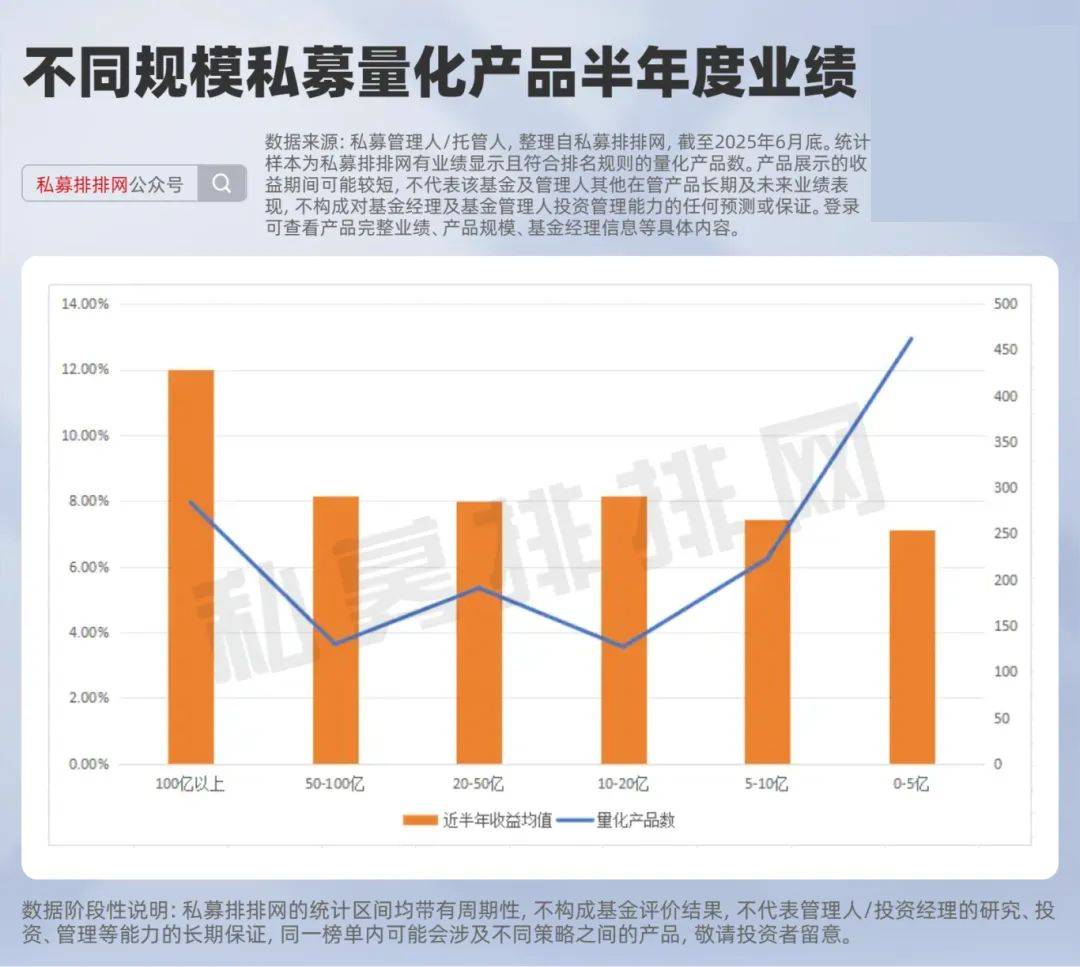
Core Insights - The private equity quantitative products have shown strong performance in the first half of 2025, with an average return of 8.45%, significantly outperforming the Shanghai and Shenzhen 300 index, which only increased by 0.03% [1] - The top-performing quantitative fund managers have been identified across different asset sizes, showcasing their impressive returns and management strategies [4][8][11] Group 1: Performance Overview - As of June 30, 2025, there are 1,417 quantitative products with a total scale of approximately 101.33 billion yuan, achieving an average return of 8.45% in the first half of the year [1] - Among the 284 quantitative products managed by billion-yuan private equity firms, the average return is 11.99%, with only one product showing negative returns [4][5] - The top three fund managers in the billion-yuan category are Yin Tao from Stable Investment, Wang Yiping from Evolutionary Asset, and Zhan Haitao from Abama Investment, with average returns of 11.99%, ***%, and ***% respectively [4][5] Group 2: Fund Manager Rankings - In the 50-100 billion yuan category, the average return for 130 quantitative products is 8.15%, with 93.85% of products showing positive returns [8] - The leading fund manager in this category is Guo Qitian from Qianyan Private Equity, with an average return of ***% [10] - In the 20-50 billion yuan category, the average return is 8.01%, with the top three managers being Shi En from Yunqi Quantitative, Mo Bo from Luxiu Investment, and Qiu Peng from Guangzhou Shouzheng [11][12] Group 3: Manager Profiles - Yin Tao, the top manager in the billion-yuan category, has a background in computer science and has developed a unique quantitative research and trading system based on multi-factor models and AI [6] - Wang Yiping from Evolutionary Asset has 16 years of experience and emphasizes logical quantitative strategies to enhance model stability and risk control [6] - Guo Qitian from Qianyan Private Equity has over 10 years of quantitative research experience and has held various roles in quantitative investment management [10] Group 4: Smaller Fund Categories - In the 10-20 billion yuan category, the average return is 8.16%, with Li Jing from Anzi Fund leading the rankings [15][17] - The 5-10 billion yuan category shows an average return of 7.44%, with Wang Weinan from Liangchuang Investment at the top [19][20] - The 0-5 billion yuan category has an average return of 7.11%, with Hu Qintian from Guangzhou Tianzhan leading [23][25]