玩具

Search documents
大行评级丨花旗:料泡泡玛特IP多元化等突破将驱动集团继续增长 为中国消费板块首选股
Ge Long Hui· 2026-02-11 05:31
Core Viewpoint - Citigroup's report predicts that Pop Mart (9992.HK) will enhance its ability to withstand IP cyclical risks and revive new demand through its IP-centric diversification strategy [1] Group 1: Market Performance - Recent app download data shows an upward trend, particularly in China and the United States, driven mainly by the launch of the new series Skullpanda x My Little Pony [1] - The company is expected to see growth driven by breakthroughs in IP diversification, product innovation, and monetization across various fields by 2026 [1] Group 2: Product and IP Development - Other iconic IP products such as SKULLPANDA and CRYBABY are becoming new growth drivers with their own fan bases, rather than merely serving as substitutes for LABUBU [1] - There is potential upside for non-LABUBU IP this year, with recent global consumer surveys indicating that overseas interest in non-LABUBU IP may be underestimated [1] Group 3: Investment Outlook - Citigroup maintains a "Buy" rating for Pop Mart, setting a target price of HKD 415 based on a projected 28x price-to-earnings ratio for 2026 [1] - The company is trading at a premium compared to most global toy and IP peers, likely due to rapid growth driven by overseas expansion [1] - Citigroup believes that Pop Mart should enjoy a premium due to its leading position compared to domestic peers [1]

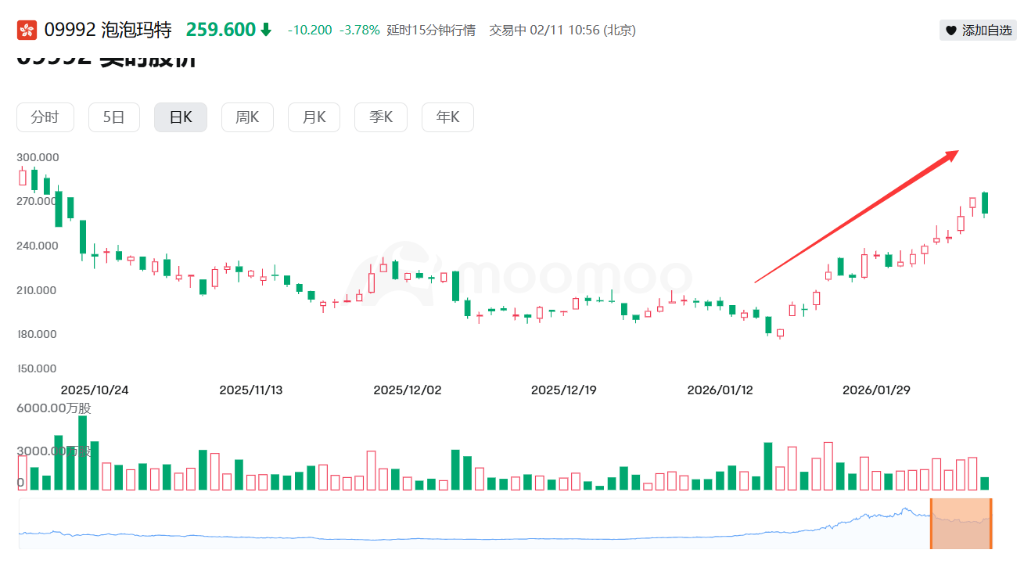
暴涨50%空头死扛不退!泡泡玛特正面临一场史诗级“逼空”风暴?
美股IPO· 2026-02-11 04:01
Core Viewpoint - The stock of Pop Mart has surged by 50% recently, yet short sellers have increased their positions, leading to a highly risky situation with a short squeeze risk score of 100, indicating extreme market tension [1][5][13] Group 1: Stock Performance and Short Selling - Despite a 50% increase in stock price within a month, short sellers have not retreated; instead, they are building a dangerous confrontation [4] - According to S3 Partners, the short interest in Pop Mart has risen sharply from 2% to 16% of the free float, indicating a significant increase in bearish sentiment [5][6] - The current short positions are much larger than institutional long positions, creating an extremely crowded one-sided bet that remains unyielding [6] Group 2: Market Dynamics and Analyst Insights - The market is experiencing a stark divide regarding Pop Mart's future growth trajectory, with management attempting to bolster stock prices through buybacks while short sellers remain skeptical about overseas market performance [9][10] - Analyst Melinda Hu from Bernstein noted that short sellers are particularly focused on the slowing sales trends in key overseas markets, especially the U.S., which has led to increased short interest [10][11] - Despite management's aggressive buyback of HKD 347 million (approximately USD 45 million), short sellers have not been swayed, as short positions increased from 44 million shares to 60 million shares within a week [11] Group 3: Potential Market Volatility - The ongoing tug-of-war between the company's defensive measures and the offensive strategies of short sellers is escalating, with the risk of significant volatility looming [12][13] - The situation is at a critical juncture, where either a forced buy-in by short sellers due to margin pressure could trigger a price surge, or deteriorating fundamentals could burst the stock price bubble [13]


暴涨50%空头死扛不退!泡泡玛特正面临一场史诗级“逼空”风暴?
Hua Er Jie Jian Wen· 2026-02-11 03:28
Core Viewpoint - Despite a 50% surge in stock price within a month, short-sellers are intensifying their positions against Pop Mart, leading to a precarious standoff in the market [1]. Group 1: Stock Performance and Short-Selling Dynamics - Pop Mart's stock has seen a significant increase, yet short-sellers have not retreated, with short positions rising from 2% to 16% of free-floating shares [1]. - The short squeeze risk score for Pop Mart has reached the maximum of 100, indicating potential for a rapid price increase if the stock continues to rise [1]. - The current market structure shows a larger short position compared to institutional long holdings, creating a crowded one-sided bet [1]. Group 2: Market Sentiment and Analyst Insights - There is a notable divergence in market sentiment regarding Pop Mart's future growth, particularly in overseas markets, with short-sellers expressing skepticism [4]. - Despite management's efforts to support the stock price through buybacks, short interest has continued to rise, indicating a lack of confidence in the company's fundamentals [5]. - Analysts have pointed out that the recent stock price increase is not driven by fundamental factors, suggesting that short-sellers may see this as an opportunity to increase their positions [5]. Group 3: Potential for Market Volatility - The ongoing battle between the company's defensive measures and the aggressive stance of short-sellers is escalating, with both sides preparing for potential volatility [7]. - The market is at a critical juncture, where either a forced exit by short-sellers due to margin pressure could lead to a price surge, or deteriorating fundamentals could burst the stock price bubble [7].
陈曦:AI赋能“玩”出新赛道
Jing Ji Ri Bao· 2026-02-11 00:55
兼具节日纪念与智能互动价值的公仔、文创AI产品、陪学机器人纷纷面世。如今,AI玩具越来越 成为传统玩具厂商突破同质化、实现数字化转型的核心支撑,2025年我国AI玩具市场规模预计增至290 亿元。作为AI技术落地的一个重要载体,AI玩具不仅推动玩具产业向智能化和高附加值升级,更通过 个性化交互满足儿童教育、成人陪伴、老人关怀等多元需求,对于激活消费新动能、打造更有品质的美 好生活具有积极作用。 (本文来源:经济日报 作者陈曦系国家发展改革委宏观经济研究院副研究员) 人工智能赋能玩具产业,是科技创新与产业创新深度融合的一个典型案例,对于创新成果转化具有 带动作用。通过人工智能和大模型的融合应用,AI为玩具产品注入了"灵魂",让玩具的价值从物品陪伴 升级到情感连接,促进产品形态和价值的双重升级,也让陪伴更有温度。适配老、中、青、幼各类消费 群体的不同需求,形成了从儿童的教育交互、成人的情感陪伴,到老人的关爱和记忆辅助等的"全龄化 产品矩阵",也带动了产业链上下游发展。比如,上游算力与芯片的迭代升级,中游数字内容市场规模 的扩大,下游IP与渠道的快速发展等。可以说,AI玩具不仅有望成为玩具产业的新引擎,也为上下游关 ...
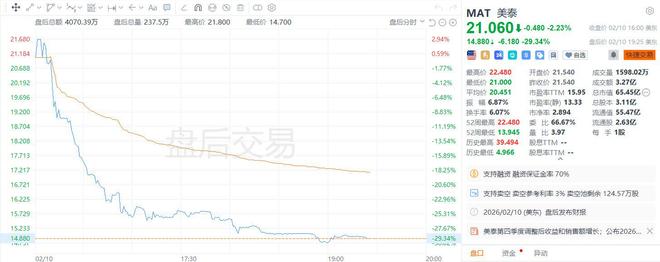
玩具制造商美泰假日销售业绩低迷 股价盘后暴跌29%
Ge Long Hui A P P· 2026-02-11 00:37
Core Viewpoint - Mattel's stock price plummeted by 29% in after-hours trading due to disappointing holiday sales and a lower-than-expected profit outlook for 2026 [1] Group 1: Sales Performance - Mattel reported a 7% increase in fourth-quarter sales, reaching $1.77 billion, which fell short of Wall Street's forecast of $1.84 billion [1] - The company experienced a key sales period before Christmas that did not meet expectations, leading to increased discounting that pressured profit margins [1] Group 2: Profitability and Margin Impact - Due to increased discounts, tariff costs, and other factors, both profit and gross margins significantly declined [1] - The company’s annual performance outlook was also below expectations as it plans to increase investments to boost sales [1] Group 3: Competitive Landscape - In contrast, competitor Hasbro reported that shoppers were willing to pay higher prices for toys during the holiday season, allowing them to pass on tariff costs without severely impacting demand [1]
AI赋能“玩”出新赛道
Jing Ji Ri Bao· 2026-02-10 22:13
兼具节日纪念与智能互动价值的公仔、文创AI产品、陪学机器人纷纷面世。如今,AI玩具越来越成为 传统玩具厂商突破同质化、实现数字化转型的核心支撑,2025年我国AI玩具市场规模预计增至290亿 元。作为AI技术落地的一个重要载体,AI玩具不仅推动玩具产业向智能化和高附加值升级,更通过个 性化交互满足儿童教育、成人陪伴、老人关怀等多元需求,对于激活消费新动能、打造更有品质的美好 生活具有积极作用。 从我国发展实践看,AI玩具聚焦不同人群使用习惯,将语音、视觉乃至情感与产品形态精准结合,将 算法打造成老百姓买得起、用得好、离不开的娱乐伙伴、教育助手、生活工具。在技术融合方面,AI 玩具将语音识别、多模态交互、大语言模型等一系列技术融合,实现能感知、会思考、可互动。在功能 融合方面,区别于传统玩具单一的娱乐功能,AI玩具除了好玩以外,还融合了启蒙、教育、科普乃至 创造力激发、情绪回应、陪护关怀等多重功能。在跨界融合方面,AI玩具成为"AI+教育""AI+养老"等 跨界场景的重要载体,不断突破行业发展边界,充分体现了"人工智能+"赋能千行百业的积极作用。比 如"AI+国潮IP"就赋予了玩具科技与文化的双重附加值。 人工 ...
孩之宝Q4业绩受惠于强劲的假日需求,拟回购10亿美元股票
Xin Lang Cai Jing· 2026-02-10 13:27
格隆汇2月10日|孩之宝公布2025年第四季度业绩,收入同比增长31.8%至14.5亿美元,超过分析师预期 的12.6亿美元,受惠于节假日期间的需求上升;调整后每股收益为1.51美元,亦超过分析师预期的0.96 美元。公司公布一项新的10亿美元的股票回购计划。展望今年,公司预计营收将增长3-5%,低于分析 师预期的增长5.16%。此外,孩之宝和华纳兄弟探索的全球消费品部门建立多年合作关系,共同开发以 《哈利·波特》为题材的玩具和游戏。 来源:格隆汇APP ...

资金动向 | 北水净卖出腾讯14亿,净买入美团5.5亿
Ge Long Hui· 2026-02-10 12:17
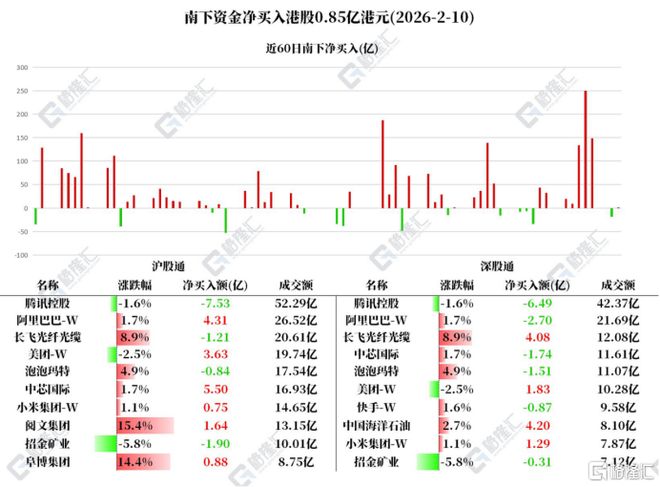
Group 1: Southbound Capital Movements - Southbound capital net bought Hong Kong stocks worth 84.6567 million HKD on February 10, with significant net purchases in Meituan-W (545 million HKD), CNOOC (420 million HKD), SMIC (376 million HKD), and others [1] - Xiaomi has seen continuous net buying for 9 days, totaling 4.0236 billion HKD, while Alibaba has had 5 days of net buying amounting to 4.59095 billion HKD [3] Group 2: Industry Insights - Longi Green Energy reports a moderate increase in fiber optic prices over the past six months, driven by a supply-demand reversal due to AI data center construction, leading to a supply shortage [4] - According to Zhongyin International, Wenwen Group has over ten works with over 100 million views and over 80 works with over 10 million views, indicating a potential acceleration in industry growth with the release of Seedance 2.0 [4] - Huifu Global Research predicts that the rapid growth driven by Labubu will fade, but platform capabilities will persist, with UBS noting that new IP Twinkle has a strong start in early 2026, providing a growth observation window [4] Group 3: Copyright Protection in AI Content - Fubo Group is positioned to benefit from the rise of AI video content, leveraging its Vobile MAX rights confirmation and revenue-sharing platform to create a full-chain solution for copyright protection in the AI content era [5]

港股收盘(02.10) | 恒指收涨0.58% 医药、AI相关股走高 乐欣户外(02720)上市首日翻倍
智通财经网· 2026-02-10 08:44
Market Overview - The Hong Kong stock market experienced a rise followed by a slight retreat, with the Hang Seng Index closing at 27,183.15 points, up 0.58% or 155.99 points, and a total trading volume of HKD 234.04 billion [1] - The Hang Seng China Enterprises Index increased by 0.81% to 9,242.75 points, while the Hang Seng Tech Index rose by 0.62% to 5,451.03 points [1] Blue-Chip Stocks Performance - Pop Mart (09992) continued its upward trend, closing up 4.9% at HKD 269.8, contributing 14.96 points to the Hang Seng Index [2] - Other notable blue-chip stocks included: - CSPC Pharmaceutical Group (01093) up 5.52% at HKD 10.32, contributing 7.01 points [2] - Innovent Biologics (01801) up 4.98% at HKD 89.65, contributing 11.16 points [2] - New Oriental Education (09901) down 4.39% at HKD 46.66, detracting 2.61 points [2] - Alibaba Health (00241) down 2.07% at HKD 6.14, detracting 1.34 points [2] Sector Highlights - The biotechnology sector showed strong performance, with notable gains from: - CSPC Pharmaceutical Group (01093) up 5.52% [3] - Genscript Biotech (01672) up 5.15% [3] - Innovent Biologics (01801) up 4.98% [3] - WuXi Biologics (02269) up 4.65% [3] - The AI-related stocks also surged, with: - China Literature (00772) up 15.41% [4] - Zhiyun (02513) up 14.81% [4] - Fubo Group (03738) up 14.44% [4] Investment Opportunities - The global strategic cooperation between Innovent Biologics and Eli Lilly could reach a potential transaction value of USD 8.85 billion, indicating a strong start for 2026 in business development [4] - The North American electricity shortage is expected to drive investments in various technologies, with the Department of Energy predicting a peak shortfall of 20-40 GW by 2030 [6] Notable Stock Movements - Lexin Outdoor (02720) saw a significant increase of 102.29% on its first trading day, closing at HKD 24.78 [7] - Ruifeng New Energy (00527) rose by 12.9% after signing an investment framework agreement for a major AI computing center project in Zhangjiakou, with a total investment of approximately RMB 24 billion [8] - Jizhi Technology (02590) increased by 11.05% after launching a new general-purpose robot for warehouse scenarios [9] - Ninepoint Investment Holdings (09636) issued a profit warning, expecting revenue of approximately RMB 3.43 billion for 2025, a growth of about RMB 1.12 billion [10] - Changfei Optical Fiber (06869) reached a new high, closing up 8.88% as fiber prices have been rising due to supply-demand imbalances [11]
你以为中国货消失了?美国关税倒逼全世界变成了中方的阳澄湖
Sou Hu Cai Jing· 2026-02-10 07:51
Group 1 - The article discusses the paradox of how a country with minimal industrial base, like Yemen, can produce missiles and drones, drawing parallels to the current state of the US-China trade war [1][3] - The US has imposed tariffs of up to 125% on Chinese goods, aiming to isolate China's economy, but this strategy has backfired, leading to increased global reliance on Chinese manufacturing [3][9] - In 2024, China's total trade with the US reached $688.2 billion, with exports to the US at $524.6 billion and imports from the US at $163.6 billion, highlighting China's significant influence on US trade [6][3] Group 2 - The article describes the "Yangcheng Lake" phenomenon, where despite apparent trade disruptions, Chinese manufacturing continues to infiltrate the US market through various indirect channels [11][18] - Companies are adapting by relocating parts of their production to other countries to circumvent high tariffs, allowing them to comply with US import regulations while still benefiting from Chinese manufacturing [11][18] - Vietnam, for instance, has become a key player in this dynamic, exporting $136.6 billion to the US while importing $13.1 billion from the US, heavily relying on Chinese materials for its exports [17][18] Group 3 - Trump's tariff strategy aimed to bring manufacturing back to the US and reduce trade deficits, but these goals are fundamentally flawed as the trade deficit is a result of US choices rather than external imposition [20][25] - The reliance on the dollar as a global currency allows the US to maintain trade deficits without immediate production costs, complicating the feasibility of Trump's manufacturing return strategy [25][27] - The article argues that the trend of "de-Americanization" is intensifying, with countries seeking alternatives to US economic dominance and increasingly depending on Chinese manufacturing [27][20] Group 4 - The conclusion emphasizes that control over manufacturing is essential for maintaining international competitiveness, contrasting the US's financial dominance with China's robust manufacturing capabilities [27]