
内循环经济

Search documents
消费激励:激活内循环经济的新引擎——评91团帮模式创新
Sou Hu Cai Jing· 2025-12-11 06:09
Core Viewpoint - Activating domestic circulation is crucial for promoting high-quality development under the dual pressures of external demand fluctuations and domestic economic structural transformation [1] Mechanism Innovation - The traditional promotional model relies on price wars, leading to a vicious cycle of discount dependence, profit compression, and weakened service. The innovative model of 91 Group helps create a closed loop of "consumption-accumulation-re-consumption," where users earn discounts on each purchase that can be used for future transactions, enhancing customer loyalty and increasing average transaction value by 18% for a certain restaurant brand [3] Ecological Empowerment - 91 Group integrates online and offline channels to break market segmentation, utilizing a 50% online and 50% offline discount distribution mechanism. This approach attracts foot traffic to physical stores while meeting immediate consumption needs, exemplified by a regional supermarket that effectively targets users within a 3-kilometer radius [5] Compliance Foundation - The consumption incentive model of 91 Group avoids risks associated with funding pools by sourcing funds from platform profits rather than user prepayments. This design adheres to legal requirements and ensures transparency in consumption scenarios, providing a replicable regulatory example for the industry [6] Policy Resonance - The practices of 91 Group resonate with macro policies aimed at stimulating consumption, such as the 2025 "Special Action Plan for Boosting Consumption." The model transforms consumption into capital accumulation, enhancing consumer willingness to spend and optimizing supply through data-driven decision-making [7]


不是河南落后,是没等他们!这3个河南人,改变了中国的消费版图
Sou Hu Cai Jing· 2025-12-06 05:51
Core Viewpoint - The rise of entrepreneurs from Henan province signifies a shift in China's consumption landscape, showcasing that success is achievable through grounded, practical approaches rather than traditional elite backgrounds [1][11]. Group 1: Entrepreneurs from Henan - Yu Donglai, founder of a retail chain, offers employees 150 to 180 days of annual leave with an average salary of 8,000, demonstrating a commitment to employee satisfaction that translates into business success, with annual sales nearing 17 billion [5][11]. - Zhang Hongchao and Zhang Hongfu, founders of Mixue Ice City, disrupted the beverage market by significantly lowering prices, establishing their brand as the world's largest restaurant chain by store count, surpassing even global giants like KFC and McDonald's [7][11]. - Wang Ning, founder of Pop Mart, capitalizes on emotional pricing, transforming toys into luxury items for young consumers, and has achieved a personal net worth surpassing that of prominent figures like Jack Ma [9][11]. Group 2: Economic and Social Context - Henan, with a population exceeding 100 million and a significant labor force, has historically faced economic challenges, including a stark wealth gap and limited educational opportunities, yet is now positioned to leverage its demographic advantages in the new economic landscape [3][11]. - The shift from an export-driven economy to a domestic consumption-focused model has allowed Henan to emerge as a key player, with its large population now serving as both a consumer base and a labor reserve [11][15]. - The character and mindset of Henan entrepreneurs, characterized by practicality and resilience, contrast with traditional business narratives, emphasizing a focus on supply chain efficiency and grounded business practices [13][17]. Group 3: Broader Implications - The rise of Henan entrepreneurs reflects a structural change in China's economy, moving towards a decentralized and diversified consumption model, challenging previous stereotypes associated with the region [15][19]. - The success stories from Henan illustrate that future consumption trends may prioritize accessibility, cost-effectiveness, and emotional connection over high-tech solutions, indicating a potential shift in market dynamics [17][19]. - The emergence of Henan as a business hub symbolizes a broader transformation in Chinese commercial civilization, suggesting that growth can originate from traditionally overlooked areas [19].

如果死扛房价不降,社会将遇到这4大麻烦,每一个都很棘手
Sou Hu Cai Jing· 2025-10-28 05:40
Core Insights - The persistent high housing prices are significantly impacting the social economy, with negative effects becoming increasingly evident [1] - Despite some cities experiencing a slight easing in housing prices, the overall situation remains high, causing pressure on the public [1] Housing Market Dynamics - Developers and second-hand homeowners are reluctant to significantly lower prices due to expectations of future price increases and concerns about buyer psychology [3] - The average housing price in 60 key cities reached 17,593 yuan per square meter in August, necessitating at least 2 to 3 million yuan for a typical residential purchase [1] Economic Implications - High housing prices severely weaken consumer spending power, with mortgage payments consuming over 40% of household income, leaving little for other expenditures [7] - The consumer rate in China stands at 39%, significantly lower than India's 66%, indicating a potential hindrance to economic growth and structural adjustments [7] - The number of newborns in China dropped from 17.56 million in 2017 to 10.63 million in 2021, suggesting a risk of negative population growth if housing prices remain stagnant [8] Impact on Real Economy - The influx of capital into the real estate market is constraining the development of the real economy, as businesses struggle with high rental costs for commercial properties [8] - High housing prices exacerbate the urban-rural wealth gap, limiting the urbanization rate, which currently stands at 64% [8] - The disparity in property values between urban and rural areas is widening, further complicating balanced development [8] Urgency for Solutions - Addressing the issue of high housing prices is becoming an urgent necessity for the health of the social economy [8]

中谷物流20250804
2025-08-05 03:15
Summary of Zhonggu Logistics Conference Call Company Overview - **Company**: Zhonggu Logistics - **Industry**: Domestic Container Shipping Key Points and Arguments Financial Improvement - Zhonggu Logistics improved its financial condition by increasing its free capacity to 74% and optimizing its fleet structure, with 83% of its vessels being less than 10 years old [2][3][4] Domestic Container Shipping Growth - The domestic container shipping sector benefits from improved domestic demand and the economic efficiency of water transport, particularly in the transportation of goods related to the domestic circulation economy, such as grain and coal [2][4] - The current share of water transport in total freight volume in China is only 17%, significantly lower than road transport at 72%. However, with policy support for multimodal transport and containerization, the share of water transport is expected to increase [2][5][6] Supply Chain Advantages - Zhonggu Logistics has ordered 18 large vessels to lock in low-cost capacity, contributing to an industry supply growth rate of 17%. The company also constructed 4,600 TEU new container ships for the foreign trade market, enhancing its market competitiveness [2][7] Characteristics of Domestic Container Shipping - The domestic container shipping industry is characterized by precision and high efficiency, with scheduled services reducing delivery time risks and container transport minimizing storage costs and cargo damage [2][8] Policy Support for Multimodal Transport - National policies actively promote multimodal transport and containerization, which can significantly enhance the efficiency of freight transport. A 1% increase in coastal waterway cargo share can lead to a 6% increase in domestic container shipping volume, while a 1% increase in containerization can boost volume by 4% [2][10] External Market Strategy - Zhonggu Logistics is directing some capacity to the foreign trade market due to high rental rates resulting from events like the Red Sea incident and the US trade war. The company anticipates that this strategy will yield better economic benefits [2][11] Cost Structure and Profitability - The historical lowest freight rate on the international Europe line is around $500, while the operating cost for Zhonggu's vessels is approximately $400-$450 per container. This indicates that the company can maintain profitability even with fluctuations in international freight rates [2][12] Profit Growth Expectations - For 2025, Zhonggu Logistics expects profit growth to exceed 10%, with a projected dividend yield of over 6% based on a commitment to a minimum 60% payout ratio [2][14] Performance in Domestic Market - The domestic container shipping business has shown resilience, with freight rates increasing since the beginning of the year, supported by favorable oil prices and capacity adjustments [2][15] Additional Important Insights - The company has a strong commitment to shareholder returns, with a historical dividend payout ratio of 88% and 90% in the past two years, indicating a robust approach to capital allocation [2][13]

重生的TA | “悬崖边”的中国生姜,如何上演48小时反击战?
Xin Lang Cai Jing· 2025-05-20 23:36
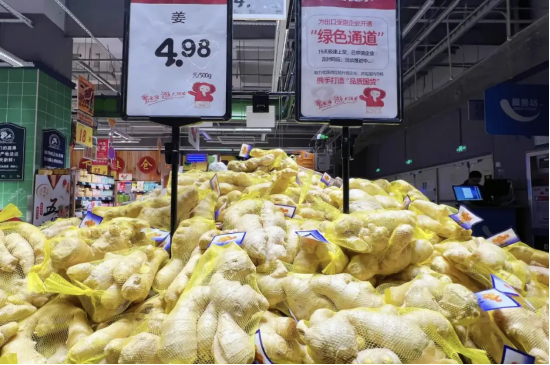
Core Viewpoint - The article highlights the challenges faced by Qingdao Litai Agricultural Products Co., Ltd. due to increased tariffs on ginger exports to the U.S. and the subsequent pivot to domestic sales as a viable solution for the company’s survival and growth [3][4][6]. Group 1: Challenges Faced - Qingdao Litai Agricultural Products Co., Ltd. experienced a significant setback when U.S. tariffs on ginger exports were raised, leading to a need for renegotiation of prices [3]. - The company, located in a key agricultural region, faced difficulties as the increased tariffs threatened its profitability and operational viability [3][4]. Group 2: Strategic Response - A turnaround occurred when RT-Mart announced a green channel for foreign trade enterprises, allowing them to sell excess inventory domestically [4]. - The company quickly engaged with RT-Mart, resulting in products being listed in stores within 48 hours, alleviating immediate financial pressures [4]. Group 3: Market Opportunities - After transitioning to the domestic market, the company reported daily sales of at least two tons, indicating a strong demand for quality ginger [6]. - The shift to domestic sales has restored confidence among the company and local farmers, with increasing interest from supermarkets across various cities [7]. Group 4: Upcoming Events - The first "Beautiful Life Expo" is scheduled for June 27-29, 2025, in Beijing, aimed at stimulating consumer activity and supporting quality brands [8]. - The expo will feature a unique online-offline integration model, connecting quality products and services with domestic distribution channels [8].
风语筑20250319
2025-03-19 15:31
Summary of the Conference Call for Fengyuzhu Company Overview - Fengyuzhu is a leading company in the domestic digital display industry, focusing on exhibition and digital content for public cultural spaces. Key projects include the Chinese Communist Party History Exhibition Hall and the World Skills Museum, along with immersive cultural experiences in collaboration with CCTV [3][4]. Current Business Situation - As of September 30, 2024, Fengyuzhu has nearly 5 billion yuan in hand orders, with annual new orders ranging from 2 billion to 4 billion yuan. The overall gross margin remains stable at 30%-35%, while the net profit margin fluctuates between 10%-15%. However, a projected loss of 110 million yuan in 2024 marks the first annual loss since 2015, although profitability has improved in the second half of 2024 due to favorable policy changes [3][4][5]. Future Outlook - The company is transitioning from focusing solely on exhibition halls to news and consumer scenarios to adapt to the domestic economic cycle. This shift is expected to generate more projects based on consumer demand, leading to improved performance in 2025 [3][5]. - Fengyuzhu has established the Jushen Intelligent Research Institute to apply intelligent products in exhibition, cultural tourism, and news consumption scenarios, particularly focusing on the potential of humanoid robots in cultural heritage and tourism [3][8]. Technological Advancements - The company plans to deploy humanoid robots in 3,000-4,000 existing venues, with each venue requiring approximately 3-5 robots for functions such as reception and guided tours. The cost for a venue to purchase 3-5 robots is about 7 million yuan, with potential selling prices tripling, leading to gross margins of 50% or higher [3][10][15]. Competitive Position - Fengyuzhu maintains a cooperative relationship with humanoid robot manufacturers, focusing on application channels and secondary development. The company has a strong team of 200 planners, 300 creative designers, and nearly 500 developers, ensuring its leading position in the exhibition display industry [11]. Revenue Model - The business model involves purchasing robots from manufacturers, developing content, and selling them to venues. The high demand for humanoid robots in exhibition and cultural tourism scenarios supports a profitable revenue stream [15][21]. Data Utilization and AI Capabilities - The company plans to collaborate with research institutions to collect data for training humanoid robots, creating a closed-loop business model. This involves accumulating real-world data to enhance the robots' capabilities [16][18]. Project Implementation Timeline - Some projects may take 1-3 months to be operational, with the potential for rapid deployment of sample projects for client demonstrations [19][20]. Conclusion - Fengyuzhu is well-positioned to leverage its existing orders and technological advancements to enhance its market presence in the digital display and humanoid robot sectors, with a focus on adapting to consumer needs and expanding into new business scenarios.
