
租赁和商务服务业

Search documents
深挖潜能扩内需优供给 拓展经济增长新空间
Xin Lang Cai Jing· 2025-12-30 20:11
Core Viewpoint - The central economic work meeting emphasizes expanding domestic demand as a primary strategy for economic growth in 2026, highlighting the importance of optimizing supply and implementing targeted policies to enhance quality and efficiency [1][2]. Group 1: Economic Strategy - The focus on expanding domestic demand is a long-term commitment rather than a short-term emergency measure, necessitating more proactive macroeconomic policies [2][3]. - The shift towards demand-side strategies aims to balance supply and demand contradictions, with an emphasis on high-quality development and nurturing new growth drivers [1][2]. Group 2: Specific Measures - Encouraging consumer spending is prioritized, with plans to enhance residents' income and provide incentives to boost consumption capacity [3][5]. - The implementation of policies such as optimizing "two new" policies and "two heavy" projects, along with issuing long-term special bonds, are crucial for expanding domestic demand [3][4]. Group 3: Regional Focus - Sichuan Province - Sichuan aims to leverage its demand potential and enhance economic growth by focusing on effective demand and stabilizing the economy through various initiatives [5][6]. - The province has maintained a stable economic growth rate between 5.3% and 6.1% over the past six quarters, with industrial output and service sectors showing positive growth [6][7]. Group 4: Market Expansion - Strategies include increasing domestic market demand, enhancing external market sales, and attracting foreign investment to stimulate economic activity [8][9]. - The province's trade balance shows a significant "deficit," indicating a need to boost the export of local products and attract more external consumers [8][9].
普惠金融—小微指数显示:2025年三季度,小微企业融资成本稳步下降
Zhong Guo Jing Ji Wang· 2025-12-30 05:22
Core Insights - The "Inclusive Finance - Micro and Small Enterprises Index" indicates a significant decrease in financing costs for micro and small enterprises by Q3 2025, with a continuous increase in funding supply and improved quality of financial services [1][2] Group 1: Financing Trends - By the end of September 2025, the balance of inclusive micro and small loans reached 36.1 trillion yuan, a year-on-year increase of 12.2%, driven by ongoing optimization of systems and innovation in products and services [1] - The financing supply index reached 209.45 points in Q3 2025, reflecting a quarter-on-quarter increase of 2.12%, indicating ample financing supply [1] - Over 70% of micro and small enterprises reported that the financing amounts met their needs, showing high satisfaction with financing [1] Group 2: Cost and Efficiency - The financing price index fell to 65.32 points, a decrease of 4.92% quarter-on-quarter, indicating a stable decline in comprehensive financing costs for inclusive micro and small enterprises [2] - The weighted average interest rate for newly issued loans in September was approximately 3.1%, down about 40 basis points from the same period last year [2] - The financing efficiency index rose to 215.09 points, with nearly 60% of micro and small enterprises able to receive loans in a timely manner, reflecting improved financing efficiency [2] Group 3: Financial Service Quality - The inclusive finance service index showed improvements in both accessibility and quality, with the accessibility index at 203.47 points (up 3.02% quarter-on-quarter) and the quality index at 111.76 points (up 0.31% quarter-on-quarter) [2] - The inclusive finance development index remained stable at 52.48 points, with a slight increase of 0.21% quarter-on-quarter, indicating a positive trend in the development of micro and small enterprises [3] - The business environment for micro and small enterprises continues to improve, with the inclusive finance - micro business index at 57.85 points, reflecting a slight increase of 0.02% quarter-on-quarter [3] Group 4: Sector Analysis - Financing price indices across five major sample industries (wholesale and retail, manufacturing, leasing and business services, construction, and scientific research and technical services) showed declines, indicating the effectiveness of accommodative monetary policies [3] - The accessibility and quality indices for financial services in these sectors also increased, with construction, manufacturing, and scientific research sectors seeing over 2% growth in accessibility [3]
11月份国民经济延续稳中有进发展态势 - 国家统计局
Guo Jia Tong Ji Ju· 2025-12-29 09:36
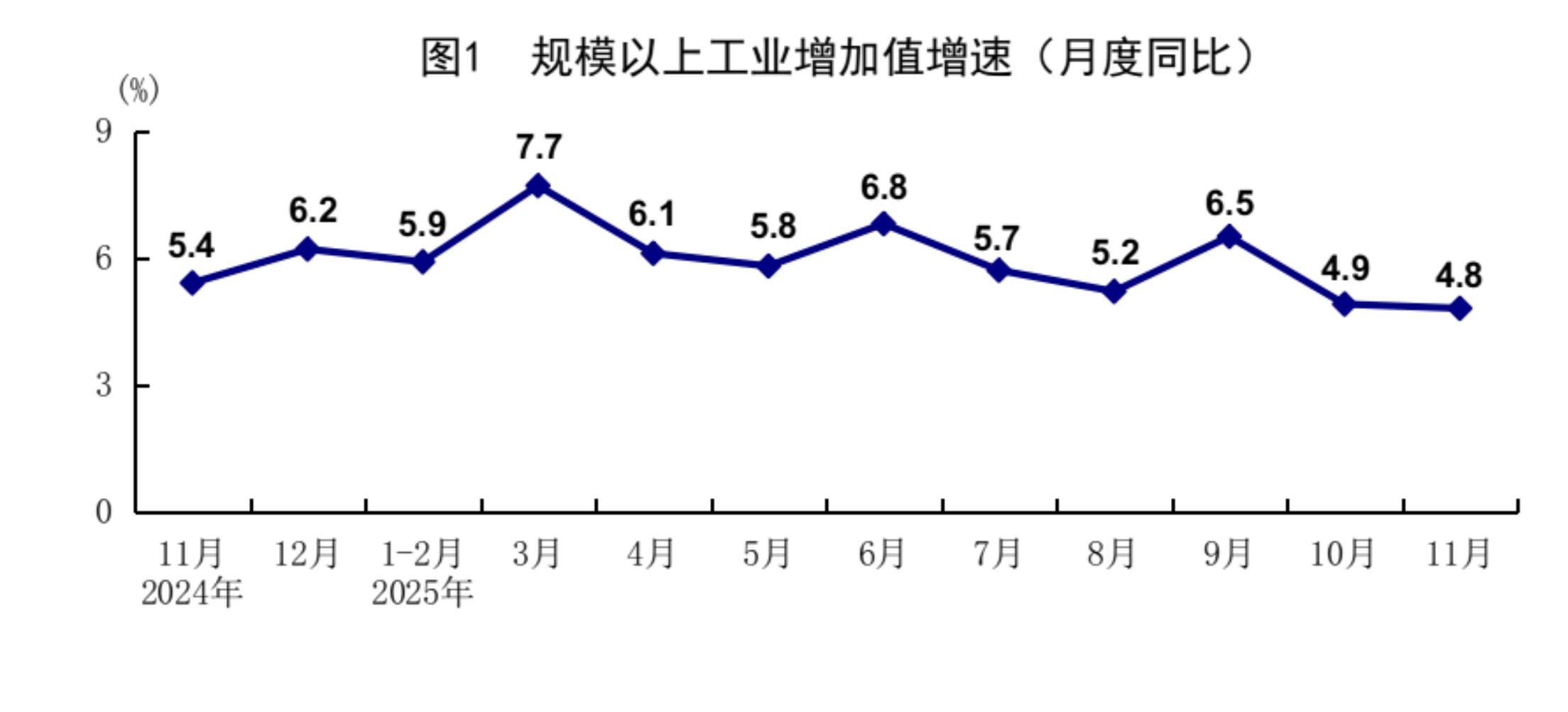
(2025年12月15日) 国家统计局 11月份,在以习近平同志为核心的党中央坚强领导下,各地区各部门认真贯彻落实党中央、国务院决策 部署,坚持稳中求进工作总基调,深入实施更加积极有为的宏观政策,纵深推进全国统一大市场建设, 着力推动高质量发展,生产供给基本平稳,就业形势总体稳定,市场价格继续改善,新质生产力稳步发 展,经济运行延续总体平稳、稳中有进发展态势。 一、全年粮食实现丰收,稳定在1.4万亿斤以上 全年全国粮食产量14298亿斤,比上年增加167.5亿斤,增长1.2%,稳定在1.4万亿斤以上。其中,秋粮 产量10732亿斤,比上年增加163.6亿斤,增长1.5%。全国谷物产量13204亿斤,比上年增加158.4亿斤, 增长1.2%。粮食播种面积增加、单产提高。全国粮食播种面积17.91亿亩,比上年增加134.8万亩,增长 0.1%;粮食单产399.1公斤/亩,每亩产量比上年增加4.4公斤,增长1.1%。 二、工业生产稳定增长,装备制造业和高技术制造业增长较快 11月份,全国规模以上工业增加值同比增长4.8%,环比增长0.44%。分三大门类看,采矿业增加值同比 增长6.3%,制造业增长4.6%,电力、热 ...

国家统计局关于2024年国内生产总值最终核实的公告 - 国家统计局
Guo Jia Tong Ji Ju· 2025-12-29 09:36
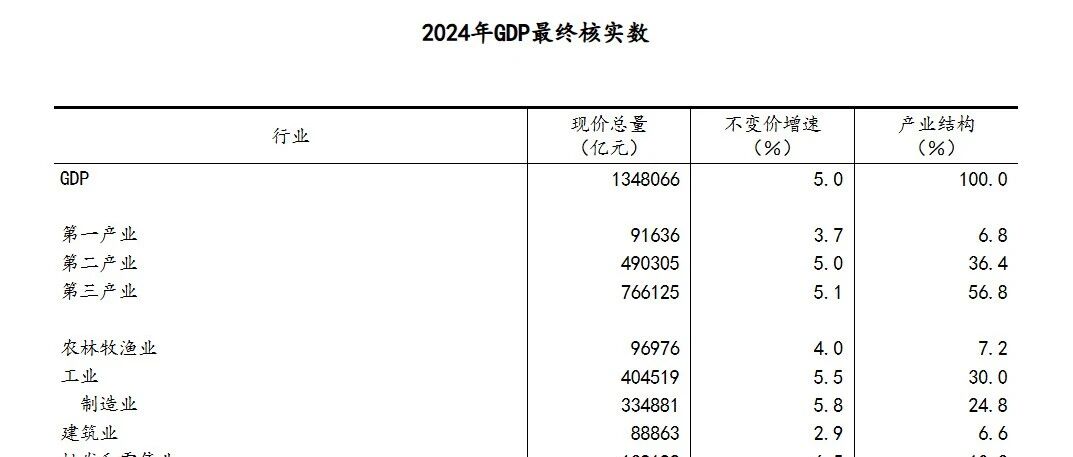
Group 1 - The core point of the article is the final verification of China's GDP data for 2024, which shows a total nominal GDP of 13,480.66 billion yuan, a decrease of 10.18 billion yuan from the preliminary estimate, with a year-on-year growth of 5.0% at constant prices, consistent with the preliminary estimate [1][2][4]. Group 2 - The primary industries contributed 91.64 billion yuan with a growth rate of 3.7% [5]. - The secondary industries accounted for 490.305 billion yuan, growing at 6.8% [5]. - The tertiary industries reached 766.125 billion yuan, with a growth rate of 5.1% [5]. - The agricultural sector, including forestry, animal husbandry, and fishery, grew by 4.0% [5]. - The industrial sector, which includes manufacturing, grew by 5.5% [6]. - The construction industry saw a growth of 2.9% [6]. - The wholesale and retail sector grew by 6.5% [6]. - The transportation, warehousing, and postal sector grew by 6.7% [6]. - The accommodation and catering sector grew by 7.0% [6]. - The financial sector grew by 3.7% [6]. - The real estate sector experienced a decline of 2.2% [6]. - The information transmission, software, and IT services sector grew by 11.7% [6]. - The leasing and business services sector grew by 11.1% [6]. - Other industries grew by 3.9% [6].
【数据发布】国家统计局关于2024年国内生产总值最终核实的公告
中汽协会数据· 2025-12-26 09:37
Core Viewpoint - The final verification of China's GDP for 2024 shows a total nominal GDP of 13,480.66 billion yuan, a decrease of 10.18 billion yuan from the preliminary estimate, with a year-on-year growth rate of 5.0% at constant prices, consistent with the preliminary estimate [1]. Summary by Categories GDP Overview - The final verified nominal GDP for 2024 is 13,480.66 billion yuan, reflecting a reduction of 10.18 billion yuan from the preliminary figure [1]. - The year-on-year growth rate at constant prices is 5.0%, unchanged from the preliminary estimate [1]. Industry Breakdown - **Primary Industry**: - Current value: 91,636 billion yuan - Growth rate: 3.7% - Contribution to GDP: 6.8% [4] - **Secondary Industry**: - Current value: 490,305 billion yuan - Growth rate: 5.0% - Contribution to GDP: 36.4% [4] - **Tertiary Industry**: - Current value: 766,125 billion yuan - Growth rate: 5.1% - Contribution to GDP: 56.8% [4] Specific Sector Performance - **Agriculture, Forestry, Animal Husbandry, and Fishery**: - Current value: 96,976 billion yuan - Growth rate: 4.0% - Contribution to GDP: 7.2% [4] - **Industrial Sector**: - Current value: 404,519 billion yuan - Growth rate: 5.5% - Contribution to GDP: 30.0% [4] - **Manufacturing**: - Current value: 334,881 billion yuan - Growth rate: 5.8% - Contribution to GDP: 24.8% [4] - **Construction**: - Current value: 88,863 billion yuan - Growth rate: 2.9% - Contribution to GDP: 6.6% [4] - **Wholesale and Retail Trade**: - Current value: 139,192 billion yuan - Growth rate: 6.5% - Contribution to GDP: 10.3% [4] - **Transportation, Storage, and Postal Services**: - Current value: 59,045 billion yuan - Growth rate: 6.7% - Contribution to GDP: 4.4% [4] - **Accommodation and Catering**: - Current value: 24,894 billion yuan - Growth rate: 7.0% - Contribution to GDP: 1.8% [4] - **Financial Sector**: - Current value: 96,956 billion yuan - Growth rate: 3.7% - Contribution to GDP: 7.2% [4] - **Real Estate**: - Current value: 84,047 billion yuan - Growth rate: -2.2% - Contribution to GDP: 6.2% [4] - **Information Transmission, Software, and IT Services**: - Current value: 63,958 billion yuan - Growth rate: 11.7% - Contribution to GDP: 4.7% [4] - **Leasing and Business Services**: - Current value: 56,941 billion yuan - Growth rate: 11.1% - Contribution to GDP: 4.2% [4] - **Other Industries**: - Current value: 232,676 billion yuan - Growth rate: 3.9% - Contribution to GDP: 17.3% [4]
国家统计局公布2024年GDP最终核实结果
Sou Hu Cai Jing· 2025-12-26 01:53
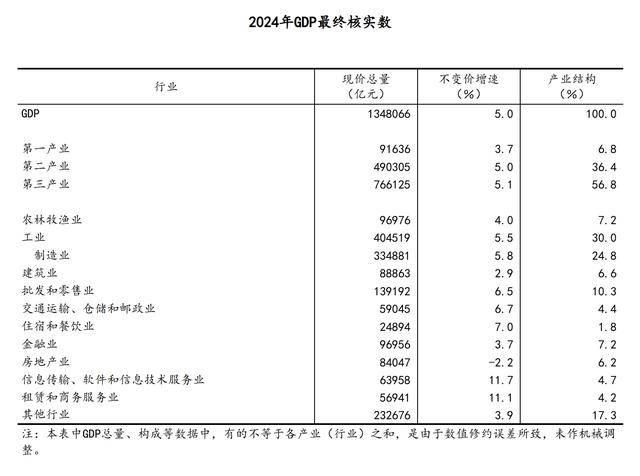
Core Insights - The National Bureau of Statistics of China has released the final verification of the GDP for 2024, showing a total nominal GDP of 13,480.66 billion yuan, which is a decrease of 10.18 billion yuan from the preliminary estimate. The GDP growth rate at constant prices is 5.0%, unchanged from the preliminary figure [1][4]. Group 1: Overall GDP Data - The final verified nominal GDP for 2024 is 13,480.66 billion yuan, a reduction of 10.18 billion yuan from the preliminary estimate [1]. - The GDP growth rate at constant prices is 5.0%, consistent with the preliminary calculation [1]. Group 2: Sectoral Breakdown - The primary industry contributed 91,636 billion yuan with a growth rate of 3.7%, accounting for 6.8% of the GDP [2]. - The secondary industry reached 490,305 billion yuan, growing at 5.0%, representing 36.4% of the GDP [2]. - The tertiary industry totaled 766,125 billion yuan, with a growth rate of 5.1%, making up 56.8% of the GDP [2]. - The agricultural sector (including forestry, animal husbandry, and fishery) generated 96,976 billion yuan, growing at 4.0% [2]. - The industrial sector produced 404,519 billion yuan, with a growth rate of 5.5% [2]. - The manufacturing sector accounted for 334,881 billion yuan, growing at 5.8% [2]. - The construction industry reached 88,863 billion yuan, with a growth rate of 2.9% [2]. - The wholesale and retail sector generated 139,192 billion yuan, growing at 6.5% [2]. - The transportation, warehousing, and postal sector produced 59,045 billion yuan, with a growth rate of 6.7% [2]. - The accommodation and catering sector reached 24,894 billion yuan, growing at 7.0% [2]. - The financial sector generated 96,956 billion yuan, with a growth rate of 3.7% [2]. - The real estate sector saw a decline, totaling 84,047 billion yuan with a negative growth rate of 2.2% [2]. - The information transmission, software, and IT services sector grew significantly at 11.7%, totaling 63,958 billion yuan [2]. - The leasing and business services sector reached 56,941 billion yuan, growing at 11.1% [2]. - Other industries contributed 232,676 billion yuan, with a growth rate of 3.9% [2].
国家统计局:经最终核实2024年GDP现价总量为1348066亿元
Guo Jia Tong Ji Ju· 2025-12-26 01:39
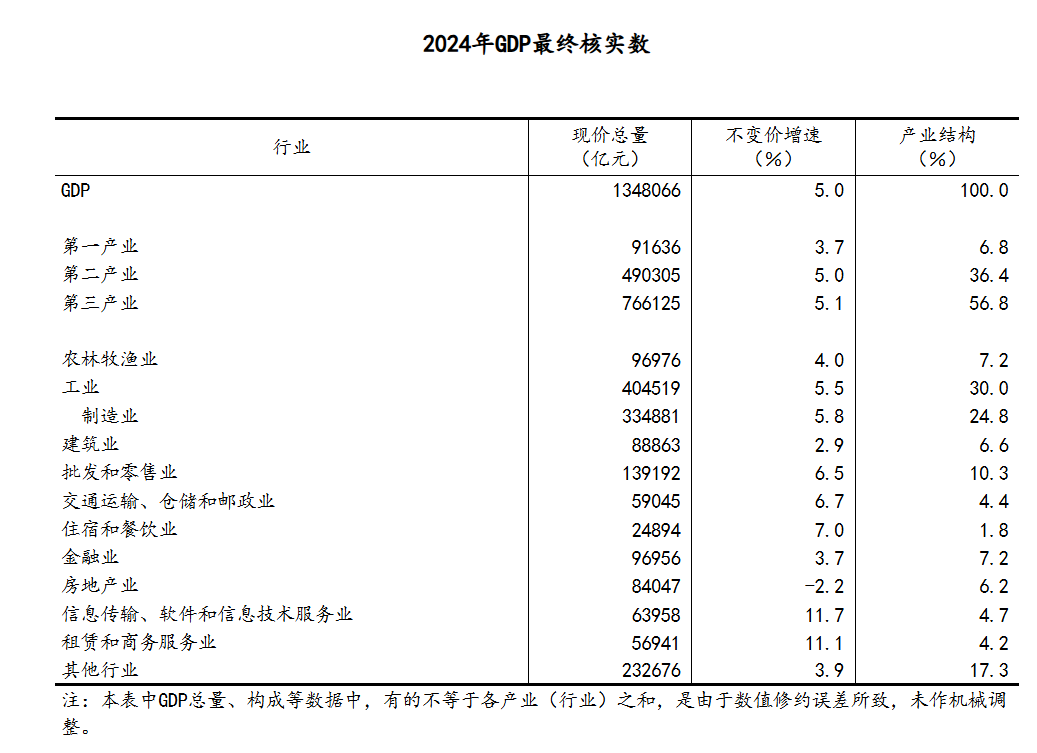
Core Insights - The National Bureau of Statistics of China announced the final verification of GDP data for 2024, revealing a total GDP at current prices of 13,480.66 billion yuan, which is a decrease of 10.18 billion yuan from the preliminary estimate [1] - The GDP growth rate at constant prices for 2024 is confirmed at 5.0%, consistent with the preliminary estimate [1] Industry Breakdown - The first industry (agriculture, forestry, animal husbandry, and fishery) contributed 91.636 billion yuan with a growth rate of 3.7%, accounting for 6.8% of GDP [3] - The second industry (including manufacturing and construction) totaled 490.305 billion yuan, growing at 5.0%, representing 36.4% of GDP [3] - The third industry (services) reached 766.125 billion yuan, with a growth rate of 5.1%, making up 56.8% of GDP [3] - Notable sectors include: - Manufacturing at 334.881 billion yuan with a growth rate of 5.8% [3] - Information transmission, software, and IT services at 63.958 billion yuan, growing at 11.7% [3] - Real estate sector showing a decline at -2.2% with a total of 84.047 billion yuan [3]
国家统计局关于2024年国内生产总值最终核实的公告
Guo Jia Tong Ji Ju· 2025-12-26 01:30
Core Points - The final verified GDP for 2024 is 13,480.66 billion yuan, which is a decrease of 10.18 billion yuan compared to the preliminary estimate, while the year-on-year growth rate at constant prices remains at 5.0% [1][4]. Group 1: GDP Overview - The GDP at current prices for 2024 is 1,348,066 million yuan, reflecting a reduction from the preliminary figure [1][4]. - The GDP growth rate at constant prices is confirmed at 5.0%, consistent with the preliminary estimate [1][4]. Group 2: Sector Contributions - The primary industry contributed 91,636 million yuan with a growth rate of 3.7%, accounting for 6.8% of GDP [4]. - The secondary industry, including manufacturing, contributed 490,305 million yuan with a growth rate of 5.0%, representing 36.4% of GDP [4]. - The tertiary industry showed the highest growth rate at 5.1%, contributing 766,125 million yuan, which is 56.8% of GDP [4]. Group 3: Industry-Specific Data - The manufacturing sector grew by 5.8%, contributing 334,881 million yuan [4]. - The construction industry experienced a slower growth rate of 2.9%, contributing 88,863 million yuan [4]. - The information transmission, software, and IT services sector had a significant growth rate of 11.7%, contributing 63,958 million yuan [4]. - The real estate sector faced a decline of 2.2%, contributing 84,047 million yuan [4].
12月31日截止 快来申请重点群体社会保险补贴
Xin Lang Cai Jing· 2025-12-25 17:24
Policy Overview - The Chongqing Human Resources and Social Security Bureau has issued a notification to accelerate the implementation of expanded social insurance subsidy and one-time employment expansion subsidy policies, providing a 25% subsidy on individual social insurance contributions to encourage enterprises to expand employment [2][3] Subsidy Details - The subsidy is targeted at small and medium-sized enterprises in key industries that sign labor contracts for over one year and have made new or continued contributions to basic pension, medical, and unemployment insurance in 2025 [2] - Key industries include manufacturing, information transmission/software and IT services, wholesale and retail, accommodation and catering, leasing and business services, and other services [2] - Key groups eligible for the subsidy include 2025 college graduates, unemployed graduates from 2023 and 2024, individuals registered as unemployed for over six months in 2025, and those monitored for poverty prevention [2] Subsidy Amount - Eligible individuals can receive a monthly subsidy ranging from 115.6 yuan to 577.9 yuan based on their social insurance contribution amounts [2] Application Process - The application deadline for the subsidy is December 31, 2025, with the subsidy period lasting for one year, starting from the month the enterprise makes actual social insurance contributions for the key groups [4] - The subsidy will be disbursed monthly, with the latest payment expected by the end of 2026 [4] Implementation Measures - Chongqing is utilizing big data to establish a dynamic screening mechanism to identify key industries and groups, facilitating a "direct subsidy and quick processing" approach [3] - The policy includes a "one-time certification, subsequent exemption from reporting" system, where enterprises only need to confirm information once, and the system will automatically generate subsidy lists based on monthly insurance data [3] - Local districts are tasked with accurately identifying key groups and ensuring timely insurance contributions and subsidy applications by eligible employees [3][5]

江西赣臻行文旅有限公司成立,注册资本200万人民币
Sou Hu Cai Jing· 2025-12-25 16:26
天眼查显示,近日,江西赣臻行文旅有限公司成立,法定代表人为邓博,注册资本200万人民币,江西 森柯管理有限公司、江西森联共创企业管理有限公司持股。 经营范围含许可项目:旅游业务(依法须经批准的项目,经相关部门批准后在许可有效期内方可开展经 营活动,具体经营项目和许可期限以相关部门批准文件或许可证件为准)旅行社服务网点旅游招徕、咨 询服务,旅游开发项目策划咨询,职工疗休养策划服务,体验式拓展活动及策划,组织文化艺术交流活 动,旅客票务代理,票务代理服务,小微型客车租赁经营服务,航空商务服务,商务代理代办服务,个 人商务服务,教育咨询服务(不含涉许可审批的教育培训活动),信息咨询服务(不含许可类信息咨询 服务),因私出入境中介服务,广告设计、代理,广告制作,广告发布,摄像及视频制作服务(除依法 须经批准的项目外,凭营业执照依法自主开展经营活动) 企业名称江西赣臻行文旅有限公司法定代表人邓博注册资本200万人民币国标行业租赁和商务服务业> 商务服务业>综合管理服务地址江西省九江市濂溪区濂溪产业园莲花片区(长江路1688号研发大楼三楼 301)企业类型其他有限责任公司营业期限2025-12-25至无固定期限登记机关九 ...