
计算机通信和其他电子设备制造业

Search documents
1-7月湖南规模工业增加值增长8% 比去年同期快1个百分点
Zhong Guo Chan Ye Jing Ji Xin Xi Wang· 2025-08-29 01:00
Economic Performance - Hunan's economy continues to show a stable and positive trend, with industrial added value increasing by 8% year-on-year from January to July, which is 1 percentage point faster than the same period last year [1] - The equipment manufacturing and raw materials industries saw added value growth of 12% and 9.1% respectively, contributing 3.8 percentage points and 2.1 percentage points to the overall industrial growth [1] Investment Trends - Fixed asset investment in Hunan increased by 2.9% year-on-year, which is 0.3 percentage points faster than the first half of the year [1] - Private investment grew by 6%, outpacing the first half of the year by 0.6 percentage points and the same period last year by 4.1 percentage points [1] - Investment in equipment and tools rose by 28.4%, which is 19.6 percentage points higher than the same period last year, contributing 2.9 percentage points to total investment growth [1] Consumer Market - The total retail sales of consumer goods in Hunan increased by 6.2% year-on-year, remaining stable compared to the first half of the year [1] - Retail sales of automotive products by large wholesale and retail enterprises grew by 1.3%, marking the first positive growth this year, with a notable increase of 10.6% in July [1] - Retail sales of essential consumer goods by large wholesale and retail enterprises rose by 10.4% year-on-year, with a 4.6% increase in July, which is 1.3 percentage points faster than the previous month [1] High-tech Industry Growth - The added value of Hunan's high-tech manufacturing industry increased by 13.9% year-on-year, with aerospace and equipment manufacturing growing by 27.3% and electronic and communication equipment manufacturing by 18.4% [2] - Investment in high-tech industries grew by 5.5%, which is 2.6 percentage points faster than the overall investment growth rate, while high-tech manufacturing investment increased by 8.2% [2]
1-7月杭州经济运行总体平稳
Mei Ri Shang Bao· 2025-08-25 22:16
Economic Overview - Hangzhou's economy shows resilience and vitality, with steady recovery in the consumption market and robust industrial support, maintaining a stable operational trend [2] Consumer Market Performance - From January to July, the total retail sales of social consumer goods reached 527.1 billion yuan, a year-on-year increase of 5.1% [3] - The retail sales of household appliances and audio-visual equipment, as well as communication equipment, grew by 86.3% and 34.5% respectively, driven by consumption promotion policies [3] - New energy vehicle retail sales increased by 23.7%, while the retail sales of sports and entertainment products and gold and silver jewelry surged by 40.5% and 29.9% respectively [3] - Basic living necessities maintained stable growth, with retail sales of grain, oil, and food products rising by 9.7% [3] - In July, consumer prices remained flat year-on-year, with a month-on-month increase of 0.4% [3] Industrial Growth - The industrial added value for large-scale enterprises reached 261.3 billion yuan from January to July, with a year-on-year growth of 6.9%, surpassing the national average [4] - Key industries such as computer communication and other electronic equipment manufacturing, automotive manufacturing, and electrical machinery and equipment manufacturing saw added value growth of 17.0%, 30.1%, and 8.5% respectively [4] - High-tech industries, strategic emerging industries, and equipment manufacturing also outperformed the average industrial growth, with increases of 8.3%, 9.7%, and 10.3% respectively [4] - In the smart manufacturing sector, production of industrial control computers and systems grew by 101.3%, while industrial robot production increased by 110.1% [4] Service Sector Expansion - The service sector, excluding wholesale and retail, accommodation and catering, finance, and real estate, generated operating income of 1,094.4 billion yuan from January to June, reflecting an 8.6% year-on-year increase [5] - The information transmission, software, and information technology service industries saw revenue growth of 12.7%, while scientific research and technical services grew by 6.2% [5] - Emerging service industries, particularly in the digital economy and high-tech services, reported revenue increases of 12.6% and 11.8% respectively, significantly outpacing the overall service sector growth [5]


杭州1-7月工业机器人产量同比增长110.1%
Xin Lang Cai Jing· 2025-08-25 06:13
Core Insights - Hangzhou's economy shows steady recovery with industrial added value reaching 261.3 billion yuan, a year-on-year increase of 6.9% [1] Industrial Performance - Key industries driving growth include: - Computer, communication, and other electronic equipment manufacturing with a growth of 17.0% - Automobile manufacturing with a growth of 30.1% - Electrical machinery and equipment manufacturing with a growth of 8.5% [1][1][1] Emerging Industries - New growth drivers are evident with: - High-tech industries growing by 8.3% - Strategic emerging industries growing by 9.7% - Equipment manufacturing growing by 10.3% - All growth rates exceed the average level of above-scale industries [1][1][1] Smart Manufacturing - The smart manufacturing sector shows remarkable performance: - Industrial control computers and systems production increased by 101.3% - Industrial robot production increased by 110.1% - This indicates Hangzhou's leading position in the integration of digital economy and advanced manufacturing [1][1][1]

1-7月杭州经济稳中向好
Hang Zhou Ri Bao· 2025-08-25 02:55
Economic Overview - Hangzhou's economy shows strong resilience with steady recovery in consumption and robust industrial support, indicating a dual characteristic of stability and new vitality [1][4] - The total retail sales of consumer goods reached 527.1 billion yuan, a year-on-year increase of 5.1% from January to July [1] Consumption Trends - Upgrading consumption categories performed well, with home appliances and audio-visual equipment retail sales increasing by 86.3%, and communication equipment by 34.5% [1] - New energy vehicle retail sales grew by 23.7%, reflecting a trend towards green and smart consumption [1] - Basic living consumption remained stable, with grain and oil, and food retail sales increasing by 9.7% [1] Foreign Trade Performance - The total import and export value reached 515.4 billion yuan, a year-on-year increase of 7.2% from January to July [2] - Exports amounted to 368 billion yuan, growing by 12.3%, surpassing the national average [2] - Private enterprises played a significant role, with exports of 282 billion yuan, accounting for 76.6% of total exports [2] Industrial Growth - The industrial added value for large-scale enterprises reached 261.3 billion yuan, with a year-on-year growth of 6.9% [3] - Key industries such as computer communication and electronic equipment manufacturing saw substantial growth, with increases of 17.0% and 30.1% respectively [3] - High-tech industries and strategic emerging industries also showed strong performance, with added values growing by 8.3% and 9.7% respectively [3] Service Sector Development - The revenue of large-scale service industries reached 1,094.4 billion yuan, with a year-on-year growth of 8.6% [3] - The information transmission, software, and IT services sector grew by 12.7%, indicating a strong digital economy [3] - The core industries of the digital economy and high-tech services saw revenue increases of 12.6% and 11.8% respectively [3]
湖北1—7月经济运行平稳 进出口总额增速达28.7%领跑全国
Chang Jiang Shang Bao· 2025-08-18 23:45
Economic Overview - Hubei province's economy shows a stable and positive trend across various sectors including industry, investment, consumption, foreign trade, and finance [1][2] Industrial Performance - The industrial added value above designated size in Hubei increased by 7.9% year-on-year in the first seven months of 2025, matching the growth rate from January to June and exceeding the national average by 1.6 percentage points [2] - High-tech manufacturing led the growth with an increase of 13.5%, contributing 26.2% to the overall industrial growth [2] - Specific sectors such as computer, communication, and other electronic equipment manufacturing grew by 14.5%, while electrical machinery and equipment manufacturing rose by 18.4% [2] - Production of integrated circuit wafers, electronic components, lithium-ion batteries, and optical fibers saw significant increases of 20.9%, 46.8%, 56.6%, and 23.0% respectively [2] Investment Trends - Fixed asset investment in Hubei grew by 6.5% year-on-year, with manufacturing investment increasing by 12.8% and infrastructure investment rising by 4.4% [3] - Excluding real estate development, fixed asset investment surged by 9.8% [3] - The sales area of new commercial housing reached 28.4 million square meters, marking a growth of 5.8% [3] - Investment in the primary industry rose by 14.7%, the secondary industry by 12.1%, and the tertiary industry by 2.8% [3][4] Consumption Insights - The total retail sales of consumer goods in Hubei amounted to 1,518.587 billion yuan, reflecting a year-on-year growth of 6.2%, surpassing the national average by 1.4 percentage points [5] - The "old-for-new" policy significantly boosted consumption, with retail sales of energy-efficient home appliances and smart home devices increasing by 72.2% and 42.3% respectively [5] - Online retail sales also showed strong growth, increasing by 20.3% [5] Foreign Trade Performance - Hubei's total import and export value reached 477.18 billion yuan, a year-on-year increase of 28.7%, outpacing the national growth rate by 25.2 percentage points [5] - Exports totaled 342.79 billion yuan, growing by 37.9%, while imports were 134.39 billion yuan, up by 10.0% [5] - General trade accounted for 80.6% of the total import and export value, with a growth of 36.6% [5] Financial Sector - Local general public budget revenue in Hubei reached 266.065 billion yuan, growing by 7.9% year-on-year [6] - The balance of deposits in financial institutions was 9,973.627 billion yuan, an increase of 8.9% compared to the beginning of the year [6] - The balance of loans reached 9,258.903 billion yuan, growing by 7.8% [6]
7 月通胀点评:服务消费季节性走强
Bank of China Securities· 2025-08-11 14:46
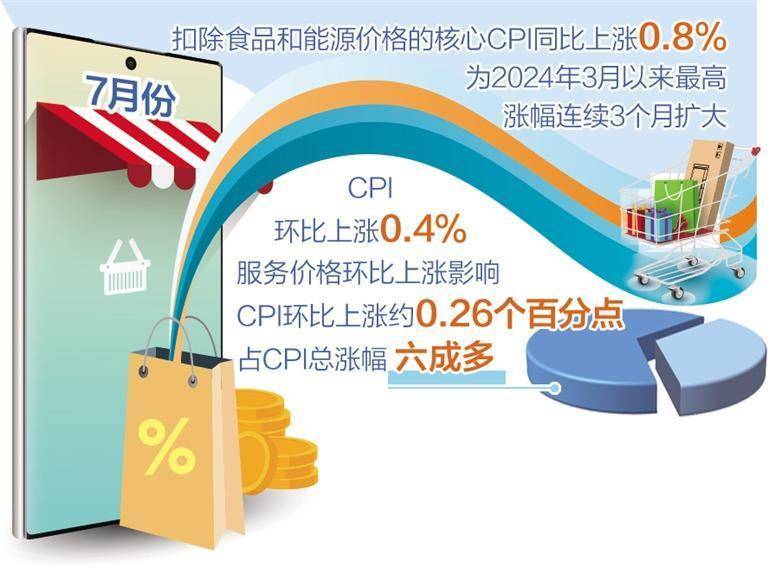
Inflation Overview - July CPI year-on-year growth slightly exceeded consensus expectations, while PPI year-on-year growth fell below expectations[1] - July CPI increased by 0.4% month-on-month, remaining flat year-on-year, with core CPI rising by 0.8%[2] - Service prices rose by 0.5% year-on-year, while consumer goods prices fell by 0.4%[2] CPI Analysis - Year-on-year growth in July was driven by other goods and services (8.0%), clothing (1.7%), and healthcare (0.5%), while food and tobacco prices fell by 0.8%[2] - Food prices contributed to a 0.29 percentage point decline in CPI year-on-year, with gold and platinum jewelry prices adding 0.22 percentage points to CPI growth[2] - Service prices accounted for approximately 0.26 percentage points of the month-on-month CPI increase, representing over 60% of the total CPI rise[6] PPI Insights - July PPI decreased by 0.2% month-on-month and 3.6% year-on-year, with the decline in production materials contributing significantly[15] - The month-on-month decline in PPI was the first narrowing since March, influenced by seasonal factors and international trade uncertainties[16] - The overall PPI decline was impacted by eight industries, which collectively contributed approximately 0.24 percentage points to the PPI decrease[16] Future Outlook - The second half of the year is expected to see a narrowing of the PPI year-on-year decline due to improved supply-demand relationships in certain industries[20] - Seasonal and policy factors may cause fluctuations in various price segments, particularly in food and durable goods[7] - Risks include potential global inflation resurgence and rapid economic downturns in Europe and the U.S.[30]
锐财经|七月份CPI环比上涨0.4% 物价数据透露哪些积极信号
Ren Min Ri Bao Hai Wai Ban· 2025-08-11 07:08
Group 1 - The Consumer Price Index (CPI) in July showed a month-on-month increase of 0.4%, indicating a shift from decline to growth, while the year-on-year change remained flat [1][2] - The core CPI, excluding food and energy, rose by 0.8% year-on-year, marking the highest increase since March 2024, with the growth rate expanding for three consecutive months [2][4] - The increase in CPI was primarily driven by rising prices in services and industrial consumer goods, with service prices up 0.6% month-on-month, contributing significantly to the overall CPI increase [2][3] Group 2 - The Producer Price Index (PPI) decreased by 0.2% month-on-month, but the decline was less than the previous month, indicating a potential improvement in supply-demand relationships in certain industries [3][4] - The year-on-year PPI fell by 3.6%, but macroeconomic policies and industry upgrades are contributing to positive price changes in some sectors [4][5] - The ongoing expansion of domestic demand and the implementation of consumption-boosting policies are expected to support price stability and gradual recovery in the second half of the year [5][6]
消费领域价格呈现积极变化
Jing Ji Ri Bao· 2025-08-10 02:03
Group 1 - The consumer price index (CPI) increased by 0.4% month-on-month in July, reversing a previous decline of 0.1%, while year-on-year it remained flat [1] - The core CPI, excluding food and energy, rose by 0.8% year-on-year, marking the highest increase since March 2024, with significant price increases in gold and platinum jewelry [2] - The producer price index (PPI) decreased by 0.2% month-on-month, but the decline was less than the previous month, indicating a potential stabilization in prices [2] Group 2 - The rise in CPI was primarily driven by increases in service and industrial consumer goods prices, with service prices up 0.6% month-on-month [1][2] - The implementation of consumption-boosting policies has led to a recovery in demand, contributing to the positive changes in prices across various sectors [3] - The recent PPI data suggests improvements in supply-demand relationships and reflects the effectiveness of macroeconomic policies aimed at optimizing industrial structures [3]
核心CPI连续3个月回升——消费领域价格呈现积极变化
Sou Hu Cai Jing· 2025-08-09 22:53
Group 1 - The consumer price index (CPI) increased by 0.4% month-on-month in July, reversing a previous decline of 0.1%, while year-on-year it remained flat [2] - The core CPI, excluding food and energy, rose by 0.8% year-on-year, marking the highest increase since March 2024 [3] - The producer price index (PPI) decreased by 0.2% month-on-month, but the decline was narrower than the previous month, indicating a potential stabilization in prices [2][3] Group 2 - Service prices increased by 0.6% month-on-month, contributing significantly to the CPI rise, while industrial consumer goods prices, excluding energy, also saw a 0.2% increase [2] - The decline in food prices, down 1.6% year-on-year, was a major factor in keeping the year-on-year CPI unchanged [2] - The improvement in supply-demand relationships in certain industries is attributed to ongoing macroeconomic policies and consumer demand initiatives [4] Group 3 - Recent months have shown a stabilization in PPI declines, reflecting effective policy measures and structural adjustments in the industry [5] - The concept of "anti-involution" is expected to be a key focus for policies in the second half of the year, aiming to optimize resource allocation and improve industry efficiency [5] - The sustainability of price recovery remains uncertain and is contingent on effective policy execution and coordination [5]
核心CPI连续3个月回升—— 消费领域价格呈现积极变化
Jing Ji Ri Bao· 2025-08-09 21:55
Group 1: Consumer Price Index (CPI) Insights - In July, the Consumer Price Index (CPI) increased by 0.4% month-on-month, reversing a previous decline of 0.1% in June, while year-on-year it remained flat [1] - The core CPI, excluding food and energy, rose by 0.8% year-on-year, marking the highest increase since March 2024, with significant price increases in gold and platinum jewelry at 37.1% and 27.3% respectively [2] - Service prices contributed to the CPI increase, rising by 0.6% month-on-month, accounting for over 60% of the total CPI increase [1][2] Group 2: Producer Price Index (PPI) Trends - The Producer Price Index (PPI) decreased by 0.2% month-on-month, but the decline was narrower by 0.2 percentage points compared to the previous month, indicating a potential stabilization in prices [1][2] - Year-on-year, the PPI fell by 3.6%, consistent with the previous month, reflecting ongoing challenges in certain industries due to seasonal factors and international trade uncertainties [1][2] - Specific sectors such as non-metallic mineral products, black metal smelting, and coal mining experienced price declines, influenced by seasonal weather conditions and reduced demand for electricity [2] Group 3: Economic Policy and Market Dynamics - The ongoing macroeconomic policies are showing positive effects, with improvements in supply-demand relationships across various industries, leading to price increases in some sectors [3] - The implementation of consumption-boosting policies is contributing to a healthier consumer market, with an increase in demand for upgraded consumer goods driving price rises [3] - The concept of "anti-involution" is expected to be a key focus for policies in the second half of the year, aiming to reshape supply-demand structures and enhance overall efficiency in industries facing overcapacity [3]